Quick Answer
An AI agent development company in the USA designs, builds, integrates, and governs autonomous AI systems that execute multi-step business workflows. Unlike chatbot vendors, these firms handle API integration, retrieval architecture, evaluation, and compliance. The right partner is judged on production deployments and evaluation discipline — not on demo quality or model choice.
Key Takeaways
- The market is flooded with "AI agencies" that are thin wrappers over public APIs. Vetting matters more here than in any other software category.
- Roughly 79% of enterprises say they have adopted AI agents, but only about 11% run them in production — ask any vendor which side of that gap their portfolio sits on.
- Gartner expects more than 40% of agentic AI projects to be cancelled by 2027, mostly over unclear ROI and weak governance.
- The single best vetting question: "Show me your evaluation set for a past project." Firms without one are guessing.
- Typical US pricing: $15,000–$60,000 for a single production agent; $80,000–$250,000+ for multi-agent enterprise systems.
- Integration and data work consume 50–60% of a real budget. The model is rarely the main cost.
- Insist on IP assignment, model portability, and full logging access in the contract — before kickoff.
- Fixed-price suits scoped pilots. Retainers suit ongoing agent operations. Avoid pure time-and-materials with no ceiling on a first engagement.
Introduction
Choosing an AI agent development company in the USA in 2026 is harder than choosing a web developer was in 2016 — not because the work is more complex, but because the market is noisier. Every agency now claims agentic AI capability, and most of the difference is invisible in a sales demo. At Trusinva Tech Solutions, we built our practice around the unglamorous parts that determine whether an agent survives production: integration depth, evaluation discipline, and governance. That is the same standard we apply across our AI automation services in the USA, our work as an AI development company for US businesses, and our broader custom software development engagements. If you are still deciding whether agents suit your operation at all, our guide to AI for small businesses is the better starting point.
This article is a buyer's guide. It tells you what these companies genuinely do, what fair pricing looks like in the US market, which questions expose weak vendors, and what belongs in the contract.
1. What Is an AI Agent Development Company?
Direct answer: An AI agent development company is a specialist software firm that builds autonomous AI systems capable of planning, retrieving information, calling APIs, and executing multi-step tasks inside a client's business systems. Its scope covers architecture, integration, prompt and context engineering, evaluation, deployment, and ongoing governance — not just model access.
The distinction matters commercially. A chatbot vendor delivers a conversation. An AI agent development company delivers actions inside your systems — a CRM record updated, a claim scrubbed, a ticket resolved, an invoice matched.
The Four Types of Vendor You Will Encounter
| Vendor Type | What They Sell | Best For | Risk |
| Platform reseller | Configured off-the-shelf agents | Standard workflows, fast launch | Limited customization, per-seat costs |
| Prompt/automation shop | No-code flows on Zapier, Make, n8n | Small teams, simple tasks | Breaks at scale, no evaluation |
| Full-stack AI agent development company | Custom agents + integration + governance | Differentiated workflows | Higher upfront cost |
| Enterprise consultancy | Strategy plus delivery at scale | Large transformations | Expensive, slower |
Expert observation: Most US mid-market companies overbuy at the consultancy tier and underbuy at the automation-shop tier. The full-stack specialist is usually the correct fit between roughly 200 and 20,000 monthly transactions per workflow.
Primary, Secondary and Attribute Entities
The primary entity is AI Agent Development Company. Secondary entities include agentic AI development, custom AI agent development, AI agent integration, enterprise AI development, and AI consulting. Attribute entities include evaluation, observability, guardrails, human-in-the-loop, tool calling, and agent memory. Related entities span providers (OpenAI, Anthropic, Google, Microsoft, AWS, IBM, NVIDIA), frameworks (LangChain, LangGraph, CrewAI, AutoGen, LlamaIndex, Semantic Kernel), and standards bodies (NIST, ISO, OWASP).
2. What Services Do These Companies Actually Provide?
Direct answer: A credible AI agent development company delivers eight service lines: AI strategy and workflow assessment, agent architecture design, custom agent development, enterprise system integration, retrieval and knowledge engineering, evaluation and red-teaming, deployment with observability, and ongoing optimization under a governance framework.
Full service breakdown:
- Discovery and workflow assessment — scoring which processes justify an agent and which need process repair first.
- AI agent architecture — single-agent vs multi-agent, tool boundaries, escalation design.
- Custom AI agent development — reasoning logic, prompts, context engineering, tool definitions.
- Integration services — Salesforce, HubSpot, SAP, Oracle, Dynamics 365, ServiceNow, Zendesk, Slack, Teams, Jira, and custom internal APIs.
- Retrieval and knowledge engineering — RAG pipelines, embeddings, vector databases, permission-aware retrieval.
- Evaluation and testing — historical test sets, regression suites, adversarial and prompt-injection testing.
- Deployment and observability — tracing, logging, cost caps, alerting, rollback.
- Managed operations — monitoring, model updates, quarterly re-evaluation, governance reporting.
Many firms also bundle adjacent build work. If your agent depends on a system that does not yet exist, expect the scope to include CRM development, web development, or SaaS application development.
Summary box: If a proposal contains items 3 and 4 but not 6 and 7, you are buying a prototype at production prices.
3. Why US Businesses Are Hiring AI Agent Developers in 2026
Direct answer: Demand accelerated in 2026 because orchestration frameworks, governance models, and observability tooling matured together, making production deployment realistic. Enterprises now have the architectures and governance capabilities to deploy agents without sacrificing control or accountability.
The market signals are consistent:
- The agentic AI market grew from $7.6 billion in 2025 to a projected $10.8 billion in 2026.
- Gartner forecasts that 40% of enterprise applications will embed task-specific AI agents by the end of 2026, up from under 5% in 2025.
- Gartner's 2026 CIO survey found only 17% of organizations had deployed agents, while over 60% expect to within two years — the steepest adoption curve among all emerging technologies measured.
- Enterprise adoption leads at around 25% due to technical resources and dedicated budgets, but mid-market and SMB segments show faster year-over-year growth.
Why companies outsource rather than build in-house: the scarce skill is not prompt writing. It is evaluation design, integration engineering, and governance — capabilities most internal teams have never had to develop. Hiring a specialist firm for the first two or three agents, then transferring capability internally, is the pattern we see working most often.
4. Who Needs an AI Agent Development Company (and Who Doesn't)
Direct answer: You need a specialist firm when the workflow is high-volume, integrated across multiple systems, and business-critical. You do not need one when a no-code automation tool or an off-the-shelf platform already covers the process.
Eligibility checklist — you are a good fit if:
- The target workflow runs 200+ times per month
- It touches two or more business systems
- Errors carry real cost (revenue, compliance, customer churn)
- Your systems expose APIs
- You can name a business owner who will review outputs weekly
- You have baseline metrics, or can gather them in four weeks
You probably do not need one if:
- The task is low volume and low stakes
- A template inside your existing SaaS already handles it
- Your data lives in spreadsheets nobody trusts — fix that first
- You cannot define what "done correctly" means
Practical tip: If four or more boxes above are unchecked, spend your first budget on systems and process work instead. Our guides on choosing the right development partner and why US small businesses need custom development cover that groundwork.
5. In-House vs Agency vs Freelancer: A Comparison
Direct answer: Freelancers suit prototypes, agencies suit first production deployments, and in-house teams suit long-term ownership at scale. Most US companies get the best economics from a hybrid: an agency builds the first two agents and transfers the capability to internal staff.
| Factor | Freelancer | AI Agent Development Company | In-House Team |
| Speed to first prototype | Fastest | Fast | Slowest |
| Integration depth | Limited | Strong | Strong |
| Evaluation and testing | Rare | Expected | Depends on maturity |
| Governance and compliance | No | Yes | Yes |
| Cost (first agent) | Lowest | Moderate | Highest |
| Cost at 10+ agents | Escalates | Moderate | Lowest |
| Continuity risk | High | Moderate | Low |
| Domain knowledge transfer | Low | Contractual | Native |
Decision rule: Below three planned agents, hire an agency. Above ten, build a team. Between the two, do both — and write the knowledge-transfer obligation into the contract.
6. How to Evaluate an AI Agent Development Company
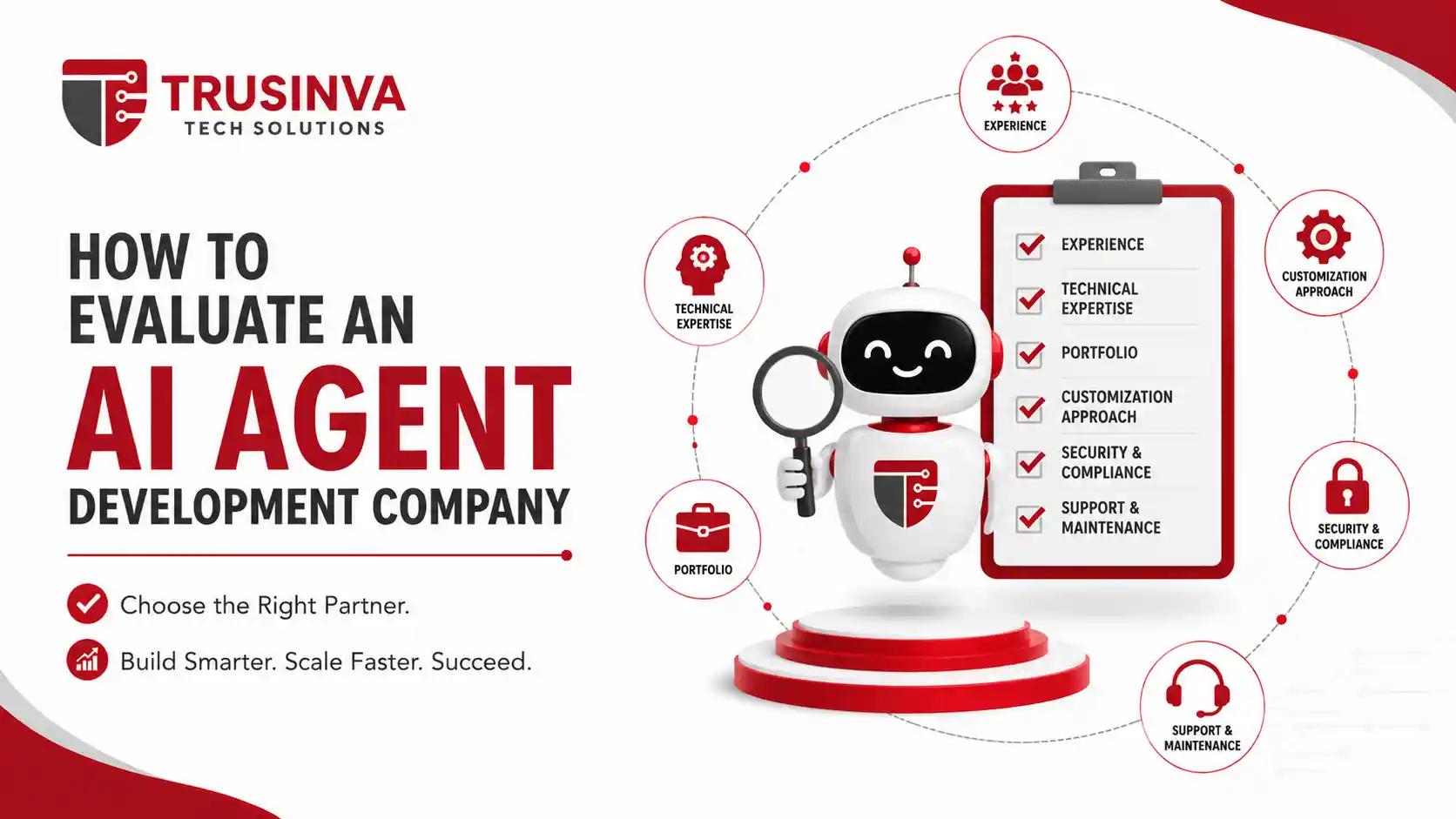
Direct answer: Evaluate on five dimensions: production evidence, integration engineering depth, evaluation methodology, governance maturity, and post-launch support. Portfolio screenshots and model partnerships prove nothing. Ask for production metrics and a redacted evaluation set.
The Five-Dimension Scorecard
| Dimension | What Strong Looks Like | What Weak Looks Like |
| Production evidence | Named workflows live for 6+ months with metrics | Demos, pilots, "coming soon" case studies |
| Integration depth | API-first, handles auth, rate limits, retries, idempotency | Screen-scraping, manual exports, no error handling |
| Evaluation | Historical test set, regression suite, documented pass rates | "We tested it manually" |
| Governance | Least-privilege design, audit logs, escalation matrix, NIST/ISO alignment | No mention until you raise it |
| Support | SLA, monitoring, quarterly re-evaluation, cost caps | Handover and goodbye |
Verification Steps
- Ask for two client references with live agents — and actually call them.
- Request a redacted architecture diagram from a past project.
- Ask what their last agent failure was and how they found it. Honest firms answer immediately. Weak ones say they haven't had one.
- Check whether they push back on your scope. A vendor that agrees to automate your hardest workflow first is optimizing for the sale, not the outcome.
- Review their own operations — a firm with mature engineering practice will have visible standards in its wider portfolio, whether in mobile app development, UI/UX design, or ecommerce builds.
7. 15 Questions to Ask Before You Sign
Direct answer: The most revealing questions concern evaluation, permissions, failure handling, and ownership — not technology preferences. A firm that answers these crisply has shipped before.
Technical
- How do you build and maintain an evaluation set for our workflow?
- What is your approach to prompt injection from untrusted content?
- How do you scope permissions and prevent irreversible actions?
- What happens when the agent is uncertain?
- How do you handle model version changes without regression?
Commercial 6. What is the fixed price for a defined pilot, and what triggers change orders? 7. What are the realistic monthly running costs at our projected volume? 8. Who pays for token overruns? 9. What is the total cost of ownership over 24 months?
Operational 10. What observability do we get access to — full traces or a dashboard? 11. What is your incident response process? 12. How often do you re-evaluate after launch?
Legal and ownership 13. Do we own the code, prompts, and evaluation sets outright? 14. Can we migrate to a different model provider without a rewrite? 15. Where is our data processed and stored?
Warning: If question 13 gets a hesitant answer, stop the process. Prompt libraries and evaluation sets are the durable assets in an agent project. A vendor retaining them retains you.
8. Red Flags and Warning Signs
Direct answer: The clearest warning signs are guaranteed accuracy claims, no evaluation methodology, refusal to share logs, headcount-replacement pricing, and pressure to start with your most complex workflow.
- "99% accurate" guarantees. Nobody can promise this on a probabilistic system across unseen inputs.
- No evaluation set. The defining marker of a demo shop.
- Model name as the pitch. The model is a commodity input. Architecture is the product.
- No mention of failure modes until you raise them.
- Dashboard-only observability. You need raw traces for audit and debugging.
- Pricing based on "employees replaced." This inflates expectations and poisons internal adoption.
- Unwillingness to start read-only. Any competent firm proposes a proposal-and-approve phase first.
- No named technical lead on your account.
- Case studies without metrics — or with metrics that can't be verified.
- Same-week start with no discovery. Speed here is a symptom, not a feature.
9. Cost of Hiring an AI Agent Development Company in the USA
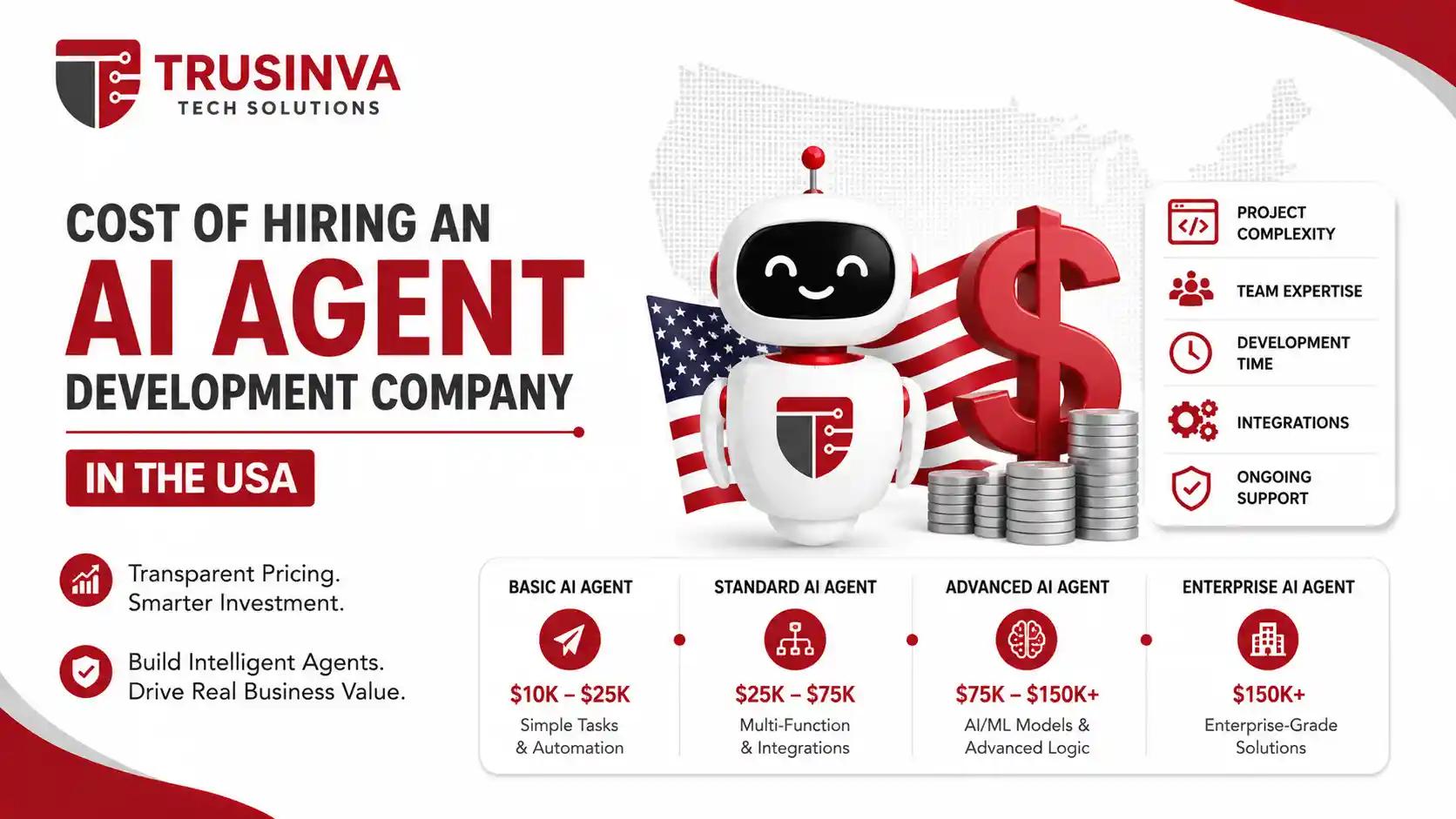
Direct answer: In the US market, expect $15,000–$60,000 to build one production-grade AI agent, plus $500–$5,000 per month to run and maintain it. Enterprise multi-agent systems with deep ERP integration typically run $80,000–$250,000 or more. A scoped pilot usually costs $8,000–$20,000.
Where the Budget Actually Goes
| Component | Share of Build Cost |
| Discovery, workflow mapping, agent contract design | 10–15% |
| Data preparation and knowledge base | 20–25% |
| Integration with business systems | 25–30% |
| Agent logic, prompts, context engineering | 10–15% |
| Evaluation, testing, red-teaming | 10–15% |
| Governance, documentation, training | 10% |
The insight most buyers miss: model and token costs rarely exceed 10% of first-year spend. If a vendor's proposal is dominated by "AI costs," they are either inexperienced or mispricing deliberately.
Rate Benchmarks
| Vendor Location | Typical Blended Hourly Rate |
| US onshore boutique | $120–$250 |
| US mid-size firm | $150–$300 |
| Nearshore (LatAm) | $60–$110 |
| Offshore specialist | $35–$80 |
Cheaper rates are not automatically worse value — but integration and evaluation quality vary far more than rate cards suggest. For adjacent budget context, see our breakdowns of software development cost, website development cost in the USA, and mobile app development cost.
10. Engagement Models and Pricing Structures
Direct answer: Four models dominate — fixed-price pilot, fixed-scope build, monthly retainer, and outcome-based pricing. For a first engagement, a fixed-price pilot followed by a fixed-scope build gives the best risk balance.
| Model | Best For | Watch Out For |
| Fixed-price pilot | Proving value on one workflow | Scope creep disguised as "discovery" |
| Fixed-scope build | Well-defined production agent | Change-order pricing |
| Monthly retainer | Ongoing agent operations and iteration | Retainers with no deliverable definition |
| Time & materials | Genuinely exploratory R&D | No ceiling = no accountability |
| Outcome-based | Mature vendors, measurable workflows | Metric gaming; needs a clean baseline |
Recommended sequence: 4-week paid discovery → fixed-price pilot (read-only) → fixed-scope production build → retainer for operations. Each stage is a genuine off-ramp.
11. Typical Project Timeline
Direct answer: A first production AI agent typically takes 6–12 weeks from kickoff. A prototype takes 1–2 weeks. Enterprise multi-agent programs run 4–9 months. Integration complexity, not model work, drives the schedule.
| Phase | Duration | Output |
| Discovery and baseline | 1–3 weeks | Workflow scoring, agent contract, success metrics |
| Data and access setup | 1–2 weeks | Knowledge base, service accounts, permissions |
| Prototype | 1–2 weeks | Working loop on 3 tools |
| Evaluation build | 1 week | 50–100 historical test cases |
| Human-in-the-loop pilot | 2–4 weeks | Agent proposes, human approves; override rate tracked |
| Production hardening | 1–2 weeks | Observability, cost caps, rollback, docs |
| Handover and training | 1 week | Runbook, owner training |
Expert tip: Any vendor promising a production agent in two weeks is skipping evaluation and governance. That time gets paid back later, with interest.
12. Contract, IP and Data Terms That Matter
Direct answer: Five clauses protect you: full IP assignment including prompts and evaluation sets, model portability, raw log access, data processing and residency terms, and a defined exit and knowledge-transfer obligation.
Contract checklist:
- IP assignment covering code, prompts, tool definitions, and evaluation sets
- Model portability — no architecture that hard-locks one provider
- Log and trace access in raw form, retained for a defined period
- Data processing terms — where data goes, what is retained, what trains what
- Sub-processor disclosure for every third-party API used
- Acceptance criteria tied to the evaluation set, not to a demo
- Named key personnel with substitution notice
- Exit clause with documentation and knowledge transfer
- Liability position on agent-caused errors and remediation duty
- Confidentiality extending to your prompts and process documentation
Important note: Acceptance criteria written as "client satisfaction" are unenforceable. Write them as measurable pass rates on an agreed test set. This one change prevents most disputes.
13. The Technology Stack a Credible Firm Should Master
Direct answer: A competent AI agent development company works fluently across reasoning models, orchestration frameworks, retrieval infrastructure, tool interfaces, and observability tooling — and is model-agnostic rather than tied to one vendor.
| Layer | Expected Fluency |
| Models | Claude, GPT, Gemini, open-weight options; cost/latency trade-off reasoning |
| Cloud platforms | Amazon Bedrock, Google Vertex AI, Azure AI Foundry, IBM watsonx |
| Orchestration | LangGraph, LangChain, CrewAI, AutoGen, Semantic Kernel |
| Retrieval | Vector databases, embeddings, knowledge graphs, permission-aware RAG |
| Tool interface | Function calling, Model Context Protocol, REST APIs, webhooks |
| Deterministic execution | Power Automate, Zapier, Make, n8n, UiPath, Automation Anywhere |
| Enterprise systems | Salesforce, HubSpot, SAP, Oracle, Dynamics 365, ServiceNow, Zendesk, Slack, Teams, Jira |
| Governance | Tracing, evaluation harnesses, audit logging, policy enforcement |
Industry insight: Framework loyalty is a warning sign. Frameworks turn over roughly every nine months; a firm that leads with a framework name rather than an architecture argument is optimizing for familiarity, not for your outcome.
14. Industries Served in the US Market
Direct answer: US AI agent development demand concentrates in healthcare revenue cycle, logistics and freight, ecommerce, financial services, SaaS support, and professional services — sectors with high document volume and repetitive exception handling.
| Industry | Highest-Demand Agent | Why It Works |
| Healthcare | Claims scrubbing and denial triage | Rule-heavy, expensive when late |
| Logistics / Trucking | Load matching, carrier communication | High message volume, clear outcomes |
| Ecommerce | Returns and order exception handling | Repetitive, measurable |
| Finance | Document processing, reconciliation | Structured outputs, audit trail exists |
| SaaS | Tier-1 support, onboarding | Volume plus retention impact |
| Professional services | Research, intake, drafting | Direct billable-hour recovery |
Healthcare: denial management is close to an ideal first agent. See the top medical billing mistakes US clinics make and how medical billing services reduce claim denials, plus web development for US healthcare companies.
Freight and dispatch: agents monitor boards, draft outreach, and verify documents while dispatchers retain authority — see how truck dispatching services save US carriers money and owner-operator dispatch benefits.
Sales operations: agent value depends on CRM data quality — review essential CRM features and CRM solutions for US sales teams.
Supply chain: where provenance matters, agents pair with distributed ledgers — see blockchain for supply chain use cases.
15. Governance, Security and Compliance Requirements
Direct answer: Your vendor should design to four controls: least-privilege permissions, complete action logging, human approval gates for irreversible actions, and a named accountable owner. Most US firms operationalize this through the NIST AI Risk Management Framework and ISO/IEC 42001, layered over SOC 2 and ISO/IEC 27001.
A defining feature of Gartner's 2026 Hype Cycle for Agentic AI is the emergence of governance, security and cost-focused profiles alongside the core agent technologies — evidence that the market has moved past capability questions and into control questions.
Ask your vendor to document:
- Permission scope per agent (never a shared superuser account)
- Data classification and redaction before external API calls
- Prompt-injection testing aligned to OWASP LLM guidance
- Escalation thresholds by confidence, dollar value, and customer tier
- Retention and audit-log policy
- Re-evaluation cadence after model updates
- Named human owner for every agent in production
Trust signal: A firm that raises governance before you do has shipped in a regulated environment. One that treats it as an add-on has not.
16. Common Mistakes Businesses Make When Hiring
Direct answer: Buyers usually fail before the vendor does — by shopping on price, skipping baselines, choosing the wrong first workflow, and treating the engagement as an IT project rather than a business one.
- Buying on hourly rate instead of production evidence.
- No pre-project baseline — value becomes unprovable afterwards.
- Choosing the most complex workflow first because it is the most impressive.
- Automating a broken process and getting faster chaos.
- No internal business owner assigned. Orphaned agents rot within a quarter.
- Accepting demo-based acceptance criteria.
- Ignoring running costs in the ROI model.
- Skipping change management — staff who fear replacement quietly undermine adoption.
- Requesting multi-agent architecture before one agent works.
- No exit plan. Assume every vendor relationship eventually ends.
17. Expert Tips and Best Practices
- Run a paid discovery before committing to a build. Four weeks and a few thousand dollars buys clarity worth ten times the cost.
- Ask two shortlisted vendors to score the same three workflows. Their scoring logic reveals more than any pitch deck.
- Insist on read-only for the first six weeks of production. Propose-and-approve is not a limitation; it is your evidence base.
- Require the evaluation set as a deliverable, versioned in your repository.
- Fund maintenance from day one — 15–25% of build cost annually is a realistic reserve.
- Track override rate weekly. It is the single best predictor of whether autonomy can be safely expanded.
- Keep the vendor's access separate from staff access, with independent revocation.
- Plan the second agent before finishing the first — reused integration work is where margins improve.
18. Careers, Skills and Salary Scope
Direct answer: The US market is hiring AI engineers, agent developers, AI product managers, evaluation specialists, and AI governance leads. The Bureau of Labor Statistics does not yet track "AI agent engineer" as a separate occupation, so pay is best benchmarked against senior software and machine-learning engineering bands, which sit well above general developer medians in major US metros.
Skills that command a premium in 2026:
- Evaluation design and red-teaming (scarcest by far)
- API and enterprise systems integration
- RAG architecture and permission-aware retrieval
- Context and prompt engineering with version control
- AI governance mapping (NIST AI RMF, ISO/IEC 42001)
- Domain expertise — frequently the actual bottleneck
Career insight: For non-engineers, domain depth is the fastest entry route. Professionals with deep process knowledge in billing, dispatch, taxation, or finance are moving into AI-adjacent supervisory roles faster than technical generalists. Structured programs help — explore our courses, including medical billing, truck dispatching, and USA taxation.
19. Latest Updates and Regulations (2026)
Direct answer: AI regulation became operational in 2026. The EU AI Act entered phased enforcement, US federal policy pushed toward preempting state laws, and state statutes continue to shift. Any vendor you hire should document risk classification, human oversight, and record-keeping regardless of jurisdiction.
What changed:
- Enforcement powers including fines activate for general-purpose AI models placed on the market after 2 August 2025, beginning 2 August 2026, while models already on the market before that date have until 2 August 2027.
- High-risk obligation dates under the EU AI Act were postponed by the Digital Omnibus simplification package, politically agreed on 7 May 2026.
- A December 2025 executive order directed federal agencies toward a uniform national AI policy and initiated challenges to inconsistent state laws; in March 2026 the White House issued a national policy framework recommending broad congressional preemption under a light-touch standard.
- Preemption is not settled law — congressional efforts have repeatedly stalled and courts will determine how far executive action reaches.
- Three areas are carved out from preemption: child safety in AI contexts, AI compute and data-centre infrastructure, and state procurement of AI systems.
- Colorado repealed and replaced its high-risk AI framework with a narrower automated decision-making law effective 1 January 2027, removing the NIST/ISO 42001 safe harbour that had served as a codified legal defence.
Buyer implication: Framework alignment is no longer a guaranteed legal shield in the US, but it remains the most defensible operational posture available — and it is now a fair contractual requirement to place on your vendor. This is orientation, not legal advice; confirm specifics with counsel. Firms in regulated professions should also review technology threats to audit firms.
20. Future Trends: 2026–2030
Direct answer: Expect five shifts — multi-agent orchestration, agentic coding, guardian agents that supervise other agents, agentic commerce, and low-code platforms that move agent building closer to business teams.
The five most consequential agentic AI trends identified for 2026 are multi-agent orchestration, agentic coding, guardian agents, agentic commerce, and the democratization of agent building through low-code platforms. Low-code and no-code tooling increasingly lets business users design agents aligned to real operational needs, accelerating adoption while keeping initiatives close to the business.
What this means for buyers:
- Vendor consolidation is coming. With Gartner expecting over 40% of agentic AI projects to be cancelled by 2027, thin-wrapper agencies will not survive the shakeout. Choose for durability.
- Integration cost falls as interoperability standards like the Model Context Protocol mature — renegotiate long contracts accordingly.
- Guardian agents become standard, and should appear in vendor architectures by 2027.
- Governance moves into procurement, not just IT — expect AI clauses in standard MSAs.
- The "AI employee" pitch fades in favour of task-specific framing that actually delivers.
21. People Also Ask
What does an AI agent development company do? It designs, builds, integrates, tests, and governs autonomous AI systems that execute multi-step workflows inside a client's business software.
How much does it cost to hire an AI agent development company in the USA? Typically $15,000–$60,000 per production agent, with $500–$5,000 monthly running costs. Enterprise programs commonly exceed $80,000.
How do I choose the best AI agent development company? Score on production evidence, integration depth, evaluation methodology, governance maturity, and post-launch support — then verify with client references.
Is it better to hire an agency or build in-house? Hire an agency for the first two or three agents. Build in-house once you plan ten or more, and contract knowledge transfer in between.
How long does AI agent development take? Six to twelve weeks for a first production agent; four to nine months for enterprise multi-agent programs.
Do I own the AI agent my vendor builds? Only if the contract says so. Insist on assignment of code, prompts, tool definitions, and evaluation sets.
Are AI agent development companies regulated in the US? There is no licensing regime. Compliance obligations attach to the deployment, so hold vendors to NIST AI RMF and ISO/IEC 42001 alignment contractually.
Can small businesses afford custom AI agents? Yes, for one narrowly scoped workflow. Below a few hundred monthly tasks, a configured automation platform is usually the better economic choice.
22. FAQs
Q1. What is an AI agent development company in the USA? A specialist software firm that builds custom autonomous AI agents — covering architecture, integration with enterprise systems, evaluation, deployment, and governance — for US-based businesses.
Q2. What is the difference between an AI agent development company and a chatbot vendor? Chatbot vendors deliver conversations. AI agent development companies deliver systems that take real actions in your CRM, ERP, ticketing, and database platforms.
Q3. What should an AI agent development proposal include? Discovery and baseline, agent contract, integration scope, evaluation methodology, observability plan, governance controls, acceptance criteria tied to test-set pass rates, and running-cost estimates.
Q4. How do I verify a vendor's experience? Ask for two references with agents live for six or more months, a redacted architecture diagram, and a description of their most recent production failure and how it was detected.
Q5. What are fair payment terms? Milestone-based payments tied to measurable deliverables, with acceptance defined against an agreed evaluation set — not a demo or subjective sign-off.
Q6. Which industries hire AI agent developers most in the USA? Healthcare revenue cycle, logistics and freight, ecommerce, financial services, SaaS support, and professional services.
Q7. What compliance frameworks should my vendor follow? NIST AI Risk Management Framework and ISO/IEC 42001, layered over SOC 2 and ISO/IEC 27001, with GDPR or CCPA obligations depending on data scope.
Q8. Can I switch AI agent development companies later? Yes, if you own the code, prompts, and evaluation sets and the architecture is model-agnostic. Without those terms, switching means rebuilding.
Q9. What is a realistic first project? One high-volume, well-defined workflow, deployed read-only with human approval, measured against a four-week pre-project baseline.
Q10. What is the biggest hidden cost? Maintenance. Budget 15–25% of build cost annually for monitoring, re-evaluation, and model updates.
23. Conclusion
Choosing an AI agent development company in the USA comes down to one question: can this firm show you something running in production, with numbers, that survived contact with real users? Everything else — model partnerships, framework preferences, polished demos — is noise. The vendors worth hiring lead with evaluation methodology, insist on starting read-only, raise governance before you do, and push back when your chosen workflow is the wrong first project.
Our key recommendation: run a four-week paid discovery with your top two candidates before committing to any build. Have each score the same three workflows and propose a fixed-price pilot. The difference in their reasoning will make the decision for you — and the cost is trivial against a six-figure mistake.
Your logical next step is a workflow assessment: identifying which of your processes genuinely justify an agent, which need systems work first, and what the honest ROI case looks like.
At Trusinva Tech Solutions, we build and govern AI agents for US businesses across healthcare, logistics, ecommerce, and SaaS — alongside our wider services in digital marketing, SEO, and enterprise software. You can review our project portfolio or contact our team for a no-obligation workflow assessment. If you would rather build this capability inside your own organization, our practical training programs are the fastest route — Book a Seat in an upcoming cohort and start with the workflow that pays for itself first.