Quick Answer
AI agents for business are autonomous software systems that use large language models to plan, reason, call tools and APIs, and complete multi-step work with limited human supervision. Unlike chatbots that only reply, agents take action — updating a CRM, resolving a ticket, reconciling an invoice. In 2026, they deliver the strongest ROI on high-volume, well-defined workflows.
Key Takeaways
- An AI agent is defined by action, not conversation. If it cannot use a tool, it is a chatbot.
- Adoption is wide but shallow. Roughly 79% of enterprises say they have adopted AI agents, yet only about 11% run them in production — the gap is integration and accountability, not model quality.
- Gartner forecasts that 40% of enterprise applications will embed task-specific AI agents by the end of 2026, up from under 5% in 2025.
- The winners deploy narrow, task-specific agents on repetitive workflows first — support resolution, document processing, claims, reporting.
- Gartner also expects more than 40% of agentic AI projects to be cancelled by 2027 — usually because of unclear ROI, dirty data, or missing governance.
- Budget 60–70% of your effort for data, integration, evaluation, and governance, not for the model.
- Human-in-the-loop is not a limitation. It is the control that makes autonomy commercially defensible.
- Compliance now matters: NIST AI RMF, ISO/IEC 42001, SOC 2, and a fast-moving US state-law patchwork.
Introduction
Most US businesses did not fail at AI in the last two years because the technology was weak. They failed because they bought a chatbot and expected an employee. AI agents change that equation — and at Trusinva Tech Solutions, we see the same pattern across every engagement: the companies that win are the ones that treat agents as software systems with owners, guardrails, and measurable outputs, not as a magic layer bolted onto broken processes. That is exactly how we approach AI automation services, and why our work as an AI development company in the USA always begins with process mapping before model selection. Whether you run a five-person startup exploring AI for small businesses or a mid-market operation planning custom software development, the fundamentals below apply.
This guide is written for decision-makers: CEOs, founders, IT managers, and operations leads in the United States who need to know what AI agents genuinely do in 2026, what they cost, and what breaks.
1. What Are AI Agents for Business?
Direct answer: An AI agent for business is a software system built on a large language model that receives a goal, breaks it into steps, retrieves the information it needs, calls tools and APIs to act inside your business systems, checks its own results, and reports back. The defining feature is autonomous execution of multi-step tasks — not text generation.
Think of it as the difference between an assistant who tells you how to file a claim and one who actually files it, checks the payer response, and flags the exception.
The Five Components Every Business Agent Needs
- Reasoning model — the LLM (Claude, GPT, Gemini) that plans and decides.
- Tools — function calling or API access to your CRM, ERP, ticketing, database, or email.
- Memory — short-term context plus long-term storage, often a vector database.
- Knowledge — retrieval-augmented generation (RAG) over your own documents and policies.
- Guardrails — permissions, approval gates, escalation rules, logging, observability.
Remove any one of these and you do not have a production agent. You have a demo.
Primary, Secondary and Related Entities
The primary entity is the AI agent. Secondary entities include agentic AI, large language models, multi-agent systems, retrieval-augmented generation, and AI orchestration. Attribute entities include planning, reasoning, tool calling, agent memory, and human-in-the-loop. Related entities span platforms (OpenAI, Anthropic, Google, Microsoft, AWS, IBM, NVIDIA), frameworks (LangChain, LangGraph, LlamaIndex, CrewAI, AutoGen, Semantic Kernel), and governance standards (NIST AI RMF, ISO/IEC 42001, SOC 2, GDPR).
2. AI Agents vs Chatbots vs RPA vs Copilots
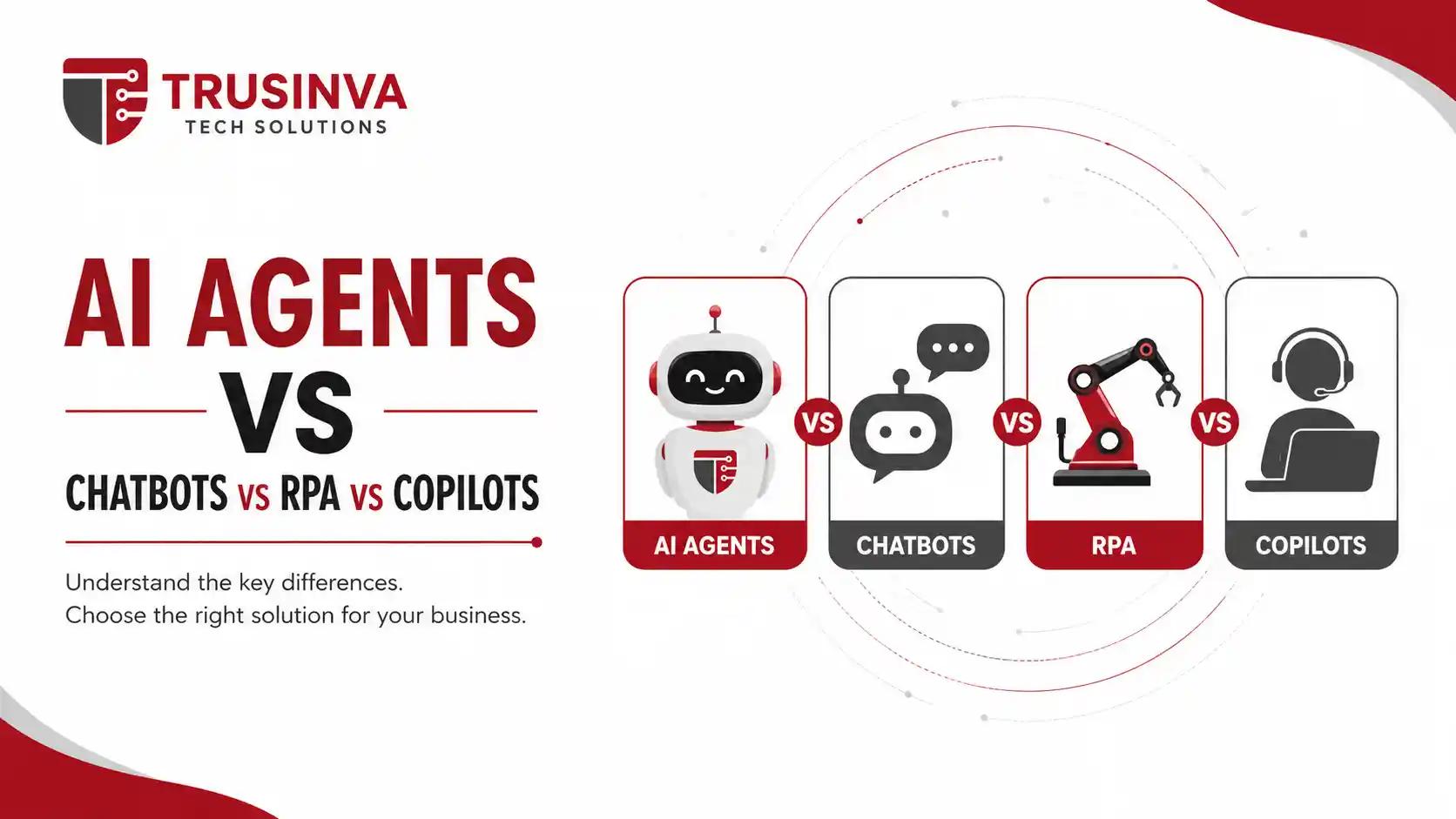
Direct answer: Chatbots respond, copilots assist a human in real time, RPA repeats fixed rules, and AI agents pursue goals autonomously across systems. Traditional automation follows rigid, predefined rules and cannot adapt to unexpected situations, whereas agentic AI can reason through problems, make contextual decisions, and adjust its approach as conditions change.
| Capability | Chatbot | RPA | AI Copilot | AI Agent |
| Handles unstructured input | Limited | No | Yes | Yes |
| Takes action in systems | No | Yes | With approval | Yes |
| Adapts when the process changes | No | No | Partially | Yes |
| Multi-step planning | No | Scripted only | No | Yes |
| Needs a human present | Yes | No | Yes | Optional |
| Breaks when a screen changes | N/A | Frequently | N/A | Rarely (API-based) |
| Best for | FAQs | Fixed, high-volume tasks | Knowledge work | Variable, multi-step workflows |
Expert observation: RPA is not dead — it is the hands. Agents are the judgment. The best 2026 architectures use agents to decide and existing RPA or workflow tools (Power Automate, Zapier, Make, n8n, UiPath) to execute deterministic steps. Do not rebuild reliable plumbing with a probabilistic model.
3. How AI Agents Actually Work
Direct answer: An agent runs a loop: perceive the goal, plan the steps, retrieve context, call a tool, observe the result, evaluate whether the goal is met, and repeat or escalate. Orchestration frameworks manage this loop, while guardrails decide which actions require human approval before execution.
The execution loop, step by step:
- Trigger — an email arrives, a ticket is created, a schedule fires, or a user asks.
- Planning — the model decomposes the goal into ordered sub-tasks.
- Retrieval — RAG pulls relevant policy documents, records, or prior cases from a vector database or knowledge base.
- Tool calling — the agent invokes APIs: read a Salesforce record, post to Slack, create a Jira ticket, query a database.
- Observation — the agent reads the tool output and updates its plan.
- Verification — a checker step (often a second model) validates the output against rules.
- Action or escalation — either commit the change, or route to a human with a summary.
- Logging — every step is recorded for audit and evaluation.
Practical tip: The verification step (step 6) is the single highest-ROI addition to any agent. Teams that skip it spend the next quarter debugging silent failures.
4. Why AI Agents Matter in 2026
Direct answer: 2026 is the year agents moved from pilot to production, because orchestration frameworks, governance models, and observability tooling finally matured together. The business case is no longer capability — it is operational readiness.
The market data tells a consistent story:
- The agentic AI market expanded from $7.6 billion in 2025 to a projected $10.8 billion in 2026.
- Gartner's 2026 CIO and Technology Executive Survey found only 17% of organizations had deployed AI agents, yet more than 60% expect to within two years — the steepest adoption curve of any emerging technology measured.
- Adoption skews to enterprises at around 25%, largely because of technical resources and dedicated AI budgets, while mid-market and SMB segments show faster year-over-year growth thanks to turnkey solutions.
- IDC and Microsoft measure an average return of roughly 3.7x per $1 invested in generative AI, yet IBM's CEO study found only 25% of AI initiatives delivered the expected ROI.
Read those last two together. Returns are real but unevenly distributed. The variable is execution quality, not technology access.
Industry insight: The single strongest predictor of a successful 2026 deployment is scope discipline. Successful deployments are consistently task-specific, targeting high-volume, well-defined workflows such as customer service resolution, document processing, inventory redistribution, and clinical documentation.
5. Top AI Agent Use Cases by Business Function
Direct answer: The highest-ROI business AI agent use cases in 2026 are customer support resolution, sales and CRM enrichment, invoice and document processing, IT service desk triage, HR onboarding, marketing content operations, and internal reporting. Each shares three traits: high volume, structured outcomes, and clear success criteria.
Customer Support
Agents read the ticket, retrieve the account history, check policy, draft or issue a resolution, and escalate genuine exceptions. Deflection is not the metric — resolution without follow-up contact is.
Sales and CRM
Agents enrich leads, log call notes, update pipeline stages, draft follow-ups, and surface at-risk deals. This is where a well-structured CRM pays dividends; if your data model is weak, fix that first. Our guides on essential CRM features and CRM development solutions for US sales teams cover the foundations, and our CRM development services handle the build.
Finance and Accounting
Invoice extraction, three-way matching, expense policy checks, vendor onboarding, and month-end reconciliation. One Fortune 500 deployment reduced reporting time from 15 days to 35 minutes while cutting cost per report from $2,200 to $9.
IT Service Desk
Password resets, access provisioning, log triage, and first-line diagnostics — with hard permission boundaries on anything destructive.
HR and Recruiting
Resume screening summaries, interview scheduling, onboarding checklists, and policy Q&A. Caution: HR is among the most heavily regulated AI use cases in the US. Bias auditing and disclosure obligations apply.
Marketing and SEO
Brief generation, competitive monitoring, internal-link auditing, and performance reporting. Agents accelerate output but do not replace strategy — see our practical guides on ranking a business website in the USA and SEO for US ecommerce, or work directly with our SEO services team.
Operations and Reporting
Scheduled data pulls, anomaly detection, exception routing, and executive summaries delivered into Slack or Microsoft Teams.
6. Industry-Specific AI Agent Use Cases
Direct answer: Agents deliver fastest returns in industries with high document volume and repetitive exception handling — healthcare revenue cycle, logistics and freight, ecommerce, professional services, and SaaS support.
| Industry | Highest-Value Agent | Typical Outcome |
| Healthcare | Claims scrubbing and denial triage | Fewer rejections, faster reimbursement |
| Logistics / Trucking | Load matching and carrier communication | Reduced deadhead, faster booking |
| Ecommerce | Order exception and returns handling | Lower support cost per order |
| Finance / Accounting | Document processing and reconciliation | Compressed close cycles |
| SaaS | Tier-1 support and onboarding | Higher activation, lower churn |
| Manufacturing | Inventory redistribution and supplier follow-up | Reduced stockouts |
| Professional Services | Research, drafting, and intake | More billable capacity |
Healthcare and Medical Billing
Denial management is close to an ideal agent workload: high volume, rule-heavy, and expensive when handled late. Agents pre-check claims against payer rules before submission. If you are assessing this area, review the top medical billing mistakes US clinics make and how medical billing services reduce claim denials. Teams building internal capability often start with a structured medical billing course.
Trucking and Freight Dispatch
Agents monitor load boards, draft carrier outreach, verify documents, and flag rate anomalies — while the dispatcher keeps final authority. See how truck dispatching services save US carriers money and the benefits of owner-operator dispatch services for the underlying economics, or explore our truck dispatching course.
Ecommerce and Retail
Product data enrichment, returns adjudication, and post-purchase support integrate directly with the storefront. Businesses running Shopify or custom builds can pair agents with proper ecommerce website development and Shopify development services.
Supply Chain and Traceability
Where provenance matters, agents pair well with distributed ledgers — see blockchain for supply chain: US business use cases.
Professional and Audit Firms
Agents accelerate document review and testing — but introduce new independence and confidentiality considerations, as discussed in technology threats to audit firms.
7. Benefits of AI Agents for Business
Direct answer: The measurable benefits are cycle-time reduction, cost per transaction reduction, 24/7 coverage without headcount, higher consistency in rule-based decisions, and scalability that does not require linear hiring. The strategic benefit is capacity — your team spends time on exceptions instead of throughput.
- Speed — multi-day processes compress into minutes.
- Cost per unit of work — drops sharply once volume clears the build cost.
- Consistency — an agent applies the same policy at 3 a.m. on day 400.
- Scalability — volume spikes do not require recruitment cycles.
- Employee experience — fewer repetitive tasks, measurably lower burnout in support and billing teams.
- Data hygiene as a side effect — building an agent forces you to document processes you never wrote down.
- Better decisions — agents surface patterns across systems a human would never query.
Why this works (not just what): Agents outperform on these dimensions because LLMs handle unstructured variance — the messy 20% of cases that break rule-based automation. That 20% is usually where 80% of your manual labour hides.
8. Disadvantages, Risks and Limitations
Direct answer: AI agents fail in predictable ways — hallucinated actions, compounding errors across steps, prompt injection through untrusted content, unclear accountability, unpredictable token costs, and integration debt. None of these are reasons to avoid agents; all are reasons to design for them.
| Risk | What It Looks Like | Mitigation |
| Hallucinated action | Agent updates the wrong record | Verification step + write permissions scoped narrowly |
| Error compounding | Step 2 mistake corrupts steps 3–8 | Checkpointing, short chains, evaluation suites |
| Prompt injection | Malicious text in an email hijacks the agent | Treat all retrieved content as untrusted; OWASP LLM guidance |
| Cost drift | Token spend triples in month three | Per-run budget caps, model routing, caching |
| Accountability gap | Nobody owns the agent's decisions | Named human owner per agent, documented |
| Vendor lock-in | Rewriting when a provider changes terms | Abstraction layer, model-agnostic architecture |
| Data leakage | Sensitive records sent to an external API | Data classification, redaction, regional processing |
Important note: Never grant an agent irreversible permissions — deleting records, issuing refunds above a threshold, sending external communications to customers — without an approval gate in the first six months of production.
9. Requirements: Is Your Business Ready?
Direct answer: You are ready for AI agents if you have a documented high-volume process, API-accessible systems, reasonably clean data, a named business owner, and a defined success metric. You are not ready if the process only exists in one person's head.
Readiness checklist:
- The target workflow runs at least 200–500 times per month
- Success and failure can be judged objectively
- Your core systems expose APIs (not just a UI)
- Source data is accurate more than 90% of the time
- A business owner will review agent outputs weekly
- Legal and security have reviewed the data flow
- You have a rollback plan
- Baseline metrics exist before you start
If four or more boxes are unchecked, invest first in process documentation and systems integration. Our custom software development and web development teams frequently do this groundwork before any agent work begins.
10. Step-by-Step AI Agent Implementation Guide
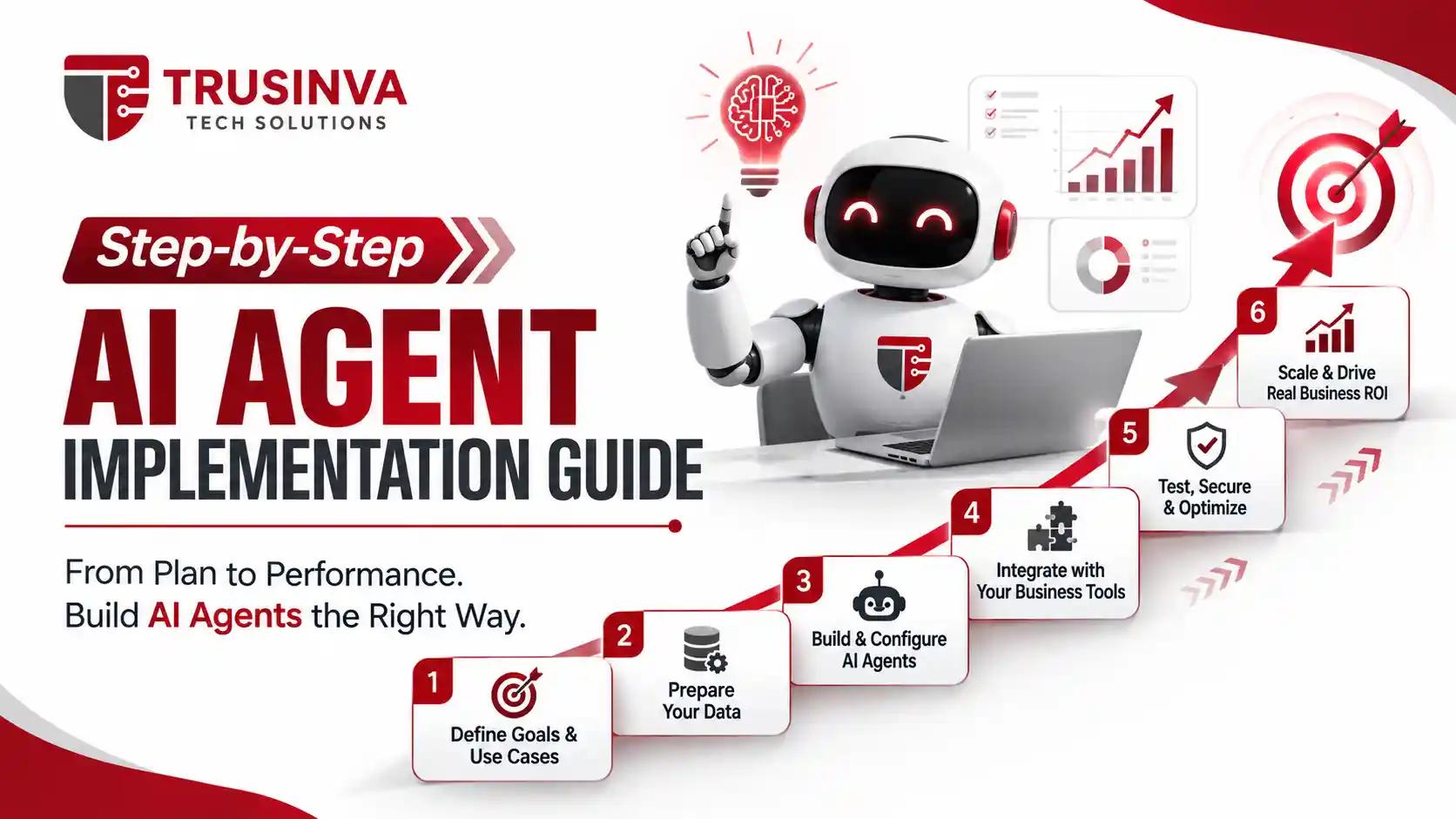
Direct answer: Implement AI agents in nine stages: select a workflow, baseline it, design the agent contract, prepare data and permissions, build a thin prototype, evaluate against a test set, pilot with humans in the loop, deploy with observability, then expand. Expect 6–12 weeks for a first production agent.
Step 1 — Select one workflow. Score candidates on volume × time per instance × error cost ÷ implementation difficulty. Pick the highest score, not the most exciting one.
Step 2 — Baseline it. Measure current handling time, cost, error rate, and volume for four weeks. Without this, ROI is unprovable later.
Step 3 — Write the agent contract. One page: goal, allowed tools, forbidden actions, escalation triggers, success criteria, owner. This document prevents 90% of scope disputes.
Step 4 — Prepare data and permissions. Set up retrieval sources, clean the knowledge base, and create a service account with least-privilege access. Read-only first.
Step 5 — Build a thin prototype. One model, three tools, no orchestration framework yet. Prove the core loop works before adding architecture.
Step 6 — Build an evaluation set. Collect 50–100 real historical cases with known correct outcomes. Run every version against them. This is the difference between engineering and guessing.
Step 7 — Pilot with human-in-the-loop. The agent proposes; a human approves. Track the approval-override rate weekly. When overrides drop below your threshold, loosen the gate.
Step 8 — Deploy with observability. Log every step, tool call, token cost, and escalation. Alert on anomalies. Set spending caps.
Step 9 — Expand deliberately. Add a second agent only after the first has run stably for 30 days. Multi-agent orchestration is a stage, not a starting point.
11. The 2026 AI Agent Tech Stack
Direct answer: A typical 2026 stack combines a reasoning model (Claude, GPT, Gemini), an orchestration framework (LangGraph, CrewAI, AutoGen, Semantic Kernel), a retrieval layer (vector database + RAG), a tool interface (function calling or Model Context Protocol), and an observability and evaluation layer.
| Layer | Common Options | Selection Criteria |
| Model | Claude, GPT, Gemini, open-weight models | Reasoning quality, latency, cost, data residency |
| Cloud / Platform | Amazon Bedrock, Google Vertex AI, Azure AI Foundry, IBM watsonx | Existing cloud commitment, compliance posture |
| Orchestration | LangGraph, CrewAI, AutoGen, Semantic Kernel | State management, debuggability |
| Retrieval | Vector database, embeddings, knowledge graph | Freshness, permission-aware retrieval |
| Tool access | Function calling, Model Context Protocol, APIs, webhooks | Standardization, maintenance burden |
| Execution | Power Automate, Zapier, Make, n8n, UiPath | Reliability for deterministic steps |
| Business systems | Salesforce, HubSpot, SAP, Oracle, Dynamics 365, ServiceNow, Zendesk, Slack, Teams, Jira | API maturity |
| Governance | Evaluation harness, tracing, audit logs, policy engine | Auditability |
Expert tip: Choose your evaluation and observability tooling before your framework. Frameworks change every nine months; your evaluation set is a durable asset.
12. How Much Do AI Agents Cost in the USA?
Direct answer: In the US market, a single production-grade business AI agent typically costs $15,000–$60,000 to build, plus $500–$5,000 per month to run and maintain. Multi-agent enterprise systems with deep ERP integration commonly run $80,000–$250,000+. Off-the-shelf agent platforms start far lower but limit customization.
Where the money actually goes:
| Cost Component | Typical Share of Build Budget |
| Discovery, process mapping, contract design | 10–15% |
| Data preparation and knowledge base | 20–25% |
| Integration with business systems | 25–30% |
| Agent logic and prompt engineering | 10–15% |
| Evaluation, testing, red-teaming | 10–15% |
| Governance, documentation, training | 10% |
Note what is not on that list: the model itself is rarely the main cost. Token spend is usually a modest recurring line, while integration dominates the build.
Ongoing costs to budget for: model/API usage, vector database hosting, observability tooling, monitoring time, and a quarterly re-evaluation cycle. Under-budgeting maintenance is the most common financial mistake.
For comparison across adjacent projects, see our breakdowns of software development cost, website development cost in the USA, and mobile app development cost.
13. Build vs Buy: A Decision Matrix
Direct answer: Buy when the workflow is standard and speed matters. Build when the workflow is your competitive differentiator, your data is proprietary, or vendor pricing scales badly with your volume.
| Factor | Favors Buying | Favors Building |
| Workflow is industry-standard | ✅ | |
| Workflow is your competitive edge | ✅ | |
| Need production in under 6 weeks | ✅ | |
| Deep integration with custom systems | ✅ | |
| Strict data residency requirements | ✅ | |
| Small volume, uncertain ROI | ✅ | |
| High volume, per-seat pricing hurts | ✅ | |
| No internal engineering capacity | ✅ |
Hybrid is usually correct: buy the platform, build the agents. Most mature 2026 deployments look like this. If you need custom work, our AI and automation development and SaaS development services cover both the platform and the agent layer.
14. Governance, Security and Compliance
Direct answer: Effective AI agent governance rests on four pillars: least-privilege permissions, full action logging, human approval gates for irreversible actions, and a named accountable owner. Most US organizations operationalize this using the NIST AI Risk Management Framework and ISO/IEC 42001, layered on existing SOC 2 and ISO/IEC 27001 controls.
Practical governance controls:
- Scope permissions per agent — never share a superuser service account.
- Classify data before retrieval — decide what may leave your environment.
- Log every tool call — with inputs, outputs, and timestamps.
- Define escalation thresholds — confidence, dollar value, customer tier.
- Red-team for prompt injection — using OWASP LLM guidance.
- Review weekly, re-evaluate quarterly — models and data both drift.
- Document the human owner — accountability cannot be delegated to software.
A defining signal in Gartner's 2026 Hype Cycle for Agentic AI is the emergence of governance, security and cost-focused profiles alongside the core agent technologies — a clear indication that the market has moved past capability questions.
15. How to Measure ROI
Direct answer: Measure AI agent ROI on four metrics: task completion rate without human intervention, cycle time reduction versus baseline, cost per completed task, and error or rework rate. Track token cost separately so unit economics stay visible as volume scales.
| KPI | Definition | Healthy Direction |
| Autonomous completion rate | % of tasks finished with no human edit | Rising |
| Human override rate | % of proposed actions corrected | Falling |
| Cycle time | Trigger → resolution | Falling |
| Cost per task | (Build amortized + run cost) ÷ tasks | Falling |
| Escalation quality | % of escalations that were genuinely necessary | Falling |
| Rework rate | % of completed tasks reopened | Falling |
Warning: Do not report "hours saved" as your primary ROI metric. Executives discount it, and it is rarely verifiable. Report cost per completed task against your documented baseline.
16. Common Mistakes That Kill Agent Projects
Direct answer: Most AI agent projects fail for organizational reasons, not technical ones — no baseline, no owner, too broad a scope, dirty data, no evaluation set, and no plan for the exceptions.
- Starting with the hardest workflow. Ambition is not a strategy.
- No pre-project baseline. You can never prove value afterwards.
- Automating a broken process. You get faster chaos.
- Giving write access on day one. Read-only first, always.
- Skipping the evaluation set. Prompt tweaks become superstition.
- Ignoring the exception path. The 10% of weird cases consumes 60% of support effort.
- No named owner. Orphaned agents rot within a quarter.
- Multi-agent architectures before a single agent works. Complexity is not maturity.
- Treating it as an IT project. Business ownership is non-negotiable.
- Forgetting change management. Staff who fear replacement quietly sabotage adoption.
17. Expert Tips and Best Practices
- Write the escalation rules before the prompts. They define the product.
- Keep chains short. Every additional step multiplies failure probability.
- Use a smaller, cheaper model for routing and reserve the frontier model for reasoning.
- Cache aggressively. Repeated retrievals dominate cost in support workloads.
- Version your prompts like code. Store them in your repository, not a spreadsheet.
- Give the agent a "I don't know" path. Agents forced to answer will invent.
- Show your work to users. Displaying the reasoning trace dramatically increases trust and adoption.
- Run a monthly failure review. Read ten failed runs end-to-end. You will learn more than from any dashboard.
- Train your existing staff, don't just hire. Your billing clerk who understands payer rules is more valuable as an agent supervisor than a new engineer who doesn't.
18. Careers, Skills and Salary Scope
Direct answer: Demand in 2026 centres on AI engineers, agent developers, AI product managers, evaluation specialists, and AI governance leads. The US Bureau of Labor Statistics does not yet track "AI agent engineer" as a distinct occupation, so compensation is best benchmarked against senior software and ML engineering bands, which typically sit well above general developer medians in major US markets.
The most valuable skills right now:
- Prompt and context engineering (with evaluation discipline)
- API and systems integration
- RAG architecture and vector search
- Evaluation design and red-teaming
- AI governance and risk mapping (NIST AI RMF, ISO/IEC 42001)
- Domain expertise — underrated, and often the actual bottleneck
Career insight: The fastest route into this field for non-engineers is domain depth plus tooling literacy. Professionals with strong process knowledge in taxation, billing, dispatch, or finance are converting into AI-adjacent roles faster than generalists. Structured programs help — see our courses covering areas like USA taxation and UAE taxation alongside technical training.
19. Latest Updates and Regulations (2026)
Direct answer: In 2026, AI regulation stopped being theoretical. The EU AI Act is in phased enforcement, US federal policy is pushing toward preemption of state laws, and a patchwork of state statutes remains active. Businesses deploying agents should document risk classification, human oversight, and record-keeping regardless of jurisdiction.
What changed recently:
- Enforcement powers, including fines, activate for general-purpose AI models placed on the market after 2 August 2025 beginning 2 August 2026, while models already on the market before that date have until 2 August 2027 to comply.
- High-risk obligation dates under the EU AI Act were postponed by the Digital Omnibus simplification package, politically agreed on 7 May 2026.
- A December 2025 executive order directed federal agencies toward a uniform national AI policy and initiated efforts to challenge inconsistent state laws; in March 2026 the White House followed with a national policy framework recommending broad congressional preemption under a light-touch standard.
- Preemption is not settled law — congressional efforts have repeatedly stalled, and courts will ultimately determine how far executive action reaches.
- The executive order carves out three areas from preemption: child safety in AI contexts, AI compute and data-centre infrastructure, and state government procurement of AI systems.
- Colorado repealed and replaced its high-risk AI framework with a narrower automated decision-making law effective 1 January 2027, removing the NIST/ISO 42001 safe harbour that had operated as a codified legal defence.
What this means practically: Voluntary framework alignment is no longer a guaranteed legal shield in the US, but it remains the most defensible operational posture available. Document your controls. This is terrain mapping, not legal advice — confirm specifics with counsel.
20. Future Trends: 2026–2030
Direct answer: Expect five shifts — multi-agent orchestration, agentic coding, guardian agents that supervise other agents, agentic commerce, and low-code agent building that moves development closer to business teams.
The five most consequential agentic AI trends identified for 2026 are multi-agent orchestration, agentic coding, guardian agents, agentic commerce, and the democratization of agent building through low-code platforms. Low-code and no-code platforms increasingly let business users design and deploy agents aligned with real operational needs, accelerating adoption while keeping initiatives close to the business.
Our forecast for the next 24 months:
- Guardian agents become standard. A supervising agent that audits other agents will be table stakes by 2027.
- Interoperability standards consolidate. The Model Context Protocol and similar standards reduce integration cost sharply.
- Agent ROI reporting becomes a board-level metric, not an innovation-team story.
- The "AI employee" framing fades. Buyers found it misleading; task-specific framing sells better and delivers better.
- Consolidation. With Gartner expecting over 40% of agentic AI projects to be cancelled by 2027, expect a shakeout among thin-wrapper vendors.
21. People Also Ask
What is an AI agent in simple terms? Software that is given a goal, figures out the steps itself, and uses your business tools to complete them — then tells you what it did.
Are AI agents the same as ChatGPT? No. ChatGPT is a chat interface over a model. An AI agent uses a model plus tools, memory, and permissions to take real actions in your systems.
Can AI agents replace employees? They replace tasks, not roles. The realistic 2026 outcome is fewer people doing repetitive throughput and more people handling exceptions, judgment, and customers.
How long does it take to build an AI agent? A working prototype takes days. A production agent with integration, evaluation, and governance typically takes 6–12 weeks.
Do small businesses need AI agents? Only where volume justifies it. Below a few hundred repetitive tasks a month, a well-configured automation tool usually beats a custom agent on cost.
What is agentic AI? Where generative AI creates content in response to prompts, agentic AI uses the same underlying models to independently plan, chain decisions, and execute multi-step tasks without ongoing human direction.
Are AI agents secure? They are as secure as the permissions you grant them. The dominant risk is not the model — it is over-privileged access combined with untrusted input.
What is human-in-the-loop? A design where the agent proposes an action and a person approves it before execution. It is the standard control for high-stakes workflows.
22. FAQs
Q1. What are AI agents for business? AI agents for business are autonomous software systems that use large language models to plan, retrieve information, call APIs, and complete multi-step work inside your business systems with limited human supervision.
Q2. How much do AI agents cost in the USA? A production-grade single agent typically costs $15,000–$60,000 to build with $500–$5,000 monthly running costs. Enterprise multi-agent systems commonly exceed $80,000.
Q3. Which business processes should be automated with AI agents first? Start with high-volume, rule-heavy, well-defined workflows: support ticket resolution, invoice processing, claims scrubbing, lead enrichment, and reporting.
Q4. What is the difference between AI agents and RPA? RPA executes fixed rules and breaks when the process changes. AI agents reason about context, handle unstructured input, and adapt — but are probabilistic, so they need verification.
Q5. Do AI agents require clean data? Yes. Agents amplify data quality problems. Retrieval accuracy above roughly 90% is the practical floor for a reliable production deployment.
Q6. What compliance frameworks apply to AI agents? Most US organizations use the NIST AI Risk Management Framework and ISO/IEC 42001, layered over SOC 2 and ISO/IEC 27001, with GDPR or CCPA obligations depending on data scope.
Q7. Why do most AI agent projects fail? Because of scope, ownership, and data — not model quality. No baseline metrics, no named business owner, and workflows too broad to evaluate are the three most common causes.
Q8. Can AI agents integrate with Salesforce, HubSpot, or SAP? Yes, through APIs and function calling. Integration depth — not the model — is usually the largest line item in the build budget.
Q9. Should I build or buy AI agents? Buy for standard workflows and speed; build where the workflow is a competitive differentiator or your data is proprietary. Hybrid approaches dominate mature deployments.
Q10. How do I measure AI agent ROI? Track autonomous completion rate, human override rate, cycle time, and cost per completed task against a documented pre-deployment baseline.
23. Conclusion
AI agents in 2026 are no longer a bet on future capability. The technology works. What separates the businesses seeing 3x returns from the ones cancelling projects is disciplined execution: one workflow at a time, measured against a real baseline, with permissions scoped tightly, evaluation built in from day one, and a named human accountable for every agent in production.
Our single strongest recommendation: pick one high-volume, well-defined process this quarter. Baseline it for four weeks. Build a read-only agent that proposes actions while a human approves. Loosen the gate only when your override rate proves it is safe. That sequence has a far higher success rate than any technology choice you will make.
Your logical next step is a workflow audit — identifying which of your processes actually justify an agent, and which need process or systems work first.
At Trusinva Tech Solutions, we help US businesses design, build, and govern AI agents that survive contact with real operations — from AI automation and custom development to digital marketing and mobile app development. If you would rather build the capability inside your own team, our practical training programs are the fastest route — Book a Seat in an upcoming cohort, or contact our team for a workflow assessment tailored to your operation.