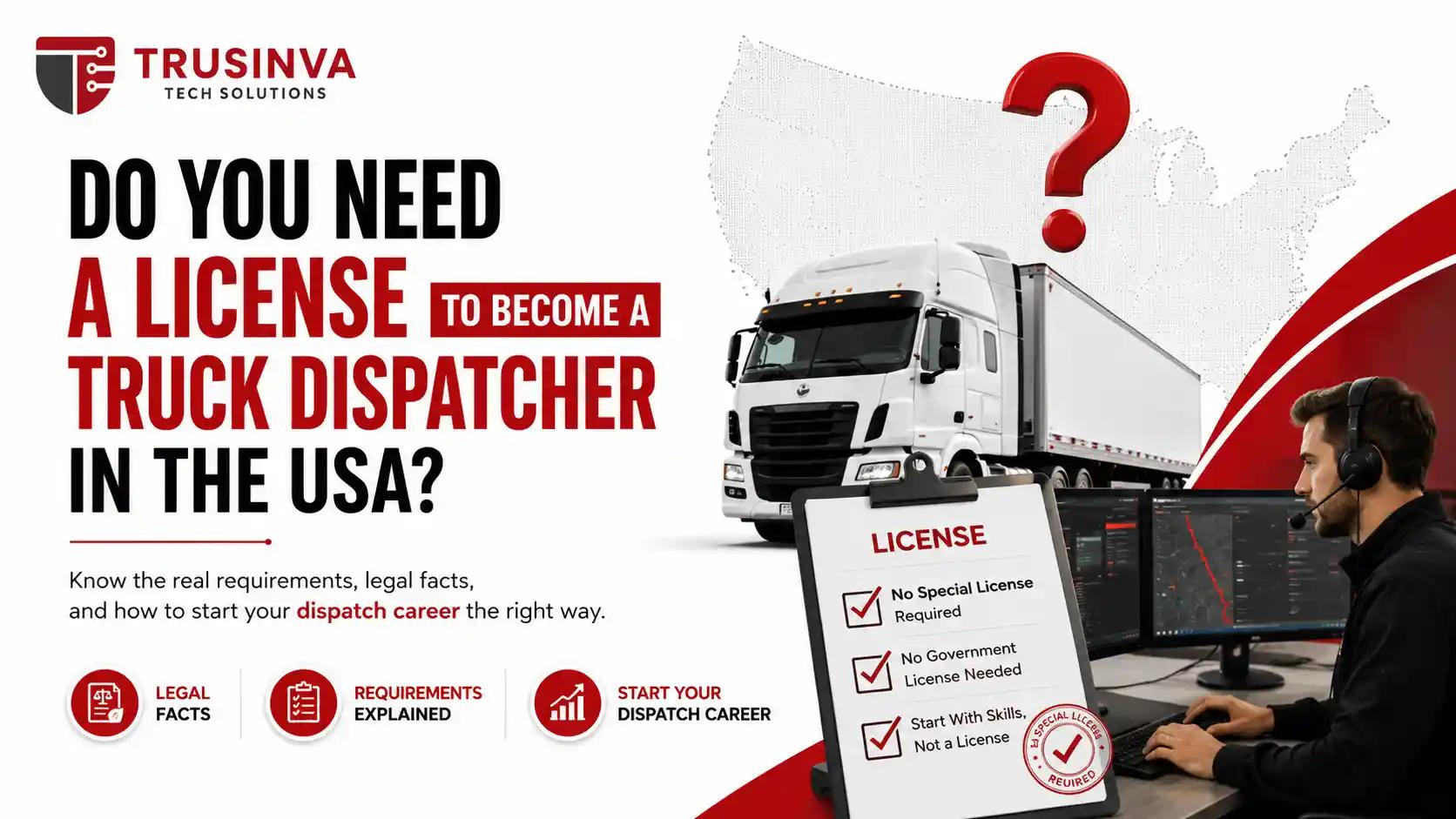
Quick Answer
No. There is no federal or state licence specifically required to work as a truck dispatcher in the USA. Dispatchers acting as agents of a motor carrier do not need FMCSA operating or broker authority. However, you do need standard business registrations, and if you arrange freight as an intermediary rather than as the carrier's representative, broker authority and a $75,000 surety bond become legally required.
Key Takeaways
- There is no "truck dispatcher licence" issued by FMCSA, the DOT, or any US state.
- Certification is not a licence. Training programs issue certificates of completion, not government credentials.
- The real legal risk is unlicensed brokering — arranging freight without broker authority carries civil penalties.
- Dispatchers must operate as a bona fide agent of the carrier, under a written dispatch agreement, working for the carrier — not for shippers.
- You do need ordinary business items: entity registration, EIN, local business licence, and insurance.
- FMCSA's 2025–2026 registration overhaul and fraud enforcement has made role documentation far more important than it used to be.
- Startup cost is low — typically $500–$2,000 — because no licensing fee exists.
1. Introduction
"Do I need a licence to become a truck dispatcher?" is the first question almost every newcomer asks — and the internet answers it badly. Some sites sell "dispatcher licences" that don't exist. Others insist you need broker authority when you usually don't. The truth sits in between, and getting it wrong can expose you to real penalties. At Trusinva Tech Solutions, we train US-focused dispatchers and see this confusion constantly, so this guide separates what the law actually requires from what training companies market. If you're planning the business itself, read how to start a truck dispatching business in the USA and the updated start a truck dispatching business guide for 2026. To understand the earning side before committing, see truck dispatcher salary in the USA 2026, and for structured training with compliance built in, our truck dispatching course covers the regulatory framework alongside daily operations.
Note: This article is educational and not legal advice. Federal and state requirements change. Verify current rules directly with FMCSA and consult a transportation attorney before structuring your business.
2. The Direct Answer: Is a Truck Dispatcher Licence Required?
No US federal agency issues a truck dispatcher licence, and no state requires one to work as a dispatcher. FMCSA licences motor carriers, freight brokers, and freight forwarders — not dispatchers. A dispatcher working as the carrier's representative operates under the carrier's authority, not their own.
Here's the clean breakdown of who FMCSA actually registers:
| Role | FMCSA Registration Required? | What They Need |
| Motor Carrier | Yes | USDOT number, MC number, insurance filings |
| Freight Broker | Yes | Broker authority, $75,000 surety bond (BMC-84), process agents |
| Freight Forwarder | Yes | Forwarder authority, bond, insurance |
| Truck Dispatcher (agent of carrier) | No | Business registration only |
| Company driver | CDL (driver's licence) | Commercial Driver's Licence |
Expert observation: The confusion exists because dispatchers touch the same freight ecosystem as brokers. But the regulatory trigger isn't what you touch — it's whose interest you represent. Represent the carrier, and you're an agent. Represent yourself as an intermediary between shipper and carrier, and you're brokering.
3. What a Truck Dispatcher Actually Does
A truck dispatcher is an authorized representative of a motor carrier who searches load boards, negotiates rates, books freight, handles broker paperwork, and coordinates schedules on that carrier's behalf — typically for a percentage of gross linehaul revenue.
Core Responsibilities
- Searching load boards (DAT, Truckstop) for freight matching the carrier's equipment and lanes
- Negotiating rates with freight brokers and, less commonly, direct shippers
- Booking loads with the carrier's approval
- Completing carrier packets and broker setup on the carrier's behalf
- Reviewing rate confirmations and bills of lading
- Planning routes, home time, and reducing deadhead miles
- Coordinating detention, layover, and accessorial claims
- Supporting invoicing and factoring paperwork
What a Dispatcher Does NOT Do
- Own or operate trucks
- Hold their own operating authority
- Contract directly with shippers as an intermediary
- Take possession of freight
- Assume liability for cargo
For a full picture of the value dispatchers deliver, see how truck dispatching services save US carriers money and owner-operator dispatch services benefits.
4. Why People Think a Dispatcher Licence Exists
Three things create the myth: marketing language from training companies, genuine confusion between "certification" and "licence," and the fact that adjacent roles — brokers, carriers, drivers — are all genuinely licensed.
The Four Main Sources of Confusion
- Course marketing. Programs advertise "licensed dispatcher training" or "get certified and licensed." The certificate is real; the licence isn't.
- Broker authority confusion. Because brokers need authority and bonds, people assume dispatchers do too.
- Business licence ≠ professional licence. Your city may require a general business licence. That's not a dispatcher licence — every business needs one.
- International comparison. Some countries do regulate logistics intermediaries more tightly. The US does not regulate dispatchers as a distinct profession.
Warning: If any company offers to sell you an official "truck dispatcher licence" or "dispatcher permit" for a fee, treat it as a red flag. No such credential exists in the United States.
5. Dispatcher vs Freight Broker: The Line That Actually Matters
A dispatcher works for one or more motor carriers under written agreement and represents the carrier's interests. A freight broker works as an independent intermediary arranging transportation between shippers and carriers for compensation, which requires FMCSA broker authority and a $75,000 surety bond.
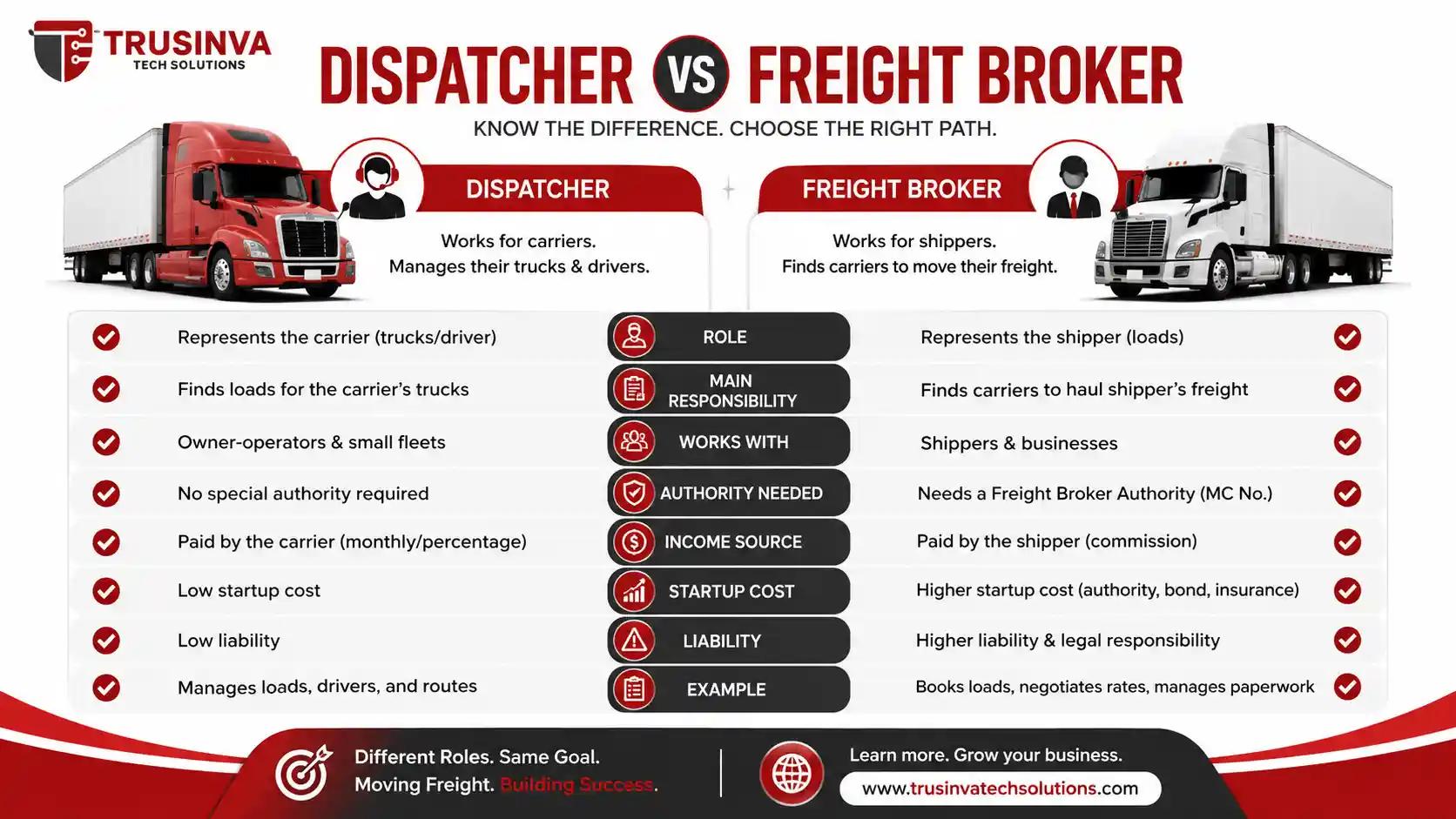
Dispatchers work as agents of the motor carrier and need no FMCSA authority, while freight brokers require broker authority and a $75,000 surety bond.
Side-by-Side Comparison
| Factor | Truck Dispatcher | Freight Broker |
| FMCSA authority required | No | Yes — broker authority |
| Surety bond | Not required | $75,000 (BMC-84) or trust (BMC-85) |
| Whose agent are they? | The motor carrier | Neither — independent intermediary |
| Who pays them? | The carrier | The shipper (margin on the load) |
| Written agreement with | Carrier | Both shippers and carriers |
| Process agents (BOC-3) | Not required | Required |
| Handles carrier's own authority? | Yes, on carrier's behalf | No |
| Sets the rate margin? | No — earns a % of carrier revenue | Yes — earns the spread |
| Contracts with shippers directly | Generally no | Yes |
The Practical Test
Ask yourself these four questions. If any answer is "yes," you may be brokering:
- Am I contracting with shippers rather than working for a carrier?
- Do I earn a margin between what the shipper pays and what the carrier receives?
- Do I arrange freight for carriers I have no agreement with?
- Do I hold myself out to shippers as able to arrange transportation?
Expert observation: The most common accidental violation happens when a dispatcher lands a direct shipper relationship, gets excited, and then farms the freight out to other carriers. That single step converts a dispatcher into an unlicensed broker. Once you're placing freight with carriers you don't formally represent, you need broker authority.
6. What Is a "Bona Fide Agent"?
A bona fide agent is a person or company that arranges transportation on behalf of a motor carrier under a continuing written agreement, where the carrier controls the agent's actions in the arrangement. Federal regulations exempt bona fide agents from broker registration — this is the legal foundation dispatchers operate on.
Elements That Support Bona Fide Agent Status
- A continuing written agreement with the carrier, not load-by-load
- The carrier directs and controls the freight decisions
- The dispatcher represents a limited number of carriers, not an open marketplace
- Compensation comes from the carrier, not from a margin on the shipper's payment
- The dispatcher acts in the carrier's name, under the carrier's authority
- The carrier approves loads before confirmation
- No direct contractual relationship between the dispatcher and the shipper
What Weakens It
- Load-by-load, no standing agreement
- Representing dozens of unrelated carriers as an open pool
- Earning the spread instead of a service fee
- Marketing yourself to shippers as a freight solution
- Making booking decisions without carrier approval
Why this matters: Bona fide agent status is not a document you apply for. It's a factual conclusion drawn from how you actually operate. That means your paperwork, your fee structure, and your marketing language all have to line up.
7. When You DO Need FMCSA Broker Authority
You need broker authority whenever you arrange transportation for compensation as an intermediary rather than as the carrier's agent — most commonly when working directly with shippers, brokering freight to carriers you don't represent, or earning a margin on the freight rate.
Broker Authority Requirements
| Requirement | Detail |
| Application | FMCSA registration (OP-1 process / Unified Registration System) |
| Filing fee | Approximately $300 |
| Surety bond | $75,000 (BMC-84) or trust fund (BMC-85) |
| Process agents | BOC-3 designation in every state of operation |
| USDOT number | Required |
| Ongoing | Biennial updates, bond maintenance |
Trigger Scenarios — Broker Authority Needed
- You sign a transportation contract directly with a shipper
- You post a load and hire an unrelated carrier to move it
- You keep the difference between shipper payment and carrier payment
- You arrange freight for carriers with no dispatch agreement in place
- You advertise transportation services to shippers
Serious warning: Operating as an unlicensed broker exposes you to federal civil penalties and potential liability to shippers and carriers. FMCSA has increased attention on unauthorized brokering, particularly in connection with freight fraud. Do not treat this as a technicality.
8. What You Legally Need to Start a Dispatch Business
Even without a dispatcher licence, you need standard business items: a legal entity, an EIN, any local business licence, a business bank account, and a written dispatch agreement. Insurance is strongly recommended though not federally mandated.
Complete Requirements Checklist
- Business entity — LLC or sole proprietorship, registered with your Secretary of State
- EIN — free from the IRS; needed for banking and taxes
- Local business licence — city or county requirement, varies widely
- Business bank account — separates personal and business funds
- Written dispatch agreement template — reviewed by an attorney
- Dispatch authorization / limited power of attorney template
- General liability insurance — recommended
- Errors & omissions (professional liability) — strongly recommended
- Load board subscription — DAT, Truckstop, or similar
- Business phone, email, and website — see web development services and affordable website design for small business
- CRM or client management system — see CRM features and CRM development
What You Do NOT Need
- USDOT number (you're not a carrier)
- MC number
- Broker authority (if operating as a carrier's agent)
- Surety bond
- BOC-3 process agents
- CDL
- Any dispatcher-specific licence or permit
9. State and Local Requirements
No US state issues a truck dispatcher licence. State-level obligations are the same as for any small service business: entity registration, state tax registration, and local business licensing where applicable.
What Varies by State and City
| Requirement | Typical Variation |
| LLC formation fee | Roughly $50–$500 depending on state |
| Annual report / franchise tax | Varies; some states have none, others charge annually |
| State income tax registration | Depends on state and entity type |
| Local business licence | City or county specific; some require none |
| Home occupation permit | Required in some municipalities for home-based businesses |
| Sales tax | Generally not applicable to dispatch services, but verify locally |
Expert tip: Dispatchers frequently operate remotely and serve carriers in multiple states. Your registration obligations follow where you operate from, not where your carriers are based. You do not need to register in every state your carriers drive through.
10. Certification vs Licence vs Training
A licence is a government permission to operate. A certification is a private credential showing you completed training. In US truck dispatching, no licence exists — only certifications and training programs, which are optional but practically valuable.
Comparison Table
| Licence | Certification | Training Course | |
| Issued by | Government agency | Private school or association | Training provider |
| Legally required? | Would be, if it existed | No | No |
| Exists for dispatchers? | No | Yes | Yes |
| Practical value | N/A | Credibility with carriers | Skills, speed to first client |
| Typical cost | N/A | $300–$2,500 | $300–$2,500 |
Is Training Worth It If It's Not Required?
Yes — for a practical reason that has nothing to do with legality. Dispatching is a skills business. Rate negotiation, lane knowledge, broker credit checks, carrier packet handling, and detention claims are learned faster with structure than through trial and error at a carrier's expense. Our truck dispatching course in the USA overview explains what a serious program should cover, and truck dispatching for flatbed carriers in the USA shows how specialization works in practice.
Buyer beware: Be skeptical of any course advertising a "dispatcher licence," "government certification," or "FMCSA-approved dispatcher credential." FMCSA does not approve or accredit dispatcher training.
11. Do Employee Dispatchers Need Anything Different?
No. A dispatcher employed by a trucking company, freight brokerage, or logistics firm needs no licence, no certification, and no registration. The employer holds whatever operating or broker authority applies, and the employee works under it.
| Situation | Licence Needed | Notes |
| Employee dispatcher at a carrier | No | Works under employer's authority |
| Employee dispatcher at a brokerage | No | Works under employer's broker authority |
| Independent dispatcher (agent of carriers) | No | Needs business registration only |
| Independent, contracting with shippers | Yes | Broker authority required |
Career note: Many dispatchers start as employees to learn the trade with no personal regulatory exposure, then go independent once they understand freight economics. It's a low-risk sequence and one we regularly recommend.
12. The Dispatch Agreement: Your Most Important Legal Document
Since no licence defines your role, your written dispatch agreement does. It is the primary evidence that you operate as the carrier's agent rather than as an unlicensed broker — which makes drafting it correctly the single most important compliance step you take.
Clauses Your Agreement Must Contain
- Agency statement — you act as the carrier's agent, not as a broker or forwarder
- Carrier control — the carrier retains final approval over loads and rates
- Continuing relationship — ongoing engagement, not load-by-load
- Fee structure — percentage of gross linehaul, and whether fuel surcharge or accessorials are included
- Scope of services — what's included and explicitly excluded
- No possession of freight — you never take custody of cargo
- Payment terms and invoicing schedule
- Cancellation and notice period
- Confidentiality and non-solicitation
- Indemnification and limitation of liability
- Governing law
Supporting Documents
- Limited power of attorney / dispatch authorization letter
- Carrier's MC and USDOT numbers, W-9
- Certificate of insurance (auto liability and cargo)
- Notice of assignment, if the carrier uses factoring
Expert observation: In a dispute or an enforcement inquiry, nobody asks for your licence — because there isn't one. They ask for your agreement, your invoices, and your marketing materials. If those three tell a consistent "agent of the carrier" story, you're on solid ground. If your website says "we find shippers and move freight," you have a problem regardless of what the contract says.
13. Cost Breakdown to Start Legally
Starting a compliant truck dispatching business in the USA typically costs $500–$2,000 in the first year, because no licensing fee exists. Ongoing monthly operating costs usually run $150–$400.
One-Time Setup Costs
| Item | Typical Cost |
| LLC formation | $50–$500 (state dependent) |
| EIN | Free (IRS) |
| Local business licence | $0–$150 |
| Attorney-reviewed dispatch agreement | $200–$800 |
| Website (basic) | $100–$1,000 |
| Registered agent (if used) | $50–$150/year |
| Total | $400–$2,600 |
Monthly Operating Costs
| Item | Typical Cost |
| Load board subscription | $45–$180 |
| VoIP / business phone | $20–$50 |
| CRM | $0–$50 |
| E&O + general liability insurance | $30–$120 |
| Website hosting | $10–$40 |
| Total | $105–$440 |
Cost Comparison: Dispatcher vs Broker
| Dispatcher | Freight Broker | |
| Federal filing fee | $0 | ~$300 |
| Surety bond | $0 | $75,000 bond (premium often $1,000–$8,000/yr) |
| Process agents | $0 | ~$50–$150 |
| Realistic entry cost | $500–$2,000 | $5,000–$12,000+ |
Why this matters: The low barrier is precisely why dispatching attracts so many newcomers — and precisely why the market is competitive. Your differentiation comes from freight knowledge, not from credentials.
14. Requirements and Eligibility Checklist
There are no education, age, citizenship, or experience requirements to become a truck dispatcher in the USA beyond the ability to legally operate a business. No degree, no exam, and no background check apply.
Eligibility Summary
| Requirement | Applies? |
| High school diploma / degree | Not required |
| Licence or permit | Not required |
| Exam | Not required |
| Minimum experience | Not required |
| Background check | Not required |
| US residency | Not federally required for dispatching itself, but business registration and banking have their own rules |
| Legal ability to run a business | Required |
Skills That Actually Determine Success
- Freight rate knowledge and lane awareness
- Negotiation with brokers
- Understanding of FMCSA compliance basics
- Communication reliability with drivers
- Broker credit-check discipline
- Documentation and record-keeping
- Client acquisition ability
15. Step-by-Step: Setting Up a Compliant Dispatch Business
Follow eight steps: choose your structure, register the entity, get an EIN, handle local licensing, open a business account, prepare your agreement, get insurance, and set up load board and operational tools.
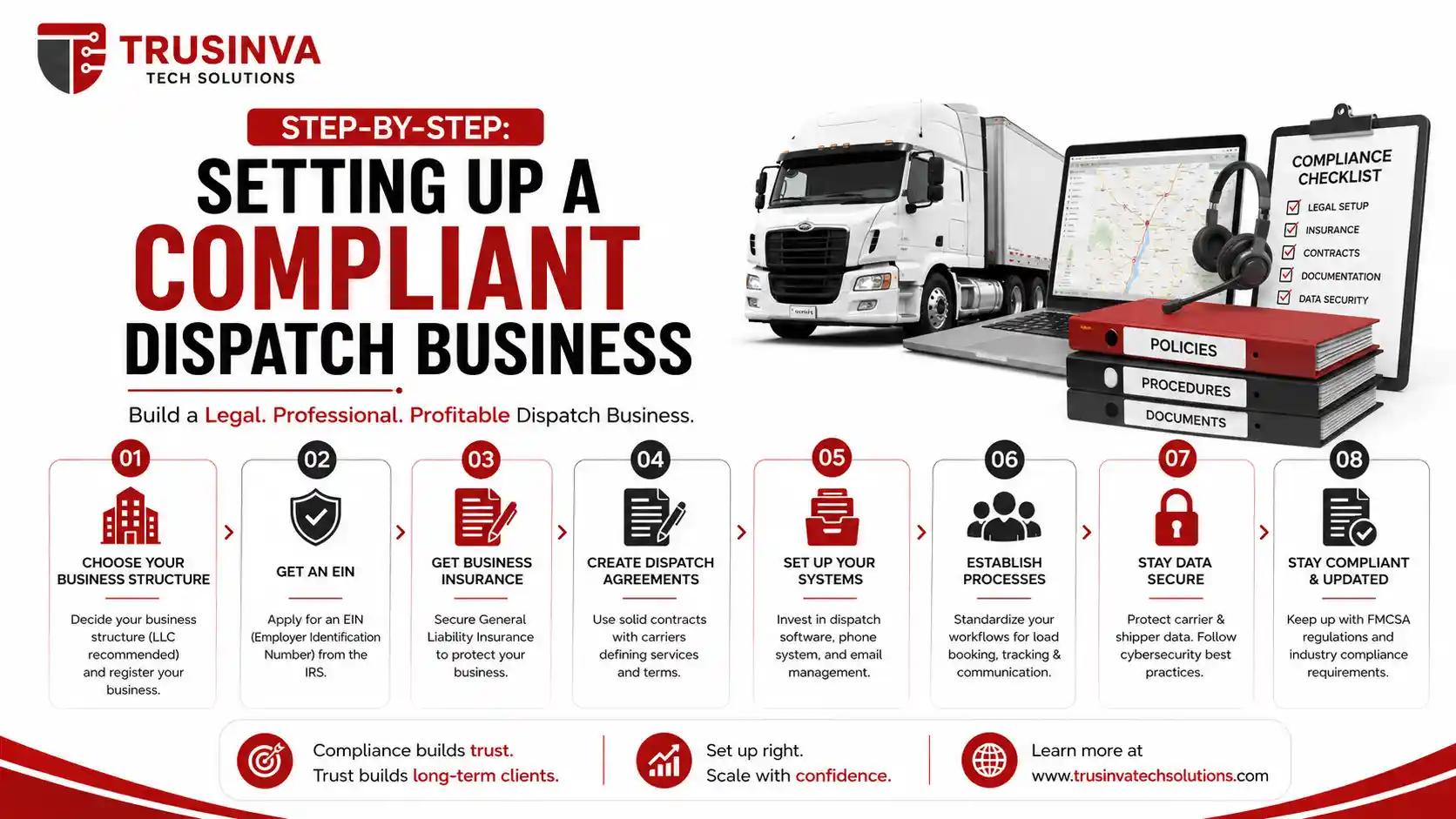
A compliant dispatch business typically takes two to four weeks to set up — entity registration, EIN, local licensing, dispatch agreement, insurance, and operational tools.
Step 1 — Choose a Business Structure
LLC is the common choice for liability separation. Sole proprietorship is simpler but offers no personal asset protection.
Step 2 — Register With Your Secretary of State
File formation documents and pay the state fee.
Step 3 — Obtain an EIN
Free directly from the IRS. Never pay a third party for this.
Step 4 — Check Local Licensing
Contact your city or county clerk. Some require a general business licence or home occupation permit.
Step 5 — Open a Business Bank Account
Keeps finances clean and supports the separate-entity position for your LLC.
Step 6 — Prepare Your Dispatch Agreement
Have a transportation attorney review it. This is the document that defines your legal role — do not use a random template unreviewed.
Step 7 — Get Insurance
General liability plus errors & omissions. Not legally mandated, but carriers increasingly ask, and it protects you against claims arising from booking errors.
Step 8 — Set Up Operations
Load board subscription, VoIP phone, CRM, e-signature, and a professional website. See CRM development solutions for US sales teams in 2026 and AI automation services in the USA for tooling.
Realistic Timeline
| Milestone | Timeframe |
| Entity registration | 1–14 days (state dependent) |
| EIN | Same day |
| Local licence | 1–14 days |
| Bank account | 1–3 days |
| Agreement drafted and reviewed | 3–10 days |
| Fully operational | 2–4 weeks total |
16. Salary and Career Scope
Employed truck dispatchers in the USA typically earn roughly $45,000–$70,000 annually, while independent dispatchers earn 5–10% of each carrier's gross linehaul revenue — often $2,000–$8,000 per month once they manage five to ten trucks.
Income Models
| Model | Typical Range | Notes |
| Employee dispatcher | $45,000–$70,000/yr | Stable, benefits, no business risk |
| Independent — percentage | 5–10% of gross linehaul | Scales with client count |
| Independent — flat weekly | $200–$400/truck/week | Predictable; carriers resent it in slow weeks |
| Dispatch agency owner | Varies widely | Requires team and systems |
A solo independent dispatcher typically manages 8–15 trucks before needing software support or an assistant. Detailed earning scenarios are in truck dispatcher salary in the USA 2026.
Career scope note: Because there's no licensing barrier, career progression is driven entirely by freight expertise and client retention. Dispatchers with deep specialization in one equipment type and region consistently out-earn generalists.
17. Latest Updates: FMCSA Registration Reform and Fraud Enforcement (2026)
The regulatory environment around dispatching tightened significantly in 2025–2026. FMCSA has been overhauling its registration systems in response to widespread carrier and broker identity fraud, and enforcement attention on unauthorized brokering has increased.
What Changed and Why It Matters
- Registration system modernization. FMCSA has been rebuilding its registration infrastructure to reduce fraudulent carrier and broker registrations. Expect stricter identity verification and more scrutiny of entity relationships.
- Freight fraud crackdown. Double-brokering, identity theft, and cargo theft schemes drove legislative and enforcement pressure. Dispatchers who blur the line into brokering are now more visible in that environment.
- Broker transparency rulemaking. FMCSA has advanced rulemaking on broker transparency requirements, sharpening the industry's focus on who is legally a broker and who isn't.
- English language proficiency enforcement returned as an active out-of-service criterion, affecting driver qualification screening dispatchers should be aware of.
- Carrier vetting expectations rose. Brokers now vet more aggressively, meaning dispatchers must present clean, consistent documentation of their agency relationship.
Practical implication for 2026: The absence of a dispatcher licence has not changed. What has changed is that sloppy role definition — vague agreements, shipper-facing marketing, margin-based fees — attracts far more scrutiny than it did three years ago. Document your agency relationship properly.
Always verify current requirements directly on FMCSA's website; regulatory developments continue to move quickly.
18. Common Mistakes and Compliance Risks
- Buying a fake "dispatcher licence." No such credential exists. Money wasted, and it signals inexperience.
- Drifting into brokering. Landing a direct shipper and farming freight out to other carriers without broker authority is the single biggest legal risk.
- No written dispatch agreement. Without it, your agent status is difficult to establish and fee disputes are near-certain.
- Load-by-load arrangements only. A continuing relationship supports agency status; ad-hoc arrangements weaken it.
- Marketing to shippers. Website copy saying "we move your freight" contradicts your agent position.
- Earning a margin instead of a fee. Taking the spread between shipper and carrier payment looks like brokering because it is.
- Skipping business registration. Operating unregistered creates tax and liability problems unrelated to FMCSA.
- Assuming certification protects you legally. It doesn't. It's a training record, not a compliance shield.
- Not verifying carrier authority. Dispatching for a carrier with revoked authority creates exposure for you.
- Using an unreviewed template agreement. The one document that defines your role deserves an attorney's eyes.
- Ignoring insurance. E&O protects against booking errors that carriers may otherwise claim against you.
19. Expert Tips and Best Practices
- Make your agreement, invoices, and website tell the same story. Consistency across all three is what actually protects you.
- Bill a service fee, never a spread. Fee-based compensation is the clearest signal of agent status.
- Keep carrier approval in the loop, in writing. Text or email approval on loads creates a record of carrier control.
- Verify every carrier in FMCSA's SAFER system before signing and periodically afterward.
- Never call yourself a broker in marketing unless you actually hold broker authority.
- Carry E&O insurance even though it isn't required — carriers increasingly ask for it.
- If you want direct shipper work, get broker authority properly. It's a legitimate growth path, not a shortcut to avoid.
- Keep training records. Certification isn't a licence, but it demonstrates professionalism to carriers evaluating you.
- Re-read your agreement annually. Your business model drifts; your paperwork should keep up.
20. Frequently Asked Questions
Q1. Do you need a licence to become a truck dispatcher in the USA? No. There is no federal or state licence for truck dispatchers. FMCSA licenses motor carriers, freight brokers, and freight forwarders, but not dispatchers. A dispatcher acting as a carrier's agent operates under that carrier's authority and needs only standard business registrations.
Q2. Do truck dispatchers need FMCSA broker authority? Not if they act as a bona fide agent of a motor carrier under a written agreement. Broker authority and a $75,000 surety bond become required if you arrange freight as an independent intermediary, contract directly with shippers, or earn a margin on the freight rate.
Q3. Is truck dispatcher certification required? No. Certification is a private credential from a training provider, not a government licence. It's optional, but useful for credibility with carriers and for learning rate negotiation, load board strategy, and compliance basics faster than by trial and error.
Q4. Do I need an LLC to be a truck dispatcher? An LLC isn't legally required — you can operate as a sole proprietor. Most dispatchers form an LLC anyway for personal liability protection, cleaner banking, and greater credibility with carriers evaluating whether to sign with them.
Q5. Can I be a truck dispatcher from home? Yes. Dispatching is fully remote work requiring a computer, phone, and load board access. Check whether your city requires a home occupation permit, and confirm any local business licence obligations with your city or county clerk.
Q6. What's the difference between a truck dispatcher and a freight broker? A dispatcher represents motor carriers under written agreement and earns a fee from the carrier. A broker is an independent intermediary between shippers and carriers, earns the margin on the load, and must hold FMCSA broker authority with a $75,000 surety bond.
Q7. How much does it cost to start a truck dispatching business legally? Typically $500–$2,000 for the first year, covering entity formation, an attorney-reviewed agreement, a basic website, and setup. Monthly operating costs of $105–$440 cover load boards, phone, CRM, and insurance. No licensing fee exists because no licence exists.
Q8. Can a truck dispatcher work with shippers directly? Only with caution. Sourcing a direct shipper load for a carrier you represent may be acceptable, but contracting with shippers and placing freight with carriers you don't represent constitutes brokering and requires broker authority. Consult a transportation attorney before pursuing direct shipper work.
Q9. Do I need a USDOT or MC number as a dispatcher? No. USDOT and MC numbers identify motor carriers and other FMCSA-registered entities. As a dispatcher, you work under your client carrier's numbers and do not obtain your own.
Q10. Is truck dispatching legal in every US state? Yes. No state prohibits or specially licenses truck dispatching. State obligations are the ordinary ones any service business faces — entity registration, tax registration, and local business licensing where applicable.
21. Conclusion and Next Step
The short answer is settled: you do not need a licence to become a truck dispatcher in the USA. No federal agency issues one, no state requires one, and anyone selling one is selling nothing.
But "no licence" is not the same as "no rules." Your real compliance obligation is structural, not credential-based. Operate as a genuine agent of the carriers you serve, put it in a properly drafted written agreement, charge a service fee rather than a margin, keep your marketing consistent with your role, and stay firmly on the correct side of the broker line. In 2026, with FMCSA tightening registration and enforcement around freight fraud, that clarity matters more than it ever has.
The practical bottleneck for new dispatchers has never been licensing. It's freight knowledge and clients — which is exactly where your energy should go.
Ready to build a compliant, profitable dispatch business? Trusinva Tech Solutions trains dispatchers on the full picture — FMCSA compliance, carrier verification, dispatch agreements, rate negotiation, broker setup, and client acquisition. Book a Seat in our truck dispatching program, browse the complete course catalogue, explore our services including digital marketing, SEO, and social media marketing for dispatch businesses, read more on how digital marketing can help you get more clients online in 2026 and how to rank your business website in the USA 2026, or contact our team to discuss a website, CRM, or lead generation system built specifically for your dispatch company.