Thousands of US healthcare websites lose patients every month—not because of poor medical care, but because of outdated web design. Could yours be one of them?
If you run a healthcare business in the US, your website is often the very first "appointment" a patient has with you. Long before they call your front desk, they're checking your site on their phone, comparing it to two other clinics, and deciding whether they trust you enough to book.
That's why web development for healthcare companies has become a non-negotiable investment rather than a nice-to-have. In 2026, healthcare organizations — from single-doctor clinics to multi-location hospital networks — need websites that are fast, secure, HIPAA compliant, and built to actually convert visitors into patients.
This guide walks you through what healthcare web development really means, why it matters more than ever, the biggest benefits, a practical step-by-step process, and the mistakes that quietly cost healthcare businesses patients and revenue every day.
If you're exploring web development options for your practice, or just want to understand what a solid healthcare website actually needs, you're in the right place.
What Is Healthcare Web Development?
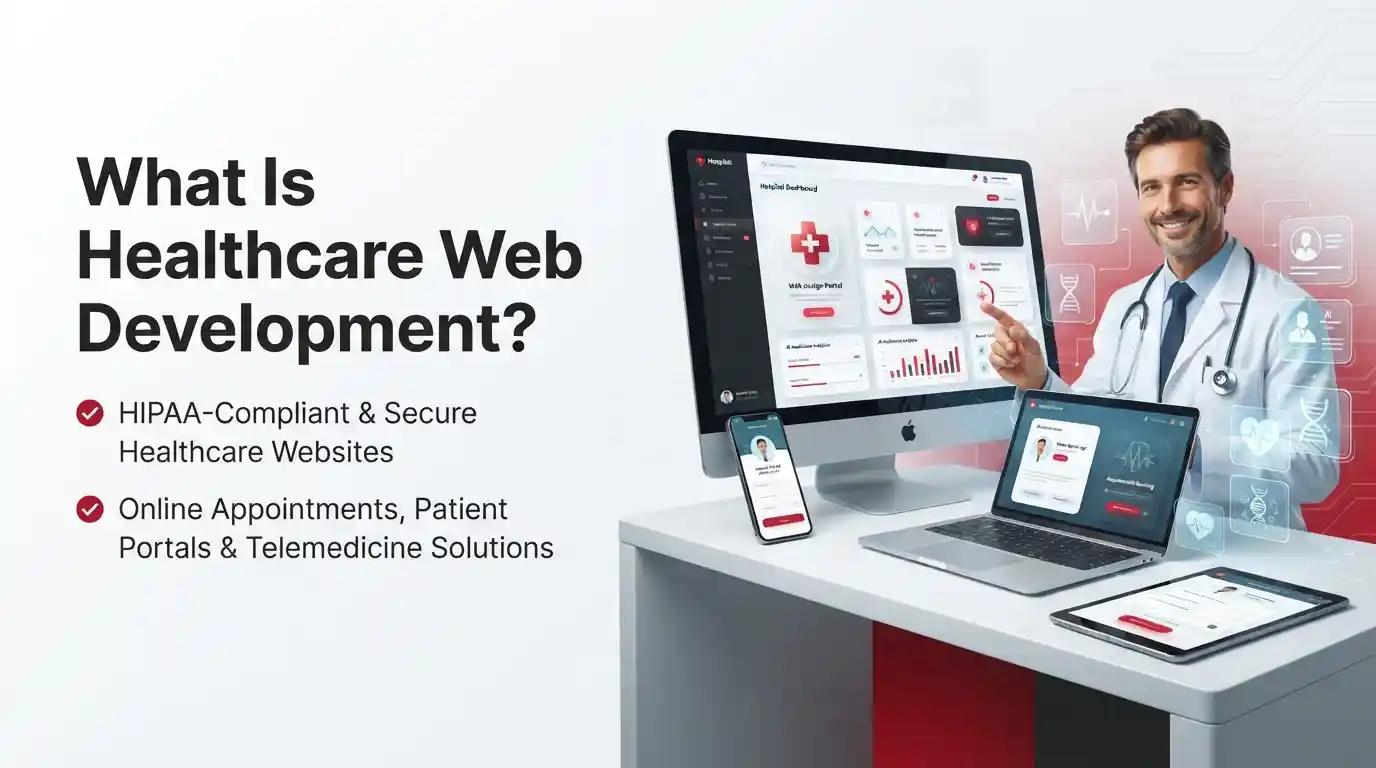
Healthcare web development is the process of designing, building, and maintaining websites and web applications specifically for medical practices, hospitals, clinics, telehealth providers, and other healthcare businesses.
It's not the same as building a regular business website. A healthcare website usually needs to handle sensitive patient data, integrate with clinical systems, and meet strict regulatory standards — all while staying easy to use for patients who may be stressed, in pain, or unfamiliar with technology.
At its core, healthcare web development includes:
- Custom healthcare websites with clear service pages and location information
- Patient portal development for appointment booking, records, and messaging
- EHR/EMR integration so patient data flows into your existing clinical systems
- HIPAA compliant web development to protect patient health information
- Telehealth website development for virtual care delivery
Think of it as building both a marketing tool and a piece of clinical infrastructure at the same time.
Why It Is Important
Healthcare is one of the most trust-sensitive industries online. A slow, outdated, or insecure website doesn't just look bad — it can actually cost lives, lose patients, or trigger compliance violations.
Here's why this matters right now:
Patients research before they book. Most people search symptoms, treatments, and providers online before ever calling. If your site doesn't answer their questions clearly, they move to the next result.
Compliance risk is real. A single data breach involving patient information can result in massive fines under HIPAA, plus permanent reputation damage.
Competition has gone digital. Hospitals, clinics, and telehealth startups across the USA — from New York to Texas to California — are all investing in modern, mobile-first websites. Standing still means falling behind.
International relevance matters too. Many US healthcare companies now work with offshore development teams and remote specialists — including agencies in Pakistan and across Asia — to build secure, cost-effective healthcare platforms without compromising on compliance or quality. This global collaboration model has become standard practice in 2026.
Whether you're a small clinic or an enterprise hospital system, your website is now part of your care delivery, not just your marketing.
Key Benefits of Custom Healthcare Web Development
A well-built healthcare website isn't just about looking professional. It directly impacts your bottom line and patient outcomes.
- Higher patient acquisition — a clear, fast, SEO-optimized site brings in more qualified patient leads
- Improved patient experience — online booking, secure messaging, and easy navigation reduce friction
- HIPAA compliance built in — reduces legal risk and protects sensitive patient data
- Better staff efficiency — patient portals reduce phone calls and administrative workload
- Stronger brand trust — a polished, secure website signals credibility to new patients
- Higher search visibility — proper SEO structure helps you appear in Google and AI Overview results
- Scalability — custom-built platforms grow with your practice, from one clinic to multiple locations
- Better ROI over time — unlike generic templates, custom development is built to last and adapt
These benefits compound. A single improvement, like adding online appointment booking, can reduce no-shows and free up front-desk staff to focus on patients instead of phone calls.
Step-by-Step Process for Building a Healthcare Website
Here's a practical roadmap most healthcare organizations follow when building or redesigning their website.
- Discovery and requirements gathering — Understand your specialty, patient demographics, compliance needs, and existing systems (EHR/EMR, billing software).
- Compliance planning — Map out exactly what HIPAA compliant web development requires for your site: encrypted forms, secure hosting, audit logs, and data handling policies.
- UX and UI design — Design a clean, accessible, mobile-first layout. Healthcare UX should reduce anxiety, not add to it — clear navigation, large readable text, and simple booking flows matter.
- Development — Build the site using a secure, scalable framework, integrating patient portals, contact forms, and any required APIs (EHR, CRM, billing).
- Content and SEO structure — Write clear service pages, location pages, and FAQ sections that answer real patient questions and target relevant search terms.
- Testing and security audits — Test for accessibility (ADA compliance), page speed, mobile responsiveness, and data security before launch.
- Launch and monitoring — Go live, then monitor site performance, security logs, and patient engagement metrics continuously.
- Ongoing maintenance — Healthcare websites need regular updates for security patches, compliance changes, and content refreshes.
Skipping any of these steps is usually where problems start — which brings us to the mistakes.
Common Mistakes Healthcare Companies Make
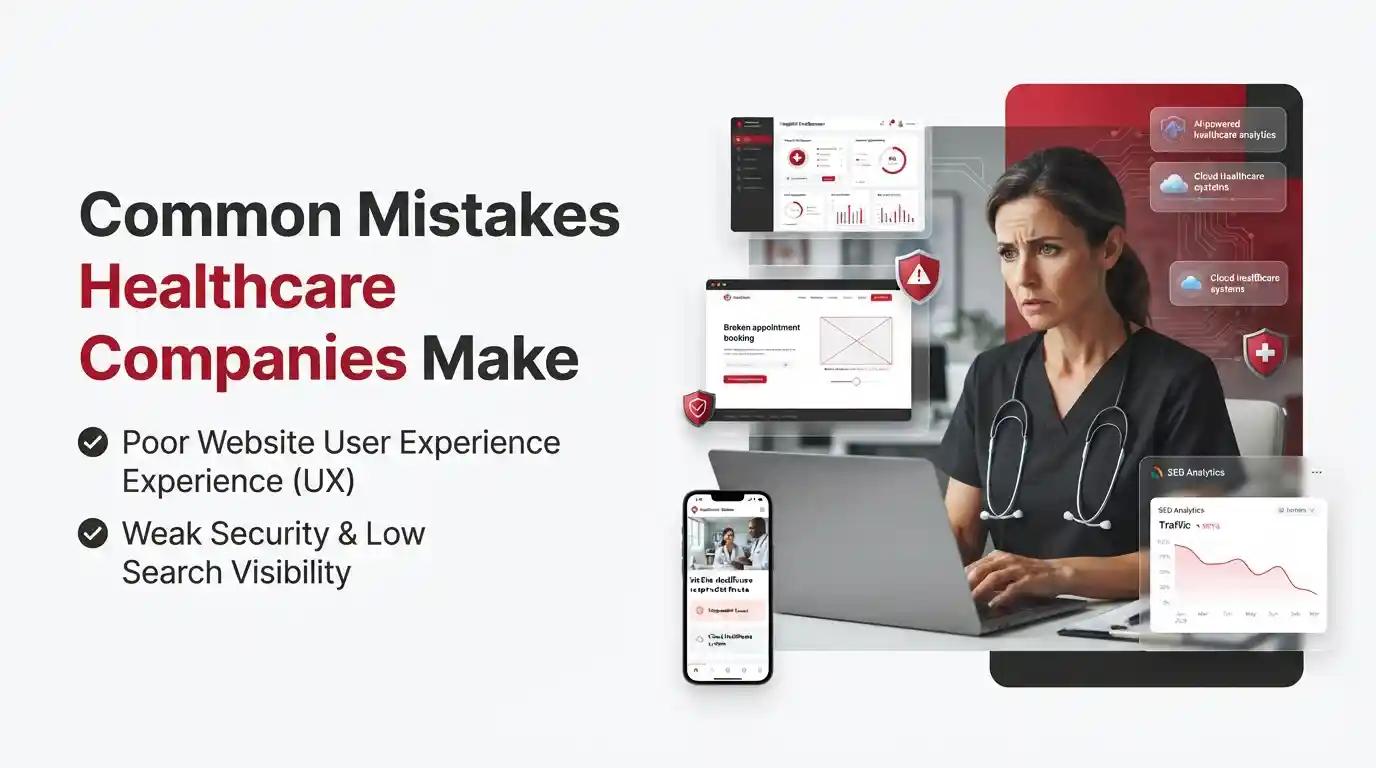
Even well-meaning healthcare businesses make avoidable errors when building their websites.
Using generic templates without compliance review. A pretty template that isn't actually HIPAA compliant creates hidden legal risk.
Ignoring mobile users. A large share of patients search and book appointments from their phones. A non-responsive site loses them instantly.
Ineffective content. Vague service descriptions that don't answer real patient questions (cost, process, what to expect) push visitors to competitors.
No clear call-to-action. Many healthcare sites bury their "Book Appointment" or "Contact Us" buttons, reducing conversions.
Overlooking site speed. Slow-loading pages hurt both patient experience and Google rankings.
Treating the website as a one-time project. Healthcare websites need ongoing updates, security patches, and content refreshes — not a "build it and forget it" approach.
Why Choose Trusinva Tech Solutions
At Trusinva Tech Solutions, we specialize in building secure, conversion-focused, HIPAA-aware websites and digital platforms for healthcare businesses across the USA and internationally.
Our team understands that healthcare is different. We don't just design a nice-looking site — we build platforms that handle patient data responsibly, integrate with your existing systems, and are optimized to bring in real patients, not just visitors.
Here's how we help healthcare businesses grow:
- Web Development — custom, secure, and scalable healthcare websites built around your practice
- Mobile App Development — patient-facing apps for booking, telehealth, and communication
- SEO Services — helping your practice rank locally and nationally, and appear in AI-driven search results
- Digital Marketing — targeted campaigns to bring qualified patient leads to your site
- CRM & ERP Solutions — through our CRM development services, we help healthcare organizations manage patient relationships and operations more efficiently
- UI/UX Design — via our UI/UX design services, we make sure your patients have a smooth, stress-free digital experience
We also support related operational needs many healthcare and logistics-adjacent businesses have, including truck dispatching workflows and medical billing systems — helping streamline the business side while your website handles patient acquisition. If you're building a team, our medical billing course and truck dispatching course can help train staff on these exact workflows.
You can explore our full range of offerings on our services page, see real examples of our work on our projects page, or read more practical guides on our blog. Want to know more about our team and approach? Visit our About page.
Frequently Asked Questions
What is healthcare web development? It's the process of designing and building websites and web apps specifically for medical practices, hospitals, and clinics — including patient portals, HIPAA compliance, and EHR integration.
How much does healthcare website development cost? Cost depends on complexity — a simple clinic website costs less than a hospital platform with patient portals and EHR integration. Custom quotes are based on your specific features and compliance needs.
What makes a healthcare website HIPAA compliant? Encrypted data transmission, secure hosting, signed Business Associate Agreements (BAAs), audit logging, and careful handling of any patient health information collected through forms or portals.
How long does healthcare website development take? A standard practice website typically takes a few weeks, while complex platforms with patient portals and system integrations can take a few months.
Can AI improve healthcare websites? Yes — AI-powered chatbots, smart appointment scheduling, and personalized content recommendations are increasingly used to improve patient engagement and reduce administrative workload in 2026.
Do healthcare websites need mobile optimization? Absolutely. Most patients now search for and book healthcare appointments on their phones, so mobile responsiveness directly affects both user experience and search rankings.
Conclusion
Your healthcare website is often a patient's first impression of your practice — and in 2026, that first impression needs to be fast, secure, mobile-friendly, and genuinely helpful. From HIPAA compliant web development to patient portals and SEO-optimized content, every piece matters for both compliance and growth.
Whether you're building a new site from scratch or redesigning an outdated one, getting it right pays off in patient trust, search visibility, and long-term ROI.
Contact Trusinva Tech Solutions for professional digital services and business growth. Reach out through our contact page to discuss your healthcare website project today.