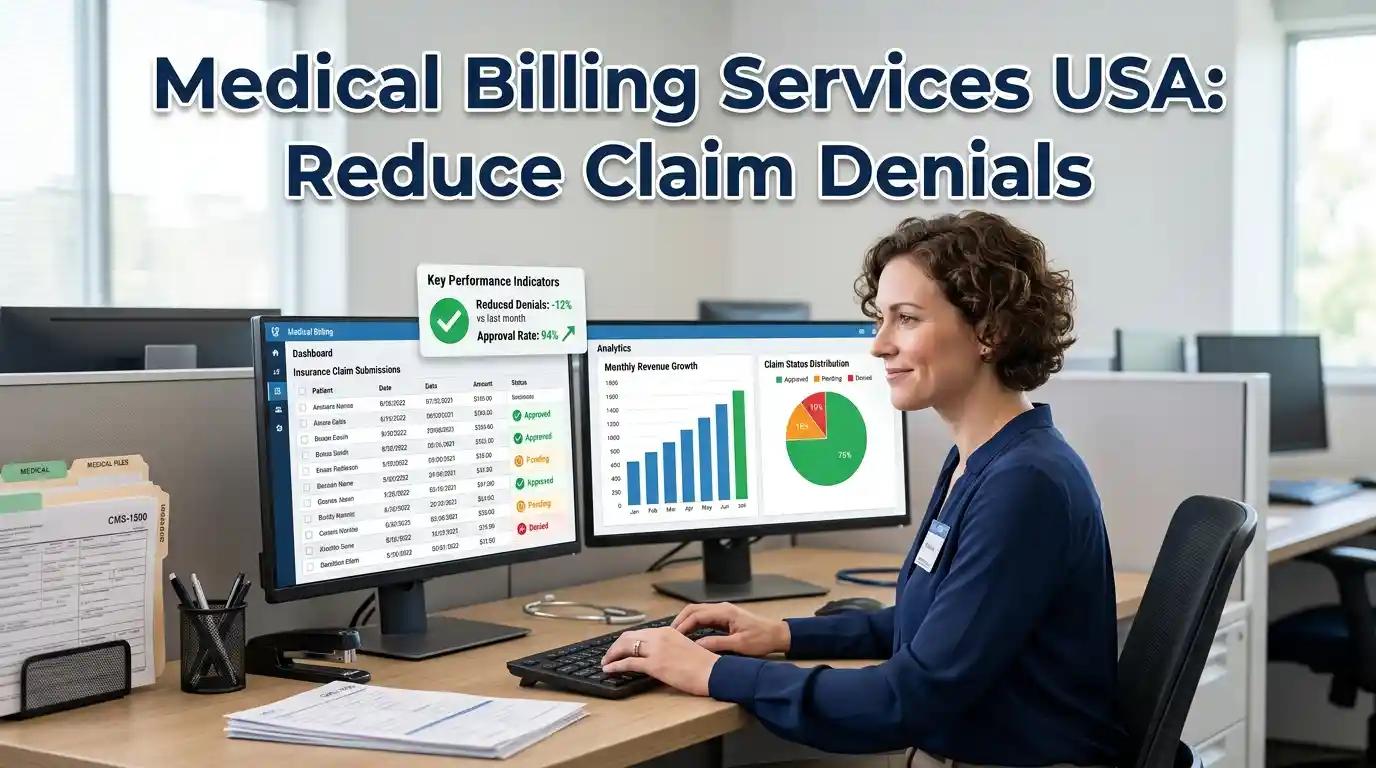
Claim denials are quietly draining revenue from healthcare practices across the United States every single day. A physician sees patients, delivers care, submits claims — and then waits. Too often, what comes back isn't payment. It's a denial. Or a rejection. Or silence that eventually becomes a write-off.
The financial impact is staggering. Studies consistently show that between 5% and 10% of all medical claims submitted in the USA are initially denied, and a significant portion of those are never reworked or resubmitted — leaving healthcare providers with billions in uncollected revenue annually. For small practices and independent physicians, those losses can threaten the viability of the practice itself.
Professional medical billing services USA exist to solve exactly this problem. By combining billing expertise, coding accuracy, denial management services, and revenue cycle management best practices, a qualified medical billing company USA doesn't just process claims — it systematically reduces denials, accelerates payments, and maximizes the revenue your practice has already earned.
This guide explains how professional medical billing and coding services reduce claim denials, how the process works, and how to choose the right billing partner for your practice. You can also explore Trusinva Tech Solutions' Medical Billing Course for professionals building careers in this high-demand field.
What Is Medical Billing and Revenue Cycle Management?
Medical billing is the process of submitting claims to insurance companies and payers for reimbursement of healthcare services provided to patients. It involves translating clinical documentation into standardized billing codes — primarily CPT codes for procedures and ICD-10 codes for diagnoses — and submitting those claims through electronic clearinghouses or directly to payers.
But medical billing in the USA is far more than data entry. It's a complex, compliance-heavy process that requires deep knowledge of insurance verification, coding accuracy, payer-specific requirements, denial management, AR follow-up, and patient billing — all while maintaining strict HIPAA compliance.
Revenue cycle management (RCM) is the broader framework that encompasses the entire financial lifecycle of a patient encounter — from insurance eligibility verification before the appointment through final payment collection after service delivery. Effective healthcare revenue cycle management USA closes the gap between services rendered and revenue received by minimizing errors, accelerating claim processing, and systematically resolving denials before they become write-offs.
For practices that lack the in-house expertise, time, or staffing to manage this process effectively, outsourced medical billing services USA provide a professional solution that typically improves both collection rates and cash flow — without adding headcount to the practice.
Why Reducing Claim Denials Matters for US Healthcare Providers
Every denied claim costs your practice in two ways: the revenue that isn't collected immediately, and the staff time required to identify, correct, and resubmit the claim. According to the American Medical Association, the average cost to rework a single denied claim is approximately $25. Multiply that across hundreds of monthly denials in a busy practice, and the administrative burden becomes significant.
The most frustrating part is that the majority of denied claims are preventable. Research consistently shows that 60–80% of all claim denials result from avoidable errors — incorrect patient information, missing prior authorizations, coding errors, timely filing violations, or failure to meet payer-specific documentation requirements. These are process failures, not clinical ones. And they're exactly what a professional medical billing company USA is equipped to prevent.
For small and independent practices — family medicine, internal medicine, mental health, physical therapy, chiropractic — the impact of claim denials is disproportionately severe. Without a dedicated billing department, denied claims often go unworked simply because no one has the time or expertise to navigate the appeals process effectively.
Outsourcing medical billing services to a specialist company with proven denial management services doesn't just improve cash flow. It gives practice owners their time back, reduces compliance risk, and creates a more predictable, sustainable revenue stream.
Key Benefits of Professional Medical Billing Services for US Practices

Working with a HIPAA compliant medical billing services provider delivers measurable improvements across your revenue cycle:
- Higher clean claim rate — Professional billers submit claims that are correct the first time. A clean claim rate of 95%+ is achievable with expert coding and documentation review — dramatically reducing denial volume before it starts.
- Faster payment cycles — Electronic claims submission through established clearinghouses and payer relationships accelerates payment timelines — improving your practice's cash flow predictability.
- Expert denial management — When denials do occur, professional denial management services track, analyze, and appeal them systematically — recovering revenue that in-house teams often write off.
- Reduced compliance risk — HIPAA compliance requirements and payer-specific documentation standards are constantly evolving. Professional billing companies stay current — protecting your practice from billing audits and penalties.
- Improved AR follow-up — Aging accounts receivable is one of the most consistent revenue leaks in medical practices. Professional AR follow-up in billing pursues outstanding claims proactively — reducing write-offs and days in AR.
- Detailed billing analytics — Regular reporting on claim acceptance rates, denial patterns, collection performance, and revenue trends gives practice owners the data they need to make informed operational decisions.
- Scalability without overhead — As your practice grows, outsourced medical billing services scale with you — without the cost and complexity of hiring, training, and managing additional billing staff.
- More time for patient care — Every hour a physician or office manager spends on billing administration is an hour not spent on patients. Professional billing partners handle the revenue side so your clinical team can focus on care.
How Professional Medical Billing Services Reduce Claim Denials — Step by Step
Understanding how a professional billing company actually operates helps set expectations and demonstrates the systematic value of the service.
Step 1: Insurance Verification and Eligibility Checks
The denial prevention process begins before the patient ever arrives for their appointment. Professional medical billing services verify insurance eligibility and benefits for every scheduled patient — confirming active coverage, understanding copay and deductible obligations, and identifying any prior authorization requirements. Catching eligibility issues before the appointment eliminates one of the most common causes of claim denials at the source.
Step 2: Accurate Medical Coding and Documentation Review
After the appointment, the billing team reviews clinical documentation and assigns the correct CPT codes and ICD-10 codes for all services and diagnoses. Coding accuracy is foundational to claim acceptance — incorrect or mismatched codes are among the leading causes of denials. Professional coders also ensure that documentation supports the level of service billed, protecting the practice from down-coding during audits.
Step 3: Claim Scrubbing and Pre-Submission Review
Before submission, every claim passes through a scrubbing process — automated and human review that checks for missing information, coding errors, format issues, and payer-specific requirements. Clean claim submission dramatically reduces the front-end denial rate and keeps your revenue cycle moving efficiently.
Step 4: Electronic Claims Submission via Clearinghouse
Claims are submitted electronically through established medical billing clearinghouses — which serve as quality checkpoints between practices and payers. Real-time acknowledgment of claim receipt and early error detection ensures problems are caught and corrected quickly rather than discovered 30 days later during follow-up.
Step 5: Payment Posting and EOB Reconciliation
When payments arrive — from insurance payers or patients — they're posted accurately against the correct claims. EOB (Explanation of Benefits) reconciliation confirms that payment matches the expected reimbursement, identifies underpayments or contractual adjustments, and flags discrepancies for follow-up.
Step 6: Denial Management and Appeals
Denied claims are immediately identified, categorized by denial reason code, and entered into the denial management workflow. Experienced billing specialists understand payer-specific appeal processes, documentation requirements, and filing deadlines — and pursue appeals systematically rather than accepting denials as final. This denial management service recovers revenue that most practices would otherwise lose entirely.
Step 7: AR Follow-Up and Aging Report Management
Outstanding claims are tracked through regular AR follow-up in billing — proactive outreach to payers on aging claims, status updates, and escalation of unresolved balances. Practices with professional billing partners consistently achieve lower days in AR and higher collection rates than those managing billing in-house with limited dedicated resources.
Step 8: Patient Billing and Collections
After insurance adjudication, any remaining patient balance is billed clearly and professionally — with multiple payment options and a patient-friendly communication approach. Effective patient billing services reduce write-offs on patient-responsibility balances while maintaining the positive patient relationships that are essential for practice growth.
Common Mistakes That Lead to High Claim Denial Rates
These are the billing errors that consistently cost US healthcare practices the most money:
Skipping insurance verification. Submitting claims for patients whose coverage has lapsed or who require prior authorization that wasn't obtained is one of the most preventable denial causes — and one of the most common in practices without systematic eligibility verification workflows.
Using outdated or incorrect billing codes. ICD-10 and CPT code sets are updated annually. Using outdated codes or selecting codes that don't match the documented diagnosis or procedure level results in immediate denials — and potentially audit risk if the pattern continues.
Missing timely filing deadlines. Most payers have strict timely filing windows — typically 90 to 365 days from the date of service. Claims submitted outside these windows are denied with no right of appeal. Practices that don't track and follow up on outstanding claims regularly miss these deadlines routinely.
Inadequate documentation. Billing a level of service that the clinical documentation doesn't support is both a denial risk and a compliance risk. Professional billing companies review documentation quality as part of the coding process — flagging gaps before submission rather than during an audit.
Not appealing denied claims. This is the single most expensive mistake practices make. Research consistently shows that 60%+ of denied claims that are properly appealed are ultimately paid. Practices that simply write off denials without appeal are forfeiting significant revenue they've already earned.
Managing billing with insufficient staff expertise. Medical billing in the USA requires specialized knowledge that general administrative staff rarely have. Under-resourced in-house billing teams consistently underperform professional outsourced billing services on every key metric — clean claim rate, denial rate, days in AR, and net collection rate.
Why Trusinva Tech Solutions Supports US Medical Billing Professionals

Trusinva Tech Solutions supports the US healthcare revenue cycle industry through specialized professional training, digital technology services, and business solutions designed for medical billing professionals and healthcare practices operating in the American market.
Medical Billing Course — Their comprehensive Medical Billing Course is built for professionals who want to build careers in US medical billing and coding — whether working for a billing company, a healthcare practice, or building their own remote medical billing business. The course covers the complete RCM cycle: insurance verification, CPT and ICD-10 coding, claim submission, denial management, AR follow-up, HIPAA compliance, and patient billing workflows. This is one of the most in-demand remote career skills for serving the US healthcare market.
Complementary Professional Courses — Trusinva offers a full portfolio of US-market professional training courses. Their Truck Dispatching Course and USA Taxation Course provide additional high-value career pathways for professionals building remote income serving American businesses. International taxation courses covering UAE, UK, and KSA markets round out the professional development offering. Browse the complete course catalog for all available programs.
Technology Solutions for Medical Billing Companies — For billing companies and RCM service providers looking to build their digital infrastructure, Trusinva's web development team builds professional, conversion-optimized websites. Their CRM development services create custom client management and billing workflow systems. And their custom software development capabilities extend to billing automation tools, patient portal development, and practice management system integrations.
Digital Marketing for Medical Billing Businesses — Medical billing companies looking to attract more healthcare practice clients benefit from Trusinva's SEO services, Google Ads management, social media marketing, and digital marketing services — building online visibility that generates consistent inbound inquiries from practices seeking billing partners.
Mobile App Development — For billing companies developing proprietary practice management apps, patient billing portals, or RCM dashboard tools, their mobile app development services deliver professional, scalable applications built for the healthcare technology environment.
Visit Trusinva Tech Solutions to learn more, view the project portfolio, or contact the team directly for a consultation on training, technology, or digital marketing needs.
Real-World Example: How Outsourced Billing Reduced Denials by 78% for a Family Practice
A family medicine practice in Texas with three physicians was managing billing in-house with two administrative staff members who handled billing alongside scheduling, front desk, and other office responsibilities. Their initial claim denial rate was running at 14% — nearly three times the industry benchmark for well-managed practices. Monthly write-offs from unworked denials and missed timely filing deadlines averaged $18,000.
After transitioning to a professional outsourced medical billing services provider, the impact was measurable within 90 days. Insurance verification workflows eliminated eligibility-related denials entirely. Dedicated coders with certified credentials improved coding accuracy — reducing coding-related denials by 60%. Systematic denial management services reworked and appealed all outstanding denied claims — recovering $54,000 in previously written-off revenue in the first quarter alone.
By month six, the practice's clean claim rate had improved from 86% to 97%. Monthly denial rate dropped from 14% to 3.1%. Days in AR fell from 52 to 31. And the two administrative staff members who had been managing billing were redeployed to patient experience and scheduling — improving both office efficiency and patient satisfaction.
The practice's annual net revenue increased by over $210,000 — from the same patient volume — simply by improving billing accuracy, denial management, and AR follow-up through professional outsourcing.
Frequently Asked Questions
Why are my medical claims getting denied? The most common causes of medical claim denials in the USA are: incorrect or missing patient information, coding errors or code mismatches, missing prior authorizations, timely filing violations, and inadequate clinical documentation. Most denials — 60 to 80% — are preventable with proper billing processes and expert coding.
How can I reduce claim denials in medical billing? Reducing claim denials requires a systematic approach: verify insurance eligibility before every appointment, ensure accurate CPT and ICD-10 coding, submit clean claims through a clearinghouse, track denials by reason code, appeal all denials within payer-specified windows, and monitor AR regularly. A professional medical billing company executes all of these systematically.
What is a clean claim in medical billing? A clean claim is a claim that is submitted with all required information, correct codes, appropriate documentation, and meets all payer-specific requirements — allowing it to be processed and paid without additional information requests, corrections, or manual review. A high clean claim rate is the primary driver of a healthy revenue cycle.
Should I outsource medical billing services for my practice? For most small and independent practices, outsourcing medical billing delivers better financial outcomes than managing it in-house — higher collection rates, lower denial rates, fewer write-offs, and reduced administrative burden. The cost of a professional billing service is typically offset many times over by improved revenue recovery.
How long does medical billing take in the USA? Clean claims submitted electronically are typically processed within 7–14 days by most major payers. Paper claims take longer — 30+ days. Denied and appealed claims add additional time. Professional billing companies reduce processing time by submitting clean claims electronically and following up proactively on outstanding balances.
What percentage of medical claims get denied in the USA? Industry benchmarks show that 5–10% of initial claims are denied nationally. High-performing practices managed by professional billing companies achieve denial rates of 2–4%. Practices managing billing in-house without dedicated expertise often see denial rates of 10–20% or higher.
Conclusion: Stop Losing Revenue to Preventable Claim Denials
Every denied claim is revenue your practice has already earned — revenue that belongs to you, revenue you delivered through genuine patient care. The medical billing process exists to collect it. When that process fails — through coding errors, missed verifications, unworked denials, and poor AR follow-up — practices pay the price in lost cash flow and preventable write-offs.
Professional medical billing services USA exist specifically to close this gap. By combining coding expertise, systematic denial management, proactive AR follow-up, and HIPAA compliant processes, a qualified RCM partner transforms your revenue cycle from a source of frustration into a reliable, optimized engine for financial performance.
Whether you're a physician looking to reduce denials and improve cash flow, an administrator evaluating outsourced medical billing services, or a professional building a career in medical billing and coding — the resources, training, and technology to succeed are available right now.
Contact Trusinva Tech Solutions today to explore professional Medical Billing training, digital solutions for billing companies, and the full suite of technology and marketing services designed to help US healthcare businesses grow efficiently and profitably.
Ready to build a career in medical billing or grow your billing business? Explore our Medical Billing Course and start building the skills that US healthcare practices need — and pay for — right now.