Quick Answer
Truck dispatch software is better than manual dispatch for almost every carrier running more than two or three trucks. Software wins on speed, accuracy, load visibility, driver communication and FMCSA record-keeping, and typically pays for itself within one to three months. Manual dispatch only remains sensible for single-truck owner-operators, very short-term operations, or fleets running one dedicated lane with fixed customers.
Introduction
Every American motor carrier eventually hits the same wall. The whiteboard stops making sense, the dispatcher is on three phone calls at once, a driver is sitting at a shipper with no rate confirmation, and nobody can say with confidence where truck number seven will be tomorrow morning. That is the moment carriers start searching for truck dispatch software vs manual dispatch — not out of curiosity, but because something is clearly broken. At Trusinva Tech Solutions, we work on both sides of this problem: we train dispatchers through our practical truck dispatching course, and we build the software layer that fleets run on through our custom software and web development services. That dual view is why this comparison avoids the usual vendor sales pitch.
Book a Seat — Talk to Our Team
This article breaks down exactly how each dispatch model works, what each one costs, where each one fails, and how to decide which is right for your operation today — not for a hypothetical fleet three years from now. We will cover workflow mechanics, real pricing, compliance exposure under Federal Motor Carrier Safety Administration (FMCSA) rules, a decision matrix by fleet size, a migration plan, and the mistakes that cause software rollouts to collapse in month two.
Key Takeaways
- Manual dispatch is not "free." Its real cost is dispatcher hours, missed loads, deadhead miles, detention that never gets billed, and paperwork errors that delay payment.
- The tipping point is usually 3–5 trucks. Below that, a disciplined dispatcher with a good spreadsheet can cope. Above it, manual coordination starts leaking money every single week.
- Typical US pricing in 2026 runs from about $20–$60 per truck per month for lightweight dispatch tools, and roughly $100–$250 per truck per month for full transportation management systems (TMS) with accounting, EDI and analytics.
- Compliance is the strongest argument for software. ELD data, hours-of-service records, driver qualification files and electronic DVIRs are far easier to defend in an audit when they live in one system.
- Software does not replace dispatcher judgement. It removes the clerical work so a dispatcher can spend time on rate negotiation, lane strategy and driver retention.
- The worst outcome is half-migration — buying software and still running the "real" schedule in a notebook. That gives you both the cost and the chaos.
- Choose by workflow, not by feature list. The right question is not "which software has more features," but "which system matches how my freight actually moves."
What Is Truck Dispatch Software?
Truck dispatch software is a digital platform that centralises load assignment, driver scheduling, route planning, document handling and communication in one system, so a dispatcher can manage more trucks in less time with fewer errors. It replaces scattered spreadsheets, sticky notes, text threads and paper rate confirmations with a single operational record that every stakeholder can see in real time.
In practice, dispatch software sits at the centre of a carrier's daily operations. A load enters the system — from a load board, an EDI feed from a shipper, a broker email or manual entry. The software matches it against available drivers based on hours-of-service capacity, current location, equipment type and home-time preferences. Once assigned, the driver receives the load on a mobile app, the customer gets tracking visibility, documents such as the bill of lading and proof of delivery are captured by photo, and the load flows straight into invoicing.
There is a naming distinction worth understanding. "Dispatch management software" usually refers to the operational core — load assignment, driver scheduling and tracking. A "transportation management system" (TMS) is broader, adding accounting, settlements, IFTA reporting, maintenance and analytics. Many small carriers start with dispatch-only tools and graduate to a full TMS. If you are evaluating whether an off-the-shelf tool or a purpose-built platform suits you better, our guide to custom software development explains where each approach pays off.
What Is Manual Dispatch?
Manual dispatch is the practice of coordinating loads, drivers and paperwork using human effort and non-integrated tools — phone calls, text messages, email, whiteboards, printed rate confirmations and spreadsheets — without a central system that automatically links load, driver, document and invoice. It is still the most common method among owner-operators and very small fleets in the United States.
Manual dispatch is not primitive. A skilled dispatcher running a whiteboard can outperform a badly configured software system, because they hold context that no database captures: which shipper always runs three hours late, which driver refuses New York City, which broker pays in fifteen days. The weakness of manual dispatch is not intelligence — it is scale, memory and evidence. Human working memory does not expand when you add trucks, and a phone call leaves no audit trail.
The failure mode is predictable. Manual dispatch works beautifully at two trucks, strains at five, and becomes genuinely dangerous at ten — dangerous in the specific sense that hours-of-service miscalculations, missed appointment windows and unbilled accessorials start costing more than any software subscription. Carriers who outsource this function instead of automating it often see similar gains, which we break down in how truck dispatching services save US carriers money.
Truck Dispatch Software vs Manual Dispatch: Side-by-Side Comparison
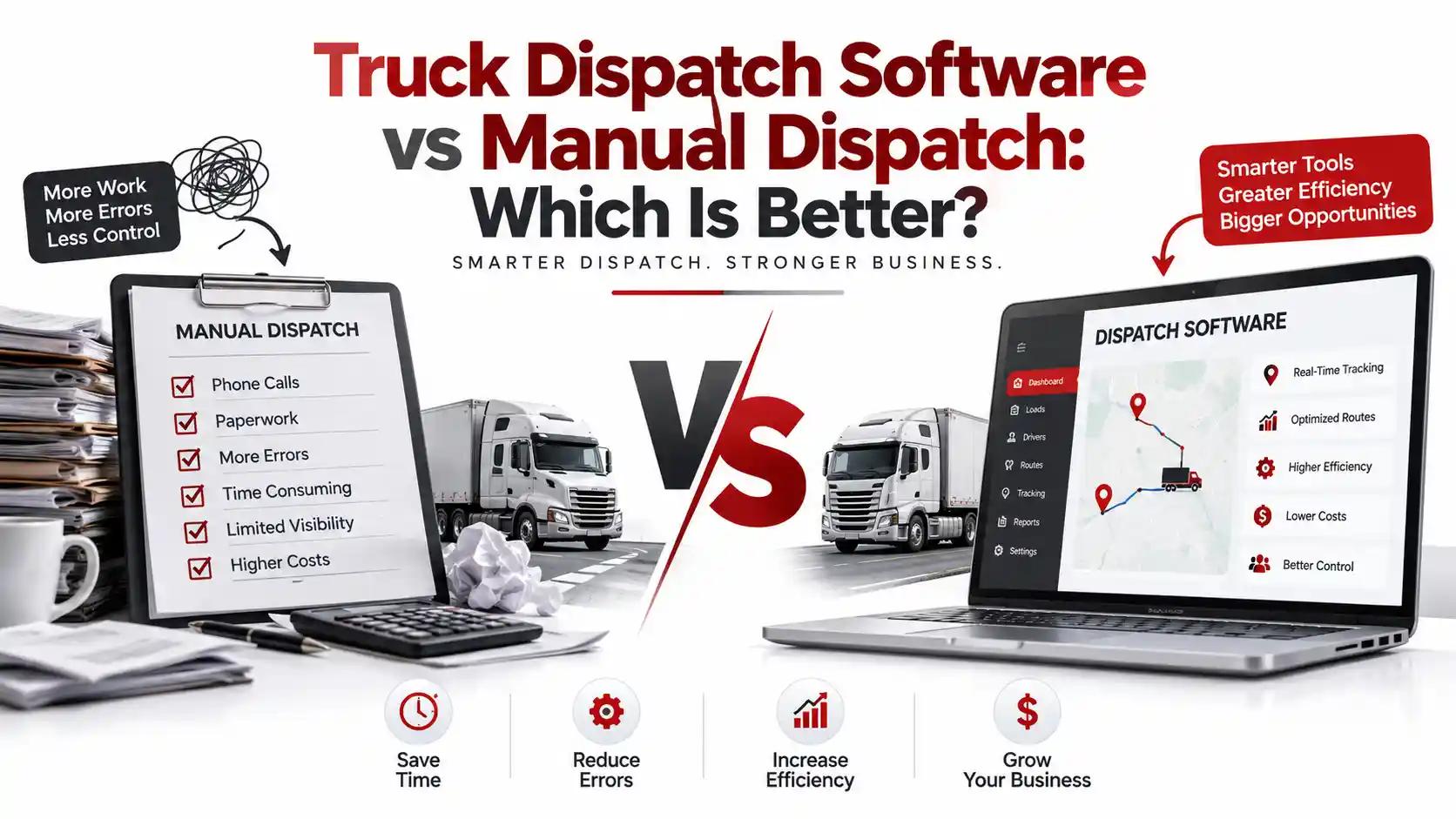
Software wins decisively on speed, visibility, accuracy and compliance; manual dispatch retains an edge only in upfront cost, zero learning curve and total flexibility. The table below reflects what carriers actually report after switching, not vendor marketing claims.
| Factor | Truck Dispatch Software | Manual Dispatch |
| Load assignment time | Seconds — driver availability and HOS capacity surfaced automatically | Minutes to hours — requires calls, memory and cross-checking |
| Real-time load tracking | GPS/telematics integrated; customer-facing tracking links | Driver check-in calls; visibility gaps between calls |
| HOS visibility | ELD data synced into dispatch view before assignment | Dispatcher estimates or asks the driver |
| Document handling | Photo capture of BOL/POD, stored against the load | Paper, scanning, email attachments, lost documents |
| Invoicing speed | Load-to-invoice in the same system; faster cash cycle | Manual re-entry; days of delay; frequent errors |
| Detention & accessorial capture | Timestamped arrival/departure creates billable evidence | Often unbilled because proof is missing |
| Scalability | Adding trucks adds little dispatcher workload | Each new truck adds direct dispatcher hours |
| Error rate | Low; validation rules catch duplicates and conflicts | Rises sharply with volume and fatigue |
| Audit readiness | Records centralised and timestamped | Records scattered across formats and people |
| Upfront cost | Subscription plus setup and training time | Effectively zero |
| Learning curve | Two to six weeks to full fluency | None |
| Flexibility for odd freight | Depends on configurability | Total — a human can improvise anything |
| Dependence on connectivity | Requires internet and working devices | Works with a phone signal alone |
Verdict in one line: manual dispatch minimises visible cost; software minimises total cost. Carriers planning growth should read our complete guide to starting a truck dispatching business in 2026 alongside this comparison, because the systems decision and the business-model decision are linked.
How Manual Dispatch Actually Works (A Real Day)
A manual dispatch day is a sequence of interruptions held together by memory. Understanding the actual rhythm explains why the model breaks at scale far better than any abstract argument.
The dispatcher opens load boards at around 6:00 a.m., scanning for freight on lanes where trucks will empty that day. They call brokers, negotiate rates verbally, and receive rate confirmations by email. Each confirmation is printed or forwarded to the driver. The dispatcher then calls each driver individually to confirm they can legally cover the run, mentally calculating the 11-hour driving limit and 14-hour on-duty window.
Through the day, information arrives in fragments: a text that a driver has been at the receiver for four hours, a call from a shipper about a rescheduled pickup, a photo of a damaged pallet. None of it is linked to anything. At day's end, the dispatcher updates a spreadsheet from memory, and paperwork for billing is assembled — or, more often, partially assembled.
The hidden costs live in the gaps. Detention goes unbilled because nobody logged the arrival time. A truck deadheads 180 miles because the dispatcher did not know a load was posted 30 miles from the delivery point. An appointment is missed because the shipper's revised time was mentioned in a call and never written down. Those leaks rarely appear in any report — which is exactly why they persist. Owner-operators feel these leaks most acutely, as we explain in the benefits of owner-operator dispatch services.
How Truck Dispatch Software Works (The Automated Workflow)
Dispatch software converts that fragmented day into a linear, auditable workflow where each step feeds the next automatically. Here is the sequence in a well-configured system.
- Load intake. Freight arrives via load board integration, EDI from a contract shipper, an emailed rate confirmation parsed automatically, or manual entry. The load is created once and never re-typed.
- Capacity matching. The system filters available drivers by current location, equipment, remaining hours-of-service, home-time window and customer restrictions, then ranks options by profitability including deadhead miles.
- Assignment and dispatch. The dispatcher confirms; the driver receives the full load packet — addresses, appointment windows, reference numbers, special instructions — on a mobile app.
- Execution and tracking. GPS and telematics feed live position. Geofences timestamp arrival and departure at each stop, which is what makes detention billable.
- Document capture. The driver photographs the signed bill of lading and proof of delivery. Documents attach to the load record instantly.
- Settlement. The completed load flows to invoicing and driver settlement without re-keying, shortening days-sales-outstanding.
- Reporting. Revenue per mile, deadhead percentage, on-time performance and driver utilisation update automatically.
The critical insight is that the software's value comes from the links between steps, not from any single feature. A carrier that uses the software for step 3 only will see almost no benefit. This is the same integration logic that governs any operational platform, which is why fleets often pair dispatch tools with a CRM development solution for the customer and broker relationship side.
Core Features of Modern Truck Dispatch Software
The features that matter are the ones that remove a repeated manual action. Everything else is a demo highlight. Evaluate against this list.
Operational core
- Automated load assignment with driver availability and HOS awareness
- Real-time load tracking with customer-facing visibility links
- Route optimisation and multi-stop sequencing
- Driver scheduling with home-time and preference management
- Load board integration and freight matching
- Deadhead and empty-mile reporting
Communication and documents
- In-app driver messaging with a permanent record
- Electronic rate confirmation, bill of lading and proof of delivery capture
- Automated appointment and status notifications to shippers and brokers
Compliance and safety
- ELD and telematics integration for hours-of-service data
- Driver qualification file storage and expiry alerts
- Electronic DVIR support
- Inspection and violation tracking
Financial
- Load-to-invoice automation and factoring integration
- Driver settlement and pay calculation
- IFTA fuel tax reporting
- Accessorial and detention billing from timestamped events
Platform
- Mobile applications for drivers (iOS and Android)
- API integration for accounting, maintenance and load boards
- Role-based permissions and audit logs
- Cloud hosting with reliable uptime
If your operation needs a driver-facing app tailored to your workflow rather than a generic one, that is a build decision, not a buy decision — our mobile app development services page covers how carriers scope that work.
Benefits of Truck Dispatch Software
The measurable benefits cluster into five areas: time, money, visibility, compliance and retention.
Time. The single largest gain is dispatcher capacity. A dispatcher managing eight trucks manually often manages 20–30 with good software, because the clerical layer — re-typing addresses, chasing paperwork, calling for locations — largely disappears.
Money. Revenue improves through better load selection and reduced deadhead miles. Cash flow improves because invoices go out same-day with documents attached rather than three days later. Detention and accessorial charges become collectable because timestamps exist.
Visibility. Shippers and brokers increasingly expect tracking. Carriers who can provide it win repeat contract freight over carriers who cannot — a competitive factor that did not exist a decade ago.
Compliance. Centralised records make an FMCSA audit a retrieval exercise rather than an archaeology project.
Driver retention. This one is underrated. Drivers leave carriers where dispatch is chaotic — where they sit uninformed, get assignments late, or fight for correct pay. Clean dispatch is a retention tool.
Scalability. Growth stops being an operational crisis. Adding your eleventh truck costs almost nothing in dispatcher workload.
Automation gains of this kind are not unique to trucking; they follow the same pattern across industries, which we cover in AI automation services in the USA.
Disadvantages and Honest Limitations of Dispatch Software
Software is not a universal fix, and pretending otherwise is how carriers end up with expensive shelfware. These are the genuine drawbacks.
Recurring cost. A ten-truck fleet on a mid-tier platform pays a real monthly bill, every month, regardless of freight market conditions. In a soft market that fixed cost bites.
Implementation effort. Data migration, integration setup and configuration consume management attention for two to eight weeks. Somebody must own it.
Driver adoption resistance. Experienced drivers who have used paper for twenty years may resist app-based workflows. Adoption fails without training and, often, without incentives.
Over-configuration. Many platforms offer far more than a small carrier needs. Complexity that is not used still costs time to navigate.
Rigidity for unusual freight. Oversize, permitted, multi-stop white-glove or heavily customer-specific freight sometimes does not fit a standard load model. Workarounds accumulate.
Vendor dependency. Your operational history lives in someone else's system. Check data export rights and contract exit terms before signing.
Connectivity dependence. Rural coverage gaps still exist. Offline capability in the driver app is not optional.
Budgeting realistically for build-or-buy matters here; our breakdown of software development cost sets out what shapes the number.
When Manual Dispatch Still Makes Sense
Manual dispatch remains the rational choice in four specific situations. Being honest about this is what separates advice from a sales pitch.
- Single-truck owner-operators. One driver, one calendar, one set of hours. A phone, a load board account and a simple spreadsheet genuinely suffice. Software adds cost without removing meaningful work.
- Dedicated single-lane operations. A carrier running the same two trucks between the same shipper and receiver five days a week has almost no dispatch complexity to automate.
- Very early-stage carriers. In the first ninety days, cash preservation matters more than efficiency. Establish freight and cash flow first, then systemaise.
- Highly specialised freight with heavy human negotiation. Certain heavy-haul, permitted and project freight involves so much per-load bespoke coordination that generic software contributes little — though even here, document management and compliance tracking often justify a lightweight tool. Specialised segments such as flatbed carry their own operational patterns, as covered in truck dispatching for flatbed carriers in the USA.
Important caveat: each of these is a temporary state for a growing business. The right posture is "manual for now, with a documented process I can migrate later" — not "manual forever."
Cost Comparison: What Each Model Really Costs
Dispatch software typically costs between $20 and $250 per truck per month depending on tier, while manual dispatch costs dispatcher salary plus invisible operational leakage. The comparison only becomes fair when you count both sides properly.
| Cost element | Truck Dispatch Software | Manual Dispatch |
| Subscription | ~$20–$60/truck/month (dispatch-only tools); ~$100–$250/truck/month (full TMS) | $0 |
| Setup / implementation | One-time fee common on enterprise tiers; often waived on SMB plans | $0 |
| Training | 5–20 hours of staff time | Minimal |
| Dispatcher salary | Fewer dispatchers per truck needed | More dispatchers per truck needed |
| Deadhead miles | Reduced through better load matching | Higher — limited visibility of nearby freight |
| Unbilled detention/accessorials | Largely recovered | Frequently lost |
| Invoice delay | Same-day possible | Commonly 2–5 days |
| Error correction | Low | Ongoing |
| Compliance exposure | Reduced | Elevated |
Pricing reflects typical US market ranges observed in 2026 and varies by vendor, contract length and module selection. Always verify current pricing directly with vendors.
The point most comparisons miss: the fair benchmark is not "subscription cost vs zero." It is "subscription cost vs the cost of the dispatcher hours, lost accessorials, deadhead miles and delayed cash that manual dispatch produces." Framed that way, software usually looks cheap. If a subscription model does not fit your operation, a purpose-built platform is an alternative — see SaaS development services.
truck-dispatch-software-vs-manual-dispatch
ROI Maths: How to Calculate Your Break-Even Point
Use this four-line calculation before you buy anything. It takes ten minutes and prevents both overspending and false economy.
Step 1 — Monthly software cost.
Trucks × per-truck price = monthly subscription.
Example: 10 trucks × $45 = $450 per month.
Step 2 — Dispatcher time recovered.
Estimate hours per week spent on clerical dispatch work (data entry, document chasing, status calls). Multiply by loaded hourly cost, then by 4.33.
Example: 12 hours/week × $22 × 4.33 ≈ $1,143 per month.
Step 3 — Recovered revenue leakage.
Add reduced deadhead miles, newly billable detention, and faster invoicing. Be conservative — use your own last three months of data, not vendor claims.
Example: 2 detention claims/month × $150 + 400 fewer deadhead miles × $0.65 ≈ $560 per month.
Step 4 — Net position.
($1,143 + $560) − $450 = +$1,253 per month, before counting compliance and retention benefits.
Rule of thumb: if your calculation does not show payback within three months, either the platform is wrong for you or your fleet is still small enough that manual dispatch is fine. Both answers are useful.
FMCSA Compliance: Where Manual Dispatch Becomes a Legal Risk
Manual dispatch is not illegal, but it makes compliance harder to prove — and in trucking, unprovable compliance is treated as non-compliance. This is the argument that persuades carriers when cost arguments do not.
Federal hours-of-service rules under 49 CFR Part 395 remain the operational backbone. As of 2026, the core limits are unchanged: property-carrying drivers may drive up to 11 hours within a 14-hour on-duty window after 10 consecutive hours off duty, must take a 30-minute break after 8 cumulative hours of driving, and are bound by 60/70-hour weekly limits with a 34-hour restart. A short-haul exception applies within a 150 air-mile radius. Most interstate drivers must record duty status on a registered Electronic Logging Device.
The dispatch connection is direct. When a dispatcher assigns a load without accurate visibility of a driver's remaining hours, the carrier can be exposed to violations, out-of-service orders at roadside inspection, and CSA score damage. FMCSA research has long identified driver fatigue as a contributing factor in a meaningful share of large-truck crashes, which is precisely why hours-of-service violations attract serious penalties and immediate enforcement action.
Software addresses this structurally. ELD data flows into the dispatch view, so the assignment decision is made with real remaining-hours data rather than a driver's estimate over the phone. Driver qualification files, medical certificate expiries, DVIRs and inspection records sit in one auditable place.
Anyone entering this profession should learn the compliance layer properly before touching a load board — that is a core module in our truck dispatching course, which is built around US federal requirements rather than generic logistics theory.
Book a Seat — Enrol in the Truck Dispatching Course
Regulations change. Always verify current requirements at the FMCSA official website before making compliance decisions.
Which Is Better for Your Fleet Size? (Decision Matrix)
Fleet size is the single most reliable predictor of which model wins. Use this matrix as a starting point, then adjust for freight complexity.
| Operation | Recommended model | Reasoning |
| 1 truck (owner-operator) | Manual, plus a load board app | Coordination overhead is minimal; cash preservation matters more |
| 2–3 trucks | Manual with a structured spreadsheet, or an entry-level tool | Borderline; adopt software early if growth is planned |
| 4–9 trucks | Dispatch software — strongly recommended | This is where manual dispatch starts losing money weekly |
| 10–25 trucks | Dispatch software or light TMS | Dispatcher leverage and compliance evidence become decisive |
| 25–75 trucks | Full TMS with accounting and EDI | Multi-dispatcher coordination requires a shared source of truth |
| 75+ trucks | Enterprise TMS with API integrations and analytics | Optimisation and data-driven lane strategy drive margin |
| Freight broker / dispatch service | Software from day one | You are managing other people's assets; visibility is the product |
Complexity adjustments: move one tier toward software if you run multi-stop freight, more than three trailer types, temperature-controlled loads, or more than 15 active customers. Move one tier toward manual if you run a single dedicated lane with fixed appointments.
Aspiring dispatchers weighing this career should also review realistic earnings in our truck dispatcher salary guide for 2026.
Step-by-Step Guide: Migrating from Manual Dispatch to Software
A migration succeeds or fails on sequencing. Follow these eight steps in order; skipping step 1 is the most common cause of failure.
Step 1 — Document your current process (Week 1).
Write down exactly how a load moves today, from first contact to payment received. You cannot configure software to match a process you have never written down.
Step 2 — Define non-negotiables (Week 1).
List the five things the software absolutely must do. Ignore everything else during evaluation.
Step 3 — Shortlist three vendors, no more (Week 2).
Evaluating eight platforms produces paralysis. Book live demos using your own real loads, not the vendor's demo data.
Step 4 — Verify integrations before signing (Week 2–3).
Confirm compatibility with your ELD provider, accounting software, factoring company and primary load boards. Ask for the integration to be demonstrated, not described.
Step 5 — Clean your data (Week 3).
Standarise customer names, addresses and driver records before import. Migrating messy data produces a messy system.
Step 6 — Run a parallel pilot with 2–3 trucks (Week 4–5).
Run those trucks in both systems simultaneously. Painful for two weeks, and it surfaces every configuration gap before it affects the whole fleet.
Step 7 — Train drivers properly (Week 5).
A 20-minute app walkthrough plus a one-page reference card. Explain what improves for them — faster settlement, fewer calls, clearer instructions.
Step 8 — Cut over fully and retire the old system (Week 6).
Set a hard date. Delete the whiteboard. Running both systems permanently guarantees the worst of both.
Step 9 — Review at 30, 60 and 90 days.
Measure deadhead percentage, invoice cycle time and loads per dispatcher against your pre-migration baseline.
Requirements and Eligibility: What You Need Before You Start
You do not need enterprise infrastructure — you need four things.
- Operating authority and compliance basics. An active USDOT number and MC authority, current insurance, and driver qualification files in order.
- ELD in place. Dispatch software delivers most of its value when it can read hours-of-service data. Confirm your ELD remains on FMCSA's registered list, since registrations can be revoked.
- Smartphones for drivers. Either company-issued or a documented BYOD policy with a data allowance.
- One accountable owner. A named person responsible for the rollout. "Everyone" means no one.
Eligibility is not a barrier. There is no minimum fleet size, licence class or certification required to buy dispatch software — most vendors serve single-truck operators through to thousand-truck carriers. The real gate is process discipline. If your current manual process is undocumented and improvised, fix that first; software amplifies whatever process you feed it. A structured truck dispatching course in the USA is the fastest way to build that discipline.
Real-World Examples and Scenarios
Three scenarios that show where the line actually falls.
Scenario A — The six-truck regional dry van carrier.
The owner dispatches personally while also handling sales and safety. Loads are booked on load boards, confirmations sit in an inbox, invoicing happens on Sundays. The visible problem is "too busy." The actual problem is that three of six trucks average over 90 deadhead miles per load because no one has time to search freight near delivery points. Outcome: software wins clearly. Deadhead reduction alone exceeds the subscription cost.
Scenario B — The two-truck dedicated hauler.
Two trucks run the same lane between a manufacturer and a distribution centre, five days a week, fixed appointments, monthly invoicing under contract. Outcome: manual dispatch is fine. Software would automate almost nothing. A shared calendar and a document folder suffice.
Scenario C — The dispatch service managing 40 owner-operator trucks.
The dispatch service does not own trucks; visibility is its product. Clients expect status updates, documented detention claims and clean settlements. Outcome: software is mandatory. Manual dispatch here is not inefficiency — it is a credibility failure with paying clients.
Pattern to extract: software value scales with variability, not just truck count. A fleet of fifteen trucks on identical dedicated runs may need less automation than a fleet of five running spot freight across twenty states. You can see how we approach similar operational builds in our projects and case studies.
Industry Statistics and Operational Benchmarks
Use benchmarks to diagnose, not to boast. These are the metrics that reveal whether your dispatch model is working.
| Metric | What to measure | Healthy direction |
| Deadhead percentage | Empty miles ÷ total miles | Lower; sustained improvement after software adoption is the clearest ROI signal |
| Loads per dispatcher | Active loads managed per dispatcher per week | Should rise materially post-migration |
| Invoice cycle time | Delivery date to invoice sent | Target same-day or next-day |
| Detention capture rate | Billed detention ÷ eligible detention events | Should approach 100% once geofencing is live |
| On-time pickup/delivery | Percentage within appointment window | Drives contract freight eligibility |
| Driver turnover | Annual driver departures ÷ average headcount | Chaotic dispatch inflates this figure |
| HOS violations per 100 inspections | From your CSA data | Should trend toward zero with integrated ELD data |
Context worth knowing: the ELD mandate reached full enforcement in December 2019, which means the entire US interstate fleet now generates structured duty-status data. Carriers still dispatching from a whiteboard are, in effect, ignoring data they are already legally required to collect. That gap — data collected but not used — is the clearest argument for software in 2026.
Set your own baseline before migrating. Without a before-figure, you cannot prove an after-figure. For carriers thinking about the broader digital picture, our guide to AI for small businesses covers how operational data becomes a competitive asset.
Common Mistakes Carriers Make
Most failed software rollouts fail for the same seven reasons.
- Buying features instead of workflow fit. The platform with the longest feature list is rarely the one that matches how your freight moves.
- Skipping the parallel pilot. Cutting the whole fleet over on day one turns every configuration gap into a customer-facing failure.
- Migrating dirty data. Duplicate customers and inconsistent addresses corrupt reporting from the first week.
- Ignoring driver adoption. If drivers do not use the app, dispatchers re-enter everything manually and you have paid for nothing.
- Running both systems indefinitely. The whiteboard becomes the "real" schedule, the software becomes a data-entry chore, and the project quietly dies.
- Not verifying ELD and accounting integrations before signing. Discovering incompatibility in month two is expensive and demoralising.
- Choosing on price alone. The cheapest tool that does not integrate costs more than the mid-priced tool that does.
One more, specific to manual holdouts: believing manual dispatch is free. It is not free — it is unbilled. The cost sits in dispatcher overtime, lost detention and empty miles, none of which appear on an invoice you can see.
Expert Tips and Best Practices
These are the recommendations we give carriers most often — including the ones that argue against buying.
- Set your baseline first. Record deadhead percentage, invoice cycle time and loads per dispatcher for four weeks before you migrate. Without it, you are guessing about ROI forever.
- Demo with your own worst load. Not your simplest one. Take the multi-stop, rescheduled, partially damaged nightmare load and ask the vendor to run it live.
- Negotiate the contract term. Annual commitments usually buy 15–25% off monthly pricing, but only commit annually after a successful pilot.
- Confirm data export rights in writing. Your operational history is your asset. Make sure you can take it with you.
- Train one internal champion deeply, not everyone shallowly. A single person who knows the system properly rescues every rollout.
- Automate the boring layer first. Document capture and invoicing deliver fast, visible wins that build internal buy-in. Route optimisation can come later.
- Do not automate a broken process. If your rate confirmation workflow is chaotic, fix the process on paper first.
- Review quarterly, not never. Freight mixes change; a configuration set in January may be wrong by July.
- Keep a manual fallback. Outages happen. A one-page emergency dispatch procedure is cheap insurance.
Truck Dispatcher Career Scope and Salary Outlook
Dispatch software has not reduced demand for dispatchers — it has raised the skill floor and the pay ceiling. This matters for anyone entering the field.
The clerical portion of dispatching — typing addresses, chasing paperwork, calling for locations — is being automated. What remains is the higher-value work: rate negotiation, lane strategy, driver relationship management, compliance judgement and exception handling. Employers now advertise for dispatchers who are comfortable inside a TMS, understand hours-of-service maths, and can read a rate-per-mile trend.
Career paths from a dispatch role typically run toward Senior Dispatcher, Operations Manager, Fleet Manager, Freight Broker, or launching an independent dispatch service serving owner-operators. Compensation generally scales with fleet complexity and whether commission on booked freight is included — remote and independent dispatch service models often earn on a percentage-of-load-revenue basis rather than salary.
The practical implication: software literacy is now a hiring requirement, not a bonus. A dispatcher who can only work a whiteboard is competing for a shrinking pool of roles. For a full breakdown of earnings by experience level and model, see our truck dispatcher salary guide, and for entry into the profession, our courses hub lists the full training pathway.
Book a Seat — Start Your Dispatch Career
Latest Updates: 2026 Regulatory and Technology Changes
The 2026 compliance environment strengthens the case for software, because more of what regulators want is electronic. Here is what has changed and what is pending. Verify all of it against primary sources before acting.
- Core hours-of-service limits are unchanged in 2026. The 11-hour driving limit, 14-hour window, 30-minute break and 60/70-hour cycles remain in force. FMCSA has been running pilot programmes exploring greater sleeper-berth flexibility, but these are tests, not current law.
- A hours-of-service reform rulemaking is in progress. Proposals under discussion have included broader split-sleeper options, a wider personal conveyance allowance, an extended adverse-driving exception and a larger short-haul radius. None of these should be treated as effective until finalised in the Federal Register.
- Electronic DVIRs formally recognised. A 2026 final rule confirmed that driver vehicle inspection reports may be created, signed and retained electronically — a direct advantage for carriers already running digital dispatch.
- ELD registration enforcement has tightened. Devices have been removed from FMCSA's registered list during the 2025–2026 enforcement cycle. Carriers should check their device's status periodically, because operating on a revoked ELD can trigger out-of-service consequences.
- Drug and Alcohol Clearinghouse access controls strengthened. Authentication requirements for employers and service agents were tightened in 2026.
- English language proficiency is an out-of-service criterion. Following a 2025 executive order and updated FMCSA enforcement guidance, the Commercial Vehicle Safety Alliance added lack of English language proficiency to its North American Standard Out-of-Service Criteria effective 25 June 2025, under 49 CFR 391.11(b)(2). Rulemaking to codify the standard has continued into 2026.
- Fraud and double-brokering enforcement has intensified, raising the value of documented, auditable load records — something manual dispatch cannot easily produce.
Why this matters for your dispatch decision: each of these changes rewards carriers whose records are electronic, timestamped and centralised. If you are still building your operation, our guide to starting a truck dispatching business in the USA walks through the compliance foundation.
Future Trends in Truck Dispatching
Dispatch is moving from record-keeping to decision support. Four trends will define the next few years.
AI-assisted load selection. Machine learning models are increasingly used to score loads on projected profitability — factoring in deadhead, lane rate history, detention risk at specific facilities and the driver's remaining hours — rather than just rate per mile.
Predictive HOS and appointment planning. Instead of showing hours remaining, systems increasingly forecast whether a driver can realistically make a delivery window given traffic, weather and facility dwell history, and flag the conflict before the load is accepted.
Deeper API and EDI integration. The dispatch platform is becoming a hub connecting load boards, ELDs, accounting, factoring, maintenance and customer portals. Isolated tools are losing ground.
Autonomous and hub-to-hub freight. Autonomous operations are advancing on defined highway corridors. The realistic near-term implication is not that dispatchers disappear, but that dispatch splits into long-haul automated segments and human-managed first and last mile — with conventional carriers finding advantage in freight autonomy cannot handle: multi-stop, oversized, temperature-sensitive and customer-facing work.
Real-time visibility as a contract requirement. Large shippers increasingly make tracking a condition of award. Carriers without it are structurally excluded from the best freight, regardless of service quality.
The direction of travel is clear: dispatch is becoming a data function. See how that plays out across sectors in our overview of AI development for US companies.
People Also Ask
Is dispatch software worth it for a small fleet?
Yes, from roughly four trucks upward. Below that, the subscription rarely pays back. From four trucks, recovered dispatcher time and reduced deadhead miles usually exceed the cost within the first quarter.
Can I dispatch trucks without any software?
Yes. Manual dispatch is fully legal provided you meet hours-of-service, ELD and record-retention requirements. The constraint is practical, not legal — it stops scaling around five to ten trucks.
What is the difference between dispatch software and a TMS?
Dispatch software handles the operational core: load assignment, scheduling and tracking. A transportation management system adds accounting, settlements, IFTA, maintenance and analytics. Many carriers start with the former and upgrade later.
Does dispatch software replace dispatchers?
No. It removes clerical work and shifts dispatchers toward negotiation, planning, driver management and exception handling. Fleets typically manage more trucks per dispatcher rather than eliminating the role.
How long does implementation take?
Four to eight weeks for a small fleet, including data cleanup, a parallel pilot and driver training. Rushing this stage is the most common reason rollouts fail.
Do owner-operators need dispatch software?
Usually not. A single-truck operator is better served by a load board app, an ELD and a simple document system. Priorities change if you add a second truck or start dispatching for others. Explore all our courses for structured training either way.
Which is more accurate — software or an experienced dispatcher?
Software is more accurate on data: hours, timestamps, documents, mileage. An experienced dispatcher is better at judgement: broker reliability, customer relationships, unusual freight. The strongest operations combine both.
Why Choose Trusinva Tech Solutions for Truck Dispatch Training and Software
Because we sit on both sides of this decision — we train the dispatchers who run these systems, and we build the systems themselves. Most articles comparing dispatch software are published by vendors with one answer to sell. We do not have that conflict, which is why this guide tells you plainly when manual dispatch is the better choice.
Our truck dispatching course is built around how US freight actually moves: load board strategy, rate negotiation, hours-of-service maths, detention and accessorial recovery, broker relationships, and hands-on work inside dispatch platforms — not generic logistics theory. Learners finish able to run a live board, not just describe one.
On the technology side, our software and web development services support carriers and dispatch services who have outgrown off-the-shelf tools and need integrations, custom driver apps, or a purpose-built platform that matches their freight model. We approach that work the way we approach everything — scoped to what you actually need, with no features added simply to inflate the build.
You can read more about our team, standards and delivery approach on our about page. Whether your next step is training a dispatcher or building a system, we would rather help you choose correctly than sell you something you do not need.
Book a Seat — Speak With Trusinva Tech Solutions
Frequently Asked Questions
1. What is the main difference between truck dispatch software and manual dispatch?
Truck dispatch software centralises load assignment, tracking, documents and invoicing in one connected system. Manual dispatch coordinates the same work through phone calls, spreadsheets and paperwork with no automatic link between steps, which limits scale and leaves no audit trail.
2. At what fleet size should I switch to dispatch software?
Most US carriers reach the tipping point between four and five trucks. Below three trucks, manual dispatch is usually cheaper. Above five, dispatcher hours and lost revenue from deadhead miles and unbilled detention typically exceed the subscription cost.
3. How much does truck dispatch software cost in 2026?
Entry-level dispatch tools generally run about $20–$60 per truck per month. Full transportation management systems with accounting, EDI and analytics typically range from $100–$250 per truck per month. Confirm current pricing directly with vendors, as plans and modules vary.
4. Is manual dispatch legal under FMCSA rules?
Yes. FMCSA does not mandate dispatch software. However, carriers must still comply with hours-of-service rules under 49 CFR Part 395, use a registered ELD where required, and retain records. Manual methods make proving compliance harder during audits and roadside inspections.
5. Does dispatch software work with my existing ELD?
Most major platforms integrate with widely used ELD providers, but compatibility is never universal. Verify the specific integration during the demo and confirm your ELD remains on FMCSA's registered device list before committing.
6. Will dispatch software reduce my deadhead miles?
Usually yes, because it surfaces available freight near a truck's delivery point and factors empty miles into load profitability. The size of the improvement depends on your lanes and how consistently dispatchers use the tool.
7. How long does it take to learn truck dispatch software?
A dispatcher familiar with freight operations typically reaches basic proficiency within one week and full fluency in two to six weeks. Driver-side app training usually takes under an hour.
8. Can dispatch software help me bill detention and accessorials?
Yes. Geofenced arrival and departure timestamps create the documented evidence needed to support detention claims — evidence that manual dispatch rarely produces, which is why those charges so often go unbilled.
9. Should a new dispatch service start with software from day one?
Yes. If you are dispatching for other carriers, real-time visibility and clean documentation are effectively your product. Starting manually creates a credibility gap with clients and a painful migration later.
10. Can I build custom dispatch software instead of subscribing?
Yes, and it makes sense when your freight model does not fit standard platforms, when you need deep integration with proprietary systems, or when per-truck subscription costs at scale exceed a build. It requires higher upfront investment and ongoing maintenance ownership.
Conclusion
For the overwhelming majority of US carriers, truck dispatch software is better than manual dispatch — but the honest answer depends on where you are today, not where the industry average sits. If you run one truck on a predictable lane, manual dispatch remains rational and software would be an unnecessary cost. From roughly four trucks upward, manual coordination begins losing money every week through dispatcher hours, deadhead miles, unbilled detention and delayed invoicing, and the case for software becomes difficult to argue against.
The deeper point is that this is not really a software decision. It is a process decision. Software amplifies whatever process you feed it. Carriers who document their workflow, clean their data, pilot properly and train their drivers see the returns described in this article. Carriers who buy a subscription and keep the whiteboard get the cost of both models and the benefits of neither.
Our recommendation: run the four-line ROI calculation in Section 11 using your own last three months of data. If payback lands inside three months, start the migration plan in Section 14 this quarter. If it does not, stay manual — but document your process now so the eventual switch takes weeks instead of months. Either way, the regulatory direction is unmistakably electronic, and carriers whose records are already digital will keep finding compliance easier and better freight more accessible.
Your next step: if you want to enter dispatching professionally, or you need a system built around how your fleet actually runs, talk to us.