Quick Answer
No, you don't legally need an LLC to start a truck dispatching business in the USA — you can begin as a sole proprietor with just an EIN and a business bank account. However, an LLC is strongly recommended because it separates your personal assets from business liabilities, builds credibility with carriers and brokers, and makes tax filing cleaner as your dispatching business grows.
Introduction
If you're researching how to launch a freight dispatching career, one question comes up almost immediately: do you need an LLC to start a truck dispatching business? It's a fair question, because business structure affects your taxes, your liability, and how carriers perceive your professionalism from day one. At Trusinva Tech Solutions, we work with aspiring dispatchers every day through our truck dispatching course in USA, and this is consistently one of the first questions students ask before they even book a seat in the program. This guide breaks down exactly what's legally required, what's simply smart business practice, and how to set up your dispatching company the right way — without wasting time or money on things you don't actually need.
Key Takeaways
- An LLC is not legally required to start truck dispatching, but it's the industry-standard structure for a reason.
- Sole proprietorships are the fastest and cheapest way to start, but they offer zero personal liability protection.
- Truck dispatchers do not need FMCSA operating authority, a USDOT number, or an MC number — those apply to motor carriers and freight brokers, not dispatch services.
- You will still need an EIN, a business bank account, a carrier-dispatcher agreement, and often general liability insurance.
- LLC formation typically costs $50–$500 depending on the state, plus optional registered agent fees.
- Proper training through a structured truck dispatching course in USA can shorten your learning curve significantly.
Understanding Truck Dispatching as a Business
A truck dispatcher (also called a freight dispatcher) works on behalf of owner-operators and small trucking companies to find loads, negotiate freight rates, handle paperwork like rate confirmations and bills of lading, and coordinate pickup and delivery schedules. Dispatchers typically operate through load boards such as DAT, Truckstop, and 123Loadboard, and they earn either a flat fee or a percentage-based dispatch commission — usually 5–10% of the load's gross rate.
Unlike motor carriers, dispatchers don't move freight themselves. This distinction matters enormously for the legal and licensing side of the business, which we'll cover in detail below.
Do You Legally Need an LLC to Start a Truck Dispatching Business?
Direct answer: No. There is no federal or state law requiring a truck dispatching business to be registered as an LLC. You can legally operate as a sole proprietor using your own Social Security number instead of an EIN, and many first-time dispatchers do exactly that.
That said, "legally allowed" and "smart business decision" are two different things. Most successful dispatching companies transition to an LLC within their first year for three main reasons:
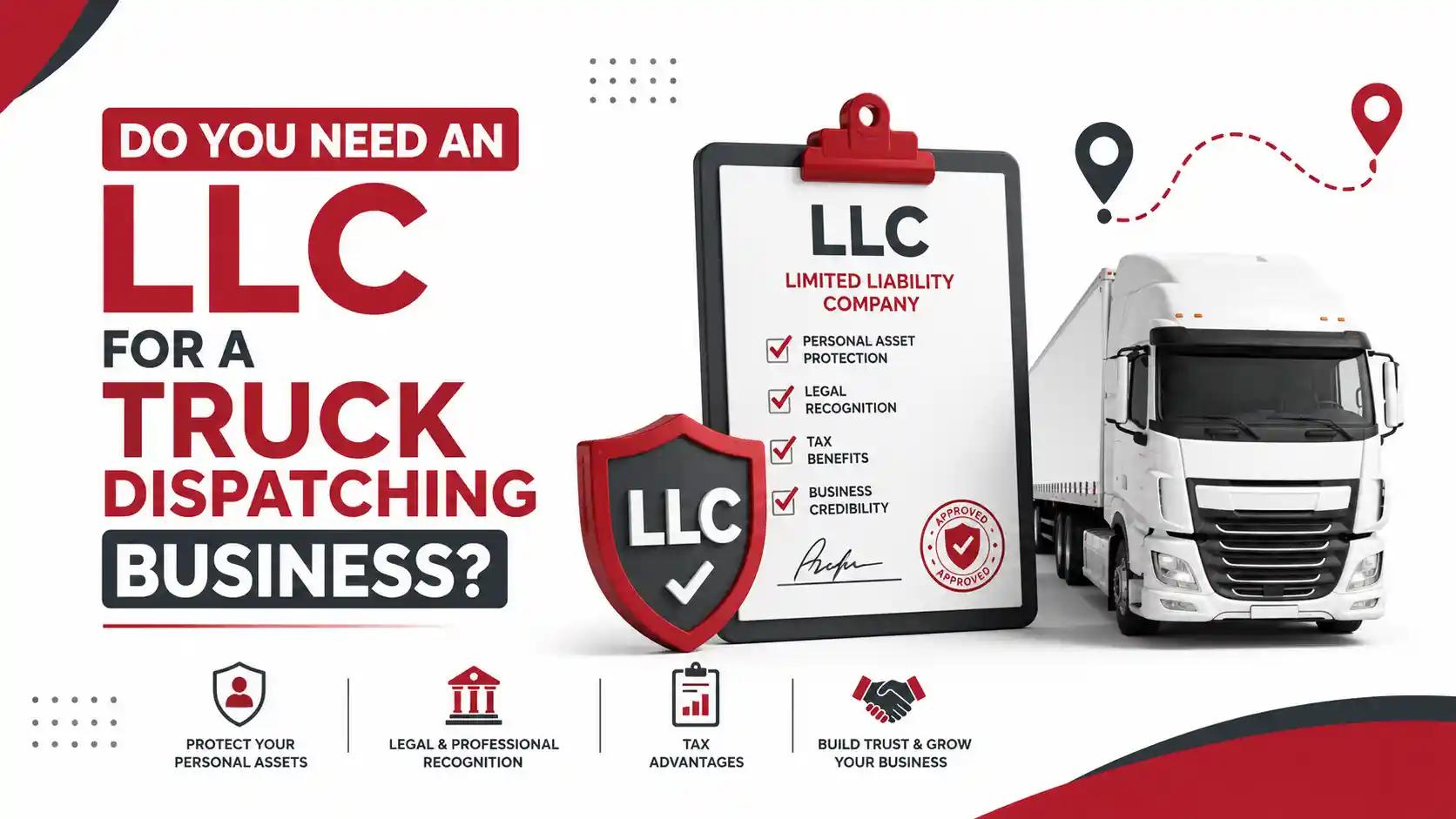
- Liability protection — if a carrier disputes a load, a payment, or a contract term, an LLC shields your personal assets (car, home, savings) from business-related lawsuits.
- Professional credibility — carriers and brokers increasingly prefer working with registered business entities over individuals operating under a personal name.
- Cleaner taxes — an LLC allows you to separate business income and expenses clearly, which simplifies bookkeeping and tax filing.
LLC vs. Sole Proprietorship for Truck Dispatchers
| Factor | Sole Proprietorship | LLC |
| Setup cost | $0–$100 | $50–$500 (state-dependent) |
| Setup time | Immediate | 1–3 weeks typically |
| Personal liability | Unlimited — personal assets at risk | Limited — business assets only in most cases |
| Credibility with carriers/brokers | Lower | Higher |
| Tax filing | Reported on personal tax return (Schedule C) | Flexible — can be taxed as sole prop, partnership, or S Corp |
| Business bank account | Optional but recommended | Effectively required |
| Best for | Testing the business, very low overhead | Anyone planning to scale or sign multiple carrier contracts |
Bottom line: If you're testing the waters with one or two carriers, a sole proprietorship works. If you're serious about building a dispatching company with recurring clients and staff, forming an LLC is the safer long-term move.
What About S Corps and Corporations?
Some established dispatching businesses elect S Corp taxation status once revenue grows past roughly $60,000–$80,000 per year, because it can reduce self-employment tax liability. This isn't a separate business entity — it's a tax election you make on top of an LLC or corporation. Full C-Corporations are rare in this industry because they involve double taxation and more administrative overhead than a small dispatching operation typically needs.
For most people starting out, the practical decision tree is: sole proprietorship → LLC → LLC taxed as S Corp, in that order, as the business grows.
Do You Need an LLC
Step-by-Step: How to Form an LLC for Your Dispatching Business
- Choose your business name and check availability with your state's Secretary of State office.
- File Articles of Organization with your state — this officially creates the LLC.
- Appoint a registered agent to receive legal and tax documents on behalf of your business.
- Draft an operating agreement outlining ownership, responsibilities, and profit distribution (required in some states, best practice everywhere).
- Apply for an EIN through the IRS — this is free and takes minutes online.
- Open a business bank account using your EIN and LLC formation documents.
- Check for local business licenses — some cities and counties require a general business license regardless of entity type.
- Set up bookkeeping (QuickBooks or similar) to track dispatch fees, expenses, and taxes from day one.
Licenses, Registrations, and Compliance Requirements
Beyond the LLC decision, here's what actually governs a truck dispatching business:
- EIN (Employer Identification Number) — issued by the IRS, needed for business banking and tax filing.
- Local business license — required in many cities/counties; check with your local government.
- Business insurance — general liability and, increasingly, professional liability (errors & omissions) coverage.
- Carrier-dispatcher agreements — a signed contract with each carrier client protecting both parties.
Notably absent from this list: FMCSA operating authority. Let's address that directly, since it's the most common point of confusion.
Do Truck Dispatchers Need FMCSA Authority, a USDOT Number, or an MC Number?
Direct answer: No. The Federal Motor Carrier Safety Administration (FMCSA) regulates motor carriers and freight brokers — not dispatchers. Since dispatchers don't physically transport freight or broker loads between shippers and carriers for a fee in the legal sense, they don't need a USDOT number, MC number, or FMCSA operating authority.
This is a critical distinction because some new dispatchers confuse their role with that of a freight broker, who does need broker authority and a surety bond. A dispatcher works exclusively on behalf of the carrier — helping them find and book loads — rather than matching shippers with carriers as an independent intermediary.
Cost Breakdown: LLC Formation for a Dispatching Business
| Item | Estimated Cost |
| State LLC filing fee | $50–$500 |
| Registered agent service (optional) | $100–$300/year |
| Business license (if required locally) | $0–$100 |
| EIN | Free (IRS.gov) |
| Business bank account | Usually free, some require minimum balance |
| General liability insurance | $300–$1,000/year |
| Load board subscriptions (DAT, Truckstop) | $150–$400/month |
Total startup cost for a dispatching business, LLC included, typically ranges from $500 to $2,000, making it one of the more affordable trucking-adjacent businesses to launch.
Insurance Requirements for Truck Dispatchers
While not always legally mandatory, most established dispatching companies carry:
- General liability insurance — protects against basic business risks and claims.
- Professional liability (errors & omissions) insurance — covers claims related to mistakes in load booking, rate negotiation, or paperwork errors that cost a carrier money.
Some carrier clients will explicitly ask for proof of insurance before signing a dispatch agreement, so it's worth budgeting for even if it isn't required by law in your state.
Carrier-Dispatcher Agreements Explained
Every dispatching relationship should be backed by a written carrier-dispatcher agreement covering:
- Dispatch fee structure (flat-rate vs. percentage-based)
- Scope of services (load booking, rate negotiation, paperwork handling)
- Payment terms and timelines
- Termination clauses
- Liability limitations
This document protects you regardless of whether you're operating as a sole proprietor or an LLC, and it's one of the first templates we walk through inside our truck dispatching course in USA — Enroll Now to get access to real-world agreement templates and negotiation scripts.
Common Mistakes New Dispatchers Make
- Skipping the business bank account and mixing personal and business funds, which creates a bookkeeping nightmare at tax time.
- Operating without a signed carrier agreement, leaving no legal protection if a dispute arises.
- Underpricing dispatch fees to win clients, which erodes profitability fast.
- Confusing dispatching with freight brokering and mistakenly pursuing FMCSA broker authority they don't need.
- Delaying LLC formation too long after landing multiple carrier clients, leaving personal assets exposed.
Expert Tips and Best Practices
- Start with a sole proprietorship only if you're testing demand with one carrier; convert to an LLC as soon as you sign a second client.
- Use a dedicated business bank account from day one, even before forming an LLC — it makes the eventual transition seamless.
- Learn load board negotiation and rate confirmation review thoroughly before taking on paying clients; a structured truck dispatching course in USA can compress months of trial-and-error into weeks — Book a Seat today.
- Keep a simple spreadsheet or QuickBooks file tracking every load, fee, and expense from your very first client.
- Review your carrier-dispatcher agreement template with a professional before using it at scale.
Why Choose Trusinva Tech Solutions to Launch Your Truck Dispatching Business
Starting a truck dispatching business involves more than paperwork — it requires real operational knowledge of load boards, rate negotiation, carrier relationships, and back-office systems. At Trusinva Tech Solutions, our truck dispatching course in USA walks you through everything covered in this article — LLC setup guidance, carrier agreement templates, dispatch fee structuring, and hands-on load board training — so you launch with confidence instead of guesswork. Beyond training, our CRM development and digital marketing services help growing dispatching companies manage carrier relationships and win new clients online. If you're also exploring adjacent career paths, check out our USA taxation course or medical billing course to see the full range of career-focused programs we offer. Learn More and take the first step toward your dispatching career today.
FAQs
1. Do I need an LLC to start a truck dispatching business?
No, it's not legally required. You can start as a sole proprietor, but an LLC offers liability protection and is recommended as your business grows.
2. How much does it cost to form an LLC for truck dispatching?
State filing fees typically range from $50 to $500, plus optional registered agent fees of $100–$300 per year.
3. Do truck dispatchers need FMCSA operating authority?
No. FMCSA authority, USDOT numbers, and MC numbers apply to motor carriers and freight brokers, not dispatch services.
4. Can I run a truck dispatching business from home?
Yes. Most dispatchers operate entirely remotely using a computer, phone, and load board subscriptions like DAT or Truckstop.
5. Do I need a business license to start dispatching?
It depends on your city or county. Some local jurisdictions require a general business license regardless of your entity type.
6. What's the difference between a dispatcher and a freight broker?
A dispatcher works exclusively for carriers to help them find and book loads. A freight broker acts as an independent intermediary between shippers and carriers and requires FMCSA broker authority.
7. Should I get an EIN even as a sole proprietor?
Yes, it's recommended. An EIN lets you open a dedicated business bank account and keeps your Social Security number off business paperwork.
8. How long does it take to form an LLC?
Typically 1–3 weeks depending on your state, though some states offer expedited processing for an extra fee.
9. Do dispatchers need insurance?
It's not always legally required, but general liability and professional liability insurance are strongly recommended and often requested by carrier clients.
10. Is truck dispatching a good business to start in 2026?
Yes — with low startup costs, no CDL requirement, and growing demand from independent owner-operators, it remains an accessible entry point into the trucking industry.
Conclusion
So, do you need an LLC to start a truck dispatching business? Legally, no — but practically, it's one of the smartest early investments you can make. An LLC protects your personal assets, builds trust with carrier clients, and sets your business up for smoother growth and taxation down the road. Combine the right business structure with solid industry training, a clear carrier-dispatcher agreement, and consistent bookkeeping, and you'll have a dispatching business built to last. Ready to learn the operational side properly? Book a seat at Trusinva Tech Solutions and start your truck dispatching course in USA today.