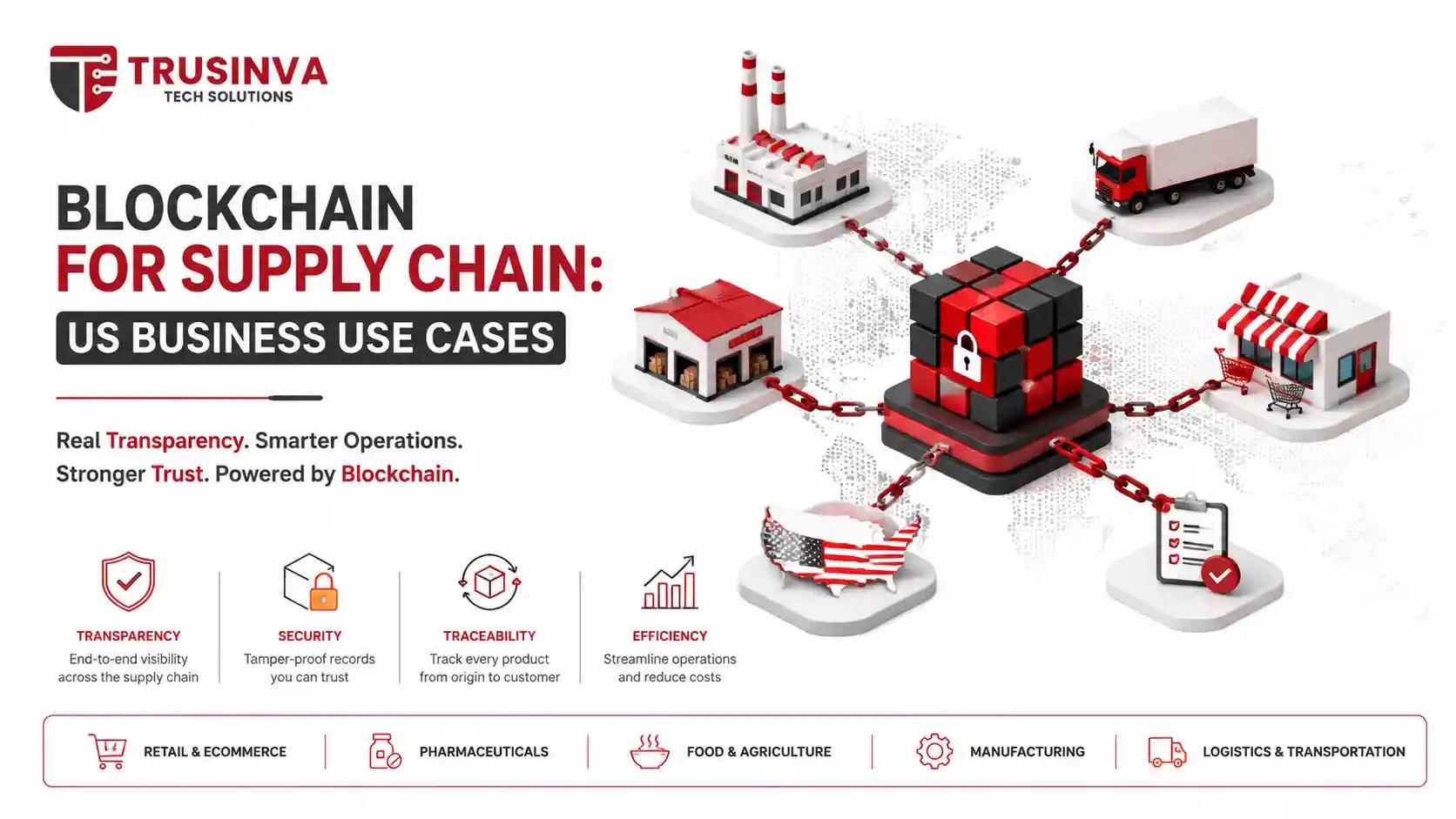
Supply chains in the United States have never been more complicated — or more vulnerable. Between global shortages, counterfeit goods, and customers who now expect to know exactly where their product came from, businesses are looking for a smarter way to manage the flow of goods. That's where blockchain for supply chain comes in.
At Trusinvatechsolutions, we work with US businesses every day that are trying to figure out whether blockchain is worth the investment, or if it's just another buzzword. The short answer: for the right use case, blockchain in supply chain management is one of the most practical applications of the technology outside of crypto. It's not about speculation or trading — it's about trust, transparency, and traceability.
In this guide, we'll walk through what blockchain supply chain technology actually does, how US companies are using it right now, and what it takes to implement it in a way that actually improves your bottom line. We'll also look at real industries — manufacturing, healthcare, retail, logistics, and food — where blockchain-based supply chain platforms are already changing how products move from origin to shelf.
If you're a logistics company, manufacturer, or enterprise leader evaluating blockchain development for supply chain, this article gives you a grounded, no-hype breakdown. And if you decide you're ready to explore blockchain development services for your own supply chain, our team can walk you through it.
What Is Blockchain in Supply Chain Management?
Blockchain for supply chain is a decentralized digital ledger technology that helps businesses track products, verify transactions, and improve transparency across global supply networks. Instead of relying on a single company's internal database, every party in the supply chain — suppliers, manufacturers, shippers, and retailers — shares access to the same secure, tamper-proof record.
Every time a product changes hands, that event gets logged as a transaction on the blockchain. Because the ledger is distributed and immutable, no single party can quietly alter the history of a shipment. This is the foundation of supply chain blockchain technology, and it's why so many enterprises are pairing it with existing ERP and CRM systems.
If you're weighing whether this fits your operations, our team can walk you through options during a blockchain development consultation — it's usually easier to evaluate with a real example from your own supply chain.
How Blockchain Actually Works
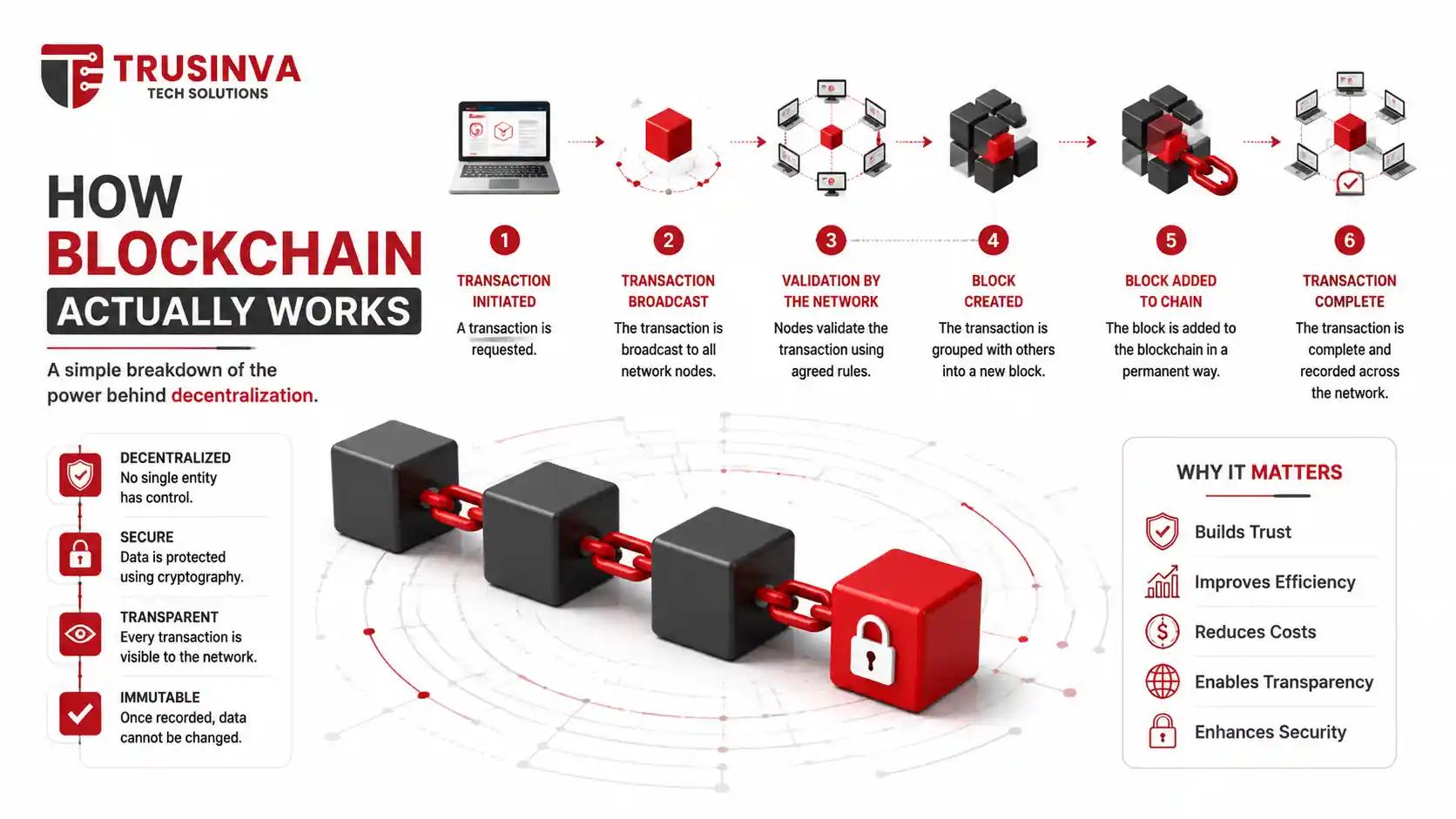
Think of a blockchain as a shared spreadsheet that thousands of computers hold identical copies of. When someone updates a cell, everyone's copy updates too, and the change is permanently recorded with a timestamp. Nobody can secretly edit history because too many copies exist for a change to go unnoticed.
In a supply chain, each "cell" might represent:
- A raw material leaving a supplier's warehouse
- A shipment passing through customs
- A product completing a quality inspection
- A pallet arriving at a distribution center
Every one of these events becomes a permanent, verifiable record — which is exactly why blockchain traceability solutions have become so valuable to industries where proof of origin and handling matters.
Why It Matters for US Businesses Right Now
American companies are under pressure from a few directions at once: consumers want proof of ethical sourcing, regulators want better food and drug traceability, and procurement teams want fewer disputes over "who's responsible" when something goes wrong mid-shipment.
A few forces are driving blockchain adoption in business today:
- Counterfeit prevention — Counterfeit goods cost US businesses billions annually, and blockchain tracking systems make it far harder to introduce fake products into a supply chain because every legitimate item has a verifiable digital trail.
- Regulatory pressure — The FDA's food traceability requirements and pharmaceutical serialization rules are pushing companies toward digital ledger systems that can prove chain-of-custody instantly.
- Consumer demand for transparency — Shoppers increasingly want to scan a QR code and see where their coffee, seafood, or clothing actually came from.
- Operational efficiency — Manual, paper-based tracking is slow and error-prone. Blockchain-based supply chain platforms cut down on disputes, delays, and reconciliation work.
According to IBM's research on supply chain blockchain use, enterprises adopting distributed ledger technology in logistics have reported measurable gains in traceability and reduced dispute resolution times — which lines up with what we see working with clients directly.
Real-World Blockchain Supply Chain Applications
Blockchain isn't a one-size-fits-all tool. Its value looks different depending on the industry. Here's how it plays out across sectors that matter most to US businesses.
Manufacturing
Manufacturers use blockchain inventory management to verify raw material origin, confirm supplier compliance, and reduce fraud in multi-tier supplier networks. If a defective part causes a recall, a blockchain-based supply chain platform can trace the exact batch and shipment in minutes instead of weeks.
Healthcare and Pharmaceuticals
Blockchain technology for pharmaceutical supply chains helps combat counterfeit medication — a serious problem globally. The US Drug Supply Chain Security Act (DSCSA) already pushes toward serialized, traceable drug distribution, and blockchain is a natural fit for meeting those requirements while improving supplier verification.
Retail
Retailers use blockchain to confirm authenticity for high-value goods (electronics, luxury items, apparel) and to give customers visibility into ethical sourcing. Several major US retailers have piloted blockchain tracking systems for produce, allowing a shopper to trace lettuce back to the exact farm within seconds.
Logistics and Freight
Blockchain for logistics companies streamlines customs documentation, reduces paperwork delays, and creates a single shared version of shipment status that carriers, brokers, and receivers can all trust — cutting down disputes over "who confirmed what, and when."
Food Supply Chain
Blockchain-based supply chain platforms for food are among the most mature use cases. They allow near-instant tracing of contamination sources, which can shrink a recall from days to hours and limit both health risk and financial damage.
Benefits of Blockchain for Supply Chain Companies
| Traditional Supply Chain | Blockchain Supply Chain |
| Limited visibility | Real-time transparency |
| Manual records | Immutable digital records |
| Higher fraud risk | Secure verification |
| Siloed data between partners | Shared, synchronized ledger |
| Slow dispute resolution | Instant audit trail |
Beyond the table above, here are the benefits businesses tell us matter most:
- Supply chain transparency — every stakeholder sees the same verified data, reducing "he said, she said" disputes.
- Product traceability — pinpoint exactly where and when an item moved, which is critical for recalls and compliance.
- Logistics automation — smart contracts in supply chain operations can automatically trigger payments or shipments once predefined conditions are met, cutting down on manual processing.
- Reduced fraud — immutable records make it far harder for bad actors to fake documentation.
- Stronger supplier accountability — supplier verification becomes data-driven instead of relying on trust alone.
Step-by-Step: How Smart Contracts Streamline Supply Chain Operations
Smart contracts are self-executing agreements written into blockchain code. Here's a simplified version of how they typically work in a supply chain scenario:
- Terms are coded — payment terms, delivery deadlines, and quality standards are written directly into the smart contract.
- Shipment is tracked — sensors or manual check-ins log each stage of the shipment onto the blockchain.
- Conditions are verified — once the contract detects that agreed-upon conditions are met (e.g., delivery confirmed, temperature maintained), it proceeds automatically.
- Payment or next step triggers — funds release, or the next stage of the supply chain begins, without needing manual approval from either party.
This is a major reason enterprise blockchain development has expanded beyond finance and into procurement, warehousing, and logistics teams that want fewer manual bottlenecks.
Why Businesses Need Blockchain Development Services
Building a blockchain supply chain solution isn't something most internal IT teams can spin up overnight. It typically requires:
- Custom blockchain architecture suited to your specific supply chain (public, private, or hybrid ledger)
- Integration with existing ERP, CRM, or warehouse management systems
- Smart contract development and testing
- Ongoing security audits and maintenance
This is where working with an experienced blockchain development company matters. At Trusinvatechsolutions, our blockchain development team builds custom blockchain solutions tailored to US supply chain needs — from small manufacturers who need better supplier verification to larger logistics companies managing multi-state distribution.
We also frequently pair blockchain projects with our CRM development and broader software development work, since most clients need the blockchain layer to talk to systems they already use daily.
Tips Before You Start a Blockchain Supply Chain Project
- Start with one pain point. Don't try to blockchain your entire supply chain at once — pick the process causing the most disputes or delays (often supplier verification or shipment tracking) and pilot there first.
- Map your current data flow. You can't design a useful ledger without understanding who touches your product and when.
- Decide on public vs. private blockchain. Most enterprise supply chain projects use permissioned (private) blockchains for better control over who can view sensitive data.
- Plan for integration, not replacement. Blockchain works best layered on top of your existing ERP and inventory systems, not as a total rebuild.
- Budget for ongoing maintenance. Smart contracts and blockchain infrastructure need monitoring, updates, and periodic security audits.
Blockchain + ERP Integration for Modern Enterprises
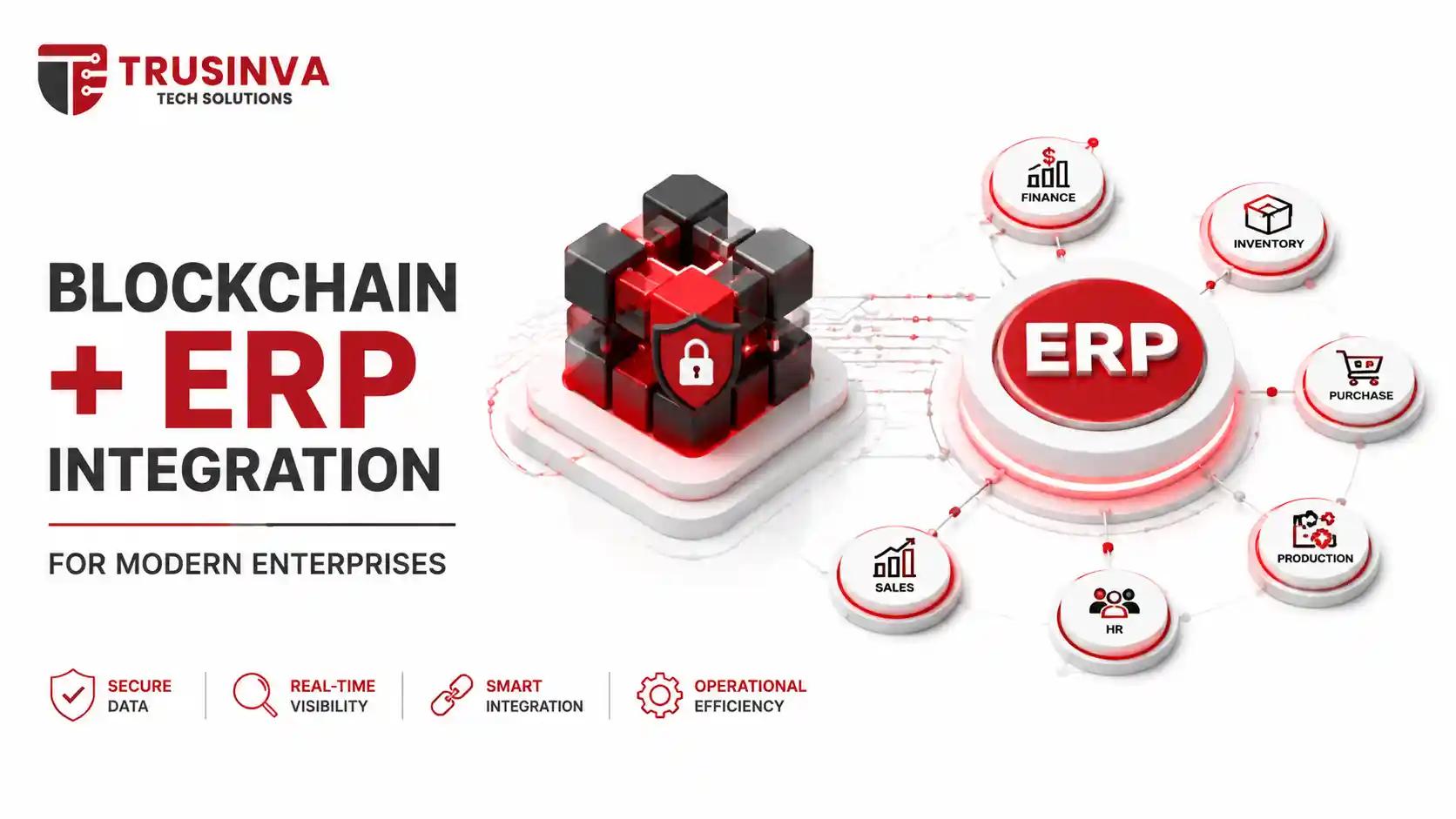
For most mid-size and enterprise businesses, blockchain doesn't work in isolation — it needs to connect with the ERP system that already runs procurement, inventory, and finance. Blockchain ERP integration lets a company automatically sync verified shipment and inventory data straight into financial and operational reporting, without manual re-entry.
This matters because ERP systems are usually the "source of truth" for a business, while blockchain becomes the trusted verification layer sitting alongside it. Combined, they give supply chain teams both operational control and cryptographic proof of authenticity.
If your business is exploring this kind of integration, our ERP-focused development work and blockchain team can scope out what a combined system would look like for your specific operations.
Why Choose Trusinvatechsolutions
There's no shortage of agencies claiming blockchain expertise, but supply chain blockchain projects require a mix of technical depth and real operational understanding of logistics, manufacturing, or retail workflows. Trusinvatechsolutions brings both.
Here's what sets our approach apart:
- Full-stack capability — we don't just build the blockchain layer; we can also handle the web development, mobile app development, and CRM development needed to connect it to your broader business systems.
- US business focus — our team understands the compliance and operational pressures American supply chain companies are dealing with right now.
- Practical, not hype-driven — we help clients avoid over-building. If blockchain isn't the right fit for a specific problem, we'll tell you.
- Proven project delivery — you can see examples of our past work on our projects page.
You can learn more about our team and approach on our about page, or explore our full range of digital services if blockchain is just one part of a bigger transformation project.
Getting Started: A Simple Blockchain Implementation Roadmap
- Discovery call — we learn about your current supply chain pain points and systems.
- Feasibility assessment — we determine whether blockchain is the right fit, or whether a different automation approach would solve the problem faster.
- Solution design — architecture planning, including smart contract logic and ERP integration points.
- Development and testing — building the blockchain layer, running security audits, and testing with real supply chain data.
- Deployment and training — rolling out the system and training your team to use it.
- Ongoing support — monitoring, updates, and scaling as your supply chain grows.
Most blockchain supply chain pilots take a few months from discovery to deployment, depending on how many systems need to integrate.
Future of Blockchain in Supply Chain
Looking ahead, blockchain is increasingly being paired with other technologies rather than standing alone:
- AI-powered blockchain solutions — combining blockchain's verified data with AI analytics for predictive supply chain intelligence.
- IoT integration — sensors automatically logging temperature, location, and handling data directly onto the blockchain in real time.
- Tokenized supply chains — representing physical goods as digital tokens for easier tracking and even financing.
- Blockchain-based digital identity — verifying supplier and product identity across international borders more efficiently.
These trends suggest blockchain won't replace existing supply chain software — it will increasingly sit underneath it, quietly providing the verification layer that other systems rely on.
Frequently Asked Questions
What is blockchain in supply chain management? Blockchain in supply chain management is a shared, tamper-proof digital ledger that records every transaction and movement of goods, giving all parties — suppliers, manufacturers, and retailers — the same verified view of a product's journey.
How does blockchain improve supply chain transparency? It replaces separate, siloed records with one shared ledger that every authorized party can view. Since entries can't be altered after the fact, everyone works from the same trusted version of events.
Is blockchain useful for logistics companies? Yes. Blockchain for logistics companies reduces paperwork disputes, speeds up customs documentation, and gives carriers, brokers, and receivers a single shared source of shipment status.
How much does blockchain development cost? Costs vary widely based on scope — a single-process pilot (like supplier verification) costs far less than a full enterprise-wide blockchain ERP integration. It's best to start with a discovery call to get an accurate estimate for your specific needs.
Can blockchain integrate with ERP systems? Yes, blockchain ERP integration is one of the most common enterprise use cases, allowing verified blockchain data to sync directly into existing procurement, inventory, and finance systems.
How long does blockchain implementation take? A focused pilot project typically takes a few months from discovery to deployment, while full enterprise-wide rollouts with multiple ERP integrations can take longer depending on complexity.
Final Thoughts and Next Steps
Blockchain for supply chain isn't about chasing a trend — it's about solving real problems: fraud, disputes, slow recalls, and a lack of trust between supply chain partners. US businesses in manufacturing, healthcare, retail, logistics, and food distribution are already using blockchain-based supply chain platforms to cut costs and build trust with both partners and customers.
If you're evaluating whether blockchain development for supply chain makes sense for your business, the best next step is a conversation, not a guess. Our team at Trusinvatechsolutions can walk through your current supply chain setup and tell you honestly whether blockchain — or a different automation approach — is the right fit.
Book a seat at Trusinvatechsolutions and let's talk through your supply chain challenges. You can get in touch here, browse our full services list, or check out more insights on our blog.