
Quick Answer
To get your first truck dispatching client in the USA, build a verified list of 300–500 owner-operators using FMCSA SAFER and new-entrant data, then contact them by phone, email, and SMS with a specific, lane-based offer. Offer a no-contract two-week trial, follow up at least five times, and close with a written dispatch agreement. Most beginners sign client one within 2–4 weeks of consistent daily outreach.
Key Takeaways
- Your first client is a trust problem, not a lead-volume problem — you have no track record, so your offer must remove all risk from the carrier.
- Verified FMCSA data beats purchased lead lists every time, and it costs nothing.
- New-authority carriers (0–6 months old) are the single easiest segment for a brand-new dispatcher to convert.
- Expect roughly 60–150 dials to close the first client with no referrals and no reputation.
- A no-contract, two-week trial is the most effective closing tool available to a beginner.
- Your first client's referral network is worth more than your first three months of cold calling.
- Document everything from day one — screenshots of rates booked become your only real proof for client two.
1. Introduction
Almost every new truck dispatcher hits the same wall. The training is finished, the laptop is set up, the load board subscription is active — and the phone doesn't ring. Getting the first client is the hardest, loneliest, and most decisive phase of the entire business, because it's the only phase where you have absolutely no proof to offer. At Trusinva Tech Solutions, we train and support US-focused dispatchers, and this is the exact point where most people quit. If you haven't set up the business side yet, begin with how to start a truck dispatching business in the USA and the updated start a truck dispatching business guide for 2026. To understand what you're actually selling to a carrier, read owner-operator dispatch services benefits, and if you want structured, US-market training with real workflows, our truck dispatching course covers acquisition alongside operations.
This guide is deliberately narrow. It is not about scaling to fifty trucks. It is about the specific, unglamorous sequence that produces one signed carrier — and how to make sure that carrier becomes the foundation of everything after.
2. What Counts as a "Truck Dispatching Client"?
A truck dispatching client is an active motor carrier — usually an owner-operator or small fleet owner — who authorizes you to search, negotiate, and book freight on their behalf in exchange for a fee. They must hold their own operating authority. Leased-on drivers cannot hire you, because they don't control their own loads.
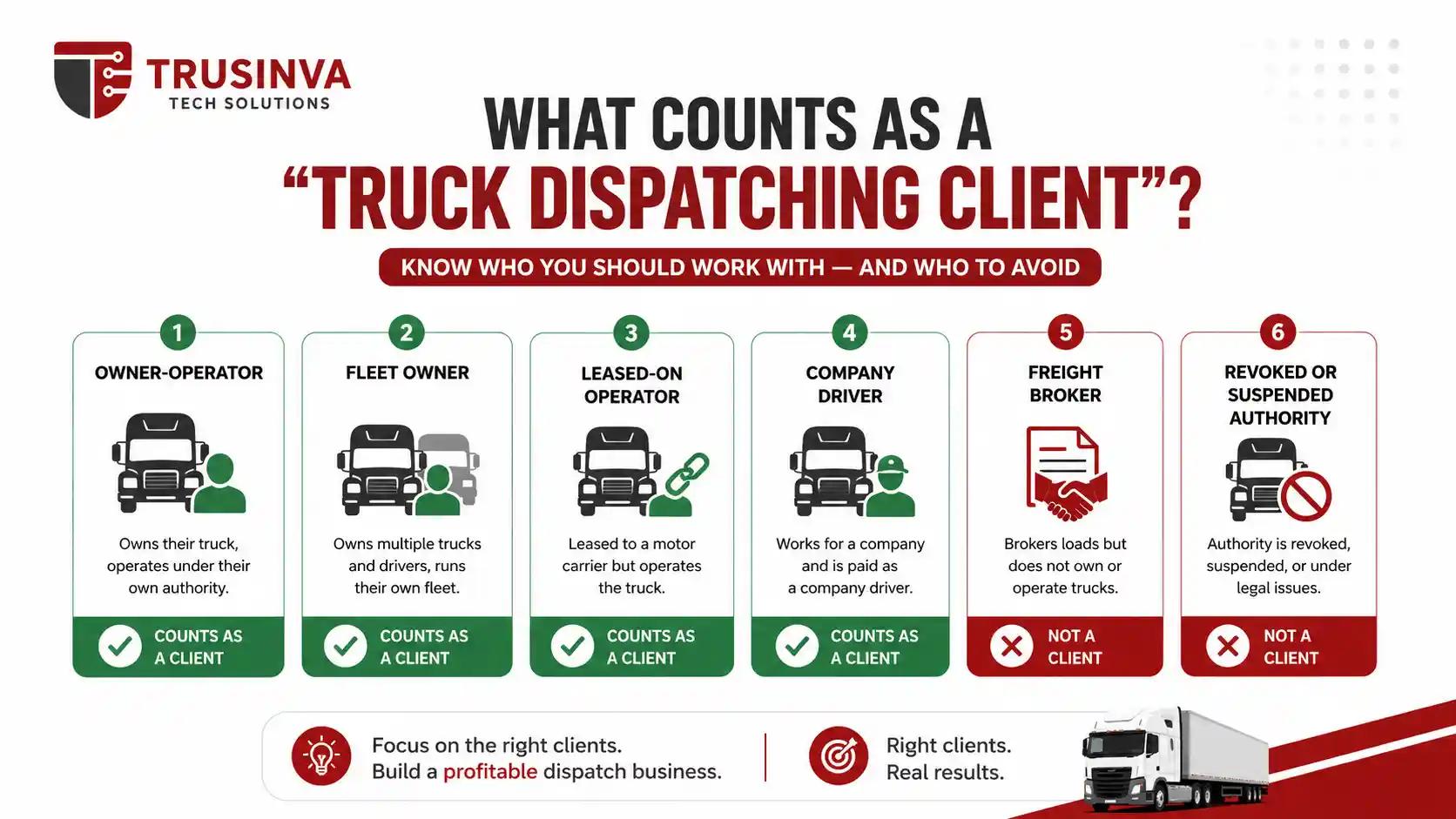
This distinction is where most beginners waste their first month.
| Type | Can Hire a Dispatcher? | Why |
| Owner-operator with own authority | Yes | Controls their own freight decisions |
| Small fleet owner (2–8 trucks) | Yes | Decision-maker for the whole fleet |
| Leased-on owner-operator | No | Carrier assigns their loads |
| Company driver | No | Employee, no authority |
| Freight broker | No | They're a customer of carriers, not a client for dispatch |
| Carrier with revoked authority | No | Cannot legally haul for hire |
Expert observation: A shockingly large share of "no interest" responses new dispatchers receive come from leased-on drivers who were never prospects. Filtering these out before you dial makes your response rate look dramatically better overnight.
3. Why Getting the First Client Is Harder Than the Next Ten
The first client is hardest because you have no proof, no referrals, no reviews, and no case studies. Every carrier you contact is being asked to trust a stranger with their revenue. After client one, you have screenshots, references, and confidence — which changes every conversation that follows.
Three specific reasons the first close is disproportionately difficult:
- Zero social proof. Carriers ask "who do you dispatch for now?" It's the first real question, and "nobody yet" is an answer you must prepare for honestly.
- Heavy competition for attention. A carrier with a fresh MC number is contacted constantly by dispatchers, factoring companies, insurance agents, and ELD vendors.
- Prior bad experiences. Many owner-operators have already paid a dispatcher who booked cheap freight, disappeared, or charged unclear fees.
Why this matters: If you understand that you're solving a trust problem, you'll design an offer that removes risk. If you think you're solving a volume problem, you'll burn through a thousand contacts and sign nobody.
4. What You Must Have Ready Before You Contact Anyone
Before your first call, you need six things: a business name and phone number, a one-page website, a service one-pager, a dispatch agreement, a carrier onboarding checklist, and a CRM or tracked spreadsheet. Without these, interested carriers go cold while you scramble.
Pre-Outreach Readiness Checklist
- Business identity — name, business phone number, professional email (not a personal Gmail address)
- Simple website — carriers Google you before calling back; a one-page site is enough to start. See web development services and affordable website design for small business
- Service one-pager (PDF) — what you do, your fee, your lanes, your equipment focus
- Dispatch agreement — ready to send the moment someone says yes
- Dispatch authorization / limited power of attorney template
- Onboarding checklist — documents you'll collect from the carrier
- CRM or tracked sheet — every contact, stage, and follow-up date
- Load board access — so you can quote real rates during the call
- Chosen niche — equipment type and region, decided in advance
Warning: Do not start calling without a load board. The single most powerful move on a first call is pulling up live rates on the carrier's lane while you're talking to them. Without it, you're guessing — and carriers hear it instantly.
5. Step-by-Step: Getting Your First Client in 30 Days
Follow a compressed 30-day plan: define your niche in days 1–2, build a verified list in days 3–5, prepare assets in days 5–7, then run daily outreach with a fixed follow-up cadence from day 8 onward. Most disciplined beginners close within this window.
Week 1 — Foundation
Day
Action
1
Choose equipment type (dry van, reefer, flatbed) and target region
2
Study 30 live loads on your chosen lanes; learn real rate ranges
3–4
Pull FMCSA data; build a list of 300–500 verified carriers
5
Clean the list: remove leased-on, inactive, and oversized fleets
6
Build website page, one-pager, agreement, onboarding checklist
7
Write call script, 3 email templates, 2 SMS templates; set up CRM
Week 2 — First Contact Wave
- Call 50–80 carriers per day, in their local morning (7–9 AM) and evening (4–7 PM)
- Log every outcome: no answer, wrong contact, not interested, follow-up, interested
- Email everyone you spoke with the same day
- Target: 15–25 real conversations by end of week
Week 3 — Follow-Up Wave
- Second call to everyone who didn't answer
- SMS to everyone who asked for information
- Send lane-specific rate examples to warm prospects
- Target: 5–10 serious conversations
Week 4 — Close
- Third touch on all warm leads
- Offer the two-week no-contract trial explicitly
- Send agreement within one hour of verbal agreement
- Target: 1–2 signed clients
Realistic Funnel
| Stage | Typical Number |
| Verified carriers contacted | 400 |
| Connected conversations | 70–110 |
| Interested / follow-up | 15–30 |
| Trial agreed | 3–6 |
| Signed first client | 1–2 |
6. Building a Verified Prospect List (FMCSA, SAFER, New Entrants)
The Federal Motor Carrier Safety Administration publishes free public data on every registered US motor carrier, including company name, address, phone number, fleet size, authority status, and registration date. This is the most accurate and cheapest prospect source available to a new dispatcher.
Where the Data Lives
- SAFER Company Snapshot — verify an individual carrier's authority, fleet size, and safety record
- Licensing & Insurance (L&I) records — authority status and insurance filings
- Motor Carrier Census / new entrant registrations — bulk downloadable carrier records
Filters That Produce the Best First-Client List
- Power units: 1–3 (single-truck operators are decision-makers and easiest to reach)
- Authority granted within the last 6–18 months
- Status: ACTIVE, not pending, revoked, or out of service
- Operation: Authorized For-Hire, Interstate
- Cargo carried matches your equipment specialization
- Insurance (BIPD) on file
Verification Checklist Before Any Pitch
- USDOT number active
- MC number / operating authority granted
- Insurance on file
- Fleet size within target
- Not currently out of service
- Safety rating not "Unsatisfactory"
Important: Dispatching for a carrier without valid, active authority creates real legal and financial exposure. Verify every prospect in SAFER before you spend time on them — and again before you sign them.
Expert tip: Sort your list by authority date, newest first. A carrier that received authority three weeks ago has an urgent, unsolved problem. A carrier operating for six years usually doesn't.
7. Where First Clients Actually Come From
In practice, most first dispatch clients come from four places: direct phone outreach to FMCSA-sourced carriers, trucking Facebook groups, personal and community networks, and truck stops or terminals. Paid ads and SEO rarely produce the very first client because they take longer to mature.
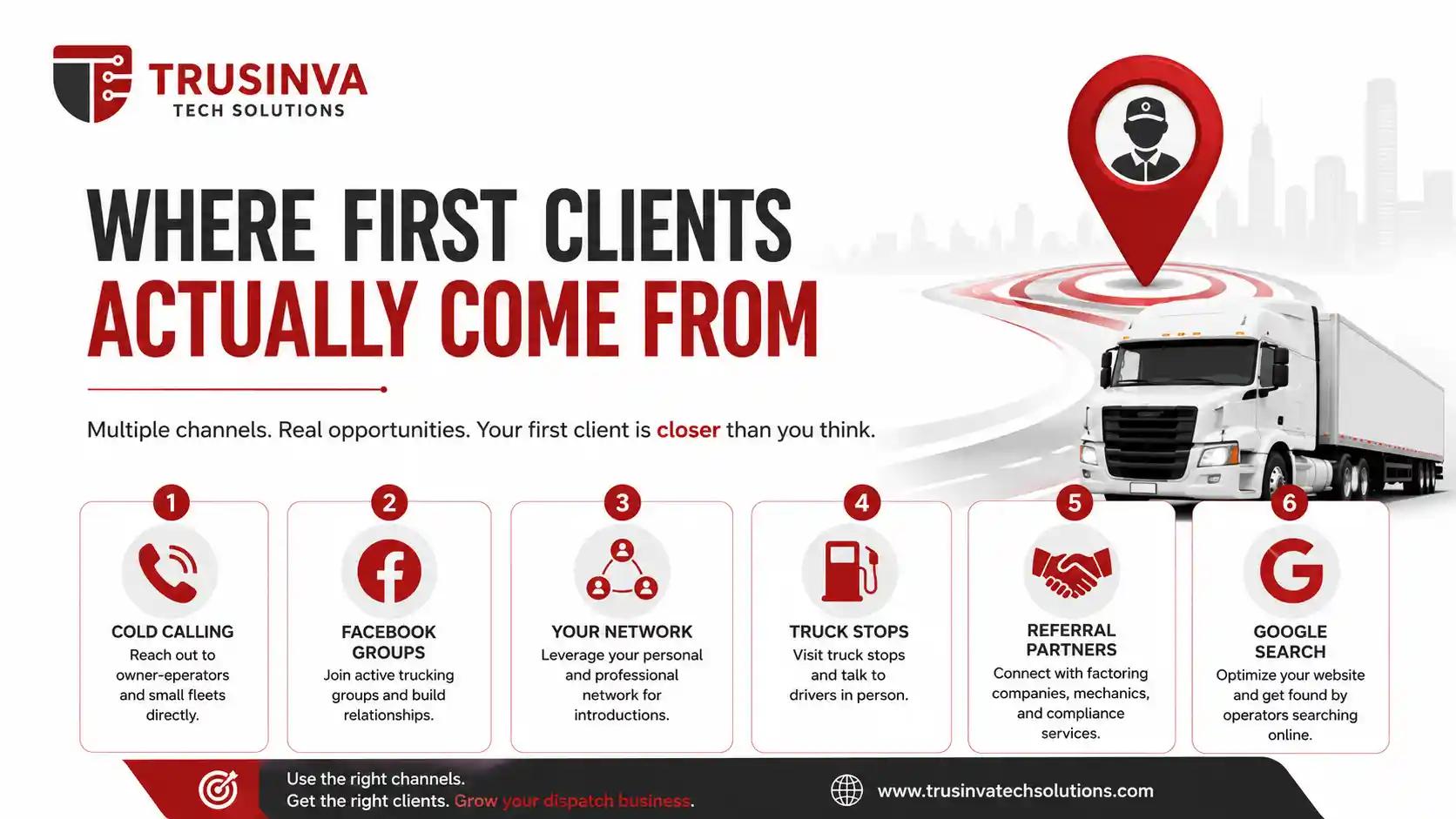
7.1 Direct Phone Outreach — Fastest
Still the number one source of first clients. Owner-operators answer their phones because their business runs on the phone.
7.2 Facebook Groups and Trucking Communities
Join owner-operator groups, state trucking groups, and equipment-specific communities. Answer questions; don't post ads. Share real rate observations on lanes you're watching. Carriers will DM you. This converts slowly but produces unusually loyal first clients.
7.3 Your Existing Network
Someone you know knows a truck owner. Ask directly: "Do you know anyone who owns their own truck?" This is how a surprising share of first clients appear — through a cousin, a neighbour, or a former colleague.
7.4 Truck Stops, Terminals, and Repair Shops
Face-to-face beats every digital channel for trust. A ten-minute conversation at a fuel island with a printed one-pager converts better than a hundred emails.
7.5 Referral Partners
Insurance agents, factoring companies, CDL schools, authority-registration services, and truck dealerships all touch new carriers daily. One relationship here can supply leads indefinitely.
7.6 SEO and Google Business Profile — Slower, But Compounding
Carriers search "dispatch service for owner operators" and "flatbed dispatcher near me." These leads convert best because the carrier initiated contact — but expect 3–6 months. Start now anyway. See how to rank your business website in the USA in 2026, local SEO services, and professional SEO services.
7.7 Paid Ads — Optional, Later
Google Ads works but is expensive per lead and unforgiving without a proper landing page. Consider it after you've proven your close rate. Details in Google Ads management.
8. The First-Client Offer: How to Remove All Risk
Your first offer should carry no contract, no setup fee, and no long-term commitment. Offer a two-week trial where the carrier pays only a percentage of loads you actually book. If you don't earn them money, they lose nothing but time.
Why This Works
A carrier evaluating an unproven dispatcher is calculating downside risk. Remove the downside and the decision becomes easy. You're not competing on experience — you're competing on risk.
First-Offer Structure
| Element | Recommendation |
| Contract length | None — cancel anytime, any week |
| Setup fee | $0 |
| Fee model | Percentage of gross linehaul only |
| Fee rate | 5–8% (slightly under market while unproven) |
| Trial period | 2 weeks |
| Minimum commitment | None |
| Guarantee | "If I don't beat your current rate per mile, don't pay me for those loads" |
Pros and Cons of the No-Risk First Offer
Pros
- Removes the biggest objection instantly
- Gets you real booking experience fast
- Produces the proof you need for client two
- Costs nothing if it fails
Cons
- Lower margin on your first client
- Attracts some carriers who'd never commit anyway
- Requires you to actually deliver quickly
Expert observation: Do not discount below 5%. Carriers read very low fees as inexperience or desperation, and it makes raising your rate later awkward. Compete on risk removal, not price collapse.
9. Cold Call Scripts for Someone With Zero Clients
An effective first-client cold call opens with the carrier's specific equipment and lane, asks a diagnostic question, and never claims false experience. Honesty about being new, paired with a risk-free offer, converts better than pretending to have a fleet of clients.
The Opening (First 12 Seconds)
"Hi, is this the owner of [Carrier Name]? My name's [Your Name] — I dispatch reefers running the Midwest to Southeast. I saw you're running a reefer out of [City]. Are you booking your own loads right now, or working with a dispatcher?"
The Diagnostic Questions
- What rate per mile are you averaging right now?
- How many deadhead miles are you running weekly?
- How much time per day are you spending on the load board?
- Which lanes do you actually want to run?
- What's your biggest frustration with freight right now?
The Value Statement (Use Live Load Board Data)
"I'm looking at your lane right now — there are three loads out of [City] this afternoon between $2.65 and $2.85 a mile. What are you seeing?"
This single move separates you from every dispatcher who calls with a generic script. You're demonstrating value inside the first two minutes.
The Close
"Here's what I'd suggest. Give me two weeks, no contract. I book, you approve every load before it's confirmed. If I'm not getting you better rates than you're finding yourself, walk away — you owe me nothing going forward. Fair?"
Call Timing Table
| Time (Carrier's Local) | Pickup Quality | Notes |
| 7:00–9:00 AM | Excellent | Pre-trip / planning window |
| 9:00 AM–3:00 PM | Poor | Driving, loading, unloading |
| 4:00–7:00 PM | Very good | Parked, reviewing tomorrow |
| After 8:00 PM | Avoid | Rest time — damages goodwill |
10. Email, SMS, and LinkedIn Templates
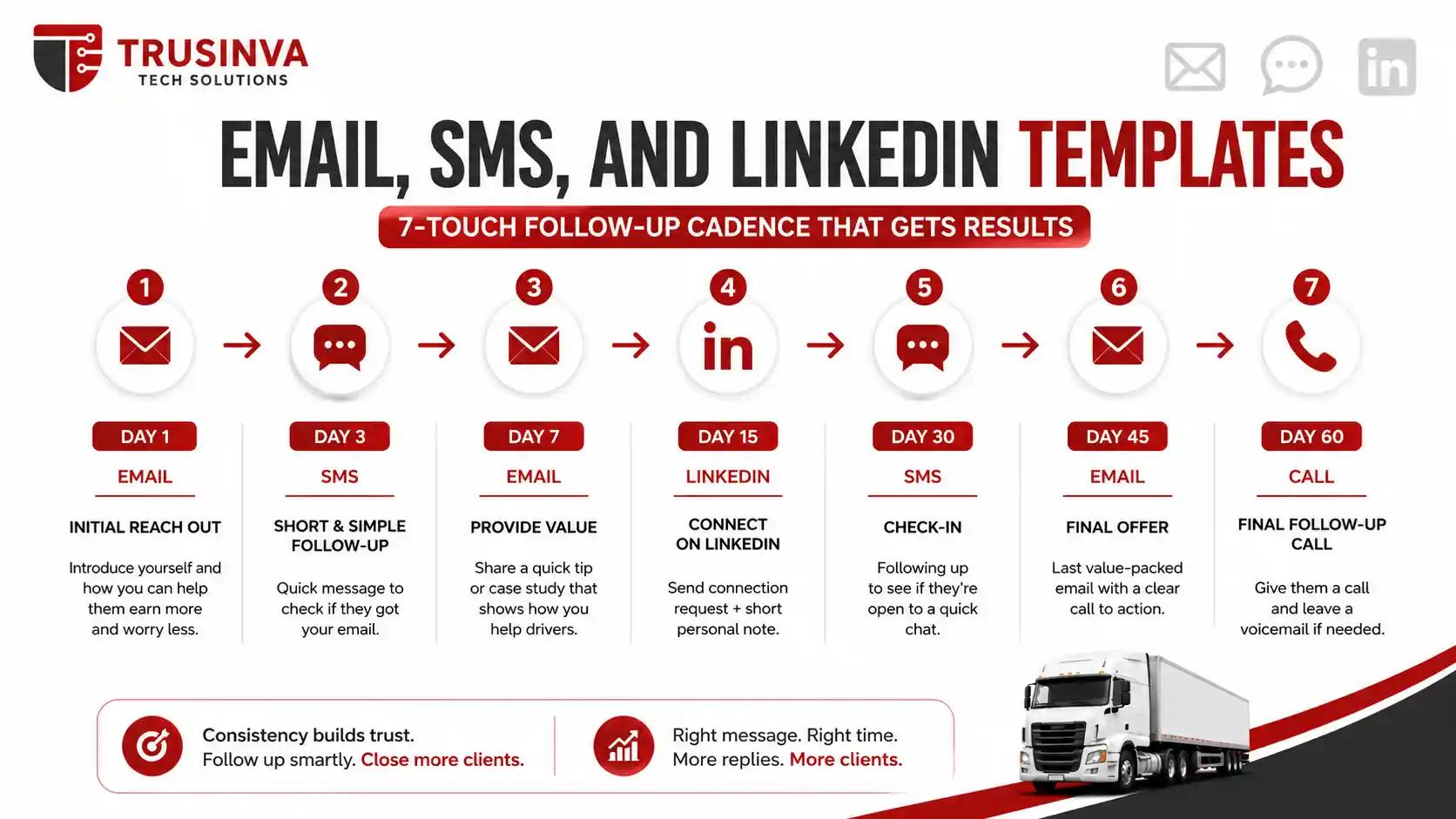
Written outreach for first clients should stay under 90 words, reference the carrier's specific equipment or lane, and end with one simple question. Long service descriptions get deleted unread.
Cold Email
Subject: Reefer loads out of Kansas City
Hi [Name],
I dispatch reefers on Midwest–Southeast lanes and noticed [Carrier Name] runs that area.
I'm seeing $2.65–$2.85/mi out of KC this week with light deadhead.
I work with no contract — two-week trial, you approve every load before I confirm it.
Are you booking your own freight right now?
[Your Name] — [Phone]
SMS
"Hi [Name], [Your Name] here — reefer dispatcher, Midwest lanes. Seeing $2.70+/mi out of KC. No contract, 2-week trial. Booking your own loads right now?"
LinkedIn (Better for Fleet Owners)
Connect first with a short personal note. Wait. Share one useful insight — a lane rate observation or a detention-pay tip. Then ask. A connection request that opens with a pitch converts near zero.
Follow-Up Cadence (Non-Negotiable)
| Touch | Day | Channel |
| 1 | Day 1 | Call |
| 2 | Day 1 | |
| 3 | Day 4 | SMS |
| 4 | Day 8 | Call |
| 5 | Day 14 | Email with rate example |
| 6 | Day 30 | Call |
| 7 | Day 60 | Email / SMS nurture |
Expert observation: Most first clients close on touch four to six. The dispatchers who fail almost always stop at touch two.
Compliance note: US cold calling and SMS are subject to TCPA and Do Not Call rules. Identify yourself on every call, honor opt-outs immediately, maintain an internal do-not-contact list, and confirm your obligations with a qualified attorney before running high-volume text campaigns.
11. Handling the "You Have No Experience" Objection
Answer honestly and immediately reframe. Say you're new, state exactly what you know about their lanes, and offer a structure where they carry zero risk. Carriers respect directness far more than invented client counts.
Objection Response Table
| Objection | Response |
| "How many trucks do you dispatch?" | "I'm building my book right now — you'd be one of my first. That means you get my full attention and no contract. Every load goes through your approval before I confirm it." |
| "I book my own loads." | "Most owner-operators do. What's your current average rate per mile? If I can't beat it in two weeks, you shouldn't pay me." |
| "Dispatchers are too expensive." | "My fee is a percentage of what I book. If you don't earn, I don't earn. What matters is your net, not my percentage." |
| "I got burned by a dispatcher before." | "That's why there's no contract. Cancel any week, no notice, no fee." |
| "Send me information." | "Sending it now. Can I call you Thursday at 10 after you've had a look?" |
| "Not interested." | "No problem. Can I check back in 60 days in case things change?" |
Why honesty wins: Carriers can verify almost nothing you claim. What they can judge is whether you know their lanes, quote real numbers, and answer straight. Fake experience collapses in the first week of actual work anyway.
12. Qualifying: Who Not to Sign as Your First Client
Your first client should be an active, insured carrier with realistic rate expectations, working capital or factoring in place, and a willingness to sign a written agreement. A bad first client can end your business before it starts.
Red Flags — Walk Away
- Refuses to provide MC/DOT number
- Authority is pending, revoked, or out of service
- No insurance on file
- Demands rates far above market for their lanes
- Won't sign a written dispatch agreement
- Has used four dispatchers in six months
- No factoring and no cash to survive 30-day broker terms
- Equipment repeatedly out of service
- Expects a guaranteed weekly income
Green Flags — Prioritize
- Active authority, 6–18 months old
- Reachable, answers the phone, responds to texts
- Clear on their own cost per mile
- Has factoring or working capital
- Flexible on lanes
- Willing to start with a trial
Expert tip: A cooperative carrier with modest expectations is worth ten difficult carriers with big trucks. Your first client teaches you the job — pick someone who'll be patient while you learn.
13. Pricing Your First Client
Most US truck dispatchers charge 5–10% of gross linehaul revenue, with 8–10% typical for single-truck owner-operators. As an unproven dispatcher, 5–8% is a reasonable starting point, with the intention of raising it once you have results to show.
| Model | Typical Range | Suitable for First Client? | Notes |
| Percentage of gross linehaul | 5–10% | Best choice | Aligns incentives; easiest to sell |
| Flat weekly fee | $200–$400/truck | Risky | Carrier resents it in slow weeks |
| Per-load fee | $75–$150 | Possible | Simple but caps your upside |
| Hybrid base + % | Varies | Avoid | Too complex for an unproven relationship |
What Must Be Explicit in Writing
- Whether the fee applies to gross linehaul only or includes fuel surcharge and accessorials (state it plainly — this is the number one source of disputes)
- When and how you invoice
- What happens on cancelled or TONU loads
- Cancellation notice period
Realistic Income From One Client
A single owner-operator grossing roughly $6,000–$9,000 per week at a 7% fee generates approximately $420–$630 weekly, or around $1,800–$2,700 monthly. For deeper income modelling, see truck dispatcher salary in the USA 2026.Legal note: Dispatching as the carrier's agent is different from brokering freight. Arranging freight as an intermediary for compensation can require FMCSA broker authority and a surety bond. Structure your agreement so you're clearly acting on behalf of the carrier, and confirm your setup with a transportation attorney.
14. The Dispatch Agreement and Onboarding Checklist
A dispatch agreement must state your fee, calculation basis, services included, payment terms, cancellation notice, and that you act as the carrier's agent. Send it within one hour of a verbal yes — delays lose deals.
Agreement Must Include
- Parties, carrier MC/DOT numbers
- Fee percentage and exact calculation basis
- Services included and explicitly excluded
- Invoicing schedule and payment method
- Cancellation terms and notice period
- Agent relationship statement (not a broker)
- Confidentiality and non-solicitation
- Governing law
Onboarding Document Checklist
- Signed dispatch agreement
- Dispatch authorization / limited power of attorney
- MC and USDOT numbers
- W-9
- Certificate of insurance (auto liability + cargo)
- Notice of assignment (if factoring)
- Preferred lanes, home time, minimum rate per mile
- Driver contact details and availability windows
- Equipment details (trailer type, length, capacity)
- Carrier packet for broker setup
Tracking this across even a handful of carriers on scattered spreadsheets breaks quickly. See CRM features and CRM development for what a proper system handles.
15. First 30 Days With Your First Client
Your first month with client one determines whether you have a business or a one-off. Over-communicate, book conservatively, document every rate you achieve, and never leave the driver guessing about their next load.
Week-by-Week Priorities
| Week | Focus |
| 1 | Broker setup, first booked load, establish communication rhythm |
| 2 | Reduce deadhead, secure a repeat lane, confirm invoicing works |
| 3 | Improve average rate per mile, plan home time properly |
| 4 | Review results with the carrier, capture proof, ask for a referral |
Rules for the First Month
- Send the next day's load plan every evening
- Never confirm a load without carrier approval in the early weeks
- Screenshot every rate confirmation — this becomes your proof for client two
- Track rate per mile, deadhead percentage, and weekly gross from day one
- Report results honestly, including the weeks that go badly
Expert observation: Carriers rarely leave a dispatcher over one bad rate. They leave over silence. Communication frequency matters more than negotiation skill in month one.
16. Turning Client One Into Clients Two Through Five
Your first client is your best marketing asset. Ask for referrals at day 30 and day 90, collect a short testimonial, and use documented rate improvements in all future outreach. Referred prospects convert several times better than cold contacts.
The Referral Ask
At day 30, once you've delivered results:
"You've been great to work with. Most owner-operators know two or three others running similar equipment. If you know anyone who could use what we've been doing, I'd really appreciate the introduction — and I'll knock a percentage point off your fee for the month for anyone who signs."
Proof Assets to Build
- Before/after rate per mile comparison
- Deadhead reduction percentage
- Weekly gross improvement
- A two-sentence written testimonial
- A 60-second video testimonial if the carrier is willing
Then Restart the Engine
Do not stop outreach after client one. Churn is real. Keep 30 minutes of daily prospecting permanently in your calendar, and start building inbound channels in parallel — how digital marketing can help you get more clients online in 2026 and how to turn your website visitors into real customers cover the mechanics.
17. Cost, Timeline, and Realistic Income Expectations
A new dispatcher can realistically acquire their first client for under $200 in direct costs, using free FMCSA data and a VoIP line. The main investment is time — typically 60–120 hours of outreach over three to four weeks.
Startup Cost to First Client
| Item | Monthly Cost |
| VoIP / business phone | $20–$50 |
| Load board subscription | $45–$150 |
| Domain + basic website | $10–$40 |
| CRM (starter tier) | $0–$30 |
| Email tool | $0–$25 |
| Total | $75–$295 |
Timeline Expectations
| Milestone | Typical Timeframe |
| List built and assets ready | 5–7 days |
| First real conversation | Day 8–10 |
| First serious prospect | Week 2 |
| First signed client | Week 3–6 |
| Three clients | Month 3–4 |
| Sustainable income (5–8 trucks) | Month 6–12 |
Career Scope
Dispatching scales through client count, not hours. A solo dispatcher typically manages 8–15 trucks before needing software support or an assistant. Beyond that, the business becomes a dispatch agency with a team. For the full picture, see how truck dispatching services save US carriers money and the truck dispatching course in the USA overview.
18. Common Mistakes Beginners Make
- Calling before learning the lanes. If you can't quote a live rate, you sound like every other cold caller.
- Pitching services instead of numbers. Carriers buy rate per mile and reduced deadhead, not "24/7 support."
- Contacting leased-on drivers. They can't hire you.
- Skipping FMCSA verification. Wasted calls and real legal exposure.
- Stopping after two follow-ups. Most closes happen at touch four to six.
- Inventing a client roster. It collapses in week one and destroys trust permanently.
- Charging 2–3% to win the deal. Reads as desperation and is impossible to raise later.
- No written agreement. Guarantees a fee dispute by week three.
- Trying to dispatch every trailer type. You negotiate poorly and rank nowhere.
- No website. Carriers Google you before returning your call.
- Quitting at day 20. Most first clients land between day 21 and day 42.
- Not tracking anything. Without dial, connect, and close data you can't fix what's broken.
19. Tools and CRM Stack for a New Dispatcher
A first-client stack needs only five things: FMCSA data, a VoIP dialer, a load board, a CRM, and an e-signature tool. Everything else can wait until you have three or more trucks.
| Function | Purpose | Priority |
| FMCSA SAFER / L&I data | Verified prospect list | Essential (free) |
| VoIP dialer | High-volume calling, local presence numbers | Essential |
| Load board (DAT, Truckstop) | Live rates during calls + freight sourcing | Essential |
| CRM | Pipeline stages, notes, follow-up reminders | Essential |
| E-signature | Fast agreement closing | High |
| Email sequencer | Automated follow-up | Medium |
| TMS | Load, invoice, document management | Add at 8–10 trucks |
| AI automation | Lead enrichment, summarization, follow-up drafts | Optional |
Dispatchers scaling past a handful of carriers typically outgrow generic tools. See CRM development solutions for US sales teams in 2026 and AI automation services in the USA.
20. Latest Updates and Trends (2026)
Three developments matter most for new dispatchers in 2026: stricter FMCSA registration scrutiny following widespread carrier identity fraud, a more selective post-downturn carrier population, and AI rate tools that let carriers verify your value instantly.
- Registration modernization and fraud enforcement. FMCSA has been overhauling registration systems in response to carrier and broker identity fraud. Expect more verification steps and stricter authority checks. Always confirm current requirements directly on FMCSA's site rather than relying on secondhand summaries.
- English language proficiency enforcement returned as an active out-of-service criterion, affecting driver qualification screening.
- A leaner carrier population. The extended freight downturn removed many undercapitalized carriers. Survivors are more numbers-driven — meaning vague pitches fail harder than they did three years ago.
- AI rate benchmarking is mainstream. Carriers now check market rates themselves before accepting a load. Access to a load board is no longer a differentiator; explaining why a rate is good is.
- Digital-first vetting. More carriers research a dispatcher through Google, YouTube, and reviews before returning a call — making even a basic web presence a genuine competitive advantage.
Practical implication: In 2026, your edge as a beginner is analysis, transparency, and responsiveness — not access to tools everyone already has.
21. Comparison: Fastest vs Most Durable Client Channels
| Channel | Speed to First Client | Cost | Conversion Quality | Best For |
| Cold calling | 2–4 weeks | Very low | Medium | Client 1–5 |
| SMS / email outreach | 2–5 weeks | Low | Low–Medium | Volume support |
| Facebook groups | 3–8 weeks | Free | High | Client 1–3 |
| Personal network | 1–3 weeks | Free | Very high | Client 1 |
| Truck stops / in-person | 2–6 weeks | Low | Very high | Client 1–3 |
| Referrals | After client 1 | Very low | Highest | Client 2+ |
| SEO / content | 3–6 months | Medium | Very high | Client 5+ |
| Google Ads | 1–3 weeks | High | High | After proven close rate |
Decision Matrix
- No budget, plenty of time? → Cold calling + Facebook groups + personal network
- Small budget, want speed? → Cold calling + simple website + Google Ads
- Building for the long term? → Start SEO and content on day one while cold calling
- Already have client one? → Referral system first, then SEO
22. Expert Tips
- Quote a live rate in the first two minutes. Nothing else builds credibility as fast.
- Say you're new — then remove all risk. Honesty plus a no-contract trial beats fake experience.
- Specialize by region first, equipment second. Local lane knowledge is defensible; "I dispatch everything" is not.
- Record a 90-second intro video and text it after every call. Almost no competitor does this.
- Track three numbers weekly: dials, connects, closes. Low connects means bad timing. Low closes means bad script.
- Never bad-mouth their current dispatcher. Ask what's working, then position around the gap.
- Send the next day's plan every evening to your first client. Silence kills relationships, not bad rates.
- Screenshot every rate confirmation. Proof is the only currency you can't fake.
- Keep 30 minutes of prospecting daily forever. Churn never stops, so neither should you.
23. Frequently Asked Questions
Q1. How do I get my first truck dispatching client with no experience? Build a verified prospect list from FMCSA data, learn live rates on two or three lanes, and call 50–80 carriers daily. Be honest that you're new, and offer a no-contract two-week trial where you only earn a percentage of loads you actually book. Most beginners sign within three to six weeks.
Q2. How long does it take to get the first dispatch client? With consistent daily outreach of 50–80 calls, most new dispatchers sign their first client in two to six weeks. Inbound channels like SEO take three to six months but deliver higher-quality leads once they mature.
Q3. Where do I find owner-operators to contact? FMCSA publishes free public carrier data including company names, addresses, phone numbers, fleet sizes, and authority dates. Filter for active carriers with one to three trucks and recent authority. This is more accurate than most purchased lead lists.
Q4. Should I buy truck dispatching leads? Usually not, especially at the start. Purchased lists are frequently outdated, heavily over-contacted, and include leased-on drivers who cannot legally hire a dispatcher. FMCSA data is free, current, and verifiable.
Q5. How much should I charge my first client? Charge 5–8% of gross linehaul revenue as an unproven dispatcher, versus the typical market range of 5–10%. State clearly whether fuel surcharge and accessorials are included. Avoid going below 5% — very low fees signal inexperience and are hard to raise later.
Q6. Do I need FMCSA authority to work as a truck dispatcher? No. A dispatcher acting as an agent of the carrier generally does not need broker authority. However, arranging freight as an intermediary for compensation can require broker authority and a surety bond. Confirm your structure with a transportation attorney.
Q7. What should I say when a carrier asks how many trucks I dispatch? Answer honestly. Say you're building your book, explain that they'd receive your full attention, and offer a no-contract trial with load-by-load approval. Carriers respect directness far more than a fabricated client list they'll see through within a week.
Q8. Is cold calling still effective for getting dispatch clients in 2026? Yes. Owner-operators run their businesses by phone and make decisions personally, so cold calling remains the fastest route to a first client. Effectiveness depends on list quality, call timing, and follow-up consistency rather than raw call volume.
Q9. What's the easiest equipment type to start with? Dry van has the highest load volume and the shallowest learning curve. Flatbed and reefer pay more and face less dispatcher competition, but require deeper knowledge of load securement, temperature requirements, and accessorial charges.
Q10. How many clients do I need to make dispatching a full-time income? Most independent dispatchers reach sustainable full-time income at five to ten active trucks, depending on fee structure and average weekly gross. Below five trucks, income is unstable; above fifteen, most dispatchers need software support or an assistant.
24. Conclusion and Next Step
Getting your first truck dispatching client is not a marketing mystery. It's a sequence: pick a niche, build a verified FMCSA list, prepare your assets, call consistently at the right hours, quote real rates, remove all risk from the offer, and follow up until you get a definitive answer either way.
The one insight that changes everything: you are not selling dispatching, and you are not selling experience — you are selling a risk-free path to a better rate per mile. Once you frame it that way, the "you're new" objection stops being a wall and becomes a reason to give you a trial.
Then deliver relentlessly for thirty days, capture the proof, and ask for the referral. That's how client one becomes clients two through five — and how a dispatching business actually begins.
Ready to build a dispatching business with real US market workflows behind it? Trusinva Tech Solutions trains dispatchers on carrier sourcing, FMCSA verification, rate negotiation, broker setup, and client acquisition — the operational and sales sides together. Book a Seat in our truck dispatching program, browse the full course catalogue, read our guide to truck dispatching for flatbed carriers in the USA, explore our services including digital marketing and social media marketing for dispatch businesses, or contact our team to discuss a website, CRM, or lead generation system built for your dispatch company.