
Quick Answer
The typical medical billing and coding salary in the USA is $51,140 per year ($24.59 per hour). That is the May 2025 median reported by the U.S. Bureau of Labor Statistics. Certified coders surveyed by AAPC average $67,260, and professionals with three or more credentials average $81,227. Entry-level coders usually start between $37,000 and $46,000. Senior specialists can pass $80,000. If you are just starting out, our online medical billing course guide explains the fastest route into the field.
Introduction
Search "medical billing and coding salary" and you will find numbers that range from $37,000 to over $90,000. They are all partly true. The real answer depends on your credential, experience, employer, and state. Trusinva Tech Solutions is a U.S.-focused technology and professional training company. We built this guide from primary data published by the Bureau of Labor Statistics and AAPC so you can see where you stand today and where you could be in five years. If you want a structured path into the field, our Medical Billing and Coding course covers the coding systems, claim workflow, and exam preparation that employers look for.
Book a Seat — Talk to Our Admissions Team →
Each figure below names its source and year. We also explain why pay moves the way it does, so you can plan career moves instead of guessing. For other healthcare-revenue topics, browse the full Trusinva blog library.
Disclaimer: This article is for informational purposes only and does not constitute tax, legal, or medical billing advice. Consult a licensed professional for guidance specific to your situation.
Key Takeaways
For the full training path behind these numbers, see our comparison of a medical billing course vs. certification.
- National median: $51,140 per year, or $24.59 per hour, in May 2025, according to the BLS.
- Pay range: The lowest 10% of earners made under $37,000, and the top 10% made over $81,150.
- Certification pays: In AAPC's survey, uncertified specialists averaged $55,721 and certified specialists averaged $67,260, a gap of 20.7%.
- Experience pays: First-year specialists earned $45,377 in 2025, while those with 31 or more years earned $80,479.
- Setting matters: Hospitals pay a median of $59,120. Physician offices pay a median of $47,120.
- Demand is growing: The BLS projects 8% employment growth from 2025 to 2035, with about 14,000 openings each year.
What Is a Medical Billing and Coding Salary?
Direct answer: A medical billing and coding salary is the pay earned by professionals who turn clinical documentation into standardized codes (coders) and use those codes to submit and follow up on insurance claims (billers). The BLS groups both roles under the occupation "Medical Records Specialists" (SOC 29-2072). Its May 2025 median for that group was $51,140.
A medical coder reads physician notes and assigns codes from three main code sets. These are ICD-10-CM for diagnoses, CPT for procedures, and HCPCS Level II for supplies, drugs, and certain services. A medical biller takes those codes and builds claims for Medicare, Medicaid, and commercial insurers. The biller then works denials and patient balances. Our guide on how medical billing services reduce claim denials shows how these two roles connect in daily practice.
These roles matter because every claim a provider sends depends on accurate codes. The American Medical Association (AMA) maintains CPT. The Centers for Medicare & Medicaid Services (CMS) and the National Center for Health Statistics (NCHS) maintain ICD-10-CM. A coding error can delay payment, trigger an audit, or expose a practice to compliance risk. That financial responsibility is the main reason certified, accurate coders earn above the occupation median. You can see what those errors cost in our breakdown of top medical billing mistakes at U.S. clinics.
Why Medical Billing and Coding Is Important
Direct answer: Medical billing and coding is how U.S. healthcare providers get paid. Every patient visit, test, and procedure must be turned into standardized codes and submitted as a claim before Medicare, Medicaid, or a private insurer will pay. Accurate coding protects provider revenue, keeps practices compliant with federal rules, and produces the health data used for research and public health planning.
Without billing and coding, a clinic can deliver excellent care and still run out of money. Insurers only pay for services that are correctly coded, documented, and submitted on time. This is why coders and billers sit at the center of the healthcare revenue cycle. Our Medical Billing and Coding course trains students to handle this full cycle, from code assignment to payment posting.
Book a Seat — Talk to Our Admissions Team →
1. It Keeps Healthcare Providers Financially Stable
Direct answer: Coding errors lead to denied, delayed, or underpaid claims. Clean, accurate claims mean faster payment and steadier cash flow for hospitals, physician practices, and outpatient facilities.
A single wrong modifier or missing diagnosis code can send a claim back unpaid. When that happens across hundreds of claims each month, a practice can lose a large share of its expected revenue. Skilled coders prevent this loss before it happens. We explain how practices recover lost revenue in our guide on how medical billing services reduce claim denials.
2. It Protects Providers From Compliance and Legal Risk
Direct answer: Billing for services that were not documented, or coding them at a higher level than supported, can be treated as fraud or abuse under federal law. Correct coding keeps providers compliant with CMS rules, HIPAA, NCCI edits, and Office of Inspector General (OIG) audit standards.
Coders act as a compliance checkpoint between clinical notes and the insurance claim. They make sure every code is supported by documentation. This protects the practice from payer recoupments, audits, and penalties. Many compliance problems start with avoidable errors, which we break down in our article on the top medical billing mistakes at U.S. clinics.
3. It Creates a Shared Language Across Healthcare
Direct answer: Code sets such as ICD-10-CM, ICD-10-PCS, CPT, and HCPCS Level II let providers, insurers, and government agencies describe the same diagnosis or procedure the same way. This standardization makes billions of claims processable every year.
Without a shared coding system, every insurer would read clinical notes differently and payment would slow down. Standard codes also allow electronic health records (EHR) systems, clearinghouses, and payer systems to exchange data automatically. That data exchange depends on well-built software, a topic we cover in our guide to web development for U.S. healthcare companies.
4. It Supports Public Health and Medical Research
Direct answer: Coded health data is used to track disease trends, measure care quality, and plan healthcare policy. Agencies such as the National Center for Health Statistics (NCHS) and CMS rely on coded data for national reporting.
When a coder assigns a diagnosis code, that code becomes part of a much larger dataset. Researchers use it to study chronic diseases, and hospitals use it to measure outcomes. Accurate coding therefore affects more than one bill. It shapes decisions across the healthcare system. Organizations increasingly analyze this data with modern tools, as explained in our article on AI automation services in the USA.
5. It Improves the Patient Experience
Direct answer: Correct billing means fewer surprise bills, fewer insurance disputes, and clearer patient statements. Patients are more likely to trust and return to a provider whose billing is accurate and transparent.
Billing errors often reach the patient as confusing statements or unexpected balances. Good billers catch these problems early and explain charges clearly when patients call. This builds trust and reduces unpaid patient balances. Practices that manage patient communication through structured systems often see better results, which our CRM development services are designed to support.
6. It Creates Stable, In-Demand Careers
Direct answer: Because every provider needs accurate claims, medical billing and coding offers steady employment across hospitals, physician offices, insurance companies, and remote revenue cycle companies. It is also one of the few healthcare careers that does not involve direct patient care.
The importance of the work is directly linked to its pay. Coders who protect revenue and reduce compliance risk are valued, and that value shows up in salary growth as they gain credentials and experience. If you are deciding how to enter the field, our comparison of a medical billing course vs. certification will help you choose the right starting point.
Summary Box: Medical billing and coding matters because it (1) keeps providers paid, (2) protects them from compliance risk, (3) standardizes healthcare data, (4) supports public health research, (5) improves patient billing experiences, and (6) creates stable careers with clear salary growth.
Medical Billing and Coding Scope in the USA
Direct answer: The scope of medical billing and coding in the USA is strong and growing. The BLS projects that employment for medical records specialists will grow 8% from 2025 to 2035, much faster than the 3% average for all occupations, with about 14,000 openings each year. Demand comes from an aging population, more chronic conditions, and the need to turn healthcare services into standardized codes for insurance payment.
This growth is steady because it does not depend on one employer type. Every hospital, clinic, insurer, and billing company needs people who can code and bill correctly. The BLS also expects many openings to come from replacing workers who retire or change careers, which keeps opportunities available even in slower years. Our Medical Billing and Coding course prepares students for this demand with practical, U.S.-focused training.
Book a Seat — Talk to Our Admissions Team →
1. Why Demand Keeps Growing
Direct answer: Older Americans need more medical services, and chronic conditions such as heart disease and diabetes create ongoing visits, tests, and treatments. Every one of those services must be coded and billed, which increases the workload for coders and billers.
Insurance rules also add to the workload. Medicare, Medicaid, and commercial payers each have their own requirements, edits, and prior authorization rules. As these rules become more detailed, providers need trained staff who can keep claims accurate. Specialty areas such as behavioral health show how complex payer rules can be, as explained in our guide to medical billing for mental health practices.
2. Where Medical Coders and Billers Work
Direct answer: Medical records specialists held about 200,700 jobs in 2025. Hospitals are the largest employer, followed by physician offices, professional service firms, administrative support companies, and corporate health systems.
The table below shows the largest employers based on BLS data. This variety gives coders room to move between settings as their skills grow. If you are unsure which setting suits you as a beginner, our online medical billing course guide explains how training connects to different job types.
| Employer Type | Share of Jobs (2025) |
| Hospitals (state, local, and private) | 28% |
| Offices of physicians | 18% |
| Professional, scientific, and technical services | 10% |
| Administrative and support services | 8% |
| Management of companies and enterprises | 7% |
Other employers include insurance companies, outpatient surgery centers, government agencies, telehealth providers, and revenue cycle management companies. Many of these organizations run their billing through custom platforms, which is why our custom software development guide is useful background for coders who want to understand the systems they work in.
3. Career Paths and Specializations
Direct answer: Medical billing and coding is not a single job. It is a career ladder. Professionals can start in billing or entry-level coding and then move into specialty coding, auditing, compliance, clinical documentation improvement (CDI), education, or management.
Common specializations include inpatient coding (ICD-10-PCS and MS-DRG), outpatient facility coding, risk adjustment (HCC coding), and payer-side claims review. Each one is supported by a credential from AAPC or AHIMA, such as the CIC, CCS, COC, CRC, CPC-P, or CPMA. To choose the right starting point, read our comparison of a medical billing course vs. certification.
The BLS lists health information technologists and medical registrars (median $68,020) and medical and health services managers (median $123,860) as advancement paths for medical records specialists. These roles usually require a higher certification or a degree in health information technology. Professionals on this path benefit from understanding healthcare systems and data, which our software development company guide explains from the business side.
4. Remote and Freelance Scope
Direct answer: Medical billing and coding is one of the most remote-friendly healthcare careers. Many employers hire credentialed coders to work from home using cloud-based EHR and billing software. Experienced professionals can also work as independent contractors for several practices.
Remote work widens the job market beyond your city. A coder living in a lower-cost area can apply to employers across the country. Freelancers, however, must handle their own taxes, including self-employment tax and quarterly estimated payments. Our USA taxation guide for freelancers explains these obligations in simple terms.
Independent billers who want to build their own client base also need a way to reach practices online. A simple website and consistent outreach can bring steady work. Our article on how digital marketing helps you get more clients online covers the basics.
5. Future Scope: What Will Change by 2035
Direct answer: The field will keep growing, but the work itself is changing. The BLS notes that AI-powered coding tools may affect demand. Routine coding will become more automated, while auditing, complex cases, risk adjustment, and AI validation will require more skilled professionals.
Several trends will shape the next decade. CMS updates ICD-10-CM and ICD-10-PCS every October, and the AMA updates CPT every January, so coders must keep learning. Value-based care and Medicare Advantage increase demand for risk adjustment coders. Payer and OIG audits increase demand for auditors and CDI specialists. Coders who understand how AI coding tools work will have an advantage, a topic covered in our guide to choosing an AI development company in the USA.
6. Who Should Consider This Career?
Direct answer: Medical billing and coding suits people who are detail-oriented, comfortable working on computers, and interested in healthcare without providing direct patient care. It also suits career changers, because most people can train in 6 to 12 months without a four-year degree.
It is a strong fit for recent graduates, medical assistants who want to move into office roles, people returning to work, and anyone looking for a remote-friendly career with a clear salary ladder. If you are comparing it with other U.S.-focused programs, browse our full course catalog to see which path matches your goals.
Book a Seat — Find the Right Course for You →
Summary Box: The scope of medical billing and coding in the USA includes (1) 8% projected job growth from 2025 to 2035, (2) about 14,000 openings each year, (3) jobs across hospitals, clinics, insurers, and billing companies, (4) a clear ladder into auditing, compliance, CDI, and management, (5) strong remote and freelance options, and (6) new specialties driven by AI, risk adjustment, and annual code updates.
Medical Billing and Coding Salary in the USA 2026: The National Numbers
Direct answer: The most recent federal data (May 2025, published in the 2026 Occupational Outlook Handbook) puts the median medical billing and coding salary at $51,140 per year. Industry survey data from AAPC's 2026 Salary Report puts the average at $65,007 for its members. The right benchmark depends on whether you are certified.
The table below combines the two most-cited sources. For context on another remote-friendly U.S. career that often appears in the same search results, compare these figures with our truck dispatcher salary guide for 2026.
| Metric | Figure | Source |
| Median annual wage | $51,140 | BLS, May 2025 |
| Median hourly wage | $24.59 | BLS, May 2025 |
| Bottom 10% (entry range) | Under $37,000 (≈ $17.79/hr) | BLS, May 2025 |
| Top 10% (senior range) | Over $81,150 (≈ $39.01/hr) | BLS, May 2025 |
| Median wage, all U.S. occupations | $50,980 | BLS, May 2025 |
| Jobs in the occupation | 200,700 (2025) | BLS |
| Average salary, AAPC members | $65,007 | AAPC 2026 Salary Report |
| Average, certified | $67,260 | AAPC 2026 Salary Report |
| Average, uncertified | $55,721 | AAPC 2026 Salary Report |
Hourly conversions assume 2,080 working hours per year, which is the standard BLS full-time basis.
The BLS reports that the median for medical records specialists was $51,140 in May 2025, just above the $50,980 median for all U.S. occupations. In plain terms, an entry-level coding job already pays close to the national midpoint. It also requires only a postsecondary certificate rather than a four-year degree. We walk through that certificate route in our online medical billing course guide.
Why BLS and AAPC Salary Figures Differ by Almost $14,000
Direct answer: The BLS surveys employers about everyone in the occupation, including uncertified records clerks and entry-level staff. AAPC surveys its own members, most of whom are certified and experienced. AAPC's 2025 survey respondents reported a median of 13.7 years in the industry. Neither figure is wrong. They measure different groups of people.
This distinction is the most useful thing to understand before you negotiate pay. If you are uncertified or in your first year, the BLS median and the AAPC first-year figure are your realistic benchmarks. If you hold a CPC or CCS and several years of experience, the AAPC averages describe your market more accurately. We explain how credentials change your benchmark in our article on medical billing course vs. certification.
There is a second reason for the gap. BLS data covers wage and salary workers and excludes self-employed coders. AAPC data is self-reported and includes some independent contractors. In our experience, when applicants compare offers against the wrong benchmark, one of two things happens: they undervalue themselves, or they walk away from reasonable first jobs. Tracking the right data is simpler when your records live in one place, which is why many healthcare teams use custom CRM systems for tracking performance data.
Important Note: The BLS classifies coders, billers, and records clerks under one occupation code. That means a "medical billing salary" and a "medical coding salary" share the same federal figure, even though coding roles usually pay more in practice.
Medical Billing and Coding Salary by Experience Level: Entry-Level to Senior
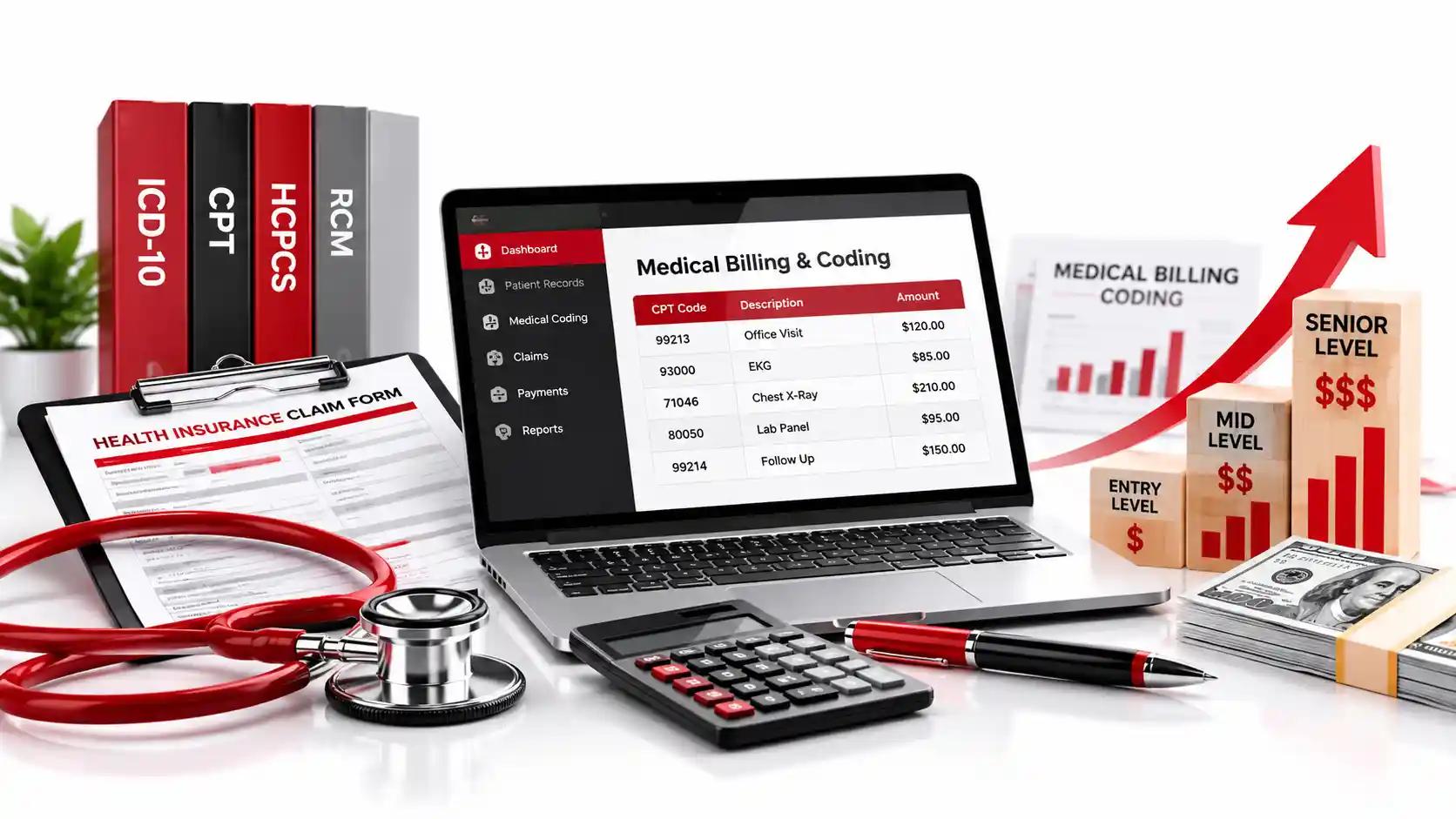
Direct answer: Experience is the second-strongest pay driver after certification. AAPC reports that first-year professionals averaged $45,377 in 2025, compared with $80,479 for those with 31 or more years, a 77.3% difference, with the largest gains in the first 15 years.
The table below maps experience to realistic pay ranges. Data points come from AAPC and BLS. Where a band sits between published data points, we label it as an estimate. To see how structured training shortens the entry-level phase, read our guide to online medical billing training.
| Career Stage | Years | Typical Salary Range | Data Basis |
| Entry-level coder/biller | 0–1 | $37,000 – $46,000 | BLS 10th percentile ($37,000); AAPC first-year average ($45,377) |
| Early career | 2–5 | $48,000 – $60,000 | Estimate between published AAPC and BLS data points |
| Experienced coder | 10–15 | ~$67,000 | AAPC average ($67,331) |
| Senior / specialist | 15–30 | $70,000 – $81,000+ | BLS 90th percentile ($81,150); AAPC multi-credential average |
| Veteran professional | 31+ | ~$80,500 | AAPC average ($80,479) |
Entry-Level Medical Coder Salary
Direct answer: An entry-level medical coder salary typically falls between $37,000 and $46,000 per year, which works out to about $17.80–$22.00 per hour. New coders who pass the CPC exam but lack work experience often carry the "CPC-A" (apprentice) designation until they meet AAPC's experience requirements.
The first job is the hardest to land because many employers ask for one to two years of experience. That is why the entry-level salary matters less than getting a role that builds production and accuracy numbers. In our training batches, we focus on real claim scenarios and practice charts for this reason: employers hire for demonstrated accuracy. Specialty practices can be a good starting point. Our piece on medical billing for mental health practices shows one niche where billing knowledge is in demand.
Experienced Medical Coder Salary
Direct answer: Coders with 10–15 years of experience averaged $67,331 in AAPC's 2026 report. At this stage, most professionals hold at least one specialty credential and often work in hospitals, health systems, or remote roles with revenue cycle vendors.
Mid-career pay grows fastest for coders who specialize instead of staying general. Specialties with complex rules include surgical, cardiology, oncology, inpatient DRG, and risk adjustment coding, and these usually pay more because errors cost providers more money. Many experienced coders also move into roles involving EHR workflows. Our article on web development for U.S. healthcare companies explains how those systems are built and why coders who understand them are valuable.
Senior Medical Coder Salary
Direct answer: A senior medical coder salary generally starts above $75,000 and can pass $81,000, which is the BLS 90th percentile. Senior earners usually hold two or more credentials and work in auditing, compliance, clinical documentation improvement (CDI), coding education, or management.
At the senior level, pay depends on responsibility more than on coding speed. An auditor who protects a hospital from Office of Inspector General (OIG) findings or payer recoupments carries measurable financial value. Advancement beyond coding is possible too. The BLS lists health information technologists and medical registrars at a $68,020 median, and medical and health services managers at $123,860, as common advancement paths. Senior professionals who lead revenue teams often rely on AI automation for healthcare workflows to scale their departments.
medical-billing-and-coding
Medical Coding Salary by Certification
Direct answer: Certification is the single biggest factor in medical coding pay. AAPC reports that certified specialists average $67,260 versus $55,721 for uncertified peers, 20.7% more. Professionals holding three or more AAPC credentials averaged $81,227, which is 25% above the overall member average.
The two main certifying bodies are the American Academy of Professional Coders (AAPC) and the American Health Information Management Association (AHIMA). AAPC credentials are most common in physician offices and outpatient settings. AHIMA credentials carry strong weight in hospitals. Our Medical Billing and Coding course is designed around the knowledge these exams test, including ICD-10-CM, CPT, HCPCS Level II, and medical terminology.
Book a Seat — Ask About the Next Batch →
| Credential | Issued By | Focus | Typical Setting | Salary Signal |
| CPC (Certified Professional Coder) | AAPC | Physician/outpatient coding (CPT, ICD-10-CM, HCPCS) | Physician offices, clinics, remote | Most common entry credential; benchmark for "certified" pay |
| CCA (Certified Coding Associate) | AHIMA | Entry-level coding competency | Hospitals, clinics | Entry-level credential |
| CCS (Certified Coding Specialist) | AHIMA | Hospital inpatient and outpatient coding, ICD-10-PCS, MS-DRG | Hospitals, health systems | Strong hospital demand; typically above entry pay |
| COC (Certified Outpatient Coder) | AAPC | Hospital outpatient and ambulatory surgery | Hospital outpatient departments | Specialty premium |
| CIC (Certified Inpatient Coder) | AAPC | Inpatient facility coding, ICD-10-PCS, DRGs | Hospitals | Largest 5-year income increase (41.9%, 2020–2025) per AAPC |
| CRC (Certified Risk Adjustment Coder) | AAPC | Risk adjustment, HCC coding | Payers, Medicare Advantage plans, remote | High remote demand |
| CPC-P (Certified Professional Coder–Payer) | AAPC | Payer-side claims and coding | Insurance companies | Payer-side career path |
| CPMA (Certified Professional Medical Auditor) | AAPC | Coding audits and compliance | Audit, compliance teams | Senior-level pay tier |
AAPC reports that the Certified Inpatient Coder (CIC) saw the largest income increase of any credential between 2020 and 2025, at 41.9%. That growth reflects how difficult inpatient coding is and how directly MS-DRG assignment affects hospital reimbursement. Credential-level averages change every year, so we recommend checking AAPC's current salary data before choosing a specialty. For a more complete view of how these credentials fit together, see our course vs. certification comparison.
Best Medical Coding Certification for Salary: Top 5 Ranked
Direct answer: For most beginners, the CPC is the best first certification because it has the widest job market. For the highest long-term salary, stack a specialty credential (CIC, CRC, or CCS) on top of it, then add CPMA for auditing roles.
The ranking below is based on AAPC salary data, job availability, and career ceiling. Every coder's path is different, so start with the credential that matches the setting you want to work in. Coders who later move into healthcare technology often find that understanding how CRM features support healthcare operations opens further opportunities.
- CPC + CPMA (auditing track): This combination has the highest common ceiling. It moves coders into audit and compliance roles, where pay depends on the financial risk they manage.
- CIC or CCS (inpatient track): These credentials lead to hospital inpatient coding, where MS-DRG accuracy drives large reimbursements. AAPC data shows the CIC had the strongest 5-year pay growth.
- CRC (risk adjustment track): Risk adjustment coding serves Medicare Advantage and value-based care. Many of these roles are fully remote.
- CPC + COC (outpatient facility track): This path suits coders who want to move from physician offices into hospital outpatient departments.
- CPC alone (foundation): The CPC is the best entry point, but it has a lower ceiling if you never add a specialty.
Medical Billing and Coding Salary by Employer and Work Setting
Direct answer: Where you work changes your pay by more than $14,000. BLS May 2025 medians were $60,980 in management of companies and enterprises and $59,120 in hospitals, compared with $47,120 in physician offices and $46,800 in professional, scientific, and technical services.
Hospitals pay more because inpatient coding uses ICD-10-PCS and MS-DRG logic, and the dollar value of each coded case is higher. Hospitals are also the largest employer: they employed 28% of medical records specialists in 2025, with physician offices at 18%. Coders who understand how hospital technology is built have an advantage, which we cover in our guide to custom software development.
| Employer Type | BLS Median (May 2025) | Why Pay Differs |
| Management of companies and enterprises | $60,980 | Corporate health systems and centralized coding departments |
| Hospitals (state, local, private) | $59,120 | Inpatient complexity, DRG-based reimbursement, 24/7 operations |
| Administrative and support services | $49,490 | Outsourced billing companies and staffing firms |
| Offices of physicians | $47,120 | Simpler outpatient coding; smaller practices |
| Professional, scientific, and technical services | $46,800 | Consulting and billing service providers |
Remote Medical Coding Salary
Direct answer: Remote medical coding salaries are generally comparable to on-site pay for the same credential and experience. Some national revenue cycle vendors pay on productivity (charts per hour), which can raise or lower earnings. Most remote employers require a credential and one to two years of experience.
Remote work is common in risk adjustment, outpatient, and professional fee coding. Remote coders use cloud EHR and practice management platforms such as Epic, Oracle Health, athenahealth, eClinicalWorks, NextGen Healthcare, AdvancedMD, and Tebra (formerly Kareo). They also use clearinghouse tools such as Waystar and Experian Health. HIPAA compliance applies at home just as it does in an office, so employers usually require secure setups. Knowing how these platforms work matters, as we explain in our article on SaaS development services.
Warning: Be careful with "remote coding job" ads that ask you to pay for training or equipment before you are hired. Legitimate employers verify your credential through AAPC or AHIMA and do not charge you for a job.
Medical Billing and Coding Salary by State and Location
Direct answer: Location can change salary by more than 50%. AAPC's 2026 report found that average pay varied by up to 54.2% across states, from $77,708 in Delaware ($37.36 per hour) to $50,393 in Mississippi ($24.23 per hour). In BLS data, the District of Columbia had the highest published state-level median at $72,040.
A higher state salary does not always mean more take-home pay. Cost of living, state income tax, and housing can cancel out a nominal raise. Remote workers who live in lower-cost states while earning national rates often come out ahead. If you work across state lines as a contractor, our guide to USA taxation for freelancers explains how state and federal taxes affect your earnings.
To check pay in your own city, the BLS Occupational Employment and Wage Statistics profiles break wages down by state and metro area. Use the occupation code 29-2072. Comparing local data before an interview gives you a defensible salary target, the same way we recommend comparing data before any major business decision in our article on how to choose the right web development company.
Medical Billing Salary vs. Medical Coding Salary: Is There a Difference?
Direct answer: Federal data does not separate them. Both fall under one BLS occupation with a $51,140 median. In practice, dedicated coding roles usually pay more than pure billing roles, because coding requires credentials and carries compliance risk. Billing roles that include denial management and appeals close much of that gap.
Job titles vary widely, and titles often signal pay level. The table below lists common titles, from entry-level billing to senior revenue cycle roles. For a practical view of how billing work affects a clinic's revenue, read our article on reducing claim denials with medical billing services.
| Job Title | Main Focus | Relative Pay Level |
| Medical billing specialist / patient billing rep | Claims submission, patient statements | Entry to mid |
| Medical claims specialist / claims examiner | Payer-side claim review | Mid |
| Medical coding specialist / professional coder | CPT, ICD-10-CM, HCPCS assignment | Mid |
| Outpatient coder | Hospital outpatient, ASC coding | Mid to upper-mid |
| Inpatient coder / clinical coder | ICD-10-PCS, MS-DRG | Upper-mid |
| Revenue cycle specialist | End-to-end claim lifecycle | Mid to upper-mid |
| Coding auditor / compliance coder | Audits, NCCI edits, OIG risk | Senior |
| CDI specialist | Documentation accuracy with clinicians | Senior |
| Coding manager / HIM director | Team leadership | Senior / management |
Billing specialists who learn coding increase their value quickly, because they can fix denials at the root instead of only resubmitting claims. That skill overlap is the core of our Medical Billing course, which teaches billing and coding together as one revenue cycle.
Book a Seat — Start Your Revenue Cycle Career →
Does Education Increase Medical Coding Salary?
Direct answer: Yes, but less than certification does. AAPC members with no college earned $61,635 in 2025, those with some college or an associate degree earned $62,643, and those with a bachelor's degree averaged $68,354, about 11% more.
The data suggests a clear order: get certified first, then consider a degree if you are aiming for management. A bachelor's degree in health information management (HIM) matters most when you want to move toward HIM director or AHIMA's RHIA credential. For most coders, a focused certificate program and a credential give a faster return. We compare those options in detail in our medical billing course vs. certification guide.
Total Compensation: W-2 vs. 1099, Benefits, and the Cost of Staying Certified
Direct answer: Salary is only part of total compensation. W-2 employees usually receive health insurance, paid time off, retirement matching, and often paid continuing education. Independent 1099 coders earn higher hourly rates but pay the full 15.3% self-employment tax and cover their own benefits and credential costs.
Consider a simple comparison. A W-2 coder earning $30 per hour has payroll taxes shared with the employer. A 1099 contractor also billing $30 per hour pays both halves of Social Security and Medicare tax, so the contractor takes home less unless the rate is higher. As a general rule, a contractor needs a noticeably higher hourly rate just to match a W-2 package. Our USA taxation guide for freelancers walks through quarterly estimated taxes and deductions for independent coders.
Credentials also have ongoing costs. AAPC and AHIMA both require annual membership or renewal fees and continuing education units (CEUs) to keep certifications active. Employer-paid CEUs are a real benefit worth several hundred dollars a year, so factor them in when comparing offers. If you also want to understand U.S. tax rules at a professional level, our USA Taxation course is a useful complement for billing professionals who handle patient payments and practice finances.
Book a Seat — Explore the USA Taxation Course →
How to Become a Medical Coder: Step-by-Step Guide (and How Long It Takes)
Direct answer: Most people become job-ready medical coders in 6 to 12 months. The usual path is to learn medical terminology and anatomy, study ICD-10-CM, CPT, and HCPCS, pass a credential exam such as the CPC, and then gain one to two years of experience to move beyond entry-level pay.
The BLS notes that most medical records specialists need a postsecondary certificate, although some enter with a high school diploma, and that employers may prefer or require certification. The steps below show the path we recommend to our students. Our guide to taking a medical billing course online covers step 2 in more depth.
- Build the foundation (4–6 weeks): Learn medical terminology, anatomy and physiology, and the basics of the healthcare revenue cycle.
- Learn the code sets (8–12 weeks): Study ICD-10-CM, CPT, and HCPCS Level II, plus modifiers, NCCI edits, and E/M coding guidelines.
- Practice on real scenarios (4–8 weeks): Code practice charts and work through claim forms (CMS-1500 and UB-04), denials, and appeals.
- Pass a credential exam: The CPC exam has 100 questions over 4 hours. Choose the CCA or CCS if you are targeting hospital work.
- Land your first role: Apply for coding, billing, charge entry, or claims roles to build verifiable experience.
- Specialize (years 2–5): Add a specialty credential such as the CIC, CRC, COC, or CPMA to move into higher pay tiers.
- Maintain and grow: Complete CEUs every year and keep up with annual code updates.
Career Timeline at a Glance
| Timeframe | Milestone | Expected Pay Range |
| Months 0–6 | Training and exam preparation | — |
| Months 6–12 | First certification, first job | $37,000–$46,000 |
| Years 2–5 | Apprentice status removed, specialty credential added | $48,000–$60,000 (estimate) |
| Years 10–15 | Experienced specialist | ~$67,000 |
| Years 15+ | Auditor, CDI, manager, or instructor | $75,000–$81,000+ |
The biggest delay for most learners is the step between certification and the first job, not the exam itself. We shorten that gap by training on the workflows employers actually use. To see how we connect training to real work, look at our portfolio of healthcare and enterprise projects.
Pros and Cons of a Medical Billing and Coding Career
Direct answer: The main advantages are fast entry without a four-year degree, remote-work options, and steady demand. The main drawbacks are a tough first-job market, productivity pressure, and the need to keep learning as code sets and AI tools change.
A balanced view helps you decide before you invest time and money. For people weighing several healthcare-adjacent careers, our digital marketing strategies guide is useful if you later plan to market freelance billing services.
| Pros | Cons |
| Entry with a certificate, no degree required | Many first jobs ask for 1–2 years of experience |
| Median pay near the national average from the start | Entry-level pay starts below $46,000 |
| Remote and hybrid roles are common | Productivity quotas (charts per hour) can be stressful |
| Clear pay ladder through stacked credentials | Annual CEUs and membership fees |
| 8% projected growth (2025–2035) | AI tools are changing routine coding tasks |
| No direct patient care | Repetitive, screen-heavy work |
Job Outlook and Future Trends for Medical Coders (2026–2035)
Direct answer: The outlook is positive. The BLS projects medical records specialist employment to grow 8% from 2025 to 2035, much faster than the 3% average for all occupations, driven by an aging population and more chronic conditions. The BLS also notes that AI-powered coding tools may affect future demand.
Trend 1: AI-assisted coding. Computer-assisted coding and AI tools now suggest codes from clinical notes. Routine, high-volume outpatient coding is where automation will have the most effect. Coders who can validate AI output, handle complex cases, and audit results will be in demand. We cover the business side of this change in our AI automation services article.
Trend 2: Annual code updates. CMS updates ICD-10-CM and ICD-10-PCS every fiscal year, with the FY2027 code set taking effect on October 1, 2026. The AMA releases CPT updates every January. Coders who master updates quickly stay valuable, and teams that track changes in structured systems adapt faster, as our CRM development solutions article explains.
Trend 3: Risk adjustment and value-based care. Medicare Advantage and value-based contracts depend on accurate HCC coding, which drives demand for CRC-certified coders. Healthcare organizations are also investing in better patient-facing platforms, a topic we cover in our guide to AI for small businesses.
Trend 4: Documentation integrity. Clinical documentation improvement (CDI) and compliance roles are growing as payers and the OIG increase audits. These roles reward coders with both clinical and coding knowledge. Organizations that pair CDI teams with good software, like the systems our AI development team builds, are better at catching documentation gaps early.
Common Mistakes That Keep Your Medical Coding Salary Low
Direct answer: The most common salary-limiting mistakes are staying uncertified, staying in one generalist role for too long, ignoring accuracy metrics, not negotiating, and comparing offers against the wrong benchmark.
These mistakes appear again and again in career conversations. Clinics make similar mistakes on their side, which we cover in our article on top medical billing mistakes at U.S. clinics.
- Working uncertified for years: The certified vs. uncertified gap is about $11,500 per year in AAPC data.
- Never specializing: General coders plateau earlier than inpatient, risk adjustment, or audit specialists.
- Not tracking your accuracy rate: Employers pay more for coders who can prove 95%+ accuracy in audits.
- Letting CEUs lapse: An expired credential can mean losing your job or your pay grade.
- Using the wrong benchmark: New coders who expect the AAPC average often turn down fair first offers.
- Ignoring the setting: Staying in a small practice when hospital roles pay a median of about $12,000 more.
Expert Tips to Increase Your Medical Billing and Coding Salary
Direct answer: The fastest ways to raise your pay are to earn a second credential, move into a higher-paying setting such as a hospital or health system, specialize in a complex area, and negotiate with published data from the BLS and AAPC.
These tips come from what we see working for billing professionals. For another perspective on turning skills into income, read our guide to getting more clients online, which helps independent billers who want to freelance.
- Stack credentials strategically: AAPC data shows three or more credentials average $81,227.
- Bring data to salary talks: Quote the BLS median, the AAPC state average, and your accuracy rate.
- Learn the tools: Experience with Epic, Oracle Health, or athenahealth makes you easier to hire.
- Move toward audit or CDI roles: These roles reward coding knowledge plus judgment.
- Teach or mentor: Instructor and trainer roles are near the top of the pay range for experienced coders.
For Practice Owners: What a Medical Coder Really Costs in 2026
Direct answer: Budget roughly $47,000–$60,000 in base salary for a certified coder, based on BLS medians for physician offices and hospitals. Add benefits and payroll taxes, which often add a significant percentage on top. The alternatives are outsourcing billing or automating repetitive tasks with software.
Many healthcare owners and operations managers read salary data to plan staffing, not to find a job. A coder's value shows up in clean claims, faster payment, and fewer denials. Before hiring, compare the full cost of each option. Our CRM development services help practices automate intake, claim tracking, and follow-ups.
Decision Matrix: Hire, Outsource, or Automate?
| Factor | Hire In-House Coder | Outsource Billing | Automate + Small Team |
| Upfront cost | Recruitment + onboarding | Low | Software build or subscription |
| Ongoing cost | Salary + benefits + CEUs | Percentage of collections | Maintenance + fewer staff |
| Control over quality | High | Medium | High |
| Scales with volume | Slowly | Quickly | Quickly |
| Best for | Mid-size and large practices | Small practices | Growing multi-location groups |
We have seen healthcare clients reduce manual claim-tracking work by connecting their EHR data to a custom dashboard instead of using spreadsheets. You can review examples like our Healthcare CRM case study on our projects page. If you need a patient-facing website or portal as well, our web development services are built for U.S. healthcare compliance needs.
Why Choose Trusinva Tech Solutions to Reach a Higher Medical Billing and Coding Salary in 2026
Direct answer: Trusinva Tech Solutions teaches medical billing and coding as one connected revenue cycle, using the same code sets, claim forms, and denial workflows U.S. employers use. The goal is to make you job-ready and credential-ready, not just to help you finish a course.
Here is what makes our Medical Billing and Coding course different:
- Practical, workflow-first training: We teach ICD-10-CM, CPT, HCPCS Level II, modifiers, NCCI edits, and E/M rules through real claim scenarios, not memorization alone.
- Billing and coding together: Students learn how a coding error becomes a denial and how to fix it at the source, the skill that most directly raises pay.
- Exam-focused preparation: Our content matches what AAPC and AHIMA exams test.
- U.S. market focus: We teach around CMS rules, HIPAA requirements, and U.S. payer workflows.
- Career guidance: We help students understand salary benchmarks, specialty choices, and the first-job strategy.
Book a Seat — Reserve Your Place in the Next Batch →
We also build healthcare technology, which gives our training real-world context. Browse our full course catalog to see our other U.S.-focused programs.
Book a Seat — Get Course Details →
Frequently Asked Questions
1. What is the average medical billing and coding salary in 2026?
The BLS median is $51,140 per year ($24.59 per hour) based on May 2025 data. AAPC members averaged $65,007, and certified professionals averaged $67,260. Your realistic number depends on certification, experience, and location. Learn more in our online medical billing course guide.
2. How much does an entry-level medical coder make?
Entry-level medical coders usually earn $37,000 to $46,000 per year. The BLS 10th percentile is $37,000, and AAPC reports that first-year professionals averaged $45,377. Pay rises quickly after the first two years. See how training affects entry pay in our course vs. certification guide.
3. Which medical coding certification pays the most?
Among common credentials, auditing (CPMA) and inpatient credentials (CIC, CCS) lead to the highest pay. AAPC reports that the CIC had the largest 5-year income increase, at 41.9%. Holding three or more credentials averages $81,227. Explore the full revenue cycle in our article on reducing claim denials.
4. What is the hourly rate for medical billing and coding?
The BLS median hourly wage is $24.59. Entry-level coders earn about $17.80–$22.00 per hour, and top earners make more than $39 per hour. Independent contractors often charge more to cover self-employment taxes, explained in our freelancer tax guide.
5. Can medical coders work from home?
Yes. Remote coding is common in outpatient, professional fee, and risk adjustment work. Most remote employers require a credential and one to two years of experience, plus a HIPAA-compliant home setup. Remote coders often work in cloud EHR systems, which we cover in our SaaS development article.
6. How long does it take to become a medical coder?
Most people become job-ready in 6 to 12 months. That includes learning terminology and code sets, practicing on charts, and passing a credential exam such as the CPC. Reaching mid-career pay usually takes 2 to 5 years. Start with our Medical Billing course.
Book a Seat — Start Your Training →
7. Do medical coders earn more in hospitals or physician offices?
Hospitals pay more. The BLS May 2025 median was $59,120 in hospitals versus $47,120 in physician offices. Inpatient coding involves ICD-10-PCS and MS-DRG assignment, which is more complex and has higher dollar value per case. Learn about hospital technology in our healthcare web development guide.
8. Will AI replace medical coders?
AI is changing medical coding, but it is not replacing skilled coders. The BLS still projects 8% growth through 2035, while noting that AI may affect demand. Routine coding will be automated first. Auditing, complex cases, and AI validation will grow. Read more in our AI automation services guide.
9. Which state pays medical coders the most?
AAPC's 2026 report lists Delaware as the highest-paying state at $77,708 on average, and Mississippi as the lowest at $50,393. In BLS data, the District of Columbia has the highest published median at $72,040. Always adjust for cost of living, as covered in our USA taxation course.
Book a Seat — Learn U.S. Tax Rules →
10. Is medical billing and coding a good career in 2026?
For most people, yes. It offers fast entry, pay near the national median from the start, remote options, and a clear path to $80,000+. The trade-offs are a competitive first-job market and constant learning. See the common pitfalls in our medical billing mistakes guide.
Conclusion: Your Next Step Toward a Higher Medical Coding Salary
Summary: The median medical billing and coding salary in the USA is $51,140, according to the BLS. Certification raises average pay to $67,260, and three or more credentials push it past $81,000. Experience, setting, and state explain most of the remaining difference. Entry-level coders start around $37,000–$46,000, while senior auditors and specialists earn at the top of the range. You can compare this career with others in our blog library.
Key recommendation: Get certified first, choose a specialty by year three, and compare offers against the benchmark that fits your stage: the BLS for entry level and AAPC for certified professionals. Structured training shortens the time it takes to reach the higher tiers. Our Medical Billing and Coding course is built for that path.
Next step: Talk to our admissions team about course structure, schedules, and exam preparation. Seats in each batch are limited.