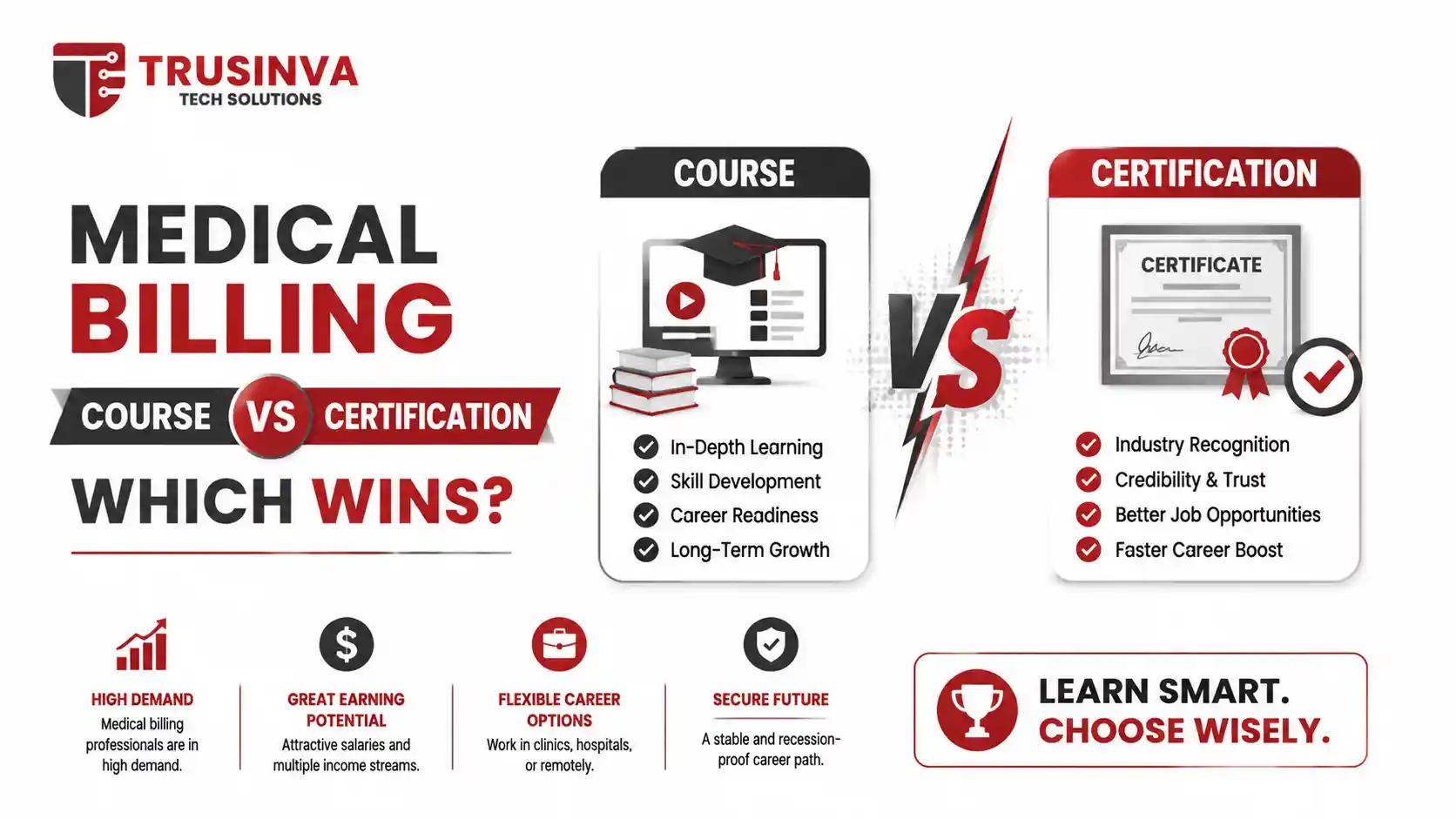
If you're exploring a career in healthcare administration, you've probably run into two confusing terms: "medical billing course" and "medical billing certification." They sound similar, but they're not the same thing — and choosing the wrong path can cost you time, money, and job opportunities.
This guide breaks down the real difference between a medical billing course and a medical billing certification, so you can decide which one actually gets you hired faster in 2026.
What Is a Medical Billing Course?
A medical billing course is a structured training program that teaches you the fundamentals of medical billing — insurance claims, patient billing, CPT and ICD-10 codes, and healthcare reimbursement systems.
Think of it as the "learning phase." You're building skills, not yet proving them to an employer.
Most courses run anywhere from a few weeks to a few months and are offered both online and in-person. Many students start with a course before pursuing formal certification, because it builds the foundation needed to pass certification exams later.
What Is Medical Billing Certification?
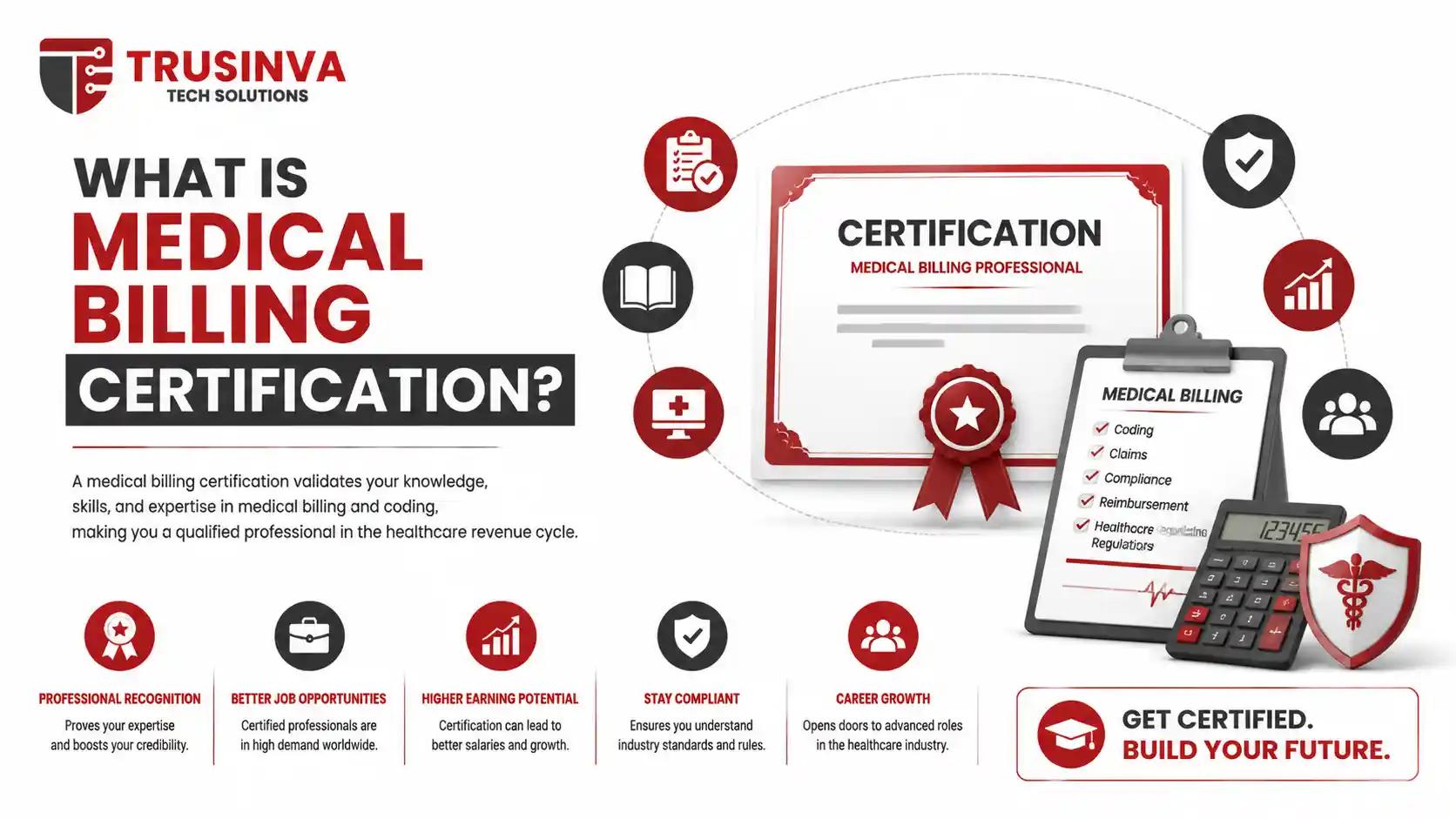
Certification is the official, tested proof that you know medical billing well enough to work professionally. Bodies like AAPC and AHIMA issue recognized credentials such as CPC or CPB after you pass a standardized exam.
Certification tells an employer: "This person didn't just study medical billing — they proved it."
That's a meaningful distinction, especially in the USA, where healthcare employers often filter resumes based on credentials before even reading experience.
Medical Billing Course vs Certification: Key Differences
| Factor | Medical Billing Course | Medical Billing Certification |
| Purpose | Builds foundational skills | Validates skills with an exam |
| Time | Weeks to a few months | Requires passing a formal exam |
| Recognition | Varies by provider | Recognized industry-wide |
| Job Impact | Helpful for beginners | Often required or preferred |
| Cost | Generally lower | Can be higher due to exam fees |
The honest answer? A course teaches you. A certification proves you. Most successful medical billers do both — course first, certification second.
Why It Is Important
Medical billing sits at the center of healthcare's revenue cycle. Every claim, every reimbursement, every patient invoice runs through this process.
For clinics and healthcare employers, hiring someone without verified skills is risky — errors in coding or claims processing can lead to compliance issues, delayed payments, or HIPAA violations.
For job seekers, the healthcare billing space is growing rapidly, driven by remote work opportunities and AI-assisted claims processing. Employers increasingly want candidates who understand both traditional billing workflows and how automation is reshaping the role in 2026.
This isn't just a US trend either. Businesses across Pakistan and other outsourcing hubs are training billing specialists to serve American healthcare providers remotely — making this one of the more accessible, high-demand international career paths available right now.
Key Benefits
Choosing the right training path pays off in several ways:
- Faster hiring — certified professionals are often prioritized in applicant screening
- Higher earning potential — credentialed billers typically negotiate better starting pay
- Remote job access — certification opens doors to fully remote US healthcare billing roles
- Career stability — healthcare billing is a recession-resistant field
- Skill transferability — billing knowledge applies across clinics, hospitals, and outsourcing companies
- Business trust — clinics prefer hiring or outsourcing to certified specialists to reduce compliance risk
Step-by-Step Process: How to Become a Certified Medical Biller
- Start with foundational learning. Take a structured medical billing course to understand claims, coding basics, and healthcare terminology.
- Choose your certification path. Decide between CPB (billing-focused) or CPC (coding-focused), depending on your career goals.
- Study exam-specific material. Certification exams test applied knowledge, not just theory — practice with real billing scenarios.
- Sit for the exam. Schedule and complete your certification exam through an accredited body.
- Build practical experience. Apply for entry-level billing roles or internships to strengthen your resume.
- Stay updated. Billing codes and compliance rules change yearly — ongoing education keeps your credential relevant, especially with AI tools reshaping claims workflows.
Common Mistakes Businesses and Learners Make
Mistake 1: Choosing certification without foundational training. Jumping straight into a certification exam without proper course prep often leads to failed attempts and wasted exam fees.
Mistake 2: Assuming a certificate equals certification. A course completion certificate is not the same as an industry-recognized certification like CPC or CPB. Employers know the difference.
Mistake 3: Ignoring ongoing education. Healthcare billing rules change often. Professionals who stop learning after certification fall behind quickly.
Mistake 4: Employers skipping verification. Some clinics hire billing staff without confirming actual certification status, leading to costly claim errors down the line.
Mistake 5: Overlooking outsourced billing support. Many small practices try to manage billing in-house without trained staff, resulting in slower reimbursements and revenue loss — when outsourcing to trained specialists would solve this immediately.
Why Choose Trusinva Tech Solutions
Whether you're an individual looking to build a career in medical billing or a healthcare business trying to streamline your revenue cycle, Trusinva Tech Solutions can support both sides of that equation.
If you're starting your career, Trusinva's Medical Billing Course is built to take you from beginner to job-ready, covering practical billing workflows, claims processing, and exam-relevant knowledge. Trusinva also offers specialized training in Truck Dispatching, along with taxation courses for the USA, UK, UAE, and KSA — giving you multiple international career paths under one roof. You can browse all training options on the courses page.
If you're a clinic, healthcare startup, or growing business, Trusinva also builds the digital infrastructure that supports healthcare operations end-to-end. That includes Web Development, Mobile App Development, CRM Development, and custom software solutions for managing patient records, billing workflows, and internal operations.
For clinics trying to attract more patients or scale visibility, Trusinva's SEO Services and Digital Marketing team — including Google Ads, Social Media Marketing, and TikTok Ads — help healthcare businesses grow their local and international client base.
You can see examples of past work on the projects page, learn more about the company on the about page, read more insights on the blog, or explore the full range of offerings on the services page.
FAQs
Is medical billing certification worth it? Yes. Certification is often the deciding factor employers use when comparing candidates with similar experience levels, especially for remote US billing roles.
Do employers prefer certification over a course alone? Most do. A course builds knowledge, but certification proves it in a way employers can verify and trust.
Can I get certified online? Yes. Most certification bodies, including AAPC, offer remote exam options, making it accessible from Pakistan or anywhere internationally.
How long does certification take? It varies, but most learners complete foundational training in a few months, followed by exam preparation and scheduling.
Which pays more — a course-only biller or a certified biller? Certified billers typically command higher pay and more job stability, since employers view the credential as verified expertise.
Is certification required to work in medical billing in the USA? It's not always legally required, but it's increasingly expected by hospitals, clinics, and outsourcing companies as a hiring standard.
Final Thoughts
So, medical billing course vs certification — which one actually wins?
The truth is, they're not competitors. A course builds your foundation. Certification proves your expertise. Together, they give you the strongest possible start in a growing, remote-friendly healthcare career.
If you're ready to start building real, job-ready skills, Trusinva Tech Solutions can help guide you through the right training path — and if you're a business looking to strengthen your healthcare operations, their software and digital marketing teams are ready to help too.
Contact Trusinva Tech Solutions today for professional digital services and business growth. Visit the contact page to get started.