Quick Answer
eCommerce app development in 2026 means building mobile and web shopping experiences that combine fast checkout, personalized product discovery, and increasingly, AI-powered shopping agents. Costs typically range from $30,000 for a basic MVP to $250,000+ for an enterprise-grade, multi-platform app with AI recommendations and headless commerce architecture.
Introduction
Shopping behavior has shifted dramatically, and eCommerce app development in 2026 looks very different from even two years ago. Customers now expect fast, personalized, mobile-first experiences — and increasingly, AI shopping assistants that help them find and buy products directly. Businesses building or upgrading their storefronts often turn to a partner like Trusinva Tech Solutions to navigate this shift without falling behind competitors.
Modern eCommerce app development draws on the same discipline as custom software development and mobile app development, while also depending heavily on UI/UX design to keep checkout friction low. Many businesses choosing between platforms also compare Shopify vs WordPress before deciding whether to build custom or on an existing platform.
This guide breaks down what eCommerce app development actually involves in 2026 — the features, the AI-driven trends, the tech stack, and the costs businesses should expect.
Key Takeaways
- Mobile-first, AI-personalized shopping experiences are now the baseline expectation, not a differentiator.
- Headless and composable commerce architectures give businesses more flexibility to adapt storefronts quickly.
- Agentic and conversational commerce — where AI assistants help shop or even complete purchases — is emerging as a major 2026 trend.
- Payment flexibility (Apple Pay, Google Pay, digital wallets) directly impacts checkout conversion rates.
- Security and privacy compliance (PCI DSS, state privacy laws) must be built into the app from the start.
- Choosing the right development partner depends on your platform (Shopify, custom-built, or headless) and long-term growth plans.
Table of Contents
- Introduction
- What Is eCommerce App Development?
- Why eCommerce Apps Matter More Than Ever in 2026
- Types of eCommerce Apps
- Must-Have Features of a Modern eCommerce App
- AI and Agentic Commerce: The Biggest 2026 Shift
- Headless and Composable Commerce Explained
- Tech Stack for eCommerce App Development
- Step-by-Step Development Process
- Cost of eCommerce App Development
- Security and Compliance Considerations
- Common Mistakes to Avoid
- Future Trends Beyond 2026
- Why Choose Trusinva Tech Solutions
- FAQs
- Conclusion
What Is eCommerce App Development?
eCommerce app development is the process of designing, building, and maintaining mobile or web applications that let customers browse, search, and purchase products online. In 2026, this increasingly includes AI-driven personalization, conversational shopping assistants, and integration with headless commerce backends for faster updates and omnichannel consistency.
Key characteristics of modern eCommerce apps:
- Mobile-first design with fast load times
- Personalized product discovery powered by AI
- Multiple secure payment options
- Real-time inventory and order tracking
- Integration with CRM, ERP, and marketing tools
- Increasingly, AI shopping agents and conversational interfaces
Why eCommerce Apps Matter More Than Ever in 2026
Mobile commerce continues to grow faster than desktop shopping, and customers now compare every shopping app against the fastest, most personalized experience they've used — usually a major retailer's app. Businesses that don't meet that bar lose customers to competitors who do.
Main drivers behind eCommerce app investment in 2026:
- Mobile-first shopping — most retail traffic and conversions now happen on mobile devices.
- AI personalization — customers expect relevant recommendations, not generic catalogs.
- Agentic commerce — AI shopping assistants are starting to search, compare, and even purchase on behalf of users.
- Omnichannel expectations — customers expect a consistent experience across app, web, and in-store.
- Faster fulfillment expectations — real-time inventory and order tracking are now standard, not premium features.
Businesses growing their online presence often pair app development with SEO for eCommerce and digital marketing to drive traffic to the new experience.
Types of eCommerce Apps
| App Type | Primary Users | Core Purpose |
| B2C shopping apps | Consumers | Direct-to-consumer product purchases |
| B2B eCommerce apps | Business buyers | Bulk ordering, account-based pricing |
| Marketplace apps | Multiple vendors, buyers | Multi-vendor product listings and sales |
| D2C brand apps | Consumers | Brand-owned direct sales channel |
| Subscription commerce apps | Consumers | Recurring product deliveries |
| Social commerce apps | Consumers | Shopping through social media integration |
Must-Have Features of a Modern eCommerce App
Customer-facing features:
- Fast, intuitive product search and filters
- Personalized product recommendations
- One-tap checkout with saved payment methods
- Wishlist and saved carts
- Order tracking and returns management
- Push notifications for offers and order updates
- Customer reviews and ratings
Business/admin features:
- Inventory and order management
- CRM and ERP integration
- Analytics dashboards
- Promotions and coupon management
- Multi-store or multi-vendor management (for marketplaces)
Emerging 2026 features:
- AI shopping assistants for product discovery
- Conversational search ("find me a waterproof jacket under $100")
- Machine-readable product data for AI shopping agents
- Visual and voice search
AI and Agentic Commerce: The Biggest 2026 Shift
Agentic commerce refers to AI systems — like shopping assistants built on models from providers such as ChatGPT, Gemini, or Claude — that can search, compare, and in some cases complete purchases on a customer's behalf. This is pushing businesses to make their product data more structured and machine-readable, not just human-readable.
What this means for app development in 2026:
- Product catalogs need clean, structured data that AI agents can parse accurately.
- Checkout flows may need to support agent-initiated transactions, not just human clicks.
- Personalization engines increasingly rely on generative AI, not just rule-based recommendation logic.
- Conversational interfaces are becoming a standard app feature, not an experiment.
Expert insight: Businesses that treat AI shopping agents as a distribution channel — similar to how they treat search engines — will likely have an edge as agentic commerce matures. Structuring product data cleanly today avoids costly rework later.
Headless and Composable Commerce Explained
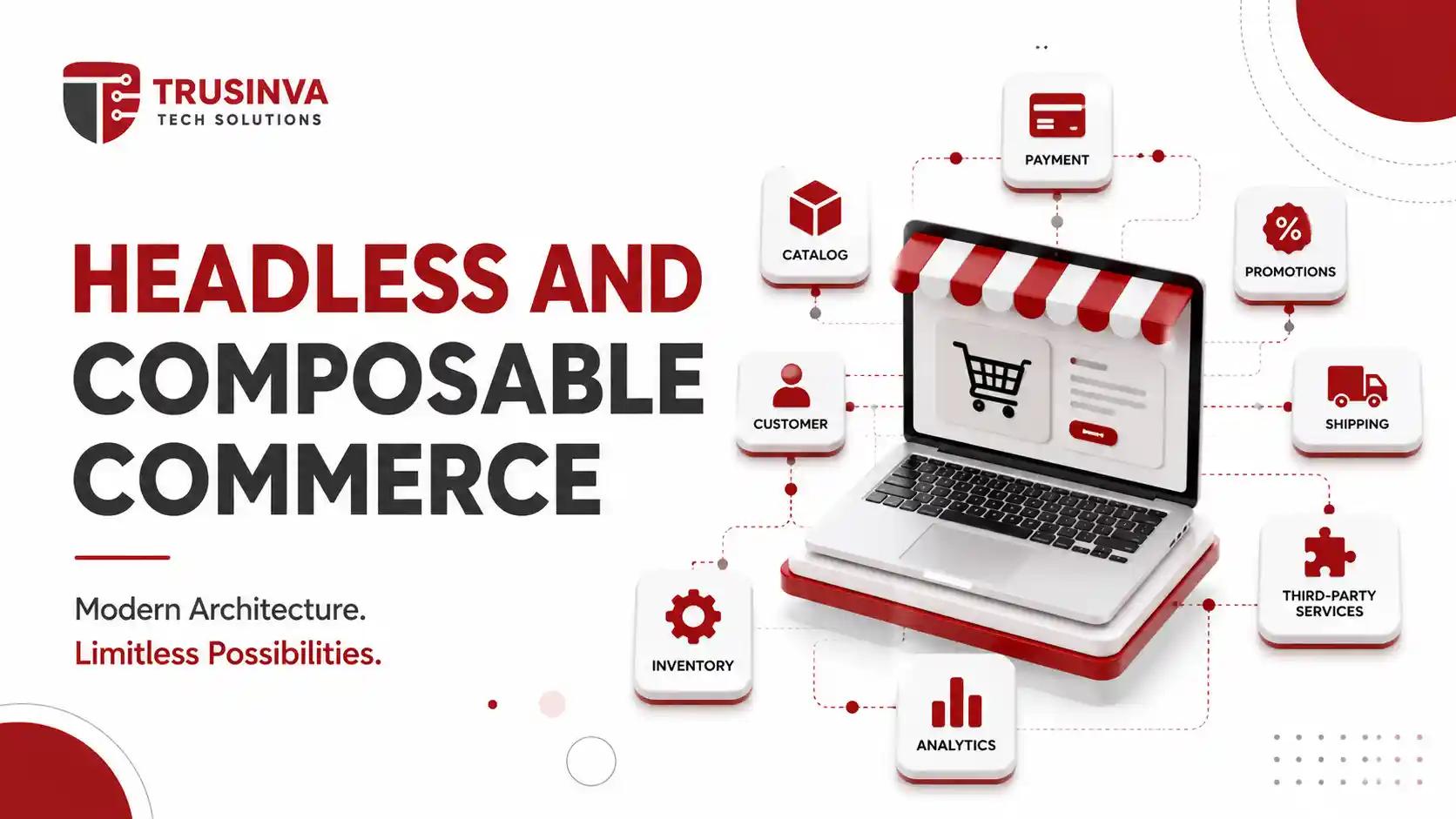
Headless commerce separates the frontend (what customers see) from the backend (product, inventory, and order logic), letting businesses update their app's design or add new AI features without rebuilding the entire platform. Composable commerce takes this further, letting businesses mix and match best-in-class tools using a MACH architecture (Microservices, API-first, Cloud-native, Headless).
Benefits of this approach:
- Faster front-end updates without backend risk
- Easier integration of new AI or personalization tools
- Better performance across web, mobile, and emerging channels
- More flexibility to switch vendors without a full rebuild
Trade-off: Headless and composable architectures usually cost more upfront and require a more experienced development team than a standard platform build — worth it for scaling businesses, often unnecessary for early-stage stores.
Tech Stack for eCommerce App Development
| Layer | Common Technologies |
| Mobile frontend | React Native, Flutter, Swift, Kotlin |
| Backend | Node.js, Python, Java |
| Database | PostgreSQL, MongoDB, Redis |
| APIs | REST, GraphQL |
| Payments | Stripe, PayPal, Apple Pay, Google Pay |
| Infrastructure | AWS, Google Cloud, Microsoft Azure, Firebase |
| Analytics | Google Analytics, Firebase Analytics, Mixpanel |
Platform choice matters too — some businesses build on Shopify, others choose WordPress or a fully custom web development build, depending on flexibility needs and budget.
Step-by-Step Development Process
- Discovery and platform strategy — decide between custom-built, Shopify, headless, or hybrid approach.
- UI/UX design — design mobile-first flows focused on reducing checkout friction.
- Architecture planning — plan data structure, especially if targeting AI shopping agents.
- MVP development — launch core shopping, cart, and checkout functionality first.
- Payment and shipping integration — connect payment gateways and shipping/tax APIs.
- AI and personalization setup — implement recommendation engines and, if relevant, conversational search.
- Testing — functional, performance, and security testing across devices.
- Deployment and monitoring — launch with analytics and performance monitoring in place.
- Ongoing optimization — continuous A/B testing and feature updates post-launch.
Cost of eCommerce App Development
| Project Type | Approximate Cost Range | Timeline |
| Basic MVP (catalog, cart, checkout) | $30,000 – $70,000 | 2–4 months |
| Mid-size app (personalization, CRM/ERP integration) | $70,000 – $150,000 | 4–7 months |
| Enterprise/headless platform (AI, multi-vendor, omnichannel) | $150,000 – $300,000+ | 7–12 months |
Costs depend on platform choice (Shopify vs. custom vs. headless), number of integrations, and whether AI personalization or agentic commerce features are included. Many businesses start with affordable web development before scaling to a full custom build.
Security and Compliance Considerations
Any eCommerce app handling payments must comply with PCI DSS, and businesses operating in states like California also need to account for privacy laws such as CCPA/CPRA when handling customer data.
Key security practices:
- Use tokenization instead of storing raw card data
- Encrypt customer data at rest and in transit
- Follow WCAG accessibility guidelines for inclusive checkout
- Run regular fraud detection and vulnerability scans
- Keep third-party payment and shipping integrations updated
Common Mistakes to Avoid
- Building for desktop first when most traffic and conversions now happen on mobile.
- Ignoring page speed and checkout friction — every extra step reduces conversion.
- Treating AI personalization as optional — customers increasingly expect it.
- Choosing a platform without a growth plan — migrating later is expensive and disruptive.
- Skipping structured product data — this will increasingly hurt visibility as AI shopping agents grow.
- Underinvesting in post-launch optimization — the app's first version is rarely its best-performing version.
Future Trends Beyond 2026
- Agentic and conversational commerce will continue expanding as AI shopping assistants become more capable.
- Composable commerce adoption will grow among mid-size and enterprise retailers seeking flexibility.
- Visual and voice search will become more common as product discovery methods.
- Social and live commerce will keep blending content and shopping into a single experience.
- Machine-readable product data will become a competitive advantage as AI agents drive more purchases.
Why Choose Trusinva Tech Solutions
Building a modern eCommerce app means balancing user experience, performance, and readiness for AI-driven shopping — all at once. Trusinva Tech Solutions brings together custom software development, mobile app development, Shopify development, and AI development expertise to help businesses build shopping experiences that perform today and adapt tomorrow.
The broader services lineup — including UI/UX design, digital marketing, and SEO — also helps eCommerce businesses drive traffic once the app is live. You can review past work in the projects portfolio or explore more guides on the blog.
FAQs
1. What is eCommerce app development? It's the process of building mobile or web applications that let customers browse, search, and purchase products, increasingly enhanced with AI personalization and conversational shopping features.
2. How much does eCommerce app development cost in 2026? Costs typically range from $30,000 for a basic MVP to $300,000+ for a full enterprise platform with AI personalization and headless architecture.
3. How long does it take to build an eCommerce app? Most projects take 2–4 months for an MVP and 7–12 months for a full-featured, AI-integrated enterprise platform.
4. Should I build on Shopify or go fully custom? Shopify suits businesses wanting speed and lower upfront cost; custom or headless builds suit businesses needing deep flexibility, unique features, or high-scale performance.
5. What is agentic commerce? Agentic commerce is when AI assistants search, compare, and sometimes complete purchases on a customer's behalf — making structured, machine-readable product data increasingly important.
6. What payment methods should an eCommerce app support? Most modern apps support cards, Apple Pay, Google Pay, and digital wallets, since payment flexibility directly affects checkout conversion rates.
7. What technology stack is best for eCommerce apps? Common choices include React Native or Flutter for mobile, Node.js/Python for backend, PostgreSQL/MongoDB for data, and Stripe/PayPal for payments.
8. What's the biggest mistake businesses make with eCommerce apps? Treating the app as a one-time project instead of an evolving product — checkout friction, personalization, and AI-readiness all require ongoing optimization.
Conclusion
eCommerce app development in 2026 is no longer just about having a mobile storefront — it's about building fast, personalized, AI-ready shopping experiences that keep up with how customers actually search and buy. Getting the architecture, features, and platform choice right early saves significant rework as AI-driven and agentic commerce continue to grow.
If you're planning to build or upgrade an eCommerce app, the right partner makes the difference between a storefront that keeps up and one that falls behind. Trusinva Tech Solutions works with businesses across the USA to design and build eCommerce apps ready for both today's customers and tomorrow's AI shopping agents. Explore the courses available for teams wanting to build in-house digital skills, or reach out directly to discuss your project — and don't forget to Book a Seat in one of Trusinva's upcoming digital marketing or technology training sessions to get your team ready before your app goes live.