Quick Answer
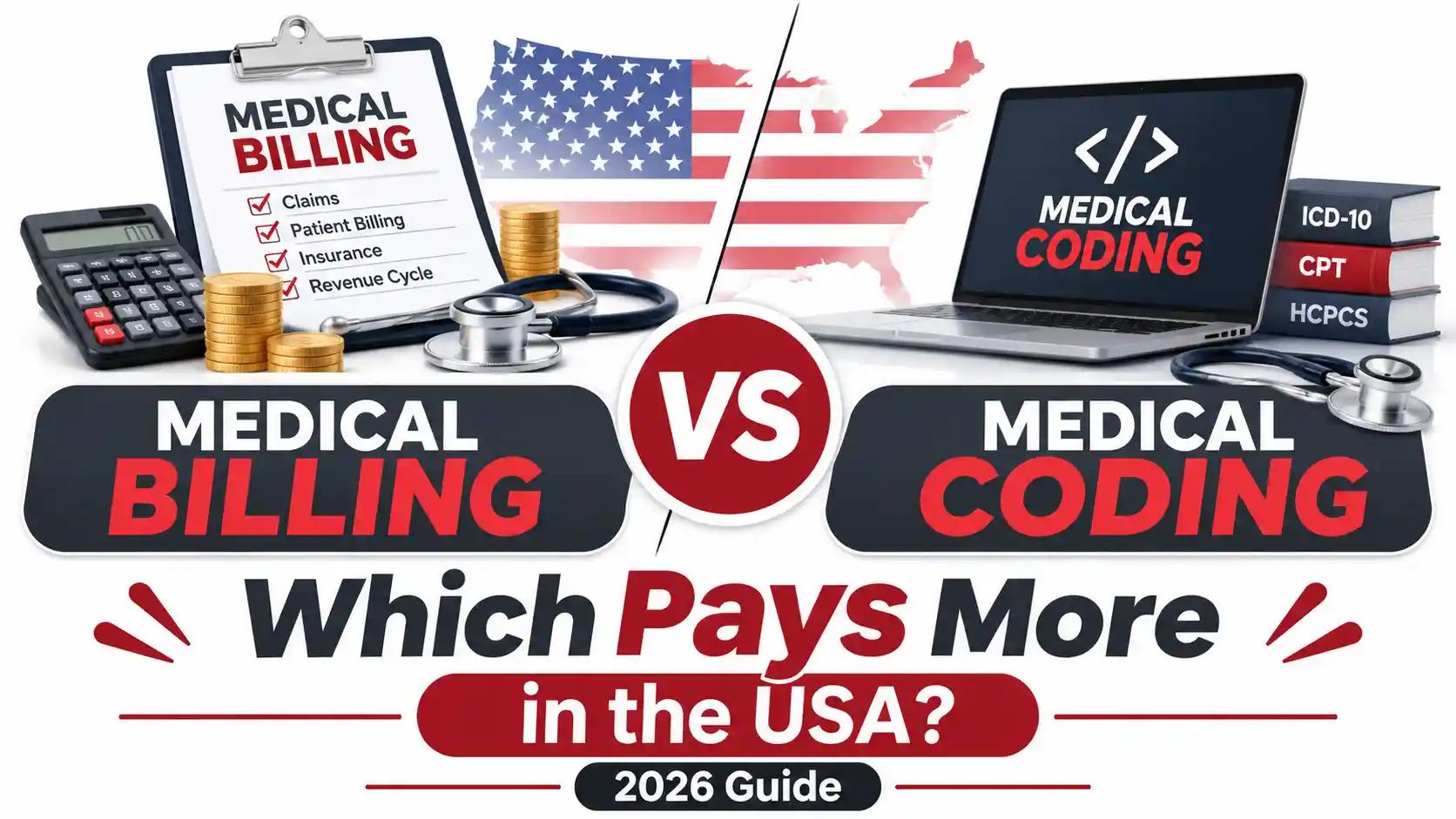
Medical coding typically pays slightly more than medical billing in the USA. In AAPC’s 2026 salary report (2025 data), Certified Professional Coders averaged $67,147 and Certified Professional Billers averaged $63,874, a gap of about 5%. Pay depends more on certification, experience, employer size and state than on job title alone.
Explore the Course → to ask about the medical billing course at Trusinva Tech Solutions.
Introduction
Medical billing vs medical coding: which pays more in the USA? The short answer is coding, but only by a modest margin, and the gap shrinks or reverses in some states. If you are comparing careers, it helps to see how certification choices change the picture before you pick a path.
Trusinva Tech Solutions offers medical billing services and a medical billing course. The website describes the course as covering healthcare billing, ICD-10 coding and insurance. We wrote this guide to answer the pay question with sourced data instead of rumors. The main sources are the U.S. Bureau of Labor Statistics (BLS) and the AAPC annual salary report.
If you want to see the course scope as you read, you can Learn More or look at the course page.
Key Takeaways
- Coders and billers earn similar money. In AAPC’s data the credentialed-coder average is about 2% to 5% higher, depending on the survey edition.
- Certification matters more than job title. AAPC reports that certified specialists average 20.7% more than non-certified ones. See how Trusinva approaches billing training below.
- Specializing beats choosing one side. Auditing, compliance and inpatient coding credentials report higher averages than entry-level CPC or CPB.
- Employer size and state shift pay by tens of thousands of dollars. Read the medical billing services guide to see the employer side.
- Most respondents in AAPC’s survey work fully remote. Remote access is common, but not guaranteed.
- No guide can promise a salary. Treat every figure here as a benchmark, not an offer.
What Is the Difference Between Medical Billing and Medical Coding?
Medical coding turns healthcare documentation into standardized codes, while medical billing uses those codes to create claims and collect payment. Coders work from clinical records and code sets such as ICD-10-CM. Billers submit claims to insurers, follow up on denials and bill patients. Both roles sit inside the healthcare revenue cycle.
In small practices one person often does both jobs. In larger organizations the roles are separate, which is why job titles and pay can differ. Our guide to billing for mental health practices shows how one specialty handles the whole cycle.
| Factor | Medical coding | Medical billing |
| Main task | Assigns diagnosis and procedure codes from documentation | Prepares and submits claims, posts payments, works denials |
| Works from | Clinical notes and records | Coded encounters, payer rules and patient accounts |
| Typical contact | Providers and auditors | Insurers and patients |
| Common AAPC credential | CPC | CPB |
| Core strength | Accuracy and documentation reading | Payer knowledge and follow-up |
The two jobs depend on each other. A coding error can trigger a denial, and billers often spot coding patterns that cause rejections. That link is a major reason many professionals eventually learn both, as the medical billing service overview illustrates.
Which Pays More: Medical Billing or Medical Coding?
Medical coding pays slightly more on average, but the gap is small. AAPC’s 2026 report puts credentialed coders (CPC) about $3,273 above credentialed billers (CPB), roughly 5%. Specialty credentials and experience add far more than the billing-versus-coding choice does.
AAPC’s 2026 report, based on 2025 data, lists $67,147 for the CPC and $63,874 for the CPB, up 19.6% and 18.5% respectively since 2020.
| Credential | 2020 average | 2025 average | Change |
| Certified Professional Coder (CPC) | $56,164 | $67,147 | 19.6% |
| Certified Professional Biller (CPB) | $53,903 | $63,874 | 18.5% |
Two things stand out. Both groups grew at nearly the same pace, and the gap is under $3,500 a year. If you plan to start in billing, you are not giving up a large premium. Enroll Now →
AAPC’s certification page shows an earlier set of figures, $58,055 for the CPC and $56,652 for the CPB, which is a gap of about 2.5%. The direction is the same, and the size of the gap changes by survey edition. A useful guide to these numbers is our piece on common billing mistakes, because accuracy is what employers pay for in both roles.
How to read salary numbers (and why sites disagree)
Salary pages disagree because they measure different things. Reading them correctly saves you from bad comparisons.
- BLS reports a median for “medical records specialists.” That median was $50,250 in May 2024. BLS covers a broad group that includes many non-certified workers. In the sources reviewed, BLS does not publish separate wages for “medical billers” and “medical coders.”
- AAPC reports averages from a voluntary survey of its members, who are mostly certified. That is why AAPC figures run higher than BLS figures.
- Job-board estimates (for example, ZipRecruiter-style city lists) can be skewed by a few outlier postings.
Use BLS for the whole labor market and AAPC for credentialed professionals. Do not compare one source’s average with another source’s median. For help planning your own path, see the online course guide.
Do billers ever earn more than coders?
Yes, in some states. AAPC’s state pages (survey edition not stated in the excerpts reviewed) show Florida CPB holders at $68,133 against $65,430 for CPC holders, and Mississippi CPB holders at $61,667 against $56,066 for CPC holders. Small samples can cause this, so treat it as a reminder that averages hide variation. Before you commit, compare your local market using the medical billing services overview.
What Affects Pay More Than Job Title?
Certification, experience, employer size and state affect pay more than the billing-versus-coding label. AAPC reports that certification is the number one factor, and its experience and employer-type data show gaps of $20,000 or more. These figures cover all AAPC survey respondents, not coders or billers alone.
If you want a structured start, the medical billing course is a way to begin building those skills.
Pay by certification
AAPC’s data shows non-certified specialists averaging $55,721 and certified specialists $67,260, which is 20.7% more.
| Credential level | Average salary |
| Non-certified | $55,721 |
| Certified | $67,260 |
| Two AAPC certifications | $74,557 |
| Three or more AAPC certifications | $81,227 |
Pay by specialty credential
| AAPC credential | 2025 average |
| Certified Professional Billers (CPB) | $63,874 |
| Certified Professional Coders (CPC) | $67,147 |
| Certified Outpatient Coder (COC) | $75,786 |
| Certified Risk Adjustment Coder (CRC) | $74,629 |
| Certified Inpatient Coder (CIC) | $76,354 |
| Certified Professional Medical Auditor (CPMA) | $81,591 |
| Certified Professional Practice Manager (CPPM) | $84,521 |
| Certified Professional Compliance Officer (CPCO) | $94,017 |
Pay by experience
AAPC reports first-year specialists earning $45,377 and those with 31 or more years earning $80,479, with the largest gains in the first 15 years.
| Years on the job | Average income |
| 0 to 1 | $45,377 |
| 2 to 4 | $51,073 |
| 5 to 9 | $59,144 |
| 10 to 15 | $67,331 |
| 16 to 20 | $72,558 |
| 21 to 25 | $75,602 |
| 26 to 30 | $78,747 |
| 31 or more | $80,479 |
Entry-level pay is modest in both roles. Experience and credentials close the gap. For examples of the work that builds experience, read how billing teams reduce denials.
Pay by employer size
AAPC reports that health systems pay an average of $67,657, individual hospitals $65,396, large physician groups $65,224, medium groups $59,088 and small practices $53,246.
| Employer type | Average pay |
| Health system | $67,657 |
| Individual hospital | $65,396 |
| Large physician group (50+ physicians) | $65,224 |
| Medium group (11 to 49 physicians) | $59,088 |
| Solo or small group (2 to 10 physicians) | $53,246 |
A larger employer can mean about $14,000 more than a small practice. For entry-level people, that may matter more than choosing coding over billing. If you are curious how outside billing firms fit in, our medical billing services page explains the model.
Pay by state
AAPC reports state averages differing by up to 54.2%, from $77,708 in Delaware to $50,393 in Mississippi.
| State | Average income (2025) |
| Delaware | $77,708 |
| California | $77,077 |
| Massachusetts | $76,483 |
| New York | $74,426 |
| Washington | $73,341 |
| Texas | $67,458 |
| Florida | $61,676 |
| Mississippi | $50,393 |
Pay by education
AAPC reports specialists with no college education averaging $29.63 per hour and those with a bachelor’s degree $32.86, which is 10.9% more. Certification does not require a degree. AAPC also notes that the higher pay of master’s degree holders has more to do with role and job title than with education. If you need a faster, lower-cost entry, see the medical billing course details.
Can Medical Billers and Coders Work From Home?
Yes, both roles can work remotely, and remote work is now common. AAPC’s survey reports 64.8% of respondents fully remote, 19.8% fully on-site and 15.4% hybrid. The survey does not split these numbers by billing versus coding in the material reviewed, so do not assume equal access for both.
AAPC says remote work among specialists was roughly 30% to 33% before 2020, and 64.8% of 2025 respondents worked fully remote.
| Work location | Share of respondents |
| Full-time remote | 64.8% |
| Full-time on-site | 19.8% |
| Hybrid | 15.4% |
Remote work usually requires secure systems and strong self-management. Employers that handle patient data must follow privacy rules, and many hire people with proven accuracy first. Our medical billing guide covers how beginners build that record.
How Strong Is Job Demand?
Demand is solid and growing faster than average. BLS projects 7% growth for medical records specialists from 2024 to 2034, much faster than average for all occupations. BLS counted 194,800 jobs in 2024 and projects a change of 13,800 by 2034.
AAPC, citing BLS, adds that about 14,200 openings are projected each year, mostly from replacement of workers who retire or change occupations. Growth is driven by an aging population and wider use of electronic health records. Practices that outsource work also create demand, which is the model behind outsourced billing.
BLS’s growth figure covers the medical records specialist group as a whole. It does not tell you whether billing or coding will grow faster, so treat any claim that one is “safer” with caution. For an employer view of the work, read about reducing claim denials.
Is Medical Coding Harder Than Medical Billing?
Neither is universally harder, but they test different skills. Coding rewards careful reading of documentation and strong command of code sets. Billing rewards payer knowledge, follow-up discipline and patient communication. This is general guidance, not a measured difficulty ranking.
| Skill area | Coding leans on | Billing leans on |
| Reading | Clinical documentation | Payer rules and remittance data |
| Precision | Code selection | Claim accuracy |
| People skills | Provider queries | Insurer and patient calls |
| Pressure points | Annual code updates | Denials and aging accounts |
If you enjoy puzzles and detail, coding may feel natural. If you prefer problem-solving with other people, billing may fit better. Our billing mistakes guide shows where beginners trip up on the billing side.
Education and Certification: What Do You Need?
You usually need a postsecondary certificate and a professional credential. BLS says certification may be required or preferred. AAPC requires membership to sit its CPC exam, and apprentice designations such as CPC-A exist for people without work experience yet.
One training provider notes that you must be an AAPC member to take the CPC exam. The CPC-A apprentice designation applies until experience requirements are documented. Other credentials include AHIMA’s CCA and CCS, and some programs bundle NHA’s CBCS. Exam fees and membership prices change, and sources disagreed on current amounts, so confirm them on the credentialing body’s website.
A practical sequence for beginners:
- Choose billing, coding, or both, using the matrix below.
- Complete a structured program such as the medical billing course.
- Practice with real claim and coding scenarios.
- Sit a recognized exam (AAPC or AHIMA).
- Apply for entry-level or apprentice roles, and keep a record of accuracy and experience.
- Add a specialty credential after you gain experience.
Not sure how courses and certifications differ? Our comparison of course versus certification answers that, and the online course guide shows what to look for.
What this course does not promise: Trusinva’s course does not promise a job, a salary, certification or visa outcomes. Contact us for current details before enrolling.
Should You Choose Medical Billing or Medical Coding?
Choose coding if you like documentation and detail work, billing if you like payer follow-up and people contact, and consider learning both. Because the pay gap is small, fit and long-term specialization matter more than the starting title.
| Your situation | Likely better start | Why |
| You like reading and rule-based accuracy | Coding | CPC averages slightly higher in AAPC data |
| You like phone follow-up and problem solving | Billing | Billing leans on payer and patient contact |
| You want the widest option set | Both | Two credentials average $74,557 in AAPC data |
| You want a fast first step | Billing course first, then coding | Builds revenue cycle understanding quickly |
| You aim for management or audit | Either, then specialize | Audit and compliance credentials report the highest averages |
| You live where billers out-earn coders | Check local data | State pages show exceptions |
Decision checklist
- I know whether I prefer documentation work or payer and patient contact
- I compared pay in my state, not only the national average
- I checked whether my target employers require a credential
- I have a plan to add a second credential within a few years
- I budgeted for training, exam and membership costs
To discuss your options, look at the medical billing course and Book a Free Consultation . For how billing works in practice, see our medical billing services page.
Career Paths Beyond Entry Level
Both roles can lead to audit, compliance, documentation improvement and management. AAPC’s data shows the highest-paying credentials sit in those areas. A typical path starts with an entry credential, adds specialty skills and then moves to a lead or oversight role.
| Stage | Example roles |
| Entry | Billing specialist, apprentice coder |
| Mid | Specialty coder, denial specialist, revenue cycle analyst |
| Senior | Medical auditor, compliance officer, practice manager |
Experience also matters. In AAPC’s data, 10 to 15 years of experience averages $67,331. Good habits early on, such as accuracy and documentation, speed up that climb, as the lessons in billing accuracy show.
Will AI Replace Medical Coders and Billers?
Nobody can say for certain, but the work is shifting from manual entry toward oversight. AAPC describes the coder and biller role as moving from task execution to workflow oversight and decision support. AI tools are changing workflows, and you should plan to work alongside them.
AAPC says the role is evolving from task execution into workflow oversight and decision support. AAPC also offers an introductory course on AI concepts for billing and coding. I found no verified evidence on exactly how many jobs automation will remove, so treat bold predictions with caution.
A sensible response is to build skills that stay valuable: auditing, documentation review, denial analysis and compliance. For a business view of automation, see our AI automation services guide and our overview of an AI development company.
HIPAA, Accuracy and Compliance Basics
Billers and coders handle protected health information, so privacy rules apply. HHS says the HIPAA Rules apply to covered entities and business associates. Business associates include billing companies and companies that process health care claims.
In practice, this means employers need written agreements and safeguards, and staff need training. This section is general information, not legal or compliance advice. Ask your employer or a qualified professional about your obligations. Our guide to billing services explains how accuracy and compliance connect to denials.
Latest Updates for 2026
The FY2027 ICD-10-CM code set took effect on October 1, 2026. Coders and billers must use it for encounters from that date through September 30, 2027. Reports differ on the number of new codes depending on how headers are counted, so check CMS for the final list.
CMS says the October 1, 2026 diagnosis code files apply to encounters from October 1, 2026 through September 30, 2027. The set is maintained by CDC’s National Center for Health Statistics, and there is no grace period. One AAPC analysis counts 238 new codes, four revisions and 21 deletions. Another breakdown splits those 238 additions into 190 billable codes and 48 non-billable headers.
| Update | What changed | Why it matters |
| ICD-10-CM FY2027 | New, revised and deleted codes effective Oct 1, 2026 | Claims with deleted codes can be rejected |
| AAPC 2026 salary report | Based on 2025 data; CPC $67,147, CPB $63,874 | Newest credential benchmarks |
| BLS projections | 7% growth, 2024 to 2034 | Demand outlook |
Last verified: November 5, 2026. Updates like these are one reason ongoing training matters, as the course overview notes.
Common Mistakes
The most common mistake is choosing a path from one salary number. Others include skipping certification, ignoring state differences and never specializing. Avoid these, and also read how clinics lose revenue to billing errors.
- Treating a single average as a promise of your pay
- Comparing BLS medians with AAPC averages as if they were the same
- Skipping certification, even though AAPC reports a 20.7% gap
- Ignoring employer size, which can add about $14,000
- Overlooking state differences (see medical billing services for how local markets work)
- Staying at entry level instead of adding a specialty credential
- Assuming remote work is guaranteed
- Using outdated code sets after the October 1 update
Expert Tips and Checklist
Build accuracy first, credentials second, specialty third. Employers pay for fewer errors and faster payment. These are general best practices, not guarantees. A guide like how billing teams cut denials shows what employers value.
- Practice with realistic claims and documentation, not only theory.
- Learn both sides of the revenue cycle, even if you specialize.
- Track annual code-set changes every fall.
- Keep records of accuracy and projects for your next job application.
- Plan continuing education early, because many credentials require it.
Before you enroll: compare programs, check what the course covers, and confirm costs. You can review the medical billing course and Enroll Now when you are ready.
Why Choose Trusinva Tech Solutions for Medical Billing Training and Services
Trusinva Tech Solutions offers both a medical billing course and medical billing services. That means the people explaining billing to students are working in the same subject area as the service. We make no ranking or outcome claims.
The website describes the course as covering healthcare billing, ICD-10 coding and insurance, which links the billing and coding sides this article compares. You can also see the rest of our course catalog and learn about the company. Our team is distributed, and we do not claim a US office or US-based staff.
If you are weighing billing against coding, we suggest reading the course versus certification guide first and then asking questions through our Contact page.
FAQs
Which pays more in the USA, medical billing or medical coding?
Medical coding pays slightly more on average. In AAPC’s 2026 report, Certified Professional Coders averaged $67,147 and Certified Professional Billers averaged $63,874. Certification, experience, employer size and state change pay more than the title does. See our medical billing course overview for training options.
What is the average medical billing salary in the USA?
AAPC’s 2026 report lists $63,874 for Certified Professional Billers, based on 2025 data. BLS does not publish a separate wage for billers in the sources reviewed. Its median for medical records specialists was $50,250 in May 2024. Read about billing services for context.
What is the average medical coding salary in the USA?
AAPC’s 2026 report lists $67,147 for Certified Professional Coders, with specialty coders such as inpatient coders averaging $76,354. BLS reports a median of $50,250 for the broader medical records specialist group. See how billing errors connect to coding accuracy.
Is medical coding harder than medical billing?
Neither is universally harder. Coding emphasizes documentation reading and code-set accuracy. Billing emphasizes payer rules, denials and patient communication. Your strengths decide which feels easier. Our guide to reducing claim denials shows the billing side in practice.
Can medical billers and coders work from home?
Yes. In AAPC’s survey, 64.8% of respondents worked fully remote, 15.4% hybrid and 19.8% on-site. The survey excerpt reviewed does not split remote access by role, so availability can differ by employer. Learn more about billing roles in different practices.
Do I need certification to start in medical billing or coding?
BLS says certification may be required or preferred, and AAPC reports certified specialists average 20.7% more than non-certified ones. Some employers hire without a credential, but certification improves your options. Compare paths in our course versus certification guide.
Should I choose medical billing or medical coding as a beginner?
Choose coding if you like detail and documentation, billing if you like payer follow-up and people contact. The pay gap is small, and two AAPC credentials average $74,557, so many professionals learn both. Review our online course guide to plan your start.
Will AI replace medical coders and billers?
No verified source shows how many jobs automation will remove. AAPC describes the role shifting toward workflow oversight and decision support. Skills such as auditing, documentation review and denial analysis stay valuable. See our AI automation services guide for the business view.
Conclusion
Summary: Medical coding pays slightly more than medical billing on average, about 5% in AAPC’s 2026 data. The bigger drivers of pay are certification (20.7% more), experience, employer size and state. The medical billing course is one way to start building those skills.
Key recommendation: Pick the side that fits your strengths, earn a recognized credential, and plan to add a specialty within a few years. Compare your own state and employer type before judging any national average, using the medical billing services page to understand the employer view.
Next step: Review the course scope, check current exam and membership costs with the credentialing body, and ask questions before you commit.
Ready to take the next step? Enroll Now or read more on our blog.