Quick Answer
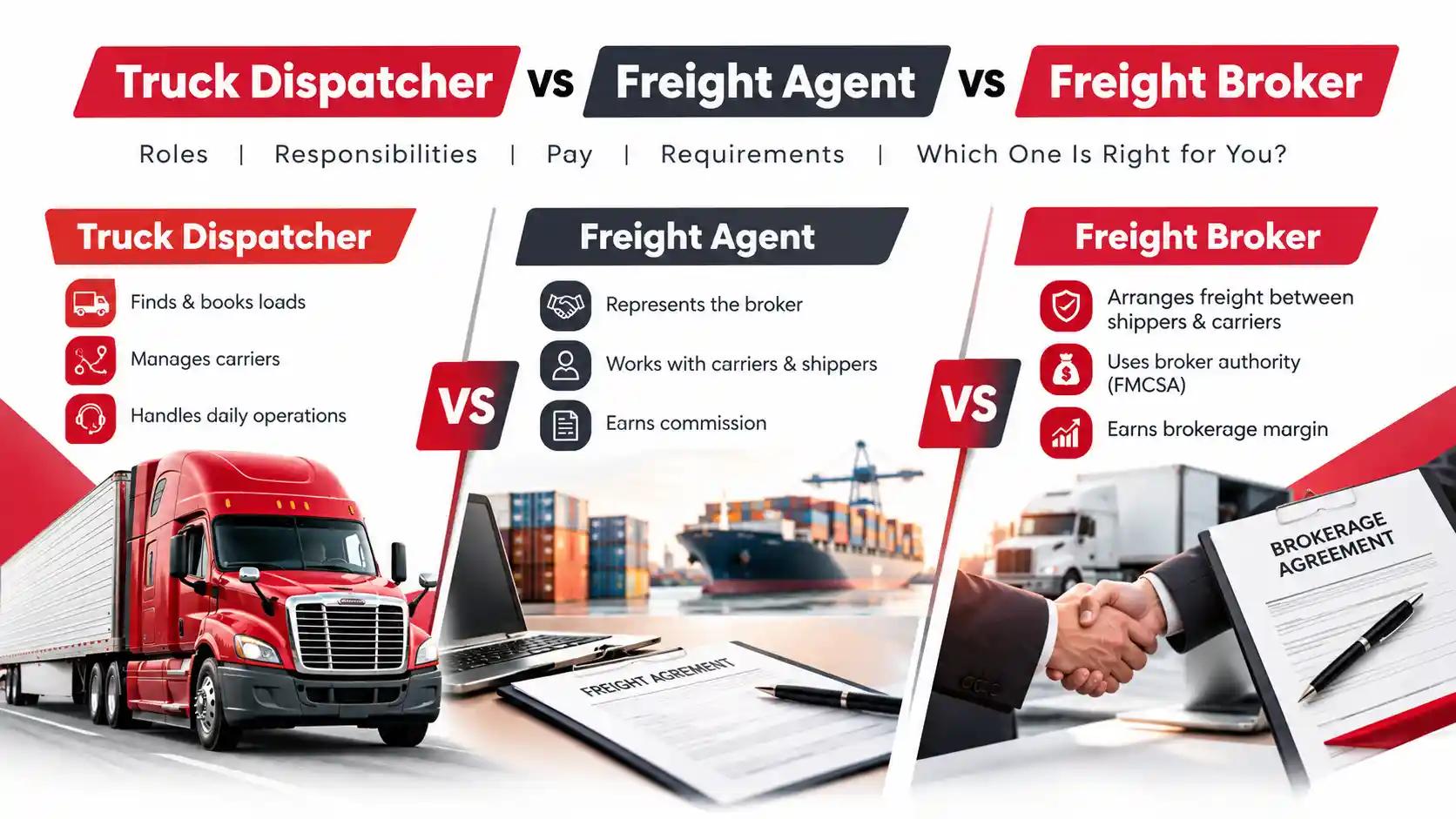
In the truck dispatcher vs freight agent vs freight broker comparison, the difference comes down to who you work for and which federal authority you hold. A dispatcher works for a motor carrier to find and manage loads. A broker holds its own FMCSA broker authority and arranges transportation between shippers and carriers. A freight agent usually sells brokerage services under a licensed broker's authority.
Introduction
Truck dispatcher vs freight broker vs freight agent looks like a vocabulary question until it costs someone money. People use the three titles interchangeably, but federal rules do not. A broker needs FMCSA authority and a financial backstop. A dispatcher may or may not, depending on what the work involves. A freight agent sits in a gray zone that depends on a contract.
This guide explains each role in plain English, shows where the legal line falls, and helps you choose. It covers general freight (non-household goods) in the United States. It does not cover state licensing differences, taxes, household goods brokers, freight forwarders, or international shipping.
Key Takeaways
- A dispatcher's job is defined by what they do, not their title. FMCSA reviews each arrangement case by case.
- A freight broker must hold FMCSA broker authority and keep at least $75,000 in financial security on file.
- Since January 16, 2026, FMCSA suspends broker authority if that security falls below $75,000 and is not restored within seven calendar days.
- A freight agent is not a separate FMCSA registration class. Agents normally work under a licensed broker's authority through a written agreement.
- Negotiating with shippers, choosing between carriers for one load, or handling the money between brokers and carriers all point toward needing broker authority.
- Before you sign with any dispatcher, agent program, or broker, read the written agreement and confirm who is paid by whom.
What Is a Truck Dispatcher?
A truck dispatcher is the operational link between a carrier or driver and the freight they haul. Dispatchers find and book loads, coordinate pickups and deliveries, track progress, and solve problems when plans change.
In plain terms:
- A freight broker works for the freight. Brokers arrange transportation for shippers and need FMCSA authority.
- A dispatcher works for the truck. Dispatchers support carriers or owner-operators.
There are two common ways to work in this field:
- In-house dispatcher. You are employed by a trucking company and manage its drivers and loads.
- Independent dispatcher (dispatch service). You contract with owner-operators or small carriers, usually for a flat fee or a percentage of what the carrier earns, as agreed in your contract.
Many people search "dispatcher" and mean emergency dispatch. They are different careers:
- Truck dispatchers coordinate freight, drivers, and carriers.
- 911 or public safety dispatchers handle emergency calls for police, fire, and ambulance services. The BLS treats these as public safety telecommunicators and lists them separately from other dispatchers.
This guide covers truck and freight dispatching only.
What is Freight Agent and Freight Broker?
A freight broker is a licensed intermediary who connects shippers (businesses that need goods transported) with carriers (trucking or transport companies that move the goods). The broker does not own trucks. Instead, they negotiate rates, arrange pickups and deliveries, handle paperwork, and make sure the shipment is moved on time. In the United States, brokers must hold a license from the Federal Motor Carrier Safety Administration (FMCSA) and carry a surety bond. They earn money from the difference between what the shipper pays and what the carrier is paid.
A freight agent is an independent sales representative who works under a freight broker's license and authority. The agent finds customers, builds relationships, and books loads, while the brokerage handles the legal, financial, and operational side, such as insurance, billing, and carrier payments. Freight agents usually work on commission, often keeping a percentage of the profit on each load, and they can start with much lower costs than opening their own brokerage.
In short, a freight broker is the licensed company that arranges transportation, and a freight agent is a commission-based salesperson who works under that broker's license to bring in and manage shipments.
What is the difference between a truck dispatcher, a freight agent, and a freight broker?
Truck dispatchers, freight agents, and freight brokers differ mainly in who they represent, who pays them, and what federal registration they need. Dispatchers support motor carriers. Brokers are registered intermediaries that arrange transport. Agents extend a broker's sales reach. The titles overlap in everyday use, but FMCSA judges each arrangement by its facts.
Here is the side-by-side view.
| Criteria | Truck dispatcher | Freight agent | Freight broker |
| Typically works for | A motor carrier, as an employee, contractor, or outside dispatch service | A licensed freight broker, usually as an independent contractor | Itself, as a registered intermediary arranging transportation for shippers and carriers |
| Core job | Finds and books loads, plans routes, handles paperwork, supports drivers | Finds shipper customers and sells brokerage services | Arranges transportation by an authorized motor carrier, quotes freight, selects and manages carriers |
| Who usually pays | The carrier, under a written agreement | A commission from the host broker, set by contract | Compensation from the freight transaction, often the spread between what the shipper pays and the carrier receives |
| Own FMCSA authority? | Not automatically; depends on activities | Usually not, when working under a licensed broker's authority (industry practice; confirm with counsel) | Yes, broker operating authority |
| Financial security | No federal dispatcher bond; if the work counts as brokerage, broker rules apply | Carried by the host broker | At least $75,000 (BMC-84 surety bond or BMC-85 trust) |
| Typical pay model | Percentage of gross or flat fee | Commission split | Margin on each load |
| Main risk | Drifting into unauthorized brokerage | Dependence on the host broker and contract terms | Compliance, cash flow, claims, keeping the security funded |
| Startup burden | Lower regulatory burden if it stays on the dispatcher side of the line | Lower capital than starting a brokerage (industry view) | Highest: registration, security, ongoing compliance |
What does a truck dispatcher do?
A truck dispatcher coordinates freight work for a motor carrier. That can mean finding loads, negotiating terms, planning routes, handling paperwork, and keeping drivers informed. FMCSA says no statutory or regulatory definition of a dispatch service exists, so the label covers in-house employees, independent contractors, and outside dispatch companies.
In practice, a dispatcher's day looks like this:
- Sourcing loads on load boards and through existing broker contacts.
- Negotiating terms such as line-haul rate, detention, layover, and other accessorial charges.
- Planning routes and backhauls to cut deadhead miles.
- Handling documents such as carrier packets, rate confirmations, bills of lading, and proof of delivery.
- Supporting drivers in transit with check calls, delay updates, and problem-solving, often using dispatch software or a transportation management system (TMS) and GPS or ELD data.
- Coordinating invoicing so delivery paperwork reaches the right party quickly.
Equipment matters. A dispatcher who knows dry van lanes may not know reefer or flatbed markets, so match the person to your trailer type. If you run open decks, see our notes on dispatching for flatbed carriers. For a fuller picture of the day-to-day value, read how owner-operators use dispatch services.
FMCSA has said it does not believe Congress meant to eliminate dispatch services. It also noted that small carriers that cannot afford a full-time employee may rely on them. That is the legitimate version of the role. The line gets crossed when a "dispatcher" starts doing what a broker does, which the next sections explain.
What does a freight broker do?
A freight broker is a registered intermediary that, for compensation, arranges for an authorized motor carrier to transport someone's property. Federal rules define the role, and FMCSA requires registration, a process agent filing, and at least $75,000 in financial security. A broker does not haul the freight itself.
The federal definition in 49 CFR 371.2 is the anchor. It also notes that brokerage service can be performed on behalf of a motor carrier, a consignor, or a consignee. So the common line that "a broker works for the shipper" is too simple. A broker is an independent intermediary, not an employee of either side.
Day to day, a brokerage typically:
- Wins shipper business and quotes freight.
- Onboards and vets carriers (carrier management).
- Issues the rate confirmation and books the load.
- Tracks the shipment and resolves delays.
- Collects proof of delivery, invoices the customer, and pays the carrier.
- Handles claims and disputes.
Part 371 of the federal regulations also contains rules on broker recordkeeping, misrepresentation, and duties, so brokerage carries compliance obligations beyond the registration itself.
What does a freight agent do?
A freight agent is usually an independent salesperson who sells brokerage services under a licensed broker's authority and shares commission with that broker. FMCSA registers motor carriers, brokers, and freight forwarders, not freight agents as a separate class. The term is also used loosely, so read the agent agreement to see who holds the authority, who invoices customers, and who bears risk.
Here is how the model usually works in the industry. The agent finds shipper customers. The host brokerage supplies its authority, financial security, systems, carrier network, and accounting. The two split the commission under a written agreement. These details come from industry practice rather than a federal rule, so treat them as typical, not guaranteed.
One caution. The "bona fide agent" concept in federal rules concerns agents of motor carriers. FMCSA's guidance also says household goods agents are a different matter. A "freight agent" in the brokerage sense falls outside that definition, so the contract with the host broker does the heavy lifting.
Can a freight agent work without broker authority?
Usually, a freight agent works under a licensed broker's authority through a written agreement. An individual who solicits shippers and arranges carriers in their own name, without a licensed broker behind them, may be acting as an unregistered broker. Confirm your structure with a transportation attorney.
The statute defines a broker as someone who sells, negotiates, or holds itself out by advertisement as arranging motor carrier transportation for pay. FMCSA's MAP-21 guidance also describes unlawful brokerage as arranging transportation without being registered as a broker. Advertising is part of that analysis, so how you market yourself matters.
Questions to ask a host broker before you sign as an agent
- Who contracts with the shipper, you or the brokerage?
- Who pays the carrier, and when?
- Am I an employee or an independent contractor?
- What is the commission split, and when is it paid?
- Who owns the customer relationship if I leave?
- What non-compete or non-solicit terms apply?
- What happens if the brokerage's authority or bond is suspended?
- Who is responsible for compliance, claims, and cargo disputes?
Does a truck dispatcher need broker authority?
Not automatically. FMCSA says a dispatch service may be treated as either a broker or a bona fide agent, depending on what it actually does. Contracting with one carrier, avoiding shippers, and staying out of payment flows point toward no authority. Negotiating with shippers or choosing between carriers for the same load points toward brokering.
This is the most misunderstood point in the whole comparison. Some websites, including some trucking blogs, state flatly that dispatchers never need broker authority. FMCSA's final guidance, published June 16, 2023, says otherwise: the answer depends on the facts. The guidance is not a law, and no single factor decides the outcome. The agency also said it cannot regulate a dispatch service unless it meets the criteria for a broker, freight forwarder, or motor carrier.
Self-check: which side of the line is your dispatch work on?
| What you do | Points toward dispatcher (no broker authority) | Points toward needing broker authority |
| Contract | A written agreement with the carrier appoints you as its agent and sets insurance and liability terms | No qualifying written agreement with the carrier |
| Who you deal with | You work through brokers and do not solicit shippers | You negotiate with a shipper or its representative |
| Who pays you | The carrier, under the agreement (1099 contractor or W-2 employee) | You take pay from a broker or factoring company, or sit inside the money flow between them |
| Which carrier gets the load | You book for the carrier you represent and do not reassign the load | You choose between carriers for the same load, or hand a load to another carrier |
| How loads arrive | You find freight for a carrier that appointed you | You accept a load first and then hunt for a truck, or solicit the open carrier market |
| Your name on the paperwork | You are not a named party on the shipping contract | You are a named party on the shipping contract |
| Disclosure | You say you dispatch under an agreement with a specific carrier | You do not disclose who you represent |
Can a dispatcher represent more than one carrier?
Sometimes. FMCSA said representing several carriers does not automatically make you a broker. What matters is whether you exercise discretion over which carrier gets a load, which FMCSA treats as "allocating traffic." If your agreements keep carriers from competing for the same loads, you may avoid that discretion. FMCSA's examples include carriers that serve separate regions, or that haul different freight types such as reefer and flatbed. If two carriers could take the same load and you pick one, you are allocating traffic and would need broker authority.
What about money?
Handling the money exchanged between shippers and carriers strongly suggests the need for broker authority, but FMCSA says it is not the only test. In its November 2022 interim guidance, FMCSA also noted that a third party that takes a shipper's payment, keeps a profit, and passes the balance to the carrier clearly needs broker authority.
What if you get it wrong?
Brokering without authority can draw penalties under 49 U.S.C. 14916. As of FMCSA's June 2023 guidance, the agency said it could pursue civil penalties for that statute only through the Department of Justice in federal court. Penalty procedures can change, so re-check before relying on that point.
What about load boards?
FMCSA's final guidance says merely making shipper information publicly available, with or without a fee, does not require broker authority, as long as the entity is not otherwise involved in a transaction between shipper and carrier. That applies to listing information, not to arranging the load.
If you are thinking about launching a dispatching business, build your agreements around these factors from day one, and have a transportation attorney review them.
What does it take to become a freight broker in 2026?
To operate as a freight broker, you register with FMCSA, apply for broker operating authority, file a process agent designation (BOC-3), and file at least $75,000 in financial security through a BMC-84 surety bond or BMC-85 trust agreement. As of January 16, 2026, FMCSA suspends authority if that security is not restored within seven calendar days of falling below $75,000.
The steps
- Register in Motus. Motus is FMCSA's new USDOT Registration System. FMCSA says its legacy registration systems began yielding to Motus on May 14, 2026.
- Apply for broker operating authority. FMCSA's application fee is $300 per type of operating authority, and it is non-refundable. Confirm the current fee in Motus when you apply.
- File a BOC-3. This names the process agents who can accept legal papers on your behalf.
- File financial security of at least $75,000. Use a BMC-84 surety bond or a BMC-85 trust fund agreement. The $75,000 is the amount of security, not what it costs. Bond premiums and trust funding vary, so get current quotes.
- Track your status. Motus shows the reason behind a pending status, such as "Pending – Process Agent (Form BOC-3) Filings" or "Pending – Financial Responsibility Filings." Authority takes effect once FMCSA publishes it and the status shows ACTIVE.
- Keep the security funded. More on this below.
- Meet the rest of your obligations. These include the broker rules in 49 CFR Part 371 and any state or local requirements. FMCSA's MAP-21 questions and answers also describe statutory expectations that registrants be qualified by experience and fit to act as brokers. Confirm current requirements before you apply.
What changed on January 16, 2026
FMCSA's financial responsibility rule took effect for brokers and freight forwarders on January 16, 2026. In short:
- If available financial security falls below $75,000 and is not replenished within seven calendar days, FMCSA will suspend the broker's operating authority.
- Surety providers (BMC-84) and financial institutions (BMC-85) must notify FMCSA when the minimum is breached and not timely restored.
- For BMC-85 trust funds, the only acceptable assets are cash, irrevocable letters of credit from federally insured depository institutions, and U.S. Treasury bonds.
- Loan and finance companies are no longer eligible to serve as BMC-85 trustees.
Do MC numbers still exist?
Some earlier industry coverage predicted that FMCSA would phase out MC numbers. FMCSA's May 2026 Motus fact sheet says something narrower: Motus will keep issuing docket numbers, the MC, MX, and FF prefixes remain, and existing USDOT and docket numbers do not change. For newly issued numbers, Motus randomizes USDOT and docket numbers and adds suffixes to USDOT numbers to show the registrations granted, with "B" for broker authority and "C" for property carrier authority. If a guide tells you MC numbers are gone, check FMCSA's own pages.
Which should you choose: truck dispatcher, freight agent, or freight broker?
Choose based on your goal and risk tolerance. Hire or become a truck dispatcher if you work with carriers and want hands-on load management. Consider a freight agent role if you prefer sales and want to build on a broker's infrastructure. Pursue broker authority only if you can fund the security, manage compliance, and run your own operation.
Decision matrix
| Criteria | Truck dispatcher | Freight agent | Freight broker |
| Best if you... | Like operations, carrier relationships, and problem-solving | Like selling and building shipper relationships | Want to run a regulated business with your own customers and carriers |
| Upfront regulatory burden | Low, if you stay on the dispatcher side of FMCSA's line | Low to moderate; the host broker carries the authority | High |
| Capital needed | Low | Low to moderate | Highest: security, setup, and working capital |
| Control over pricing and customers | Moderate | Shared with the host broker | High |
| Dependence on another company | Depends on carrier clients | High: the host broker | Lower, but you carry your own risk |
| Typical failure point | Crossing into unauthorized brokerage | Weak contract terms or a failing host broker | Cash flow, claims, or a suspended authority |
| Skills that matter most | Load planning, negotiation, communication | Prospecting, relationship building | Compliance, credit and carrier vetting, finance |
Verdict by reader scenario
- Owner-operator with one truck: You probably need freight sources and admin help, not a license. Compare working with brokers directly against adding a dispatcher.
- Small fleet that cannot justify a full-time hire: Outsourced or part-time dispatch support may fit, if the agreement is clear.
- Sales-driven newcomer with little capital: The freight agent route lets you build a book of business without owning the authority. Vet the host broker carefully.
- Operations-minded newcomer: Start as a dispatcher. Our truck dispatching course covers logistics, route planning, freight management, and load boards, according to the course page. No course guarantees a job or income. For options in the US, see our overview of dispatcher training in the USA.
- Well-funded entrepreneur comfortable with compliance: Brokerage may fit, with a clear plan for the $75,000 security and ongoing monitoring.
- Experienced dispatcher thinking about growth: First check your current work against the self-check table above. Then decide whether to restructure your agreements or apply for authority.
Who makes more money: a dispatcher or a freight broker?
There is no reliable single answer, and earnings depend on the pay model more than the title. Dispatchers often earn a fee or percentage from carriers, agents earn commission shared with a broker, and brokers earn margin while carrying compliance and cash-flow risk. This article leaves out pay figures because a sourced, like-for-like comparison is not available here. For dispatcher pay, see truck dispatcher pay in the USA.
Should an owner-operator hire a dispatcher or work with a broker?
It isn't always either-or. Carriers commonly book freight through brokers and shippers, and some add a dispatcher to find loads, negotiate, and handle paperwork. What matters is the scope, the fee structure, the written agreement, and who touches the money. Compare those before you sign.
How to vet a dispatcher before you sign
- Ask how they are paid. A percentage of gross or a flat fee should come from you, in writing.
- Read the whole agreement. It should state scope, fees, insurance and liability, and how to end the arrangement.
- Ask who they dispatch for, and how they avoid choosing between carriers for the same load.
- Keep control of your payments. FMCSA treats involvement in the money flow between brokers and carriers as a warning sign for brokerage.
- Confirm you approve each load. Many carriers want that control; put it in the contract.
- Check for a clear process on paperwork: carrier packets, rate confirmations, bills of lading, and proof of delivery.
How to vet a broker before you haul
Look up the broker's operating authority in FMCSA's records and confirm the status shows ACTIVE. FMCSA's registration materials treat an ACTIVE status in its Licensing and Insurance system as the sign that authority has been granted. Since the January 2026 rule, authority can be suspended quickly after a financial shortfall, so recheck status instead of relying on an old packet.
Where dispatch fits and what it costs
Dispatch pricing depends on scope, the number of trucks, equipment type, and whether the fee is a percentage or flat. We do not quote prices here because no sourced benchmark exists. For a closer look at the economics, see dispatch services and carrier costs.
Need outside dispatch help? Trusinva offers truck dispatching services for owner-operators and small fleets. If you have questions about scope or fit, contact our team. Whichever provider you consider, ask how its written agreement works in practice and how it fits the FMCSA factors above.
Common mistakes and red flags
- Treating titles as legal categories. Calling yourself a dispatcher does not settle whether you need authority.
- Assuming dispatchers never need broker authority. FMCSA says it depends on what you do.
- Letting a dispatcher sit in your payment flow. That is one of FMCSA's listed signals of brokerage.
- Skipping the written agreement. Verbal deals leave scope, fees, and liability undefined.
- Reassigning loads without authority. FMCSA's MAP-21 guidance says a motor carrier cannot broker shipments without broker authority.
- Underestimating broker compliance. The security must stay funded, and the suspension clock is short.
- Relying on outdated guides. MC number coverage and pre-2026 broker rules have changed.
- Quoting guaranteed income. Nobody can promise earnings in freight. Be wary of anyone who does.
Can a truck dispatcher become a freight broker?
Yes. A dispatcher can apply for broker operating authority like any other applicant by registering with FMCSA, filing a BOC-3 process agent designation, and filing at least $75,000 in financial security. FMCSA's MAP-21 guidance also refers to experience and fitness expectations, so confirm current requirements before applying.
Many people learn load boards, rates, and carrier relationships as dispatchers or agents first. That experience helps, but it does not replace the compliance work brokerage requires.
FAQ
What is the main difference between a truck dispatcher and a freight broker?
A truck dispatcher works for a motor carrier to find and manage loads, while a freight broker is a registered intermediary that arranges transportation between shippers and carriers. A broker must hold FMCSA broker authority and file at least $75,000 in financial security. A dispatcher has no separate federal registration unless its activities amount to brokerage.
Does a truck dispatcher need broker authority?
Not automatically. FMCSA's June 2023 guidance says a dispatch service can be a bona fide agent or a broker depending on its activities. Working under a written agreement with a carrier, avoiding shippers, and staying out of payment flows point away from brokering. Negotiating with shippers or choosing between carriers for one load points toward it.
Can a freight agent work without broker authority?
Usually, but only when the agent works under a licensed broker's authority through a written agreement. Someone who solicits shippers and arranges carriers under their own name, with no licensed broker behind them, may be acting as an unregistered broker. Get a transportation attorney to review your structure.
Who makes more money, a dispatcher or a freight broker?
It depends on the pay model more than the title. Dispatchers often earn a fee or percentage from carriers, agents earn commission shared with a broker, and brokers earn margin while carrying compliance and cash-flow risk. This article does not quote pay figures; compare the full cost and risk of each path before choosing.
How much does it cost to become a freight broker?
FMCSA charges a $300 non-refundable application fee for each type of operating authority. You must also file at least $75,000 in financial security, either a surety bond or a funded trust, and the bond premium or trust funding varies. Software, business setup, and any insurance your contracts require add to the total, so request current quotes before budgeting.
Can a truck dispatcher become a freight broker?
Yes. A dispatcher can apply for broker operating authority like any other applicant by registering with FMCSA, filing a BOC-3 process agent designation, and filing at least $75,000 in financial security. FMCSA's MAP-21 guidance also refers to experience and fitness expectations, so confirm current requirements before applying.
Is freight brokerage better than truck dispatching?
Neither is better in every case. Brokerage offers independence and control of customer relationships, but it brings federal registration, a $75,000 security requirement, and ongoing compliance duties. Dispatching has a lower regulatory burden if it stays on the dispatcher side of FMCSA's line, but it depends on carrier relationships and clear contracts.
Should an owner-operator use a dispatcher or a broker?
Some owner-operators use both: brokers to supply freight and a dispatcher or in-house help to find and manage loads. Before hiring a dispatcher, review the written agreement, the fee structure, and who handles payments. Before accepting a load, verify the broker's FMCSA authority status.
Conclusion
Summary. A dispatcher supports a carrier, a broker holds federal authority and arranges freight between shippers and carriers, and a freight agent usually sells under a broker's authority. FMCSA decides where dispatching ends and brokering begins by looking at what you do, not what you call yourself.
Key recommendation. Start with the structure of the relationship, not the title. Read the agreement, know who is paid by whom, and run your activities against FMCSA's factors before you sign or launch.
Next step. If you run trucks and want help finding and managing loads, explore Trusinva's truck dispatching service or start a conversation with our team. If you are weighing a career path, review the truck dispatching course page and compare it with the broker requirements above.