Running a mental health practice is hard enough without wrestling with claim denials, credentialing delays, and confusing CPT codes. If you're a therapist, psychologist, psychiatrist, or counselor in the United States, you already know that medical billing for mental health practices is one of the biggest hidden drains on your time and revenue.
This guide breaks down exactly how mental health billing works, why it matters more in 2026 than ever before, and how outsourcing it can free you up to focus on what actually matters: your patients.
Whether you're a solo private practitioner or run a multi-location behavioral health clinic, this article will walk you through the full process — in plain English.
What Is Medical Billing for Mental Health Practices?
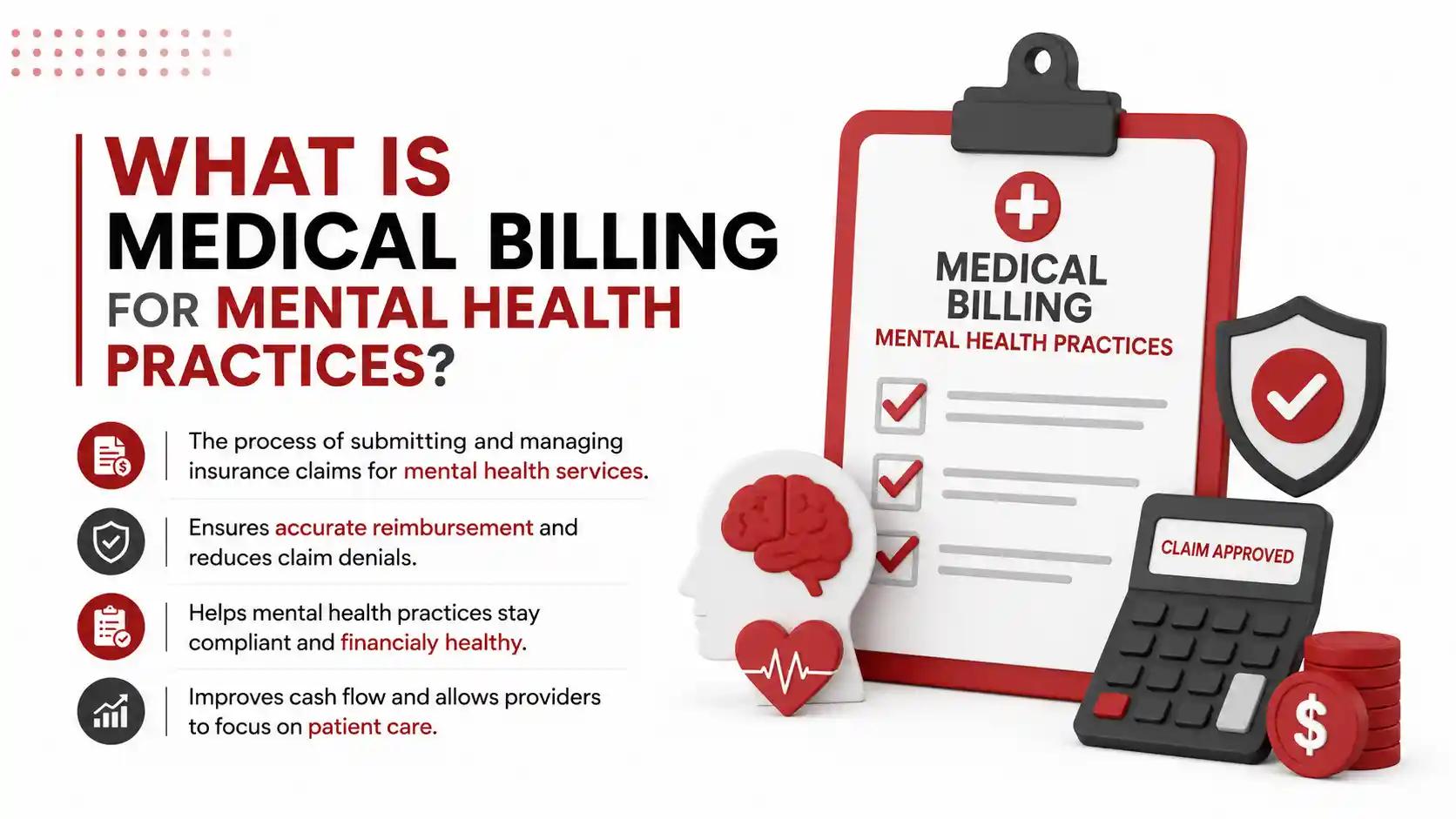
Medical billing for mental health practices is the process of translating therapy sessions, psychiatric evaluations, and behavioral health services into insurance claims that get submitted, tracked, and reimbursed correctly.
Unlike general medical billing, mental health billing has its own quirks: time-based CPT codes, session-length modifiers, prior authorization requirements, and strict documentation standards tied to DSM-5 diagnoses.
In simple terms, it covers everything from verifying a patient's insurance eligibility before their first session, to coding the visit correctly, submitting the claim, following up on denials, and posting the final payment.
Done right, it keeps cash flowing steadily into your practice. Done wrong, it means delayed payments, denied claims, and hours of administrative headaches for you or your front-desk staff.
Why It's Important
Mental health demand has exploded across the U.S. — and globally — since 2020, and it hasn't slowed down. More clients means more claims, more paperwork, and more room for costly billing errors.
Here's why getting this right matters so much:
For US practices: Insurance companies constantly update reimbursement rules, prior authorization requirements, and telehealth billing policies. A single coding mistake can mean a rejected claim and weeks of lost revenue.
For growing clinics: As your practice scales — adding therapists, opening new locations, offering group therapy — manual billing becomes unsustainable fast.
For international and remote-first agencies: Many mental health billing companies now operate as outsourced, cloud-based teams serving practices across California, Texas, Florida, New York, and beyond — meaning practices no longer need in-house billing staff to get expert-level service.
At the core, this isn't just paperwork. It's the financial engine of your practice. Without a clean revenue cycle, even the busiest, most respected practice can struggle to stay profitable.
Key Benefits of Professional Mental Health Billing Services
Outsourcing or optimizing your billing process delivers real, measurable value:
- Faster reimbursements — clean claims get paid quicker, improving cash flow
- Fewer denials — accurate CPT and ICD-10 coding reduces rejected claims
- More time for patient care — clinicians stop chasing paperwork
- Better compliance — HIPAA-compliant billing processes protect your practice legally
- Scalable revenue cycle management — systems that grow as your practice grows
- Improved patient experience — accurate billing means fewer confused or frustrated clients
- Data-driven insights — reporting on denial trends, reimbursement rates, and revenue performance
- AI-powered automation — modern billing platforms now use AI for claim scrubbing, eligibility checks, and denial prediction, cutting turnaround time significantly
The ROI is clear: practices that invest in proper revenue cycle management typically see a noticeable increase in collected revenue within the first few months.
Step-by-Step Process: How Mental Health Billing Works
Here's how a well-run mental health billing workflow actually unfolds, from intake to payment:
1. Patient Eligibility Verification Before the first session, the billing team confirms the patient's insurance coverage, copay, deductible, and whether prior authorization is needed for mental health services.
2. Accurate Medical Coding Sessions are coded using the correct CPT codes (like 90834 for a 45-minute psychotherapy session) and matched with the appropriate ICD-10 diagnosis code from the DSM-5.
3. Claims Submission Claims are submitted electronically through a clearinghouse, ensuring they reach the correct payer quickly and with minimal errors.
4. Claim Scrubbing & Review Before submission, claims are checked for missing information, incorrect modifiers, or mismatched codes — this step alone prevents most denials.
5. Payment Posting Once the insurance company processes the claim, payments are posted to the patient's account, and any remaining balance is identified.
6. Denial Management & Appeals If a claim is denied, the billing team investigates the reason, corrects the issue, and resubmits or appeals — recovering revenue that would otherwise be lost.
7. Patient Collections Any outstanding patient balance (copays, deductibles) is billed clearly and followed up on professionally.
8. Reporting & Revenue Cycle Optimization Ongoing reporting helps practices track reimbursement rates, denial trends, and overall financial health — allowing for continuous improvement.
Common Mistakes Mental Health Practices Make With Billing
Even experienced practices fall into these traps regularly:
- Using the wrong CPT code for session length — billing a 60-minute session as 45 minutes (or vice versa) leads to denials or underpayment
- Skipping eligibility verification — leads to surprise denials after the session has already happened
- Missing prior authorization — especially common with psychiatric evaluations and certain behavioral health services
- Inconsistent documentation — notes that don't support the billed CPT code raise red flags during audits
- Not following up on denied claims — many practices simply write off denied claims instead of appealing them
- Manual, paper-based processes — increases human error and slows down the entire revenue cycle
- Ignoring HIPAA compliance in billing systems — outdated software or unsecured data handling puts practices at legal risk
- Not tracking reimbursement rates by payer — makes it impossible to spot which insurance companies are consistently underpaying
Most of these mistakes are preventable with the right systems, trained staff, or an outsourced billing partner who specializes in behavioral health.
Why Choose Trusinva Tech Solutions
At Trusinva Tech Solutions, we understand that mental health practices need more than just a billing vendor — they need a partner who understands behavioral health revenue cycle management inside and out.
Our team supports mental health clinics, private practices, and behavioral health organizations across the USA with accurate, HIPAA-compliant medical billing services designed to reduce denials and speed up reimbursements.
Beyond billing, we offer a full suite of digital and business solutions to help your practice grow:
- Web Development — professional, patient-friendly websites that build trust from the first click
- Mobile App Development — custom apps for appointment booking and patient engagement
- SEO Services — helping your practice rank for the exact keywords your future patients are searching
- Digital Marketing — including Google Ads, social media marketing, and TikTok Ads for practices that want to grow their client base
- Software, ERP & CRM Solutions — including our CRM development services to help you manage patient relationships more efficiently
- Truck Dispatching Services — for logistics businesses looking to streamline dispatch operations
- Medical Billing — our core specialty, tailored specifically for mental health and behavioral health providers
We also run hands-on training programs for professionals who want to build a career in this field, including our Medical Billing course, USA Taxation course, and Truck Dispatching course.
Want to see our approach in action? Check out our past projects or browse our full range of services to see what fits your practice best. You can also read more billing and healthcare insights on our blog.
FAQs
What is medical billing for mental health practices? It's the process of coding, submitting, and managing insurance claims for therapy, counseling, and psychiatric services, ensuring providers get paid accurately and on time.
What CPT codes are commonly used in mental health billing? Common codes include 90791 (psychiatric evaluation), 90834 (45-minute psychotherapy), and 90837 (60-minute psychotherapy), among others depending on session type and length.
Why do mental health insurance claims get denied? Common reasons include incorrect coding, missing prior authorization, expired eligibility, and documentation that doesn't match the billed service.
Is outsourcing mental health billing worth it for a small practice? Yes — most small practices find that outsourcing reduces denials, speeds up payments, and frees up staff time, often paying for itself through improved collections.
How long does mental health insurance reimbursement typically take? With clean claims and proper eligibility verification, reimbursement usually takes anywhere from a couple of weeks to a month, depending on the payer.
Do psychiatrists and psychologists need different billing processes? The core process is similar, but coding can differ based on service type — psychiatric evaluations, medication management, and psychotherapy sessions each have specific CPT codes.
Final Thoughts
Medical billing for mental health practices doesn't have to be a constant source of stress. With the right process — or the right partner — you can reduce denials, speed up reimbursements, and finally focus your energy on patient care instead of paperwork.
If you're ready to simplify your billing and grow your practice with expert support, contact Trusinva Tech Solutions for professional digital services and business growth. Visit our contact page or learn more about us to get started today.