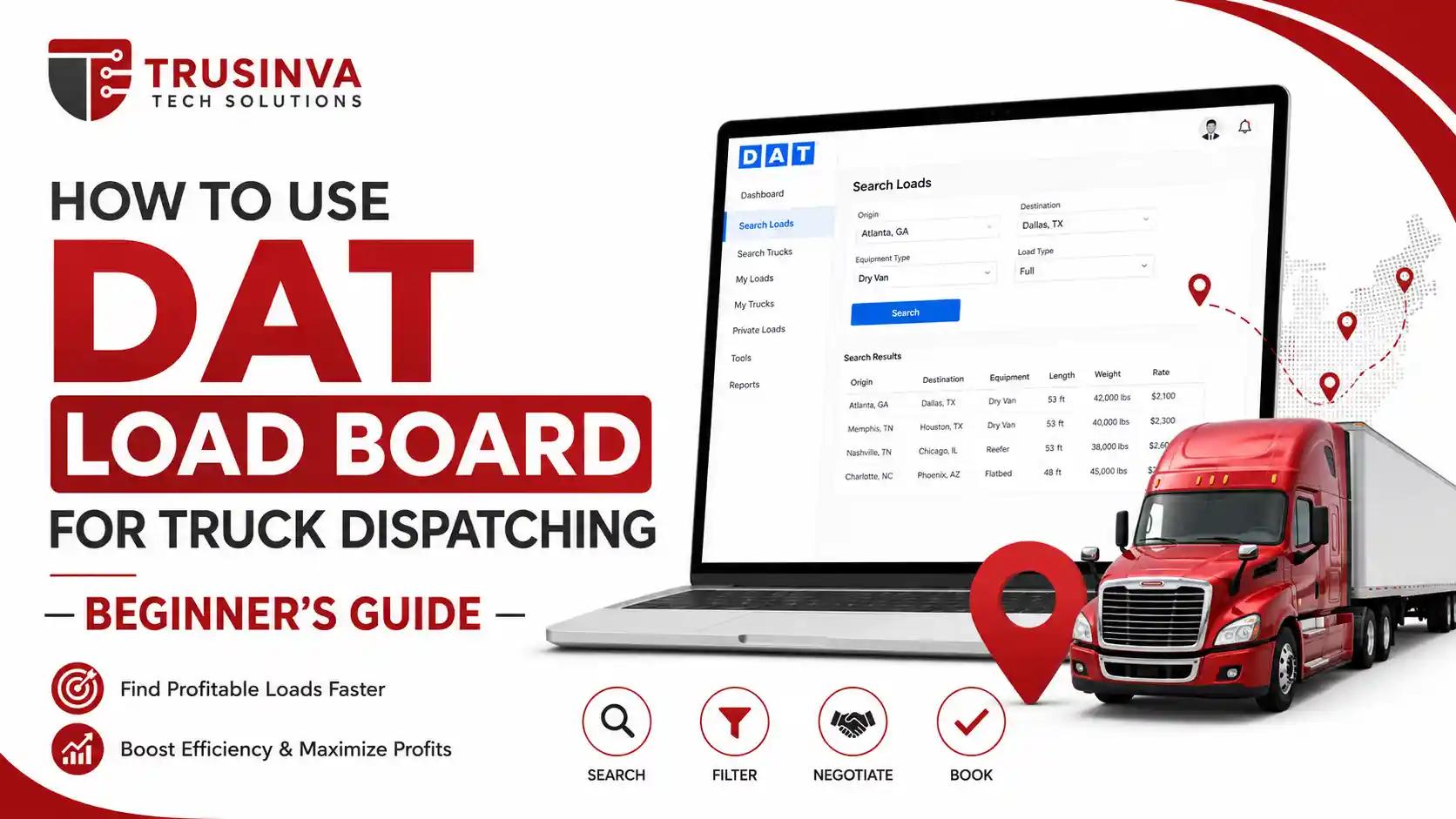
Quick Answer:
DAT load board is a freight-matching platform where truck dispatchers search for available loads, filter by equipment type and location, check lane rates, verify broker credit, and book freight for carriers. Dispatchers log in through DAT One, set search filters like origin, destination, and truck type, then contact brokers directly to negotiate and confirm rates before booking.
Key Takeaways
- DAT One is the load-board platform dispatchers use to find and book freight for carriers
- Filters for equipment type, pickup date, and location narrow results to relevant loads
- DAT RateView and DAT iQ help dispatchers check market rates before negotiating
- Broker credit scores and reviews (via DAT CarrierWatch/Directory) protect carriers from non-paying brokers
- New dispatchers benefit from structured training before working independently
Introduction
If you're new to freight dispatching, the DAT load board is probably the first tool you'll need to master. It's the platform most carriers, owner-operators, and dispatch services rely on to find available freight, check current lane rates, and connect with brokers across the country. Companies like Trusinva Tech Solutions work closely with logistics businesses on both the technology and training side, which is why we've put together this practical, beginner-friendly walkthrough of how DAT actually works in daily dispatching. Before diving in, it also helps to understand how to start a truck dispatching business in the USA, what a truck dispatcher's salary typically looks like, and how truck dispatching services save carriers money — because DAT is just one piece of a much bigger dispatching workflow. If you'd rather learn this hands-on with an instructor, Trusinva's truck dispatching course covers DAT navigation as part of a full curriculum.
What Is the DAT Load Board?
DAT (short for DAT Freight & Analytics) operates one of the largest load boards in North America, giving carriers, brokers, and dispatchers a shared marketplace to post and search freight. Through its platform, DAT One, dispatchers can search for available loads, post truck availability, and access rate data drawn from millions of daily transactions. It's essentially the digital equivalent of the old trucker CB radio network — except searchable, filterable, and backed by real pricing data.
DAT isn't the only load board in the industry, but it's the most widely used one among small carriers and independent dispatchers because of its coverage, rate transparency, and broker verification tools.
Why Truck Dispatchers Use DAT One
Dispatchers use DAT One because it centralizes everything needed to keep a truck moving profitably: available loads, current market rates, and broker reliability data, all in one interface.
For someone dispatching on behalf of an owner-operator or small carrier, DAT solves three core problems — finding freight quickly, avoiding underpriced loads, and avoiding brokers who don't pay on time. Dispatchers who understand owner-operator dispatch services know that a truck sitting idle costs money every hour, so speed and accuracy on the load board directly affect a carrier's bottom line.
Step-by-Step: How to Use DAT Load Board
Here's the basic dispatching workflow on DAT One, from login to booking.
- Log in to DAT One. Dispatchers typically use a DAT dispatcher seat or carrier account tied to the trucking company they represent.
- Set your search filters. Enter the truck's current or planned location, equipment type (dry van, reefer, flatbed, step deck, hotshot, power only), and available date.
- Review the load list. Results show pickup and delivery locations, mileage, posted rate (if shown), weight, and commodity type.
- Check the rate against market data. Before contacting a broker, compare the posted rate to DAT's lane averages so you know if it's fair.
- Verify the broker. Look up the broker's credit score, days-to-pay history, and reviews.
- Contact the broker and negotiate. Call or message to confirm rate, appointment times, and any accessorial charges.
- Get the rate confirmation. Once agreed, the broker sends a rate confirmation — review it carefully before the truck moves.
- Book the load and update truck status. Mark the truck as booked so it stops showing as available, then plan the next backhaul or reload to minimize deadhead miles.
This same cycle repeats for every load, and dispatchers managing multiple trucks often run several searches in parallel to keep every unit loaded and moving toward the most profitable lane.
Understanding DAT Rates and Market Data
DAT RateView and DAT iQ give dispatchers access to historical and real-time spot market and contract rate data by lane. This matters because posted rates on the load board can vary widely, and a dispatcher who doesn't check the market average risks booking a truck at a rate that barely covers fuel and driver pay.
A simple way to think about it: if the average rate per mile (RPM) on a lane is $2.10 and a broker posts $1.60, that's a red flag worth questioning — either the freight is undesirable, or there's room to negotiate up.
Rate factors to check before booking:
- Current spot market RPM for that lane
- Fuel surcharge inclusion
- Deadhead miles to pickup
- Detention and layover terms
- Any accessorial charges (lumper fees, extra stops)
Checking Broker Credit and Reviews
Before booking with an unfamiliar broker, dispatchers should check DAT CarrierWatch or the DAT Directory for the broker's credit score, days-to-pay average, and carrier reviews. A broker with a low credit score or a history of slow payments is a real financial risk to the carrier.
Quick broker vetting checklist:
- Verify active MC authority and USDOT number
- Check credit score and days-to-pay
- Read recent carrier reviews
- Confirm insurance certificate is current
- Ask for a written rate confirmation before dispatching the truck
DAT Load Board Pricing and Plans
DAT One offers tiered subscription plans for carriers, brokers, and dispatch services, generally ranging from basic load-search access to premium plans that bundle RateView, CarrierWatch, and advanced analytics. Pricing changes periodically, so dispatchers should confirm current rates directly on DAT's website before choosing a plan — the right tier depends on how many trucks a dispatcher manages and whether rate/market data is a daily necessity or an occasional check.
DAT vs Truckstop
| Feature | DAT One | Truckstop |
| Load volume | Very high, broad national coverage | High, strong in certain regions |
| Rate data | DAT RateView / DAT iQ | Truckstop RateView equivalent |
| Broker credit tools | DAT CarrierWatch, DAT Directory | Truckstop broker ratings |
| Mobile app | DAT One mobile app | Truckstop mobile app |
| Best for | Owner-operators, dispatch services, brokers | Carriers and brokers wanting an alternative marketplace |
Both platforms serve similar purposes, and many dispatch services subscribe to more than one to widen load visibility, especially in competitive freight markets.
Common Mistakes New Dispatchers Make
- Booking a load without checking the broker's credit score
- Ignoring deadhead miles when calculating actual profitability
- Not confirming detention or layover terms before the truck arrives
- Relying only on the posted rate instead of comparing it to lane averages
- Skipping the written rate confirmation and working off a verbal agreement
Best Practices for Booking Loads on DAT
- Set load alerts for preferred lanes so you're notified the moment a matching load posts
- Always calculate rate per mile, not just total pay, before accepting a load
- Build relationships with reliable, high-paying brokers over time
- Plan headhaul and backhaul together to reduce empty miles
- Keep carrier documents (insurance, authority) up to date in your DAT profile to avoid delays
Future Trends in Load Board Dispatching
Load boards are increasingly integrating AI-driven rate prediction, automated load matching, and tighter TMS integrations, which is changing how dispatch services operate day to day. Dispatchers who combine platform knowledge with automation tools are able to manage more trucks with less manual searching — a shift that mirrors what Trusinva sees more broadly through its work in AI automation services and AI for small businesses.
Why Choose Trusinva Tech Solutions
Trusinva Tech Solutions supports the logistics industry on two fronts: practical training and technology. Through the truck dispatching course, new dispatchers learn DAT navigation, rate negotiation, and broker vetting hands-on, alongside guidance from instructors with real dispatching experience. On the technology side, Trusinva builds truck dispatch software and CRM solutions that help dispatch services manage multiple carriers, automate load tracking, and stay organized as their client base grows. For dispatchers running their own business, Trusinva's digital marketing and SEO services also help attract more carrier clients online.
FAQs
1. What is the DAT load board used for? It's used by dispatchers, carriers, and brokers to search available freight, post truck availability, and check market rates before booking a load.
2. Do I need a subscription to use DAT One? Yes, most core features — including load search and rate data — require a paid DAT One subscription.
3. Is DAT better than Truckstop? Neither is universally "better" — DAT has broader load volume and rate data, while Truckstop is a strong alternative many dispatchers use alongside DAT.
4. How do I know if a broker is trustworthy on DAT? Check their credit score, days-to-pay history, and carrier reviews through DAT CarrierWatch or the DAT Directory before booking.
5. Can beginners learn DAT dispatching on their own? Yes, but structured training speeds up the learning curve significantly, especially around rate negotiation and broker vetting.
6. What's the difference between spot rates and contract rates on DAT? Spot rates fluctuate daily based on market demand, while contract rates are pre-negotiated fixed rates for recurring lanes.
7. How much does a truck dispatcher typically earn? Earnings vary by client base and experience — see our detailed breakdown in the truck dispatcher salary guide.
Conclusion
Learning to use the DAT load board well is one of the most valuable skills a new truck dispatcher can build — it directly affects how quickly trucks stay loaded and how profitable each lane turns out to be. The core workflow is straightforward: search, verify rates, vet the broker, negotiate, and book — but doing it consistently and profitably takes practice. If you're serious about building a dispatching career or scaling a dispatch service, Trusinva Tech Solutions' truck dispatching course walks you through DAT One and real-world dispatching scenarios step by step, backed by hands-on instructor support. You can also explore how to start a truck dispatching business in the USA and flatbed carrier dispatching for more specialized guidance. Ready to get started? Book a Seat in Trusinva's truck dispatching course today and start dispatching with confidence.
Learn More: https://trusinvatechsolutions.com/courses/truck-dispatching