Quick Answer:
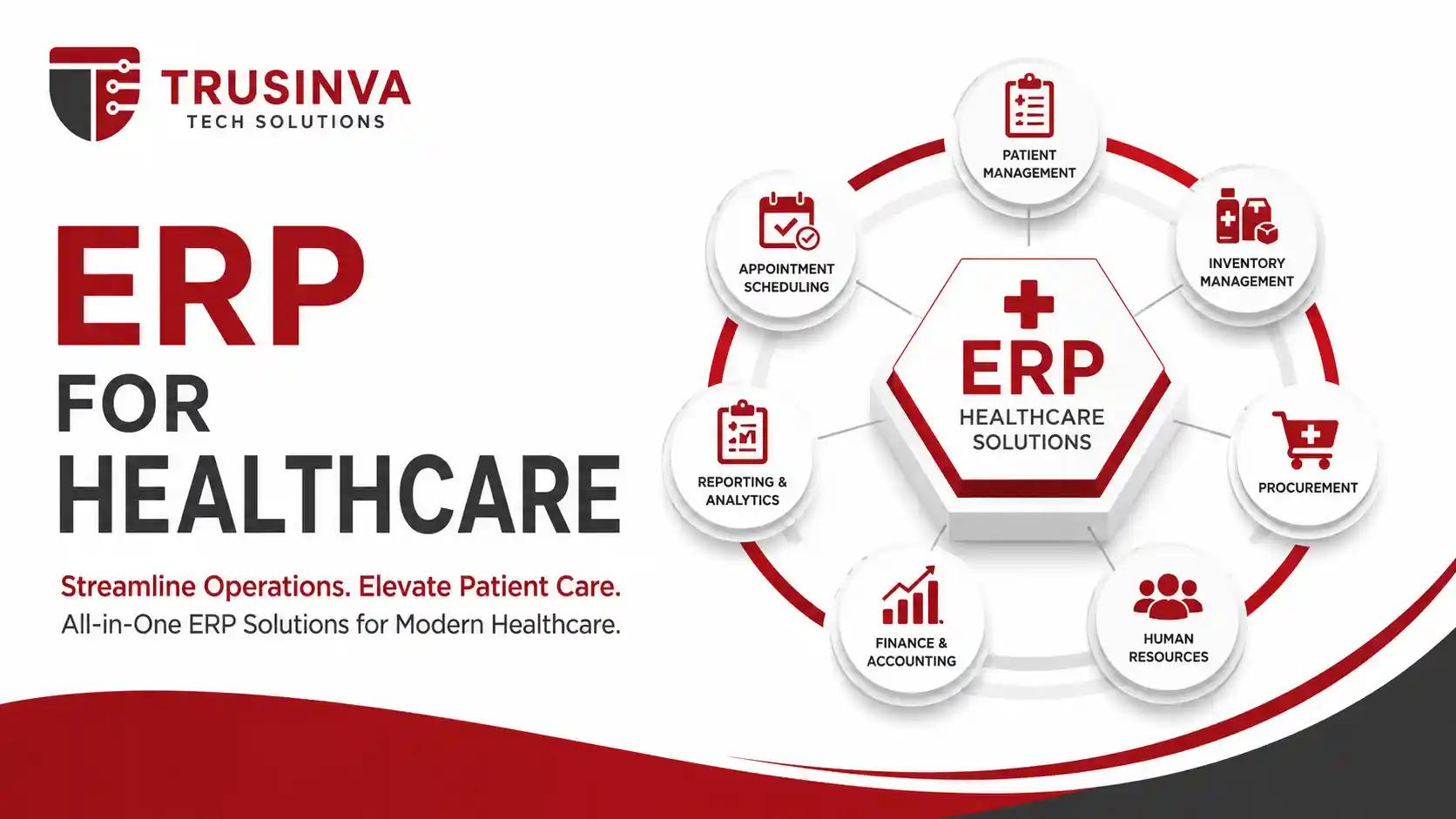
A healthcare ERP (Enterprise Resource Planning) system is centralized software that connects a hospital's finance, HR, procurement, inventory, and administrative operations into one platform. Unlike an EHR, which manages clinical patient records, a healthcare ERP manages the business side — billing, supply chain, payroll, and compliance reporting — improving efficiency and reducing operational costs.
Introduction
Running a hospital or clinic today means juggling patient billing, staff schedules, medical supply orders, and financial reports — often across systems that don't talk to each other. That's where healthcare ERP software comes in. It brings these moving parts into one connected system, so administrators spend less time reconciling spreadsheets and more time supporting patient care. At Trusinva Tech Solutions, we work with healthcare organizations across the USA to design and implement ERP systems that fit their actual workflows, not a generic template. If you're exploring healthcare software solutions or comparing this to custom software development more broadly, this guide breaks down exactly what a healthcare ERP does, how it differs from an EHR, and what to expect when adopting one — including how it connects to medical billing services.
Whether you're a small clinic or a multi-facility health system, the right ERP setup can directly affect your bottom line and your compliance posture. Let's get into the details.
Key Takeaways:
- Healthcare ERP centralizes financial, HR, procurement, and inventory data across a hospital or clinic network.
- It works alongside EHR/EMR systems rather than replacing them, focusing on operations instead of clinical care.
- Core modules include revenue cycle management, supply chain, workforce management, and compliance reporting.
- HIPAA, HL7 FHIR, and USCDI compliance are essential considerations for any healthcare ERP deployment.
- Implementation costs vary widely based on hospital size, customization, and integration needs.
Table of Contents
- What Is Healthcare ERP?
- Why Healthcare Organizations Need ERP
- Key Features of Healthcare ERP Software
- Benefits of Healthcare ERP
- Challenges and Disadvantages
- Healthcare ERP vs EHR vs EMR
- Compliance: HIPAA, FHIR, and USCDI
- Healthcare ERP Cost and Pricing Factors
- Implementation: Step-by-Step
- Common Mistakes to Avoid
- Future Trends in Healthcare ERP
- Why Choose Trusinva Tech Solutions
- FAQs
- Conclusion
What Is Healthcare ERP?
Healthcare ERP (Enterprise Resource Planning) is a category of software that integrates a healthcare organization's core administrative and financial functions — finance, procurement, inventory, HR, and payroll — into a single, centralized database. Instead of separate tools for accounting, supply ordering, and staff scheduling, everything runs through one connected system with real-time visibility.
Think of it as the operational backbone of a hospital. While clinicians rely on an EHR to document patient care, administrators rely on the ERP to keep the lights on — paying vendors, managing inventory, running payroll, and generating the financial reports leadership and regulators need.
Major platforms in this space include Oracle Health, SAP, Microsoft Dynamics 365, Infor, Workday, and NetSuite, each offering healthcare-specific modules alongside general ERP functionality.
Why Healthcare Organizations Need ERP
Direct answer: Healthcare organizations need ERP because manual, disconnected systems create billing errors, supply shortages, and compliance gaps that directly affect patient care and revenue. ERP consolidates data so decisions are based on accurate, real-time information rather than outdated spreadsheets.
Hospitals are complex businesses. A mid-size hospital might manage thousands of SKUs in its supply chain, hundreds of employees across departments, and a revenue cycle involving multiple payers and compliance rules. Without integration:
- Finance teams reconcile data manually across disconnected tools
- Supply chain teams risk stockouts or overordering
- HR and payroll errors slip through due to lack of centralized workforce data
- Compliance reporting becomes reactive instead of proactive
An ERP system removes these silos, similar to how a well-built CRM system consolidates customer data for sales teams — except here, the "customer" data is operational and financial.
Key Features of Healthcare ERP Software
A healthcare ERP typically includes these core modules:
| Module | What It Does |
| Revenue Cycle Management | Tracks billing, claims, and payments across the patient financial journey |
| Financial Management | Handles accounts payable/receivable, budgeting, and financial reporting |
| Supply Chain & Inventory | Manages medical and pharmaceutical inventory, procurement, and vendor relationships |
| Workforce Management | Covers payroll, scheduling, credentialing, and HR compliance |
| Asset Management | Tracks equipment, maintenance schedules, and asset lifecycle |
| Business Intelligence | Provides real-time dashboards and operational analytics |
| Compliance Management | Supports HIPAA, audit logging, and regulatory reporting |
Many of these systems also integrate with EHR platforms via HL7 FHIR APIs, allowing operational and clinical data to stay in sync without merging into one monolithic system.
Benefits of Healthcare ERP
Direct answer: Healthcare ERP improves operational efficiency, reduces billing errors, optimizes inventory, and strengthens compliance — typically leading to measurable cost savings within the first year of full implementation.
- Reduced administrative costs — automation cuts down manual data entry and reconciliation work
- Better inventory accuracy — real-time tracking prevents both stockouts and waste, especially for pharmaceuticals
- Faster, cleaner billing — integrated revenue cycle management reduces claim denials, a common pain point covered in our piece on medical billing mistakes
- Improved compliance readiness — centralized audit logs and reporting simplify HIPAA and regulatory audits
- Data-driven decisions — leadership gets real-time dashboards instead of month-old reports
- Scalability — easier to add new facilities or departments without rebuilding systems from scratch
Challenges and Disadvantages
No system is without trade-offs. Common challenges include:
- High upfront cost — implementation, licensing, and customization can be significant, especially for smaller clinics
- Change management resistance — staff accustomed to legacy systems may resist new workflows
- Integration complexity — connecting ERP with existing EHR/EMR systems requires careful FHIR/HL7 API planning
- Long implementation timelines — full rollouts can take months, particularly for multi-facility organizations
- Data migration risk — moving historical financial and inventory data requires careful validation
Working with an experienced enterprise software development partner significantly reduces these risks, particularly around integration and data migration.
Healthcare ERP vs EHR vs EMR
This is one of the most common points of confusion.
| System | Primary Focus | Example Use |
| ERP | Business operations — finance, HR, supply chain | Managing hospital payroll and vendor payments |
| EHR | Comprehensive clinical patient records shared across providers | Tracking a patient's full medical history |
| EMR | Digital version of a single practice's paper charts | A clinic's internal patient chart system |
ERP and EHR systems typically run in parallel and exchange data through standardized APIs rather than one replacing the other.
Compliance: HIPAA, FHIR, and USCDI
Any healthcare ERP handling patient-adjacent data must account for HIPAA's Privacy and Security Rules, which govern how protected health information is used, disclosed, and safeguarded. Beyond HIPAA, interoperability increasingly depends on HL7 FHIR standards and the USCDI dataset, which the Office of the National Coordinator for Health Information Technology (ONC) maintains to standardize data exchange across systems.
Practical compliance features to look for in an ERP:
- Role-based access control
- Encryption at rest and in transit
- Detailed audit logs
- FHIR-compatible integration endpoints

Healthcare ERP Cost and Pricing Factors
Direct answer: Healthcare ERP costs vary widely — small clinics may spend well under six figures on cloud-based solutions, while large hospital systems with custom development and multi-facility rollouts can invest significantly more. Cost depends on customization level, number of users, and integration complexity.
Key cost drivers include:
- Cloud vs. on-premise deployment
- Level of customization needed
- Number of modules implemented
- Data migration complexity
- Ongoing support and training
For a clearer picture of how software pricing generally breaks down, our guide on software development cost covers the factors that typically drive quotes up or down.
Implementation: Step-by-Step
- Assess current workflows — map existing finance, HR, and supply chain processes
- Define requirements — identify must-have modules and integration points
- Choose deployment model — cloud, on-premise, or hybrid
- Plan EHR/ERP integration — establish FHIR-based data exchange early
- Migrate data carefully — validate financial and inventory records before go-live
- Train staff — invest in hands-on training to reduce resistance
- Go live in phases — roll out module by module rather than all at once
- Monitor and optimize — use built-in analytics to refine workflows post-launch
This is similar in principle to how businesses approach any SaaS application development rollout — phased adoption reduces risk significantly.
Common Mistakes to Avoid
- Choosing a generic ERP without healthcare-specific modules
- Underestimating staff training time
- Ignoring HIPAA and FHIR compliance during the design phase
- Rushing data migration without validation
- Failing to plan for EHR integration from day one
Future Trends in Healthcare ERP
- AI-driven forecasting for inventory and staffing, an extension of broader AI automation adoption across industries
- Deeper FHIR-based interoperability between ERP and clinical systems
- Predictive analytics for supply chain and revenue cycle management
- Cloud-first deployments replacing legacy on-premise ERP installations
- Increased automation in compliance reporting and audit trails
Why Choose Trusinva Tech Solutions
Implementing a healthcare ERP isn't just a software purchase — it's a workflow overhaul that touches finance, HR, procurement, and compliance simultaneously. At Trusinva Tech Solutions, we combine custom software development, CRM development, and AI development services to build ERP integrations tailored to how your organization actually operates — not a one-size-fits-all package.
Our team also supports healthcare businesses with medical billing solutions and ongoing digital marketing to help you grow once your operations are running smoothly. We understand both the technical and regulatory sides of healthcare technology, which means fewer surprises during implementation and a system built to scale with your organization.
FAQs
Q: Is healthcare ERP the same as EHR software? No. ERP manages business operations like finance and supply chain, while EHR manages clinical patient records. They work together but serve different purposes.
Q: Do small clinics need a full ERP system? Not always. Many small clinics start with a lighter, modular ERP or cloud-based solution and scale up as they grow.
Q: How long does healthcare ERP implementation take? Timelines vary from a few months for smaller deployments to over a year for large, multi-facility rollouts.
Q: Is healthcare ERP HIPAA compliant by default? Not automatically — compliance depends on how the system is configured, including access controls, encryption, and audit logging.
Q: Can healthcare ERP integrate with existing EHR systems? Yes, most modern ERP platforms integrate with EHR systems through HL7 FHIR APIs.
Q: What's the biggest ROI driver for healthcare ERP? Most organizations see the fastest returns from reduced billing errors and optimized inventory management.
Q: Should hospitals build custom ERP or buy off-the-shelf? It depends on complexity and budget — custom development offers better long-term fit, while off-the-shelf solutions are faster to deploy.
Conclusion
Healthcare ERP software isn't a luxury anymore — it's becoming a baseline requirement for hospitals and clinics trying to run efficiently while staying compliant. From revenue cycle management to supply chain optimization, the right system gives administrators the visibility they need to make faster, better decisions.
If you're evaluating healthcare ERP options or planning an integration with your existing EHR, Trusinva Tech Solutions can help you build a system that actually fits your organization's workflows. Explore our medical billing course to strengthen your team's revenue cycle knowledge, or reach out through our contact page to discuss your ERP project. Ready to get started? Book a Seat in our upcoming medical billing training program today and take the first step toward a more efficient, compliant healthcare operation.