Running a small business in the United States today means competing against companies that never sleep, never get tired, and never miss a follow-up email. That's not an exaggeration — it's what AI automation makes possible. At Trusinvatechsolutions, we work with small and mid-sized US businesses every week that are trying to figure out exactly this: how do you use artificial intelligence to save time, cut costs, and grow revenue without hiring an entire tech team? This guide answers that question in plain English, with real examples, practical steps, and honest numbers — not just buzzwords.
Whether you run a local service business, an e-commerce store, a logistics company, or a healthcare practice, AI automation is no longer a "someday" investment. It's becoming table stakes. Businesses that automate repetitive work with AI are freeing up hours every week for the things that actually grow revenue — sales conversations, product development, and customer relationships. Through our software development and CRM development work, we've seen firsthand how the right automation strategy turns a stretched-thin team into a business that runs itself in the background.
In this article, you'll learn what AI automation actually means, why it matters so much right now, which tools and platforms power it, what it costs, and how to get started — even if you have zero technical background.
What Is AI Automation for Small Businesses?
AI automation is the use of artificial intelligence — including machine learning, natural language processing (NLP), and AI agents — to handle business tasks that used to require a human: answering customer questions, qualifying leads, scheduling, data entry, invoicing, and marketing follow-ups. Unlike older "if-this-then-that" automation, AI automation can understand context, make decisions, and adapt as it works. For a small business, this typically means chatbots that sound human, AI agents that manage workflows across your CRM and email, and tools that turn hours of manual work into minutes.
That's the short version. Now let's break down why it matters, how it works, and how to actually implement it.
Why AI Automation Matters for US Small Businesses Right Now
Small businesses in the USA operate on tight margins and tighter schedules. Owners and managers often wear five hats at once — sales, support, marketing, operations, and finance. AI automation matters because it directly attacks the biggest constraint small businesses face: limited time and limited staff.
A few reasons this trend has accelerated heading into 2026:
- Customer expectations have changed. People expect instant replies, whether it's 2 p.m. or 2 a.m. AI chatbots and virtual assistants make 24/7 response times realistic for a five-person company.
- AI tools have become dramatically more accessible. Platforms built on models from OpenAI, Anthropic's Claude, Google's Gemini, and open-source options like Llama and Mistral AI mean businesses no longer need an in-house data science team to use serious AI capability.
- Labor and hiring costs keep rising. Automating repetitive tasks — appointment reminders, lead qualification, order tracking, basic support tickets — reduces the need to hire for every new task that comes up.
- Competitors are already doing it. If a rival business responds to leads in 30 seconds using an AI agent while you take three hours, that lead usually doesn't wait for you.
Independent research from organizations like IBM has tracked this shift for years, describing how intelligent automation is moving from "nice to have" to a core operating requirement across industries — not just for large enterprises, but increasingly for smaller companies too.
Key Benefits of AI Automation for Small Businesses
1. Time Savings That Compound
Every task an AI agent handles is time an owner or employee gets back. Multiply that across a week, and automation often frees up 10–20 hours that would otherwise go into repetitive administrative work.
2. Lower Operating Costs
Instead of hiring a full-time customer support rep, a well-built AI chatbot can handle a majority of routine questions, escalating only the complex ones to a human.
3. Faster Response Times = More Closed Deals
AI sales automation can respond to a new lead instantly, qualify them, and book a meeting — before a competitor even sees the inquiry.
4. Better Data, Better Decisions
AI-powered analytics tools surface patterns in sales, customer behavior, and operations that would take a human days to find manually.
5. Consistency at Scale
Unlike a tired employee at the end of a long shift, an AI system applies the same quality of service to customer number 1 and customer number 1,000.
6. A Real Competitive Edge
Small businesses that automate intelligently can compete with much larger companies on responsiveness and service quality — something that used to require a big budget.
AI Automation vs. Traditional Automation: What's the Difference?
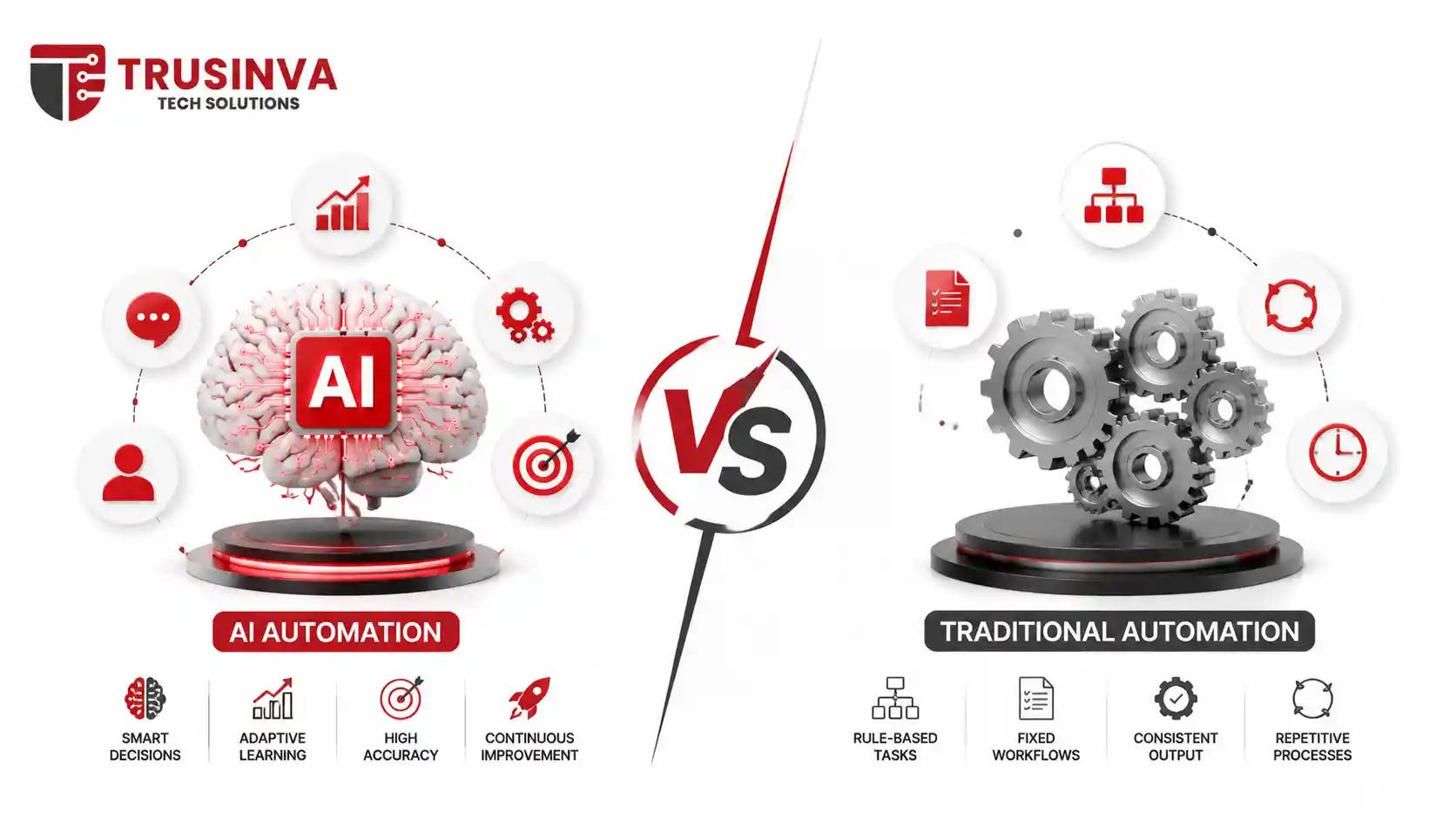
Many business owners already use some form of automation — email autoresponders, scheduled social posts, basic workflow triggers. Traditional automation follows rigid, pre-set rules. AI automation is different because it can interpret language, make judgment calls, and improve over time.
| Traditional Automation | AI Automation |
| Follows fixed rules ("if X happens, do Y") | Understands context and intent |
| Can't handle unexpected input | Adapts to new or unusual requests |
| Needs manual updates for every new scenario | Learns and improves from data |
| Best for simple, repetitive tasks | Handles complex conversations and decisions |
| Example: auto-reply email | Example: AI agent that reads the email, understands the request, and responds appropriately |
This is exactly why AI agents and generative AI have become the center of business automation conversations in 2026 — they close the gap between "automated" and "actually helpful."
Step-by-Step Guide: How to Implement AI Automation in Your Small Business
Getting started with AI automation doesn't require a massive budget or an in-house engineering team. Here's the process we walk clients through:
Step 1: Map Your Repetitive Tasks
List out the tasks your team repeats daily or weekly — answering the same customer questions, entering data into spreadsheets, following up on leads, scheduling calls, generating invoices. These are your automation candidates.
Step 2: Prioritize by Impact and Effort
Not every task is worth automating first. Start with high-frequency, low-complexity tasks (like FAQ responses or appointment reminders) before moving to more complex workflows (like full sales pipeline automation).
Step 3: Choose the Right AI Tools and Infrastructure
This is where a lot of businesses get stuck. Depending on your needs, this might involve:
- AI chatbot development for customer support
- AI agents connected to your CRM
- Workflow automation tools linking your email, calendar, and project management systems
- Custom AI models fine-tuned on your business data
At Trusinvatechsolutions, our team builds on proven infrastructure — including OpenAI and Claude-based models, Google Cloud AI, Microsoft Azure AI, and AWS — combined with tools like LangChain and vector databases such as Pinecone for retrieval-augmented generation (RAG), so your AI agent actually knows your business instead of giving generic answers.
Step 4: Integrate With Your Existing Systems
Automation only works if it connects to the tools you already use — your CRM, your website, your inventory system, your accounting software. This is often the most technical part of the process, and it's where working with an experienced AI automation company saves significant time.
Step 5: Test, Train, and Refine
No AI system is perfect on day one. Expect a testing period where you review conversations, correct mistakes, and refine how the AI responds. This is normal and expected — even the most advanced AI agents improve with real-world feedback.
Step 6: Scale What Works
Once one workflow is running smoothly — say, AI-powered lead qualification — expand into the next area: marketing automation, customer support, or operations.
Tips for a Smooth Rollout
- Start small with one workflow rather than automating everything at once.
- Keep a human in the loop for edge cases, at least initially.
- Choose AI tools that integrate with your existing software instead of replacing it entirely.
- Set clear success metrics (response time, cost saved, leads converted) before you launch.
- Revisit and retrain your AI system every few months as your business changes.
AI Automation Services We Provide
At Trusinvatechsolutions, our software development team designs and builds custom AI automation solutions for US small businesses across industries. Our core AI automation services include:
- AI Chatbot Development — Custom chatbots trained on your business data that handle customer questions, bookings, and support around the clock.
- AI Agent Development — Autonomous AI agents that manage multi-step workflows, from lead qualification to order processing.
- Workflow Automation — Connecting your tools (email, CRM, calendar, project management) so tasks move automatically between systems.
- CRM Automation — Building on our CRM development expertise, we automate lead scoring, follow-ups, and pipeline management.
- ERP Automation — Streamlining inventory, procurement, and finance workflows through intelligent system integration.
- Marketing Automation — AI-driven email sequences, ad optimization, and content workflows that support your broader digital marketing strategy.
We also bring AI automation into the other services we offer, including web development, mobile app development, WordPress development, Shopify development, and blockchain development — so your automation strategy fits into the platforms you're already using, not around them.
Real-World Examples: How Small Businesses Use AI Automation
E-commerce. A Shopify store owner uses an AI chatbot to answer sizing, shipping, and return questions instantly, reducing support tickets by handling the repetitive 80% automatically while a human handles the rest.
Truck Dispatching. Logistics companies are automating load matching, driver communication, and paperwork — work we've discussed in depth in our piece on how truck dispatching services save US carriers money. AI-powered dispatch tools reduce idle time and improve on-time delivery rates.
Medical Billing. Healthcare practices are using AI automation to flag coding errors before claims go out, reducing denials. We cover this in our article on medical billing services in the USA that reduce claim denials.
Sales Teams. B2B companies use AI agents connected to their CRM to automatically qualify inbound leads and schedule meetings with sales reps, a workflow we detail in our guide to CRM development solutions for US sales teams.
Marketing Teams. Small businesses use AI automation to personalize email campaigns and optimize ad spend — a strategy we break down in how digital marketing can help you get more clients online.
How Much Does AI Automation Cost?
Pricing depends heavily on scope. A simple AI chatbot for a small business website can start in the low thousands of dollars, while a fully custom AI agent system integrated across your CRM, ERP, and marketing stack is a larger investment, often built out in phases.
Factors that affect cost include:
- Whether you need a custom-built AI solution or a configured off-the-shelf tool
- How many systems the automation needs to connect to
- Whether you need ongoing model fine-tuning and support
- The complexity of the workflows being automated (a single FAQ bot vs. a multi-agent sales and support system)
Most agencies, including ours, offer phased implementation — start with one workflow, measure the return, then expand. This keeps the upfront investment manageable while proving value quickly. If you want a clear number for your specific situation, you can contact our team for a free scope and pricing conversation.
Why Choose Trusinvatechsolutions for AI Automation Development
There's no shortage of AI automation vendors online, so it's fair to ask why work with us specifically. A few reasons US small businesses choose Trusinvatechsolutions:
- Full-stack capability. We're not just an AI vendor — we're a complete software development agency. That means your AI automation is built directly into your website, app, CRM, or ERP, not bolted on as a disconnected tool.
- Real business experience. Our team has delivered projects across UI/UX design, SEO services, and social media marketing, so we understand how automation needs to fit into your entire growth strategy — not just your tech stack.
- US-focused delivery. We specialize in serving American small businesses and understand the tools, compliance considerations, and customer expectations specific to the US market.
- Transparent process. From the about page to our project portfolio, we're upfront about what we deliver and how long it takes.
- You can start small. We don't require a six-figure commitment to get started — many clients begin with a single automated workflow and scale from there.
You can browse examples of our past work on our projects page, or read more of our thinking on business technology on our blog.
Frequently Asked Questions
What is AI automation for small businesses? AI automation uses artificial intelligence — chatbots, AI agents, and machine learning tools — to handle repetitive business tasks like customer support, lead follow-up, and data entry, without constant human input.
How much does AI automation cost for a small business? Costs vary widely based on complexity, ranging from a few thousand dollars for a basic chatbot to a larger phased investment for multi-system automation. Most agencies recommend starting with one workflow to prove ROI before scaling.
Is AI automation worth it for a small business? For most small businesses handling repetitive customer or administrative tasks, yes. The time and cost savings from automating even one workflow — like customer support or lead qualification — often pay for the investment within months.
What business tasks can AI automate? Common tasks include customer support, lead qualification, appointment scheduling, invoicing, inventory tracking, email marketing, and data entry across CRM and ERP systems.
How long does AI automation implementation take? A simple chatbot can be live within a few weeks. More complex, multi-system automation projects typically take a few months, especially when integrating with existing CRM or ERP platforms.
Can AI automation replace my employees? Rarely entirely. Most small businesses use AI automation to handle repetitive, high-volume tasks so employees can focus on higher-value work like relationship-building, strategy, and complex problem-solving.
Conclusion: Your Next Step Toward AI Automation
AI automation isn't a trend small businesses can afford to wait out. From AI chatbots that never sleep to AI agents that manage entire workflows, the businesses adopting this technology now are building a real head start over competitors who wait. The good news is you don't need a massive budget or technical team to get there — you need the right starting point and the right partner.
If you're ready to see what AI automation could look like for your business, book a consultation with Trusinvatechsolutions and let's map out your first automated workflow together.