What if your online store is losing customers every day—not because of your products, but because your website isn't built for how modern shoppers buy in 2026? The hidden problem might surprise you.
If you're running a business in 2026 and still don't have a solid online store, you're leaving money on the table. Customers now expect to browse, compare, and buy from their phones in seconds. That's exactly what proper ecommerce web development services USA businesses rely on to compete — a fast, secure, mobile-friendly store that turns visitors into paying customers.
This guide breaks down what ecommerce web development actually means, why it matters for your business, and how to choose the right partner without wasting money on the wrong platform or agency.
What Is eCommerce Web Development?
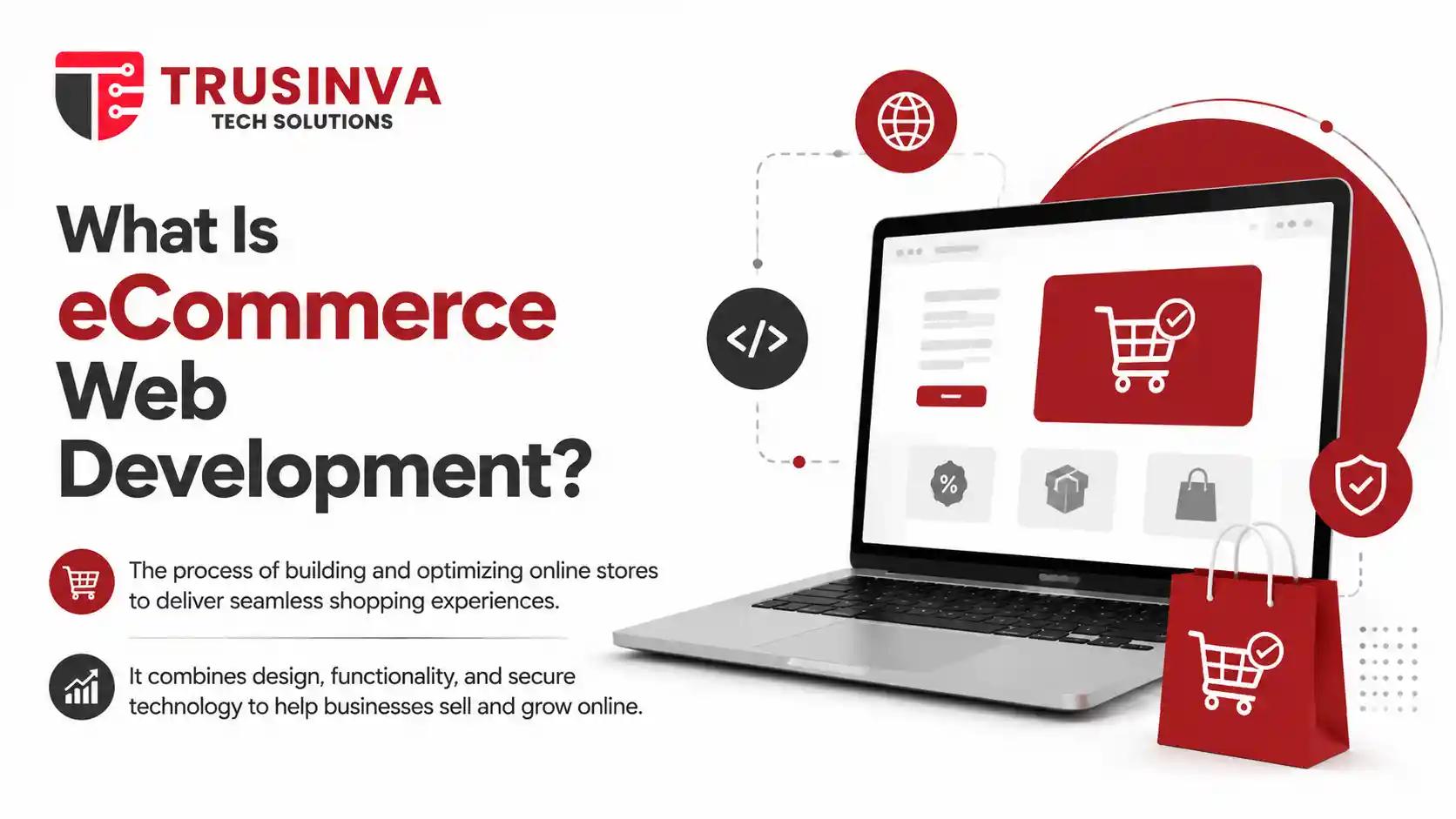
Ecommerce web development is the process of building an online store where customers can browse products, add them to a cart, pay securely, and get their order tracked — all without ever picking up a phone to call you.
It covers everything from the visual design (ecommerce web design) to the backend logic — inventory management, payment gateway integration, order management, and security.
Depending on your business size, this could mean:
- A Shopify or WooCommerce store for small to mid-size retailers
- A Magento or BigCommerce build for larger catalogs
- A fully custom ecommerce website development project for unique business logic
- Headless commerce for brands that need speed and flexibility across multiple channels
Think of it like building a physical shop, except instead of a storefront and checkout counter, you need a homepage, product pages, and a shopping cart — all working together seamlessly.
Why It Is Important
A slow or outdated store doesn't just look bad — it actively costs you sales. Studies consistently show shoppers abandon carts when checkout is confusing or pages load slowly.
For businesses in the USA — whether you're in New York, Texas, California, or Florida — competition online is fierce. A professional ecommerce development company helps you stand out with:
- Faster load times that keep customers from bouncing
- Mobile commerce optimization (most shoppers buy from their phone now)
- Secure checkout that builds trust and reduces fraud
- SEO-ready architecture so Google can actually find your store
And it's not just a US-only conversation. International sellers and remote teams — including agencies and developers based in Pakistan working with American clients — are increasingly building these stores for USA-based businesses. The tools (Shopify, WooCommerce, Magento) are the same regardless of where the development team sits; what matters is experience and execution.
If you're a startup, a retailer scaling up, or an enterprise brand needing a scalable ecommerce website, this isn't optional anymore — it's the foundation of your revenue.
Key Benefits of Professional eCommerce Development
Here's what you actually get when you invest in real ecommerce web development services instead of a cheap template:
- Higher conversion rates — smart UX design turns browsers into buyers
- Better search visibility — SEO-friendly code structure helps you rank and show up in Google AI Overviews
- Stronger brand trust — secure checkout and professional design keep customers coming back
- Scalability — your store grows with you, from 50 orders a month to 5,000
- Omnichannel reach — sell on your website, social media, and marketplaces from one backend
- Data and insights — ecommerce analytics show you exactly what's selling and what's not
- Automation — inventory, order management, and even AI-powered product recommendations run without manual effort
These aren't just nice-to-haves. They directly affect your bottom line — more visitors converting into paying customers, and lower costs from manual work you no longer need to do.
Step-by-Step eCommerce Development Process
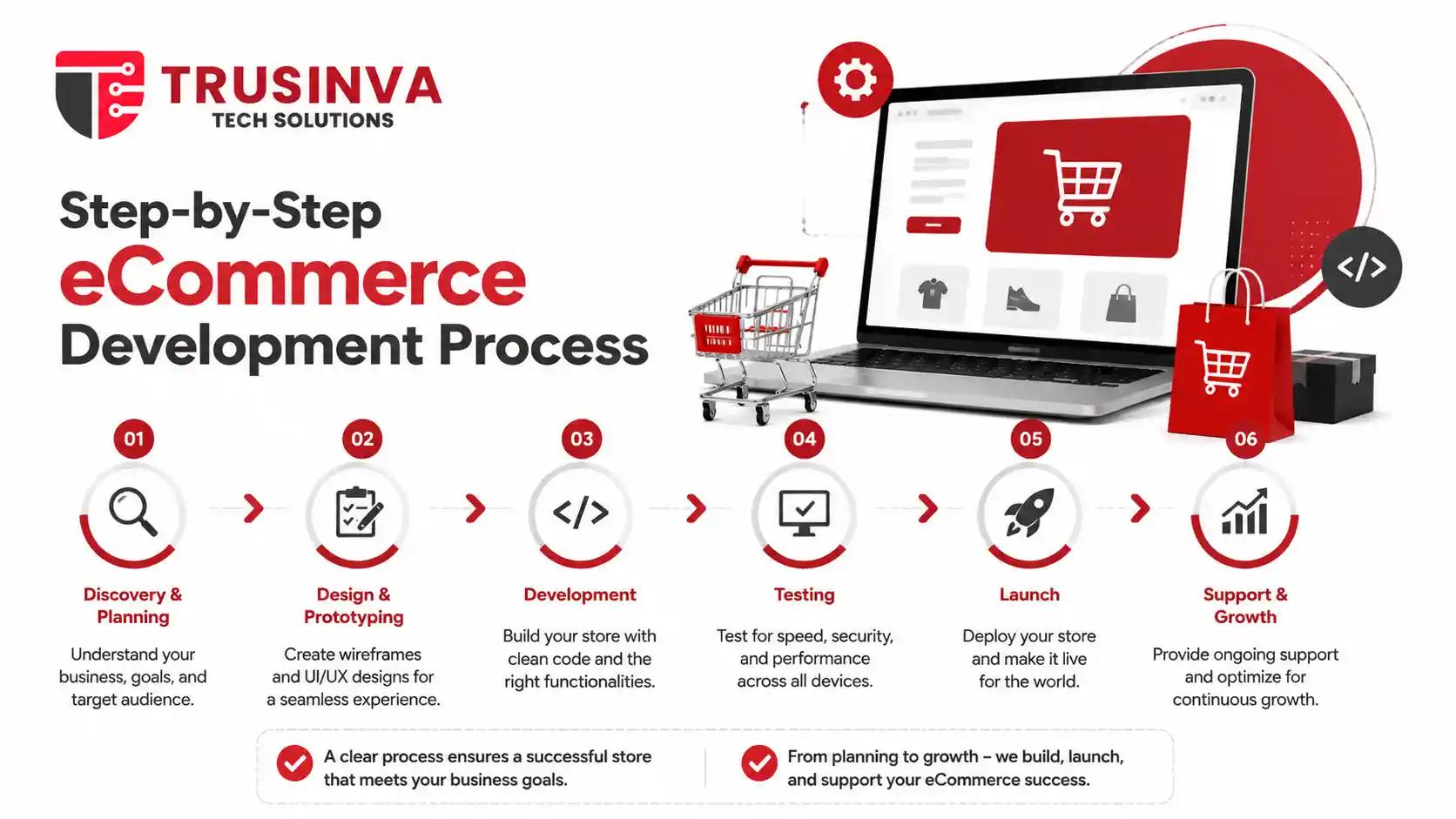
Here's how a proper ecommerce project typically moves from idea to launch:
- Discovery & Strategy — Understand your business goals, target audience, and competitors before writing a single line of code.
- Platform Selection — Choose the right foundation: Shopify for speed and simplicity, WooCommerce for WordPress flexibility, Magento for complex catalogs, or a fully custom build for unique needs.
- UI/UX Design — Design wireframes and visual layouts focused on conversion — clear navigation, strong calls-to-action, and mobile-first layouts.
- Development — Build the actual store: product catalog, shopping cart, secure checkout, payment gateway integration (Stripe, PayPal, etc.), and any custom features.
- Third-Party Integrations — Connect ERP, CRM, shipping tools, and marketing platforms so your store talks to the rest of your business.
- Testing & QA — Check every device, browser, and payment flow to make sure nothing breaks at checkout — the most expensive place for a bug to exist.
- Launch — Go live with proper redirects, analytics tracking, and SEO basics already in place.
- Post-Launch Support — Ongoing ecommerce maintenance services, performance optimization, and security updates keep your store running smoothly long after launch.
Skipping any of these steps is usually where things go wrong — which brings us to the mistakes businesses make.
Common Mistakes Businesses Make
Even well-funded businesses mess this up. Here are the patterns we see most often:
Choosing the cheapest option. A $200 template site might look fine on day one, but it usually can't scale, isn't secure, and ranks poorly on Google.
Ignoring mobile experience. If your site isn't fully responsive, you're losing a majority of potential buyers who shop exclusively on their phones.
Skipping SEO from the start. Bolting on SEO after launch is far more expensive than building it in from day one — proper URL structure, page speed, and schema markup matter from the first line of code.
No clear checkout flow. Long, confusing checkout processes are the #1 reason for cart abandonment.
Underestimating maintenance. A store isn't "done" at launch. Security patches, plugin updates, and performance checks need to be ongoing.
Picking the wrong platform for their size. Enterprise brands trying to run on basic templates — or small businesses overpaying for enterprise-grade custom builds they don't need — both waste money.
Why Choose Trusinva Tech Solutions
At Trusinva Tech Solutions, we build ecommerce stores that are designed to convert — not just look nice. Our team handles everything from strategy to launch to long-term support, so you're not left guessing what to do once the site goes live.
Here's what we offer:
- Web Development — custom, fast, SEO-ready websites built for your business goals
- Shopify Development — full store builds, theme customization, and Shopify Plus solutions
- WordPress Development — flexible WooCommerce stores built on a platform you can control
- Mobile App Development — extend your store into a native shopping app
- SEO Services — rank higher, get found in Google AI Overviews, and drive organic traffic
- Digital Marketing, Google Ads, and Social Media Marketing — to drive traffic straight to your new store
- CRM Development — keep your customer relationships organized as you scale
- UI/UX Design — conversion-focused design that keeps visitors engaged
- Truck Dispatching and Medical Billing software solutions — for businesses outside traditional retail that still need robust digital systems
We also run practical training for people who want to build careers in in-demand fields — check out our courses, including Truck Dispatching, Medical Billing, and international taxation programs for the USA, UK, UAE, and KSA.
Want to see our past work? Browse our projects or read more on our blog. You can also check our full services page or learn more about us.
FAQ
What is ecommerce web development? It's the process of building an online store — design, product catalog, checkout, and backend systems — so customers can browse and buy products online.
How much does ecommerce website development cost in the USA? Costs vary widely based on platform and complexity — a basic Shopify or WooCommerce store costs far less than a fully custom enterprise build. Get a quote based on your specific needs.
Which platform is best for ecommerce — Shopify or WooCommerce? Shopify is easier to launch and manage with less technical overhead. WooCommerce offers more flexibility if you're already using WordPress and want full control over customization.
How long does ecommerce website development take? A standard Shopify or WooCommerce store typically takes a few weeks. Custom or enterprise builds can take longer depending on integrations and features.
Why hire an ecommerce development company instead of doing it myself? An experienced team avoids costly mistakes, builds with SEO and security in mind from day one, and gets your store to market faster with fewer post-launch fixes.
Can ecommerce websites integrate with ERP and CRM systems? Yes — modern ecommerce platforms integrate with ERP, CRM, and accounting tools to keep inventory, orders, and customer data in sync across your business.
Final Thoughts
A great ecommerce store isn't just a website — it's your best-performing salesperson, working 24/7 without a day off. The businesses that invest in the right platform, design, and ongoing support are the ones winning customers in 2026.
If you're ready to build or upgrade your online store, contact Trusinva Tech Solutions for professional digital services and business growth.