Quick Answer
Truck dispatcher pay in the U.S. sits close to a national median of $50,340 a year, with the middle 50% earning between roughly $36,030 and $78,140 depending on experience, employer, and state, according to BLS wage data for the broader dispatcher occupation.The Bureau of Labor Statistics reports a median annual wage of $50,340 for dispatchers, except police, fire and ambulance, in May 2025, with a mean of $54,740. States with dense freight corridors and higher costs of living — think New York, Illinois, California, and New Jersey — consistently sit above that median, while lower-cost Southern and Midwestern states trend below it. Independent dispatchers who run their own book of owner-operators aren't captured in government wage data at all, since their income is commission-based rather than salaried.
Introduction
If you're comparing truck dispatcher salary by state before deciding where to work, who to work for, or whether to go independent, the honest answer is more layered than a single number. Pay depends on your state, your employer type, your experience, and whether you're on a payroll or running your own book of carriers on commission. This guide breaks all four of those apart so you can see where you actually stand — and where the ceiling is.
At Trusinva Tech Solutions, we work with logistics and trucking businesses on the technology side — CRM systems, automation, and web platforms that dispatch operations run on — which gives us a practical view of how dispatch teams are actually staffed and paid across the country. We've also built a dedicated truck dispatcher training program for people entering the field, so this article draws on both government wage data and what we see from students and clients moving through the industry. For a broader look at the numbers behind this occupation, our earlier breakdown in Truck Dispatcher Salary USA 2026 is a useful companion piece to this state-level guide.
Key Takeaways
- The national median for the BLS occupation covering dispatchers is $50,340 a year, with a mean of $54,740 and a 90th-percentile wage of $78,140.
- No BLS category exists specifically for "truck dispatcher" — the closest occupational match, SOC 43-5032, covers dispatchers across trucking, security, utilities, and other industries.
- Freight-dense, higher-cost-of-living states (New York, Illinois, New Jersey, California, Washington) have historically paid above the national mean for this occupation; lower-cost states in the South and parts of the Midwest pay below it.
- Independent dispatchers work on commission (commonly 5–10% of what a carrier grosses per load), so their income has no BLS equivalent and can outpace or undercut payroll dispatcher wages depending on the number and size of carriers they run.
- A written dispatch agreement and knowing FMCSA's broker-versus-agent line matter as much to long-term income as the state you work in — a misclassified dispatch service risks needing broker authority it doesn't have.
- Structured training shortens the learning curve on rate negotiation, the single skill that most directly moves dispatcher pay.
What Is a Truck Dispatcher, and What Do They Actually Do?
A truck dispatcher coordinates freight movement between carriers and the loads available to haul — finding loads on load boards, negotiating rates with brokers or shippers, and managing the paperwork, tracking, and communication that keeps a truck moving profitably. It's part sales, part logistics coordination, and part problem-solving when a delivery appointment falls through or a driver runs into a delay.
Dispatchers work in three main setups: as a payroll employee of a trucking company, as an employee of a third-party dispatch service, or as an independent dispatcher who signs owner-operators as clients and earns a percentage of what those carriers gross. Each path has a different pay structure, which is exactly why "truck dispatcher salary" can't be reduced to one figure. If you're weighing whether to launch your own dispatch service rather than take a payroll job, our guide on how to start a truck dispatching business in the USA walks through the practical setup steps.
Truck Dispatcher Salary in the USA: 2026 National Numbers
The most reliable public benchmark for dispatcher pay comes from the U.S. Bureau of Labor Statistics, under the occupational code SOC 43-5032, "Dispatchers, Except Police, Fire, and Ambulance." In its May 2025 Occupational Employment and Wage Statistics, BLS reports a median annual wage of $50,340 for this occupation, a mean of $54,740, a 10th-percentile wage of $36,030, and a 90th-percentile wage of $78,140. This occupational category isn't truck-dispatcher-specific — it also covers dispatchers in security, utilities, and other services — so treat it as the shape of the market rather than an exact truck-industry figure.
It's worth being upfront about a gap most articles gloss over: no government agency tracks "truck dispatcher" as its own line item, and independent dispatchers who work on commission aren't captured by payroll wage surveys at all. That means the true earning range for someone booking freight for owner-operators is wider than BLS numbers alone suggest — both lower for someone struggling to build a client base, and higher for an established dispatcher running a dozen trucks. If you dispatch for owner-operators specifically, our article on owner-operator dispatch services and their benefits explains how that commission relationship is typically structured.
Highest-Paying States for Truck Dispatchers in 2026
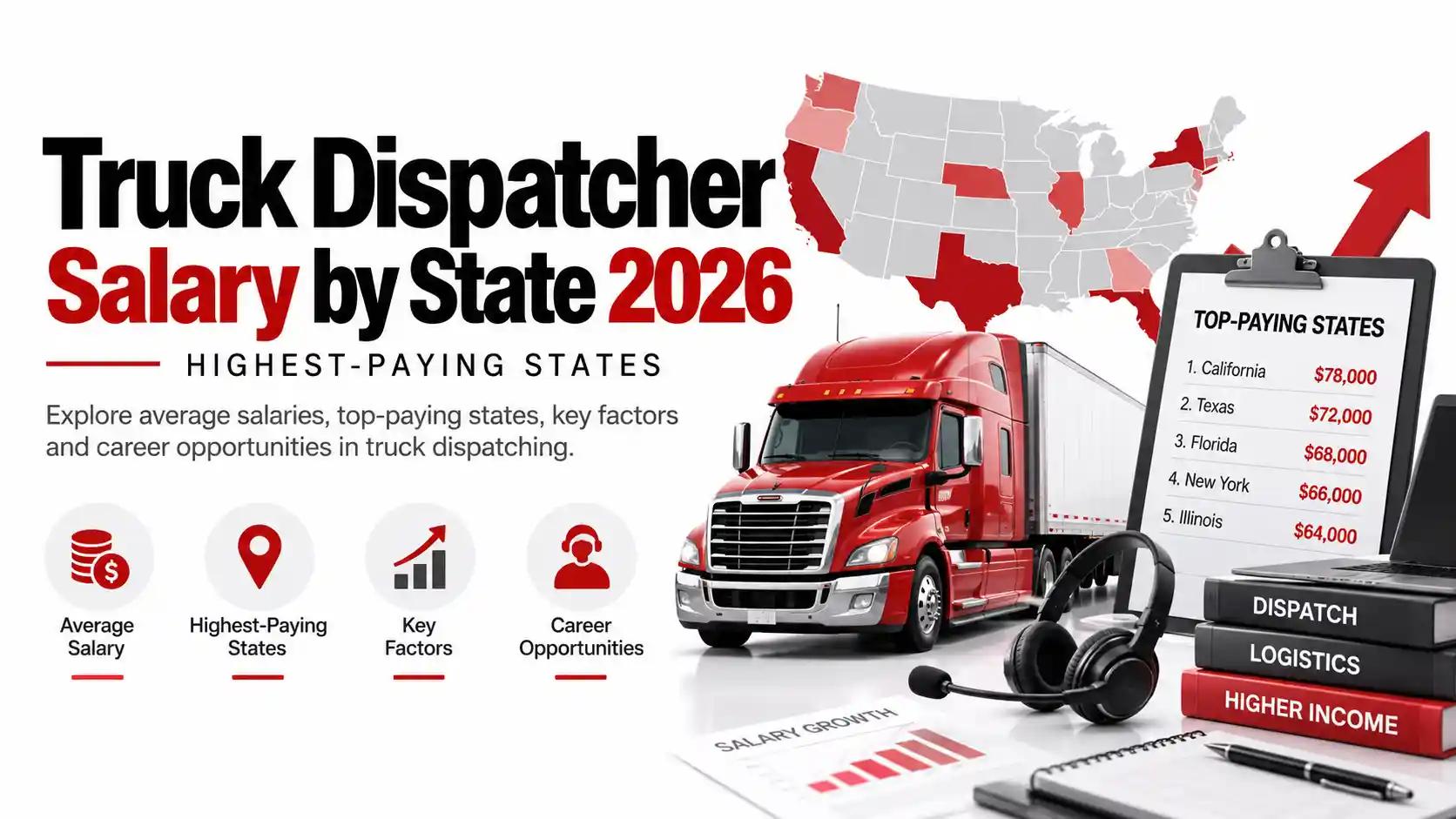
BLS doesn't publish a truck-specific state ranking, but its multi-year state-level data for the broader dispatcher occupation shows a consistent pattern: states with dense freight corridors, strong union or municipal dispatch employment, and higher costs of living pay noticeably above the national mean, while lower-cost states in the South and parts of the Midwest sit below it.
| Tier | Typical States | Pattern |
| Highest-paying | New York, Illinois, New Jersey, California, Washington, Massachusetts, Alaska | Higher cost of living, dense freight/logistics hubs, strong metro-area wage premiums |
| Mid-range | Texas, Georgia, Colorado, Pennsylvania, Virginia | High freight volume, moderate cost of living |
| Lower-paying (nominal) | Florida, Mississippi, Arkansas, parts of the Southeast | Lower cost of living generally offsets lower nominal wages |
A practical note: a lower nominal salary in a lower-cost state can leave you with more disposable income than a higher salary in an expensive metro area. Before chasing the highest number, run it against local rent, taxes, and cost of living — a dispatcher earning $48,000 in a mid-sized Texas city may be better off than one earning $58,000 in the New York metro. If you dispatch flatbed or specialized freight, pay in freight-dense states tends to run higher still, which our guide on flatbed dispatching in the USA covers in more depth.
Why Dispatcher Pay Varies So Much by State
Four factors explain most of the state-to-state gap: cost of living, freight density, employer mix, and specialization. States with major freight corridors (Chicago, the New York–New Jersey port complex, the I-5 corridor through California and Washington) simply have more dispatch jobs competing for talent, which pushes wages up. States with a heavier mix of municipal or utility dispatch jobs — which fall under the same BLS occupational code — also skew the state average upward, even though that's not trucking-specific work.
Specialization matters just as much as geography. A dispatcher who handles flatbed, reefer, or heavy-haul freight typically commands higher pay or higher commission than one running generalist dry van loads, because those loads pay more per mile and require more negotiating skill. We see this pattern consistently in the carriers we work with: the dispatchers who specialize outperform generalists at the same truck count, largely because they know their market cold. Our piece on how truck dispatching services save U.S. carriers money breaks down where that value actually comes from on the carrier side.
Truck Dispatcher Salary by Experience Level
Experience level is the single biggest lever on dispatcher pay after the employer-type decision. A brand-new dispatcher with no book of carriers and no negotiation track record sits near the BLS 10th-percentile mark — roughly $36,000 a year on a payroll job, or a thin trial-period income if going independent. A dispatcher with two to four years of experience, a stable roster, and demonstrated negotiation skill typically lands in the middle of the range, often $50,000–$65,000 on payroll or a meaningfully larger commission book if independent. Senior dispatchers who've built a specialized book of high-paying carriers, or who've moved into managing a small dispatch team, routinely clear the BLS 90th-percentile figure of $78,140 in total compensation.
The fastest way to move up that ladder isn't tenure alone — it's structured skill-building in rate negotiation, load board proficiency, and carrier relationship management. That's exactly what our truck dispatcher training program is built around: real load board practice, negotiation drills, and dispatch agreement fundamentals so you're not learning entirely on the job. Book a Seat →
Company Dispatcher vs. Independent Dispatcher vs. Freight Broker: Pay Compared
| Role | Pay Structure | Income Ceiling | Startup Cost | Regulatory Risk |
| Company (payroll) dispatcher | Fixed salary, sometimes plus bonus | Capped by employer pay bands | None | Employer's responsibility |
| Independent dispatcher | Commission (typically 5–10% of carrier gross per load) | High — scales with carriers signed | Load board subscription, minimal | Yours — must stay on the agent side of FMCSA's broker line |
| Freight broker | Margin between shipper rate and carrier rate | Highest, but requires operating authority | Broker bond, FMCSA authority | Full regulatory compliance required |
The line between an independent dispatcher and a freight broker is a regulatory one, not just a pay difference, and it's the part most salary articles skip entirely. Under FMCSA's guidance, a dispatch service can be classified as either a broker or a bona fide agent depending on what it actually does — dealing directly with shippers, being paid by a broker or factoring company, or allocating a load among several carriers all push a dispatcher into broker territory, which requires FMCSA operating authority it likely doesn't have. Getting this wrong doesn't just risk fines — it caps your legitimate earning ceiling because you can't scale a business you're not legally allowed to run that way. If you're deciding between these three paths, our guide to starting a truck dispatching business in 2026 walks through the setup decisions in order.
truck-dispatcher-salary
How Dispatcher Commission and Bonus Structures Actually Work
Independent dispatchers typically earn a percentage of what each carrier grosses per load, commonly landing in the 5–10% range depending on equipment type and service level. The arithmetic is straightforward: at a 6% fee, a carrier grossing $10,000 a month generates $600 in monthly fee revenue for the dispatcher; run ten carriers at that level and you're looking at $6,000 a month in gross fee income before tool costs and self-employment tax. Company dispatchers, by contrast, are more likely to see a base salary plus a smaller bonus tied to load volume or on-time performance metrics set by their employer.
What moves this number more than carrier count is what your carriers gross per month — a dispatcher running five carriers on high-paying flatbed or reefer freight can out-earn one running fifteen carriers on thin dry van margins. Understanding rate data well enough to negotiate a rate up by even $0.30 a mile on a 1,500-mile load puts an extra $450 in a carrier's pocket on that single load — and a direct commission bump in yours. Our truck dispatching course in the USA covers the negotiation mechanics behind numbers like this in more detail.
Remote Truck Dispatcher Salaries and the Home-Office Setup
Most truck dispatchers — company and independent alike — work remotely, and remote work doesn't inherently lower pay the way it sometimes does in other industries, since the job is phone- and computer-based by nature. What it does change is your overhead: a load board subscription, a reliable business phone line, and a system for tracking rate confirmations and carrier documents are the non-negotiables. As your carrier count grows past a handful of trucks, a proper CRM or transportation management system stops being optional — manually tracking a dozen carriers in spreadsheets is where dispatchers start dropping loads and losing clients.
This is one area where the tech side of the business matters as much as the dispatch skill itself. We've built CRM systems for logistics operations through our CRM development service, and the pattern we see is consistent: dispatchers who move off spreadsheets onto a real system earlier retain more carriers and scale faster, because they stop losing track of who needs a check call.
Running Your Dispatch Operation Like a Real Business
If you're going independent, the point where you stop being "a dispatcher" and start being "a dispatch business" usually comes down to systems, not headcount. A professional web presence helps you get taken seriously by carriers vetting who they trust with their freight — something our web development service supports for logistics operators building out their own site. Marketing yourself to prospective owner-operator clients is also a real bottleneck for many independent dispatchers, and our digital marketing service is built for exactly that kind of local, service-based client acquisition.
None of this replaces dispatch skill — negotiation, market knowledge, and carrier relationships still do the heavy lifting on income. But the dispatchers who treat their operation like a business, with the systems to match, are the ones who move from a handful of carriers to a real book faster than dispatchers relying on memory and spreadsheets.
How to Become a Truck Dispatcher: Step-by-Step Path to Higher Pay
- Learn the fundamentals — load board mechanics, rate confirmations, and basic freight terminology (dry van, reefer, flatbed).
- Choose a training path — a structured course, self-teaching, or getting hired as a junior dispatcher to learn on the job.
- Settle your legal setup — decide on a business entity if going independent, and understand FMCSA's broker-versus-agent distinction before you take your first fee.
- Set up your tool stack — a load board subscription at minimum, plus a system for documents and carrier records.
- Sign your first carriers — start with a short trial for your first two or three clients to build a track record.
- Specialize and scale — pick one equipment type, master that market, and grow your book deliberately.
No federal license or degree is required to dispatch trucks, which is exactly why the quality of your training determines how fast you move from step one to a real income. Our truck dispatcher training program is structured around this same sequence, with hands-on practice at each stage. Book a Seat →
Truck Dispatcher Certification and Training: Does It Raise Your Salary?
No government-issued dispatcher certification exists, so "certification" in this industry means completing a structured training program that covers load boards, rate negotiation, dispatch agreements, and compliance basics — not a licensing exam. What raises pay isn't the certificate itself; it's the negotiation and market knowledge the training builds, since rate negotiation is the single skill most directly tied to dispatcher income, whether you're on commission or angling for a raise on payroll.
A good training program should cover FMCSA's broker-versus-agent guidance, dispatch agreement fundamentals, and real load board practice — not just theory. That's the structure behind our truck dispatcher training course, built for people who want to move past the learning curve faster than trial and error allows. Book a Seat →
Common Mistakes That Quietly Cut Into Dispatcher Pay
- Not knowing the broker-versus-agent line. Taking on activities that push you into brokerage without FMCSA authority risks the whole operation, not just a fine.
- Underpricing to win carriers. A rock-bottom fee attracts carriers nobody else wants and leaves no margin to actually serve them well.
- Booking on load count instead of rate. Fifteen loads at $2.00 a mile is worse for everyone than ten loads at $3.00 a mile over similar distances.
- No written dispatch agreement. A verbal deal protects nobody and is one of the factors that can push a dispatch service toward broker classification.
- Skipping financial tracking. Without knowing your cost per carrier, you can't tell a profitable client from an expensive one.
Most of these mistakes cost dispatchers real money in their first year, and almost all of them are avoidable with the right groundwork before taking a first fee. Our guide on how to start a truck dispatching business in the USA covers the legal and operational setup that prevents most of this list.
Expert Tips to Increase Your Truck Dispatcher Salary in 2026
- Specialize in one equipment type rather than spreading thin across dry van, flatbed, and reefer.
- Track rate data daily so you always know when a broker's opening offer has room to negotiate.
- Put everything in writing — dispatch agreements protect your income and your regulatory standing.
- Invest in a CRM or TMS early once you're managing more than a handful of carriers.
- Ask for referrals directly after delivering good service for a month — trucking is a small, word-of-mouth industry.
Explore our full courses hub to see how truck dispatching training compares with our other career-focused programs if you're weighing multiple paths into logistics or finance-adjacent careers.
Truck Dispatcher Career Outlook and Future Trends
Freight volume and e-commerce-driven trucking demand continue to support steady dispatcher hiring, and dispatch software is increasingly AI-assisted for load matching and rate benchmarking — which raises the bar for dispatchers who can use that data intelligently rather than lowering demand for the role itself. Dispatchers who understand both the negotiation side and the technology side of the job are positioned to earn more as automation handles routine tasks and leaves the judgment calls — rate strategy, carrier relationships, problem-solving — to the human dispatcher.
For carriers and dispatch operators thinking about where the industry is headed next, our related coverage on how truck dispatching services save U.S. carriers money is a useful next read.
Why Choose Trusinva Tech Solutions for Truck Dispatcher Training in 2026
Choosing where to train matters as much as choosing to train at all, because the quality of your negotiation and market-knowledge foundation directly shapes your income ceiling. At Trusinva Tech Solutions, our truck dispatcher training program is built by people who also work with logistics companies on the technology side — CRM systems, automation, and web platforms — so the training reflects how dispatch operations actually run day to day, not just theory. We combine practical negotiation drills, dispatch agreement fundamentals, and load board practice with a clear understanding of the compliance line between dispatching and brokerage, so you start your career or business on solid footing rather than learning the hard way. If you're serious about moving from an entry-level number toward the higher end of the pay range, structured training shortens that path meaningfully compared to trial and error alone. Book a Seat →
FAQs
1. What is the average truck dispatcher salary in the USA in 2026?
Based on BLS wage data for the broader dispatcher occupation, the national median is about $50,340 a year, with a mean of $54,740. Truck-specific pay can vary above or below that depending on employer type, state, and whether you're salaried or on commission.
2. Which states pay truck dispatchers the most?
Higher-cost, freight-dense states — New York, Illinois, New Jersey, California, and Washington — have historically paid above the national average for this occupation. Lower-cost states in the South and Midwest tend to pay less in nominal terms, though cost of living often offsets the gap.
3. Do independent truck dispatchers make more than company dispatchers?
It depends entirely on how many carriers they run and what those carriers gross. An independent dispatcher on a 6% commission running ten carriers grossing $10,000 a month each can earn well above the BLS median, but there's also more income risk and no guaranteed paycheck.
4. How much do entry-level truck dispatchers make?
Entry-level dispatchers on payroll typically land near the BLS 10th-percentile wage of roughly $36,000 a year. Entry-level independent dispatchers usually earn far less in their first few months while building a carrier roster.
5. Do you need a license to become a truck dispatcher?
No federal license, CDL, or degree is required to work as a truck dispatcher. However, FMCSA guidance means a dispatch service can be classified as a broker — which does require operating authority — depending on whether it deals directly with shippers or is paid by a broker or factoring company.
6. Is truck dispatcher training worth it?
Training doesn't replace experience, but it shortens the learning curve on the skill that most directly affects pay: rate negotiation. A structured program that also covers dispatch agreements and compliance basics reduces costly early mistakes.
7. Can truck dispatchers work remotely?
Yes — most truck dispatchers, whether company employees or independent, work remotely with a computer, phone, and load board subscription as the core requirements.
8. How much commission do independent truck dispatchers charge?
Commission rates commonly fall between 5% and 10% of what a carrier grosses per load, though this varies by equipment type and service level.
9. What's the difference between a truck dispatcher and a freight broker?
A dispatcher works as an agent for specific carriers under a written agreement and is paid only by those carriers. A freight broker arranges transportation for shippers directly and requires FMCSA broker authority — crossing into broker-like activity without that authority is a compliance risk for dispatchers.
10. How can I increase my truck dispatcher salary?
Specialize in a higher-paying equipment type, build strong rate-negotiation skills, keep everything in writing, and invest in training or systems (like a CRM) as your carrier count grows.
Conclusion
Truck dispatcher salary by state isn't a single number — it's a mix of location, employer type, experience, and whether you're on a payroll or building your own book on commission. The national data points to a median around $50,340, with freight-dense, higher-cost states running above that and lower-cost states running below it, but the real driver of your income ceiling is skill: rate negotiation, market knowledge, and knowing exactly where the line sits between dispatching and unlicensed brokerage.
If you're serious about entering this field or scaling an existing dispatch business, structured training closes that skill gap faster than learning it alone. Explore our truck dispatcher training program and see how it fits your goals. Book a Seat →