Quick Answer
Mobile app development cost in the USA typically ranges from $15,000 for a simple app to $300,000+ for a complex, enterprise-grade platform. Simple apps with basic features cost $15,000–$40,000, mid-complexity apps run $40,000–$150,000, and highly complex apps with custom backends, AI, or heavy integrations can exceed $150,000–$500,000, depending on features, platform choice, and development team location.
Introduction
If you're planning to build an app in 2026, the first question is almost always the same: how much will it actually cost? The honest answer is — it depends on a lot more than most business owners expect. Working with a mobile app development company like Trusinva Tech Solutions means your budget is shaped by real technical decisions, not guesswork — things like app complexity, chosen platform, feature list, and the location of your development team. This guide breaks down real 2026 pricing for the U.S. market so you can plan your budget with confidence instead of relying on rough estimates. Before diving into the numbers, it also helps to understand how to hire the best mobile app development company without wasting your budget, and whether a website or a mobile app is the right first move for your business. Whether you're a startup building an MVP or an enterprise scaling a existing platform, this guide gives you a realistic, transparent picture of what to expect.
Key Takeaways
- App complexity, feature count, and platform choice (iOS, Android, or cross-platform) are the biggest cost drivers.
- U.S.-based development teams charge $100–$250/hour, while nearshore and offshore teams can bring costs down significantly without sacrificing quality.
- Cross-platform frameworks like Flutter and React Native reduce cost by 30–40% compared to building separate native apps.
- Post-launch maintenance typically adds 15–20% of the original development cost every year.
- Getting an accurate quote requires a clear scope — vague requirements are the number one reason app budgets spiral out of control.
Table of Contents
- What Determines Mobile App Development Cost in the USA
- Average Cost by App Complexity
- Cost by App Type
- Native vs. Cross-Platform Development Cost
- Cost Breakdown by Development Stage
- Hourly Rates by Developer Location
- Hidden Costs Businesses Often Miss
- How to Reduce Mobile App Development Costs
- Mobile App Maintenance Cost
- Common Mistakes That Inflate App Budgets
- Why Choose Trusinva Tech Solutions
- FAQs
- Conclusion
1. What Determines Mobile App Development Cost in the USA
Direct answer: Mobile app development cost is determined by five core factors — app complexity, number of features, platform (iOS, Android, or both), UI/UX design requirements, and the hourly rate of the development team you hire. Together, these factors can push a project anywhere from $15,000 to over $500,000.
Here's how each factor plays into your final bill:
- App complexity — a simple informational app costs far less than one with real-time features, AI, or complex logic.
- Feature set — every additional feature (chat, push notifications, payment gateway, geolocation) adds development hours.
- Platform choice — building separately for iOS and Android roughly doubles native development cost.
- UI/UX design — custom, animated interfaces cost more than template-based designs. See how UI/UX design services increase conversions for U.S. businesses.
- Backend & infrastructure — apps needing custom APIs, databases, and cloud infrastructure (AWS, Azure, Google Cloud) cost more upfront but scale better long-term.
- Team location — U.S.-based agencies charge premium rates; nearshore/offshore teams offer lower rates at comparable quality.
2. Average Cost by App Complexity
Direct answer: A simple app costs $15,000–$40,000, a moderately complex app costs $40,000–$150,000, and a highly complex app costs $150,000–$500,000+ in the USA, based on the number of screens, integrations, and backend logic required.
| App Complexity | Typical Features | Estimated Cost (USD) | Timeline |
| Simple | Basic UI, static content, login | $15,000 – $40,000 | 2–4 months |
| Moderate | User accounts, push notifications, payment gateway, API integrations | $40,000 – $150,000 | 4–8 months |
| Complex | AI/ML features, real-time data, custom backend, multiple integrations | $150,000 – $500,000+ | 8–14+ months |
Note: These figures reflect the U.S. market average across agencies. Rates vary based on the vendor's location and experience level.
3. Cost by App Type
Direct answer: Costs vary significantly by industry — a basic eCommerce app starts around $30,000, a healthcare app with HIPAA compliance can run $80,000–$250,000, and an on-demand service app (like food delivery) typically costs $60,000–$200,000 due to real-time tracking and multi-user architecture.
- eCommerce apps: $30,000–$150,000 — product catalogs, payment gateways, order tracking
- Healthcare apps: $80,000–$250,000 — HIPAA-compliant data handling, appointment scheduling, telehealth
- FinTech apps: $100,000–$300,000 — bank-grade security, OAuth, real-time transactions
- On-demand/logistics apps: $60,000–$200,000 — GPS tracking, live updates, multi-user dashboards
- SaaS mobile apps: $50,000–$200,000 — subscription billing, user roles, analytics dashboards. Learn more about SaaS development services.
- Retail apps: $40,000–$180,000 — see how mobile app development helps U.S. retail businesses specifically.
4. Native vs. Cross-Platform Development Cost
Direct answer: Native app development (separate iOS and Android codebases) costs 30–40% more than cross-platform development using frameworks like Flutter or React Native, because native apps require two independent development efforts instead of one shared codebase.
| Development Type | Technology | Cost Range | Best For |
| Native iOS | Swift, Xcode | $25,000 – $150,000 | Apps needing deep iOS-specific performance |
| Native Android | Kotlin/Java, Android Studio | $25,000 – $150,000 | Apps needing deep Android-specific performance |
| Cross-Platform | Flutter, React Native | $20,000 – $120,000 | Startups wanting one app for both platforms, faster launch |
| Hybrid/PWA | Ionic, Progressive Web Apps | $10,000 – $60,000 | Low-budget MVPs, quick market validation |
Cross-platform frameworks like Flutter and React Native have become the default choice for most custom mobile app development projects in 2026 because they cut both cost and time-to-market without a major compromise on performance.
5. Cost Breakdown by Development Stage
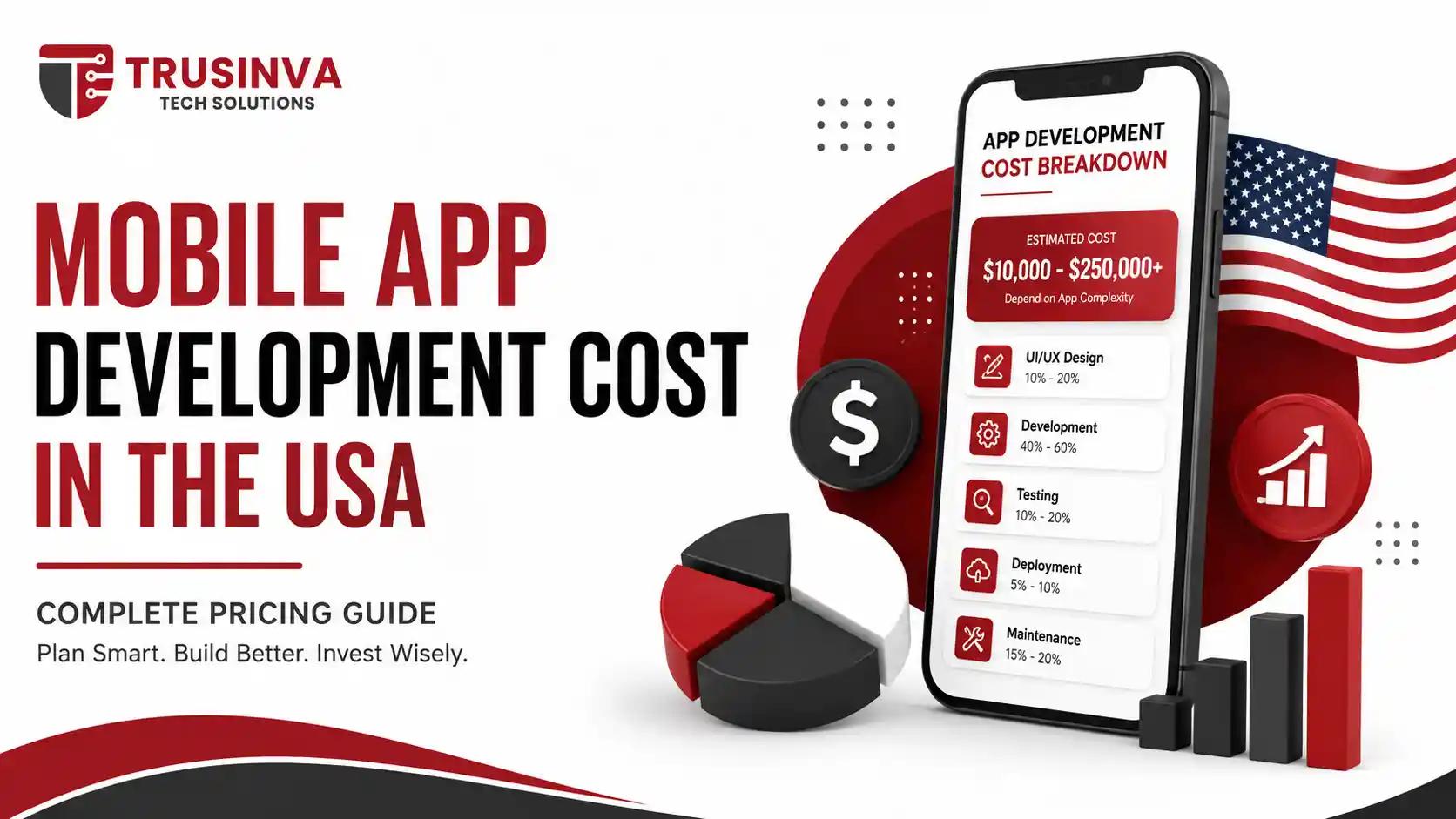
Direct answer: A typical mobile app budget splits roughly as follows: 15–20% for UI/UX design, 50–60% for frontend and backend development, 10–15% for QA and testing, and 10–15% for deployment and project management — with post-launch maintenance as a separate, ongoing cost.
- Discovery & planning: 5–10% of budget — requirements gathering, wireframes
- UI/UX design: 15–20% — user flows, prototypes, visual design
- Frontend + backend development: 50–60% — the largest chunk, covering coding, API development, and database setup
- QA & testing: 10–15% — functional testing, security testing, device testing
- Deployment: 5% — App Store and Google Play submission, configuration
6. Hourly Rates by Developer Location
Direct answer: U.S.-based developers charge $100–$250/hour, while nearshore teams (Latin America) charge $50–$100/hour, and experienced offshore teams (South Asia, Eastern Europe) charge $25–$60/hour — often delivering comparable quality at a fraction of the cost.
| Developer Location | Hourly Rate (USD) |
| United States | $100 – $250 |
| Western Europe | $80 – $180 |
| Eastern Europe | $40 – $90 |
| Latin America (Nearshore) | $50 – $100 |
| South Asia (Offshore) | $25 – $60 |
According to the U.S. Bureau of Labor Statistics, software developer wages in the U.S. remain among the highest globally, which is why many American businesses partner with skilled offshore and nearshore development teams to control costs while maintaining quality.
7. Hidden Costs Businesses Often Miss
Direct answer: Beyond core development, businesses often overlook costs like App Store/Google Play fees, third-party API licensing, cloud hosting, post-launch bug fixes, and ongoing maintenance — which together can add 20–30% to the total project cost over the first year.
- Apple Developer Program fee ($99/year) and Google Play registration ($25 one-time)
- Third-party API costs (payment gateways, maps, SMS/OTP services)
- Cloud hosting and storage (AWS, Firebase, Azure)
- App store optimization and marketing
- Ongoing mobile app maintenance and OS update compatibility
8. How to Reduce Mobile App Development Costs
Direct answer: The most effective ways to reduce app development costs are starting with an MVP instead of a full-featured app, choosing cross-platform development, working with a nearshore/offshore team, and clearly defining requirements before development begins to avoid costly scope changes.
- Build an MVP first, then scale based on real user feedback
- Choose Flutter or React Native over separate native builds
- Partner with an experienced custom software development team that offers transparent pricing
- Avoid mid-project scope changes — lock requirements early
- Reuse existing backend infrastructure where possible instead of building from scratch
9. Mobile App Maintenance Cost
Direct answer: Mobile app maintenance typically costs 15–20% of the original development cost annually, covering OS updates, bug fixes, security patches, server costs, and minor feature improvements.
Maintenance isn't optional — both Apple and Google frequently update their OS requirements, and apps that aren't maintained risk being removed from app stores. Budgeting for ongoing support from day one prevents unexpected costs later.
10. Common Mistakes That Inflate App Budgets
- Skipping the discovery phase — leads to expensive mid-project changes
- Choosing the cheapest vendor — often results in poor code quality and costly rebuilds
- Ignoring scalability — apps built without scalable architecture become expensive to fix later
- No clear feature prioritization — building "nice-to-have" features before validating the core product wastes budget
- Underestimating QA — inadequate testing leads to expensive post-launch bug fixes
If you're still weighing your options, comparing software development cost trends more broadly, or looking into a software development company in the USA, can help you benchmark pricing across your entire tech stack — not just the mobile app.
11. Why Choose Trusinva Tech Solutions
Trusinva Tech Solutions is a full-service mobile app development company built for U.S. startups, growing businesses, and enterprises that need transparent pricing without compromising on quality. The team specializes in native iOS and Android development, cross-platform builds with Flutter and React Native, and end-to-end product delivery — from UI/UX design to backend architecture, API integrations, and post-launch support.
What sets Trusinva apart is a genuine focus on affordability without cutting corners — a big reason they're known for affordable mobile app development for U.S. startups. The team also builds beyond just apps, offering web development, CRM development, and AI automation services, making it easy for businesses to consolidate their entire digital ecosystem with one trusted partner. Whether the goal is a lean MVP or a full-scale enterprise app, Trusinva's process is built around clear scoping, honest estimates, and long-term support — the exact things this guide recommends looking for in a development partner.
12. FAQs
Q1. How much does it cost to develop a simple mobile app in the USA? A simple app with basic features typically costs between $15,000 and $40,000, depending on design complexity and platform choice.
Q2. Is it cheaper to build for iOS or Android first? Development costs for a single platform (iOS or Android) are similar. Many businesses choose Android first due to broader U.S. market reach, or iOS first for higher average user spending.
Q3. How much does an app with backend and API integration cost? Apps requiring custom backend development, databases, and third-party API integrations generally cost $50,000–$200,000, depending on the number of integrations.
Q4. Do cross-platform apps really cost less than native apps? Yes. Cross-platform frameworks like Flutter and React Native can reduce total development cost by 30–40% compared to building separate native iOS and Android apps.
Q5. What is the average cost of mobile app maintenance per year? Maintenance typically costs 15–20% of the original development budget annually, covering bug fixes, OS updates, and security patches.
Q6. Can I build an MVP for under $20,000? Yes, a lean MVP with core functionality only can often be built for $15,000–$25,000, especially using cross-platform frameworks.
Q7. Why do app development quotes vary so much between agencies? Quotes vary based on team location, experience level, technology stack, and how thoroughly the agency scopes the project before quoting.
Q8. Does app development cost include App Store fees? No. Apple's $99/year developer fee and Google Play's $25 one-time fee are separate from development costs.
13. Conclusion
Mobile app development cost in the USA depends on far more than a single number — it's shaped by complexity, platform choice, features, and the development team you choose to partner with. A simple app might cost $15,000, while an enterprise-grade platform can run well into six figures. The key to staying on budget is starting with a clear scope, choosing the right technology stack, and working with a development partner who's transparent from the first conversation. If you're ready to turn your app idea into a real, working product, Trusinva Tech Solutions offers free consultations to help you scope your project accurately before committing to a budget. Explore their full range of services, browse more insights on the blog, or reach out directly to Book a Seat for a one-on-one consultation and get a realistic, no-surprises quote for your next mobile app.