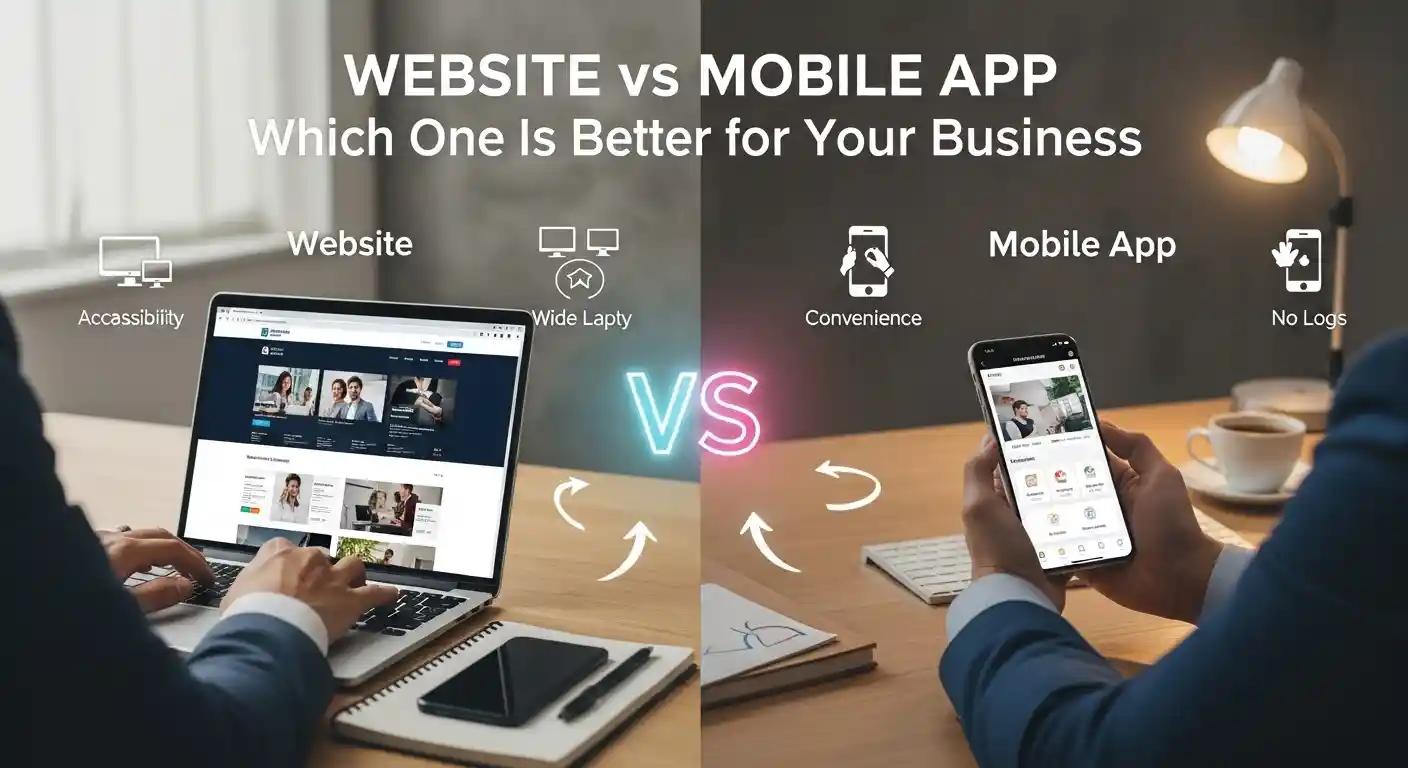
One of the most common questions growing businesses face when building their digital presence is simple but genuinely important: should we invest in a website, a mobile app, or both?
It sounds like a straightforward decision, but the answer depends entirely on your business model, your customers' behavior, your budget, and your growth goals. Choose the wrong one and you risk spending significant resources on a digital asset that doesn't move the needle. Choose the right one — or the right combination — and you create a competitive advantage that compounds over time.
This guide breaks down the website vs mobile app debate clearly and honestly. No technical jargon, no one-size-fits-all answer — just practical guidance to help you make the right decision for your business in 2026, whether you're based in Lahore, Dubai, London, Toronto, or New York.
What Is the Difference Between a Website and a Mobile App?
Before comparing them, it helps to understand what each actually is and how they work differently for businesses.
A business website is a collection of web pages accessible through a browser — Chrome, Safari, Firefox — on any device with an internet connection. It doesn't need to be downloaded or installed. Anyone can find it through Google, click a link, and access it immediately. A website is your digital storefront, your online brochure, your SEO-powered lead generation engine.
A mobile app is a software application downloaded and installed directly on a smartphone or tablet. It lives on the user's device, can work offline (depending on the type), sends push notifications, and accesses device features like camera, GPS, and contacts. An app creates a dedicated, persistent connection between your business and your users.
There's also a middle ground worth knowing about in 2026: Progressive Web Apps (PWAs) — websites that behave like apps, installable from the browser without going through an app store. They offer many app-like features at a fraction of the development cost.
The core question isn't which is technically better — it's which one serves your customers and your business goals most effectively.
Why This Decision Matters So Much for Business Growth
Making the wrong choice between a website and a mobile app doesn't just waste development budget — it can misalign your entire digital presence strategy for years.
A restaurant that builds a sophisticated mobile app before establishing a clear online presence through a website will struggle to attract new customers through Google. Conversely, an on-demand delivery service that relies only on a website will frustrate users who expect a fast, app-native experience with real-time tracking and push notifications.
For businesses in Pakistan, this decision has additional context. A web development company in Islamabad or Lahore serving local clients may see strong results from a professional website with good SEO and a Google Maps presence. A fintech startup in Karachi building an on-demand financial service almost certainly needs a mobile app from day one.
For international clients — businesses in the USA, UK, UAE, Saudi Arabia, and Canada — expectations are high on both fronts. Your website must be professional, fast, and SEO-optimized to generate inbound leads. And if your product or service involves regular, ongoing user interaction, a mobile app may be essential for retention and engagement.
According to Google's research on mobile user behavior, users spend significantly more time in apps than in mobile browsers — but they discover new businesses primarily through search and websites. This insight alone tells you something important: websites attract, apps retain.
Key Benefits of a Business Website

A professional website delivers these core advantages:
- Google discoverability — Websites rank in search engines. A well-optimized site brings in organic traffic every day from people actively searching for what you offer — with no cost per visit once rankings are established.
- Accessible to everyone immediately — No download required. Anyone with a browser and internet access can visit your site in seconds, anywhere in the world.
- Lower development and maintenance cost — A professional website costs significantly less to build and maintain than a native mobile app — making it the right first investment for most businesses.
- SEO and lead generation — A website is your primary content and SEO platform. Blog posts, service pages, case studies, and landing pages all work together to attract and convert clients.
- Credibility and brand presence — In 2026, a business without a professional website lacks credibility in virtually every market. It's the baseline expectation for any serious company.
- Broad audience reach — Websites work on every device — desktop, mobile, tablet — without requiring users to install anything.
Key Benefits of a Mobile App for Business

Mobile apps deliver a fundamentally different — and in many contexts, superior — user experience:
- Higher user engagement — Apps keep users more engaged than websites. Features like push notifications, personalized content, and seamless performance create stronger, more frequent interactions.
- Push notification marketing — Direct, cost-free communication with your users. Push notifications drive re-engagement at rates that email marketing can't match.
- Offline functionality — Certain app types work without internet — a major advantage for users in areas with inconsistent connectivity.
- Device feature integration — Camera, GPS, biometrics, contacts, and sensors enable experiences that websites simply cannot replicate — location-based services, AR features, mobile payments.
- Better performance — Native apps typically load faster and feel more responsive than mobile websites, especially for data-heavy or interactive experiences.
- Brand presence on the device — Your app icon on a user's homescreen is a constant, subtle brand touchpoint. It reinforces awareness every single time they look at their phone.
- Customer retention — Users who download your app are significantly more loyal and have higher lifetime value than website-only customers.
Website vs Mobile App: How to Make the Right Decision — Step by Step
Step 1: Define Your Primary Business Goal
Are you trying to attract new customers (awareness and acquisition)? Or deepen engagement with existing ones (retention and loyalty)? Websites are better for the former; apps are better for the latter. Most mature businesses need both — but the right starting point depends on where you are in your growth journey.
Step 2: Analyze Your Users' Behavior
How do your customers interact with your business? If they visit occasionally to browse products or make purchases, a responsive website may be sufficient. If they interact daily — tracking orders, booking appointments, accessing content — a mobile app dramatically improves that experience.
Step 3: Consider Your Budget Realistically
Website vs mobile app cost comparison is significant. A professional business website typically starts from $1,500–$5,000. A well-built native mobile app for iOS and Android typically starts from $10,000–$30,000 and above, depending on complexity.
For startups and small businesses with limited budgets, a professional website is almost always the right first investment. Once you've established revenue and validated your digital model, adding a mobile app makes strategic sense. Cross-platform development using Flutter or React Native can reduce app development costs significantly compared to building separate native apps.
Step 4: Evaluate the Nature of Your Product or Service
Some business models are inherently app-first: on-demand delivery, ride-sharing, fintech, fitness tracking, social platforms, and gaming. Others are inherently website-first: professional services, ecommerce (in early stages), B2B companies, and local service businesses.
If your service requires real-time interaction, location access, frequent repeat usage, or offline capability — build an app. If your primary goal is discoverability, content marketing, and lead generation — start with a website.
Step 5: Think About Long-Term Scalability
Both websites and apps need to scale as your business grows. A website built on a solid web development foundation can be expanded with new pages, integrations, and ecommerce functionality over time. A well-architected mobile app can add features progressively without requiring a complete rebuild.
The key is choosing development partners who build with scalability in mind from day one — not partners who deliver a quick solution that needs rebuilding in 18 months.
Common Mistakes Businesses Make When Choosing Between Website and App
Building an app before they're ready. Many startups spend their entire initial budget on a mobile app before validating their business model or building any online presence. Without a website, they have no organic discovery channel, no SEO foundation, and no credibility for prospects who search for them online.
Assuming an app will replace marketing. An app doesn't automatically bring users. Without a proper digital marketing strategy — including SEO services, Google Ads, and social media marketing — neither a website nor an app will generate consistent traffic on its own.
Neglecting mobile optimization on the website. Many businesses invest in web development but ignore mobile responsiveness. In 2026, a website that performs poorly on smartphones is a failing website — regardless of how good it looks on desktop.
Underestimating app maintenance costs. Mobile apps require ongoing updates for OS compatibility, bug fixes, feature improvements, and security patches. Businesses that budget for app development but not for ongoing maintenance end up with an outdated, broken product within two years.
Choosing based on what's trendy rather than what's needed. Progressive web apps, super apps, and no-code builders all have their place — but the right technology choice depends on your users' needs, not on what's generating industry buzz.
Ignoring UI/UX design quality. Whether you build a website or an app, poor user experience kills conversion. A beautiful design with confusing navigation, slow load times, or an unclear value proposition fails regardless of the platform. Professional UI/UX design is non-negotiable for both.
Why Choose Trusinva Tech Solutions for Your Website or App Development
Trusinva Tech Solutions helps businesses across Pakistan, the USA, UK, UAE, Saudi Arabia, and Canada make the right digital platform decision — then builds it to the highest professional standards at competitive pricing.
Professional Web Development — Their web development team builds fast, SEO-optimized, mobile-first websites that generate real business results. From WordPress development for content-driven businesses to Shopify development for ecommerce brands, every site is built with conversion and performance as core priorities.
Expert Mobile App Development — Their mobile app development services cover iOS, Android, and cross-platform development. Whether you need an MVP to test your concept or a full-featured application for enterprise use, the team builds scalable apps that perform under real user load.
UI/UX Design That Converts — Both websites and apps need exceptional user experience. Trusinva's UI/UX design services ensure that every digital touchpoint is intuitive, fast, and optimized for conversion — turning visitors and users into paying customers.
SEO and Digital Marketing Built In — Building your platform is only half the equation. Trusinva's SEO services, digital marketing, Google Ads, TikTok Ads, and social media marketing ensure your website and app get the traffic and downloads they deserve.
Custom Software and Integration — For businesses needing their website or app connected to CRM systems, ERP platforms, or custom software, Trusinva's CRM development and blockchain development teams build the integrations that turn platforms into complete business ecosystems.
Explore their full services or browse their project portfolio to see real-world examples of websites and apps built for businesses across industries and markets. Contact Trusinva for a free consultation and expert guidance on the right choice for your specific situation.
Real-World Example: Website First, Then App — The Right Sequence

Consider an on-demand home cleaning service launching in Karachi. Their instinct was to build a mobile app immediately — because apps feel modern and their service is bookable on-demand.
After consulting with a professional development agency, they were advised to launch a professional website first. The website was built with SEO-friendly structure, clear service pages targeting local search keywords, a booking form, and Google Ads integration. Within three months, the website was generating consistent local bookings from organic and paid search — at a fraction of the cost of app development.
With validated revenue and a clear understanding of how their customers behaved, they then invested in a mobile app — built with real user data informing the features and UX. The app launched to an existing customer base, achieved strong early adoption, and now drives the majority of repeat bookings through push notifications and loyalty features.
Total investment sequence: website first, app second — informed by data, not assumptions. The result was faster revenue, lower risk, and a better app because they knew exactly what users needed before building it.
Frequently Asked Questions
Which is better for business — a website or a mobile app? It depends on your business model and goals. A website is essential for every business — it handles discoverability, SEO, and credibility. A mobile app adds value when your users need frequent, high-engagement interaction. Most successful businesses eventually need both, but for most, a website is the right first investment.
Do small businesses need mobile apps? Not always, and not immediately. Small businesses benefit most from a professional website with good SEO first. A mobile app makes sense once you have consistent customers who would benefit from a faster, app-native experience — such as loyalty programs, real-time tracking, or frequent repeat purchases.
What is cheaper — a website or a mobile app? Websites are significantly cheaper. A professional business website typically starts from $1,500–$5,000. A mobile app with equivalent functionality for iOS and Android typically starts from $10,000–$30,000 or more. Cross-platform development reduces app costs but still involves greater investment than web development.
Can a website replace a mobile app? For many business types, yes — especially with Progressive Web Apps (PWAs) that offer app-like features without requiring a download. But for businesses where real-time notifications, offline access, or device feature integration are critical to the product experience, a native app remains superior.
Is a mobile app more profitable than a website? Neither is inherently more profitable — profitability depends on how well each serves your users and supports your business model. Apps tend to generate higher user lifetime value through better retention. Websites generate better first-time discovery through SEO. Combining both typically delivers the best commercial results.
How long does it take to build a website vs a mobile app? A professional business website typically takes 3–6 weeks. A mobile app takes 3–6 months for a standard build, longer for complex or feature-rich applications. Starting with a website gets your business online quickly while you plan and budget for an app.
Conclusion: The Best Choice Depends on Your Business — But You Don't Have to Decide Alone
The website vs mobile app debate doesn't have a universal answer. What it has is a right answer for your specific business — based on your customers, your goals, your budget, and where you are in your growth journey.
For most businesses, a professional website is the essential first step: it establishes credibility, enables SEO, and generates discoverable leads. A mobile app becomes the right next investment when you need to deepen engagement, drive retention, and deliver experiences that only native device access can provide.
The businesses that grow fastest in 2026 aren't necessarily the ones that built the most sophisticated technology first. They're the ones that made strategic decisions, executed them well, and built each digital asset when the time and evidence supported it.
Contact Trusinva Tech Solutions today to get expert guidance on whether a website, mobile app, or both is the right investment for your business — and to partner with a team that can build it to world-class standards, on time, and within budget.
Ready to build your digital presence the right way? Explore all our development and digital marketing services and let's make the right decision together.