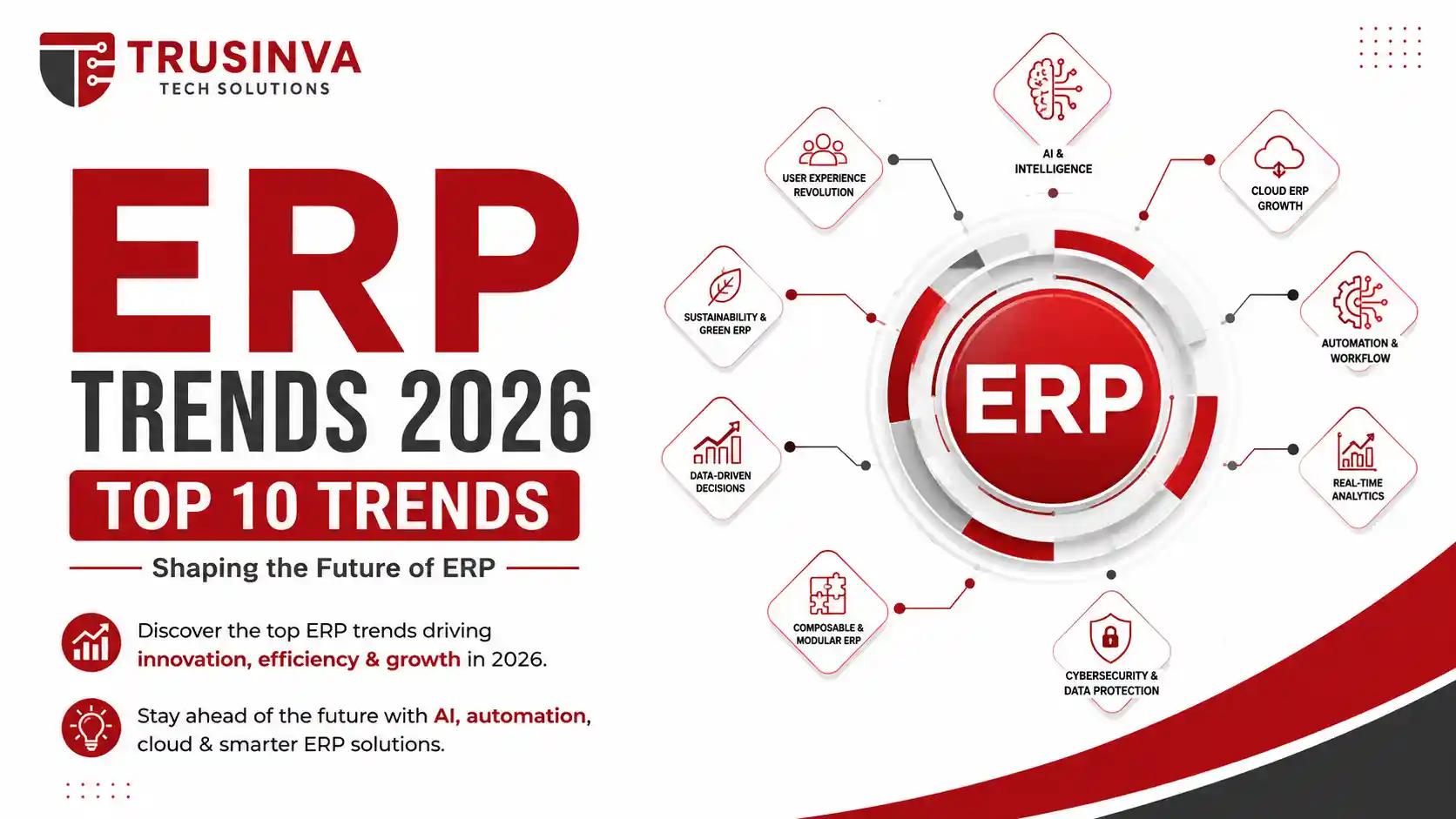
Quick Answer:
The biggest ERP trends 2026 include AI agents embedded directly into workflows, composable and cloud-native architecture, predictive analytics, autonomous process automation, and tighter cybersecurity and compliance controls. Businesses that adopt intelligent, connected ERP platforms this year gain faster decision-making, lower operational costs, and stronger long-term scalability.
Introduction
Enterprise software is changing faster than most businesses can keep up with, and ERP is right at the center of that shift. If you're trying to understand where ERP trends 2026 are headed, you're not alone — CEOs, IT managers, and operations leaders across the USA are all asking the same question: is our current system still good enough? For companies exploring ERP development or planning a broader upgrade, working with a partner like Trusinva Tech Solutions can make the difference between a rushed migration and a genuinely future-ready system.
This year's ERP landscape is being reshaped by AI agents, cloud-native architecture, and real-time automation. Businesses that once relied on custom software development to patch together disconnected tools are now consolidating everything into intelligent, connected platforms. Even smaller companies are getting in on the shift, often pairing ERP upgrades with CRM development to unify sales, operations, and finance data in one place.
In this guide, we'll break down the top 10 ERP trends 2026 is bringing, explain why they matter, and help you figure out what actually applies to your business — without the jargon overload.
Key Takeaways:
- AI agents and agentic ERP are moving from pilot projects to everyday enterprise use
- Cloud-native and composable ERP architecture is replacing rigid, legacy systems
- Predictive analytics and real-time reporting are becoming standard, not optional
- Cybersecurity, data governance, and compliance are now core ERP requirements
- Small and mid-sized businesses finally have affordable access to intelligent ERP tools
Table of Contents
- Introduction
- What Is ERP and Why It Still Matters in 2026
- Top 10 ERP Trends 2026
- Benefits of Adopting Modern ERP Trends
- Common Mistakes Businesses Make During ERP Modernization
- Cloud ERP vs Legacy ERP: A Quick Comparison
- Cost of Modern ERP Implementation
- Expert Tips for a Smooth ERP Transition
- Why Choose Trusinva Tech Solutions
- Conclusion
- FAQs
What Is ERP and Why It Still Matters in 2026
Enterprise Resource Planning (ERP) is a category of business software that connects core functions — finance, procurement, supply chain, manufacturing, HR, and sales — into a single, unified system. Instead of juggling spreadsheets and disconnected apps, ERP gives every department a shared source of truth.
In 2026, ERP matters more than ever because business decisions increasingly rely on real-time data. A delayed report or an outdated inventory number doesn't just cause inconvenience anymore — it costs revenue. Modern ERP platforms like SAP S/4HANA Cloud, Oracle Fusion Cloud ERP, Microsoft Dynamics 365, and NetSuite have all leaned into AI and automation, pushing the entire category forward.
Top 10 ERP Trends 2026
1. AI Agents Built Directly Into ERP Workflows
AI agents are now embedded inside ERP systems to handle tasks like invoice matching, demand forecasting, and approval routing without manual intervention, cutting processing time significantly while reducing human error.
Vendors including SAP and Microsoft are positioning agentic AI as a core part of their 2026 roadmaps, not an add-on. These agents don't just flag problems — they act on them, within permissions you set. For companies building custom platforms, this trend often overlaps with dedicated AI automation services designed specifically for business workflows.
2. Agentic and Autonomous ERP
Agentic ERP refers to systems where multiple AI agents coordinate with each other — one handling procurement, another handling forecasting — to complete multi-step business processes with minimal human oversight.
This is a step beyond simple automation. It's the difference between a chatbot answering a question and a system independently reordering stock, adjusting a budget, and notifying the right manager, all in one workflow.
3. Composable and Cloud-Native Architecture
Composable ERP breaks the system into modular components that businesses can mix, replace, or scale independently, instead of being locked into one rigid platform.
This "clean core" approach lets companies keep their core ERP stable while customizing only what they need through APIs. It's a major reason cloud migration projects are accelerating this year.
4. Predictive Analytics and Real-Time Reporting
Predictive analytics inside ERP platforms now forecasts demand, cash flow, and supply chain risks before they happen, replacing the traditional "look back at last month" reporting style.
Real-time dashboards mean decision-makers no longer wait for month-end close to understand where the business stands.
5. Deeper Integration Between ERP, CRM, and Business Intelligence
Businesses are connecting ERP with CRM and BI tools so sales, finance, and operations data flow into one unified view instead of living in separate silos.
This is especially valuable for growing companies. Pairing ERP with a strong CRM development solution gives sales teams visibility into inventory and finance data that used to require a separate report request.
6. Industry-Specific ERP Customization
Instead of generic ERP setups, more companies in 2026 are choosing platforms customized for their exact industry — healthcare, manufacturing, logistics, or eCommerce — to reduce the need for expensive rework later.
A logistics company and a healthcare provider have very different compliance and workflow needs, and off-the-shelf ERP rarely satisfies both well.
7. Stronger Cybersecurity and Zero Trust Architecture
As ERP systems hold more sensitive financial and operational data, businesses are adopting Zero Trust security models and aligning with frameworks like NIST and ISO/IEC 27001 to reduce breach risk.
Compliance requirements — GDPR, SOC 2, HIPAA for healthcare-adjacent businesses — are now built into ERP selection criteria from day one, not addressed after the fact.
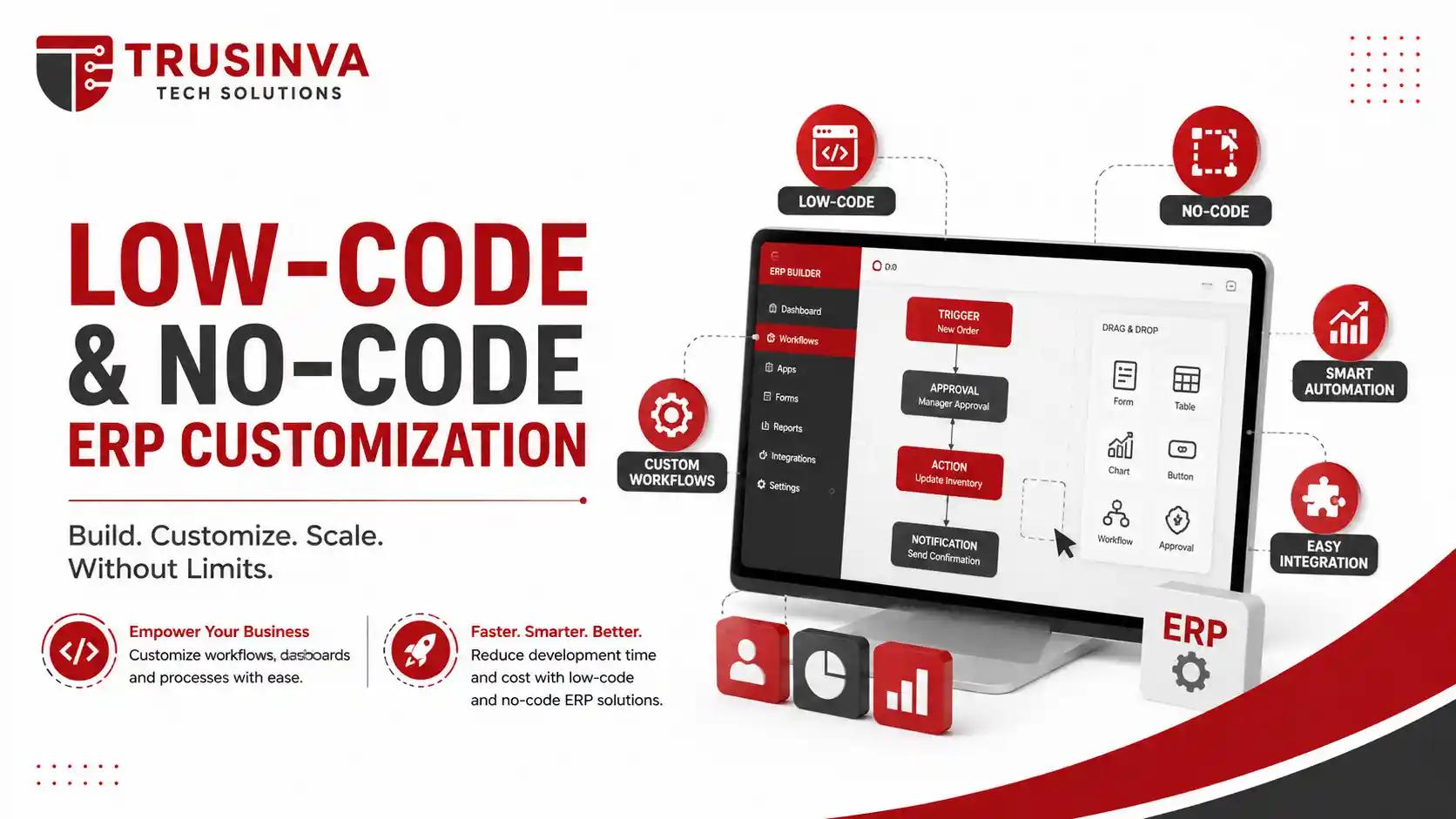
8. Low-Code and No-Code ERP Customization
Low-code and no-code tools let business teams customize ERP workflows, forms, and dashboards without waiting on developer resources, speeding up implementation significantly.
This trend is a big win for small and mid-sized businesses that don't have large in-house IT teams.
9. Sustainability and ESG Tracking Inside ERP
ERP platforms are adding built-in sustainability tracking — energy use, emissions, waste — to help businesses meet ESG reporting requirements without separate software.
This reflects growing investor and regulatory pressure on mid-size and large enterprises alike.
10. Blockchain for Supply Chain Transparency
Some ERP platforms now integrate blockchain to give supply chain data a tamper-proof, verifiable audit trail — particularly valuable for manufacturing and logistics businesses.
If your business relies heavily on multi-vendor supply chains, it's worth reading more about blockchain for supply chain use cases before evaluating vendors.
Benefits of Adopting Modern ERP Trends
- Faster, more accurate decision-making through real-time data
- Reduced manual work via AI agents and automation
- Lower long-term IT costs through composable, modular architecture
- Better compliance and reduced security risk
- Improved cross-department visibility (finance, sales, operations)
- Easier scalability as the business grows
Common Mistakes Businesses Make During ERP Modernization
- Choosing features over fit — picking the most "advanced" system instead of the one that matches actual workflows.
- Underestimating data migration — messy legacy data causes most ERP delays.
- Skipping employee training — even the best ERP fails if teams don't adopt it properly.
- Ignoring integration needs — not checking whether ERP connects cleanly with existing CRM or eCommerce tools.
- Rushing the vendor selection process — leading to costly re-implementations later.
Cloud ERP vs Legacy ERP: A Quick Comparison
| Factor | Cloud ERP | Legacy ERP |
| Deployment | Hosted, accessible anywhere | On-premise, location-locked |
| Updates | Automatic, continuous | Manual, infrequent |
| AI/Automation | Built-in, evolving | Limited or bolted-on |
| Scalability | High, pay-as-you-grow | Expensive to scale |
| Upfront Cost | Lower | Higher |
| Maintenance | Vendor-managed | In-house IT burden |
Cost of Modern ERP Implementation
ERP implementation costs vary widely based on business size, industry, and customization needs. Small businesses often start with cloud-based ERP at a lower monthly cost, while enterprise-grade implementations with heavy customization can run significantly higher. If you're also budgeting for related software work, our breakdown of software development costs can help you plan a realistic total budget.
Expert Tips for a Smooth ERP Transition
- Start with a clear list of business problems ERP needs to solve — not just features you want
- Choose a vendor or development partner experienced in your specific industry
- Migrate data in phases, testing accuracy at each stage
- Involve end-users early so adoption doesn't become an afterthought
- Plan for post-launch support, not just the initial rollout
Why Choose Trusinva Tech Solutions
Modernizing ERP isn't just about picking new software — it's about building the right architecture around your business. Trusinva Tech Solutions works with startups, growing enterprises, and industry-specific businesses across the USA to design ERP, CRM, and automation systems that actually fit how they operate.
Whether you need full enterprise software development, a SaaS-based ERP solution, or targeted AI development to automate specific workflows, the team focuses on practical, scalable outcomes rather than one-size-fits-all packages. For healthcare organizations specifically, there's dedicated experience in web development for US healthcare companies, an industry where ERP compliance requirements are especially strict.
Businesses that also need marketing support after their ERP goes live can explore digital marketing services to make sure operational improvements translate into visible business growth.
Conclusion
ERP trends 2026 make one thing clear: the future belongs to businesses that treat their ERP system as an intelligent, connected partner — not just a database. AI agents, composable architecture, predictive analytics, and stronger security aren't optional add-ons anymore; they're becoming the baseline expectation for any serious enterprise platform.
If your business is still running on a legacy system or a patchwork of disconnected tools, now is the right time to plan your next step. Whether you're exploring custom software development, evaluating AI for small businesses, or ready for a full ERP overhaul, Trusinva Tech Solutions can help you map out a system built for where your business is headed — not just where it's been. Book a Seat for a free consultation and start building an ERP strategy that actually keeps up with 2026.
Explore more: Services | Projects | About Us | Blogs | AI Automation Services | CRM Features | Blockchain Development
FAQs
1. What are the top ERP trends in 2026? The top trends include AI agents embedded in workflows, agentic ERP, composable cloud architecture, predictive analytics, stronger cybersecurity, and industry-specific customization.
2. Is cloud ERP better than on-premise ERP in 2026? For most businesses, yes. Cloud ERP offers lower upfront costs, automatic updates, built-in AI features, and easier scalability compared to on-premise legacy systems.
3. What is agentic ERP? Agentic ERP uses multiple coordinated AI agents to handle multi-step business processes — like procurement and forecasting — with minimal human intervention.
4. How much does modern ERP implementation cost? Costs vary by business size and customization needs, ranging from affordable cloud subscriptions for small businesses to higher-investment enterprise deployments.
5. Can small businesses benefit from AI-powered ERP? Yes. Low-code tools and SaaS ERP platforms have made AI-powered ERP far more accessible and affordable for small and mid-sized businesses in 2026.
6. What industries benefit most from ERP modernization? Manufacturing, healthcare, logistics, and eCommerce businesses see the biggest gains, since these industries depend heavily on real-time data and compliance accuracy.
7. How long does ERP implementation usually take? Timelines vary based on complexity, but phased cloud ERP rollouts are generally faster than traditional on-premise implementations.
8. Why is cybersecurity such a big part of ERP trends 2026? Because ERP systems hold sensitive financial and operational data, making them a high-value target — pushing businesses toward Zero Trust security and stricter compliance standards.