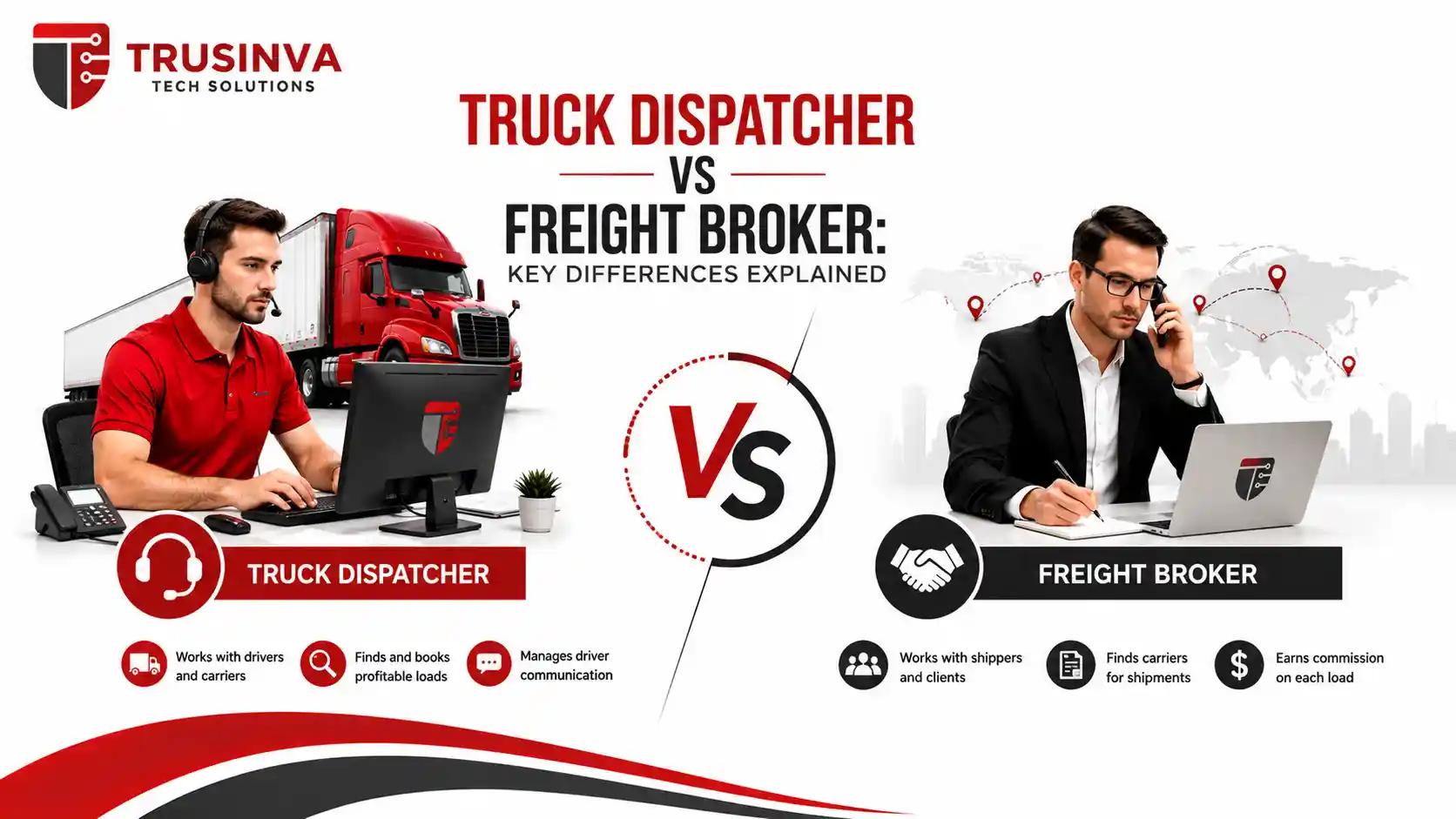
Quick Answer
A truck dispatcher works for a motor carrier, finding loads, negotiating rates, and managing paperwork for that carrier's trucks. A freight broker works between shippers and carriers, arranging transportation as a licensed intermediary. The core difference is representation and regulation: dispatchers represent carriers and need no federal authority, while brokers arrange freight for shippers and must hold FMCSA broker authority plus a $75,000 bond.
Key Takeaways
- Who you represent is the whole distinction. Dispatcher → carrier. Broker → shipper and carrier.
- Regulation separates them sharply. (cite index="6-1">Every property broker must maintain $75,000 in financial security, and FMCSA requires an application, process agents, and registration fees — there is no federal exam or certification.</cite> Dispatchers need none of this.
- Startup cost differs by roughly 10x. A dispatcher can start for a few hundred dollars. A broker faces (cite index="6-1">a $300 per-authority application fee plus a $75,000 bond with premiums from about $938 a year on good credit.</cite>
- Income models differ fundamentally. Dispatchers charge the carrier a fee. Brokers earn a margin between shipper rate and carrier rate.
- The registration system changed in 2026. (cite index="5-1">FMCSA moved registration to its new Motus system at motus.dot.gov on May 14, 2026, replacing URS and the FMCSA Portal.</cite>
- Crossing the line is expensive. (cite index="9-1">Operating as a broker without FMCSA authority is a federal violation with penalties reaching $10,000 per day.</cite>
Introduction
The truck dispatcher vs freight broker question is the most common point of confusion for anyone entering US logistics — and getting it wrong can be legally expensive, which is why Trusinva Tech Solutions starts its dispatch training by drawing that line clearly. Both roles arrange freight movement. Both talk to carriers. Both negotiate rates. But they sit on opposite sides of the same transaction, answer to different parties, and face completely different federal requirements. If you are weighing a career in this space, our truck dispatching course covers the dispatcher path end to end, our guide on how to start a truck dispatching business in the USA walks through setup, the truck dispatcher salary guide for 2026 shows real earning ranges, and our overview of owner-operator dispatch services explains the value carriers are buying.
This guide compares both roles honestly — including the parts most articles skip, like where the legal boundary actually sits and what happens when a dispatcher accidentally crosses it.
Truck Dispatcher vs Freight Broker: The Short Version
Direct answer: A truck dispatcher is a carrier's agent, paid by the carrier to find and manage freight for that carrier's trucks. A freight broker is a licensed intermediary who contracts with shippers to arrange transportation and then hires carriers to move it. The dispatcher serves one side; the broker stands between two.
Think of it as a real estate analogy. A dispatcher is like a buyer's agent working exclusively for one client. A freight broker is like the brokerage itself — holding a licence, carrying liability, and matching both sides of the market.
Summary box: If you are paid by the carrier and represent only that carrier, you are dispatching. If you are contracting with shippers to arrange transportation and hiring carriers to fulfil it, you are brokering — and you need federal authority to do it.
What Is a Truck Dispatcher?
Direct answer: A truck dispatcher is a logistics professional who manages freight operations on behalf of a motor carrier or owner-operator. They source loads from load boards and broker relationships, negotiate rates, handle rate confirmations and paperwork, plan routing to reduce deadhead, and monitor hours-of-service compliance.
What a dispatcher actually does
- Searches load boards and broker networks for suitable freight
- Negotiates rates on behalf of the carrier
- Books loads and collects rate confirmations
- Plans routing and reload sequencing to minimise empty miles
- Tracks the driver's HOS clock to avoid illegal or unrealistic bookings
- Handles BOLs, PODs, and detention documentation
- Chases accessorial pay and supports invoicing or factoring
- Manages broker relationships and carrier reputation
Employment models
| Model | Description |
| In-house dispatcher | Salaried employee of a trucking company, manages that fleet's trucks |
| Independent dispatcher | Runs their own service business with multiple carrier clients on fee agreements |
| Owner-operator self-dispatch | The driver dispatches their own truck |
The independent model is what most people mean when they say "dispatching business" — covered in detail in our 2026 guide to starting a dispatching business.
What Is a Freight Broker?
Direct answer: A freight broker is an FMCSA-licensed transportation intermediary who arranges freight movement between shippers and motor carriers without owning trucks. Brokers contract directly with shippers, take commercial responsibility for covering the freight, hire carriers, and earn the margin between what the shipper pays and what the carrier receives.
What a broker actually does
- Sells to and contracts with shippers
- Prices freight and quotes shippers
- Sources carrier capacity to cover committed loads
- Negotiates carrier rates and issues rate confirmations
- Carries commercial liability for coverage failures
- Manages carrier vetting, insurance verification, and compliance
- Handles billing to shippers and payment to carriers
- Maintains federal authority, bond, and process agent filings
The critical structural point
(cite index="8-1">A broker owns no trucks and hires no drivers</cite> — but unlike a dispatcher, the broker is a principal in the transaction. When a load fails, the shipper holds the broker accountable, not the carrier. That liability is precisely what the $75,000 bond exists to backstop.
The Core Difference: Who Do They Represent?
Direct answer: The single defining difference is representation. A dispatcher acts as an agent of a specific motor carrier and is paid by that carrier. A freight broker acts as an independent intermediary contracting with shippers, and is paid out of the spread between shipper and carrier rates. Everything else — licensing, liability, income, risk — flows from this one distinction.
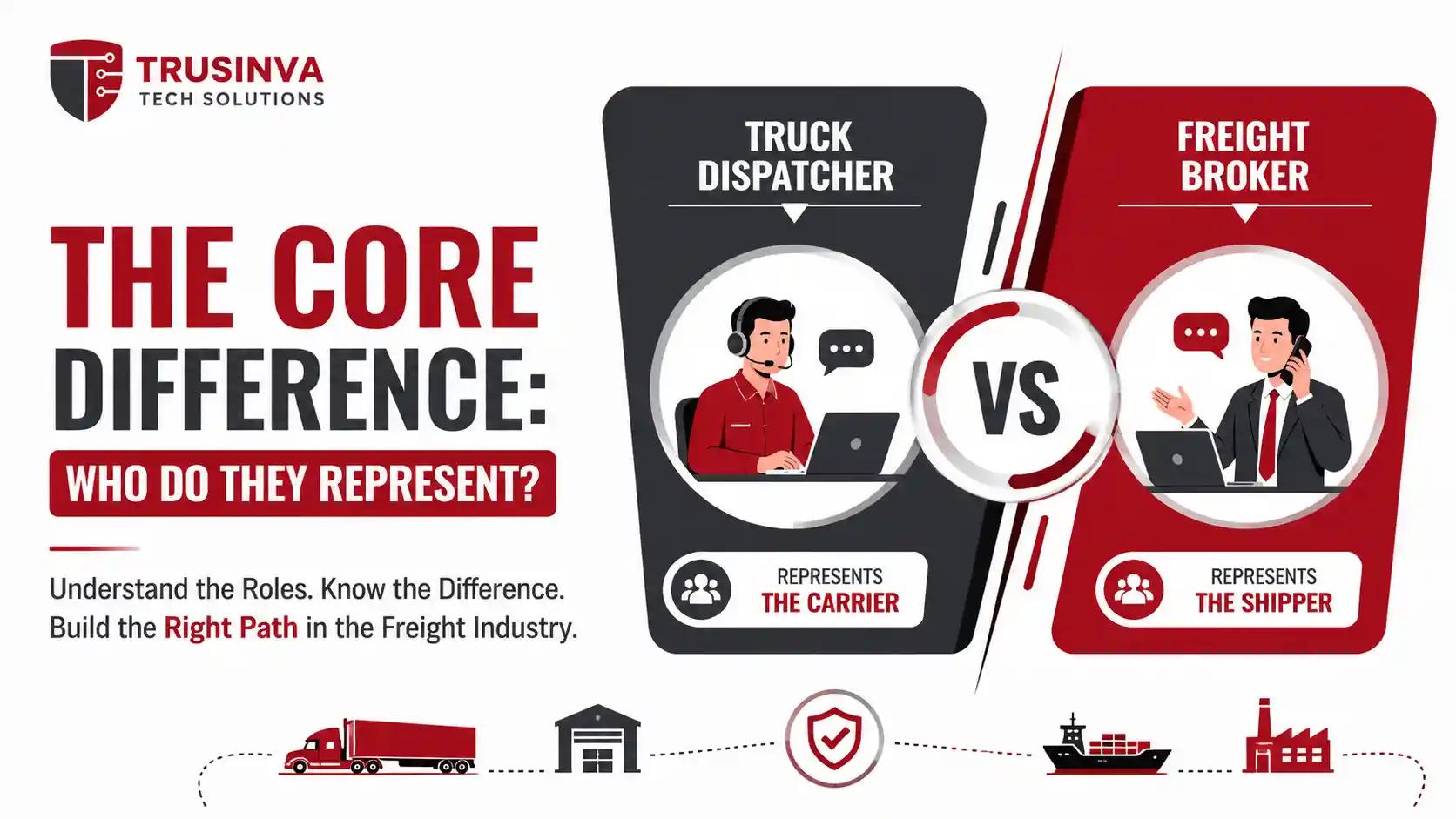
The relationship map
DISPATCHER MODEL
Shipper → Broker → [Carrier ← Dispatcher]
(dispatcher works inside the carrier's side)
BROKER MODEL
Shipper → [Broker] → Carrier
(broker stands between both parties)
Why this matters in practice
| Question | Dispatcher | Freight Broker |
| Who pays you? | The motor carrier | The shipper (you pay the carrier) |
| Whose interest do you serve? | The carrier's | Both parties, plus your own margin |
| Who signs the shipper contract? | Nobody — you have no shipper contract | You do |
| Who is liable if the load fails? | The carrier | You, the broker |
| Do you need federal authority? | No | Yes |
Expert observation: New dispatchers often describe themselves as "finding loads for shippers." That phrasing alone signals a misunderstanding of the role — and in a compliance review, it is the kind of language that invites questions about unauthorised brokerage.
Side-by-Side Comparison Table
Direct answer: Across representation, licensing, cost, income, risk, and daily work, the two roles differ in nearly every dimension. The table below is the fastest complete comparison.
| Factor | Truck Dispatcher | Freight Broker |
| Works for | Motor carrier / owner-operator | Own brokerage; contracts with shippers |
| FMCSA authority required | No | Yes — Broker of Property (BP) authority |
| Surety bond | None | (cite index="4-1">$75,000 BMC-84 bond or BMC-85 trust</cite> |
| USDOT number | Not required for the role | (cite index="9-1">Required even though brokers operate no vehicles</cite> |
| Federal application fee | None | (cite index="5-1">$300 per authority, non-refundable</cite> |
| BOC-3 process agents | Not required | Required in every state |
| Typical startup cost | $300–$2,000 | Roughly $2,000–$5,000+ before working capital |
| Income model | Fee or % of carrier gross | Margin between shipper and carrier rate |
| Typical earnings basis | (cite index="2-1">5%–10% of gross, 7% most common</cite> | 10%–20% gross margin on freight |
| Primary sales target | Carriers | Shippers |
| Cash flow burden | Low — carrier gets paid, then pays you | High — must pay carriers before shipper pays you |
| Liability exposure | Limited, contractual | Significant, principal in the transaction |
| Time to launch | Days to weeks | (cite index="5-1">Commonly 3–6 weeks after clean filings</cite> |
| Regulatory risk | Low if boundary respected | High if compliance lapses |
| Scalability | Linear with carrier clients | Exponential with shipper accounts |
Legal and Regulatory Differences
Direct answer: Freight brokers are federally regulated; truck dispatchers are not. Brokers must register with FMCSA, obtain Broker of Property authority, maintain $75,000 in financial security, and designate process agents in all states. Dispatchers acting purely as carrier agents require no federal licence — but they must not arrange freight for shippers.
What a freight broker must file
(cite index="5-1">A new broker applies for a USDOT number and property broker authority through FMCSA's Motus system, pays a $300 non-refundable federal application fee per authority, adds the $75,000 BMC-84 bond with premiums starting around $938 a year on good credit, files a BOC-3 process agent designation, and enrols in UCR at roughly $46.</cite> (cite index="5-1">The bond and BOC-3 must be on file within 90 days of applying or the application is dismissed and the fee is lost.</cite>
The 2026 financial responsibility rule
This is the most significant broker compliance change in over a decade. (cite index="3-1">Updated FMCSA financial responsibility requirements took effect on January 16, 2026, requiring the full $75,000 in financial security to be maintained at all times.</cite> (cite index="1-1">If a broker's available financial security falls below $75,000 and is not replenished within seven calendar days, FMCSA will suspend the broker's operating authority — and for BMC-85 trust funds, the only acceptable assets are now cash, irrevocable letters of credit from federally insured institutions, and U.S. Treasury bonds.</cite>
(cite index="6-1">That restriction on trust fund assets has made the BMC-84 surety bond the default path for new brokerages.</cite>
What a dispatcher must have
- A registered business entity (LLC is standard)
- A written dispatcher–carrier service agreement with each client
- Errors and omissions or general liability coverage (optional but increasingly expected)
- Nothing federal
Warning: (cite index="9-1">Arranging for-hire transportation and receiving compensation for it without FMCSA registration is a federal violation, with penalties reaching $10,000 per day of unauthorised brokerage operations.</cite> If a dispatcher begins sourcing freight directly from shippers and assigning it to carriers other than their own client, they have crossed into brokerage.
How Each One Makes Money
Direct answer: Dispatchers charge the carrier a service fee — either a percentage of gross load revenue, a flat per-load fee, or a flat weekly rate. Brokers earn the spread between what the shipper pays and what the carrier is paid, typically a 10–20% gross margin, and carry the cash-flow risk in between.
Dispatcher income models
| Model | Typical 2026 range | Trade-off |
| Percentage of gross | (cite index="2-1">5%–10%, with 7% most common for owner-operators</cite> | Aligns incentives; scales with carrier revenue |
| Flat per load | (cite index="2-1">$50–$150 per booked load</cite> | Predictable; no upside on high-value freight |
| Flat weekly per truck | (cite index="7-1">Commonly $250–$500 per truck per week</cite> | Cost certainty for carrier; risk shifts to dispatcher |
(cite index="7-1">The broader 2026 market range runs roughly 3% to 10%, with most full-service independent dispatchers landing between 4% and 7%.</cite>
Broker income model
A broker quotes the shipper $3,400, covers the load with a carrier at $2,850, and earns $550 — roughly a 16% gross margin. Out of that come staff, insurance, software, factoring costs, and bad debt. Margins compress in tight capacity markets and expand in loose ones, which is the mirror image of the carrier experience.
The cash-flow reality nobody mentions
A dispatcher invoices the carrier after the carrier gets paid. A broker often pays the carrier in 15–30 days while the shipper pays in 45–60. That working capital gap is why undercapitalised brokerages fail even when they are booking profitable freight.
Practical note on fee transparency: Most carrier agreements now exclude accessorials and fuel surcharge from the dispatcher's commission base, since detention compensates lost time and fuel surcharge is reimbursement rather than earnings. Stating this upfront builds carrier trust faster than any pitch.
Startup Requirements and Costs Compared
Direct answer: Starting as an independent dispatcher costs a few hundred to a couple of thousand dollars and can be operational within days. Starting a brokerage costs roughly $2,000–$5,000 in filings and bond premium before working capital, and takes weeks to activate.
Dispatcher startup checklist
- Register a business entity (LLC typical)
- Obtain an EIN
- Draft a dispatcher–carrier service agreement
- Load board subscription
- Business phone, email, basic CRM or tracking system
- Training in rate negotiation, HOS rules, and paperwork
- First carrier client
Estimated cost: $300–$2,000 depending on training and software.
Freight broker startup checklist
- Register a business entity
- Apply through FMCSA Motus for USDOT number and BP authority
- Pay the $300 federal application fee
- Secure the $75,000 BMC-84 bond (or fund a BMC-85 trust)
- File BOC-3 process agents in all states
- Enrol in UCR
- Obtain contingent cargo and general liability coverage
- Set up a TMS and carrier vetting process
- Secure working capital or a factoring/quick-pay arrangement
- Land the first shipper account
Estimated cost: (cite index="8-1">Roughly $1,850–$2,050 for filings and bond with good credit on a lean setup</cite>, before working capital, insurance, and software — realistically $5,000+ to operate safely.
Timeline comparison
| Milestone | Dispatcher | Broker |
| Business registered | Day 1–3 | Day 1–3 |
| Ready to operate | Week 1–2 | (cite index="5-1">Commonly 3–6 weeks; some report 4–8</cite> |
| First revenue | Week 2–4 | Week 6–12 |
| Break-even | Month 1–3 | Month 4–12 |
Day-to-Day Responsibilities Compared
Direct answer: A dispatcher's day is operational — finding loads, negotiating, routing, and solving driver problems. A broker's day is commercial — selling shippers, pricing freight, sourcing capacity, and managing risk. Dispatchers manage trucks; brokers manage accounts.
| Time block | Dispatcher | Freight Broker |
| Early morning | Check driver status, HOS, load board alerts | Review overnight tenders, check coverage gaps |
| Mid-morning | Search and negotiate loads | Cover urgent loads, call carriers |
| Midday | Rate confirmations, paperwork, reload planning | Shipper calls, quoting, account management |
| Afternoon | Track deliveries, handle detention | Sales prospecting, pricing bids |
| Evening | Plan tomorrow's loads | Confirm next-day coverage |
| Ongoing | Broker relationships, invoicing support | Carrier vetting, credit management, collections |
The emotional difference
Dispatchers solve problems in real time — a broken-down truck, a shipper that will not load, a receiver closing early. Brokers manage commitments — freight promised to a customer that must move regardless of what the market does. Both are stressful in different ways. Choose based on which kind of pressure you handle better.
Skills Each Role Actually Needs
Direct answer: Both roles require rate negotiation and market knowledge. Dispatchers additionally need operational problem-solving, HOS and compliance literacy, and driver communication. Brokers additionally need B2B sales ability, credit and risk management, and the confidence to commit to freight before capacity is secured.
Shared skills
- Freight rate negotiation and market rate reading
- Load board proficiency
- Documentation discipline (rate cons, BOLs, PODs)
- Relationship management
- Composure under time pressure
Dispatcher-specific
- Hours-of-service rules and realistic transit planning
- Deadhead and reload optimisation
- Driver communication and de-escalation
- Accessorial recovery and detention documentation
- Carrier compliance awareness (CSA, insurance, authority status)
Broker-specific
- Outbound B2B sales and shipper prospecting
- Freight pricing and margin management
- Carrier vetting and fraud prevention
- Credit assessment and collections
- Contract negotiation and liability awareness
Expert observation: The single hardest skill to acquire on the broker side is shipper sales. Many aspiring brokers underestimate it, get authority, and then discover they have a licence and no customers. Dispatchers face a much gentler client acquisition curve because carriers are actively looking for help.
Income, Salary, and Career Scope
Direct answer: Employed dispatchers earn a salary; independent dispatchers earn fees that scale with the number of trucks managed. Brokers earn margin that scales with shipper accounts, with far higher ceilings and far higher variance. Dispatching offers faster, more predictable income; brokerage offers a higher long-term ceiling.
Dispatcher earnings
(cite index="28-1">The BLS national median annual wage for truck dispatchers is approximately $52,060, with entry-level positions between $34,000 and $45,000, experienced dispatchers managing larger fleets at $55,000–$75,000, and senior dispatch managers at $75,000–$97,000 or more.</cite>
Independent dispatchers scale differently. At 7% of gross on a truck grossing $18,000 a month, that is roughly $1,260 per truck per month. Ten trucks is around $151,000 in annual revenue before costs — which is why experienced dispatchers build books rather than chase salaries.
Broker earnings
Broker income is margin-driven and highly variable. A solo broker moving 40 loads a month at $500 average margin grosses $20,000 monthly before expenses. The upside is real, but so is the volatility: one non-paying shipper can erase a quarter.
Career progression
| Stage | Dispatcher path | Broker path |
| Entry | Junior dispatcher, 2–4 trucks | Broker agent under an existing brokerage |
| Mid | Independent, 5–10 trucks | Own authority, first shipper accounts |
| Senior | Dispatch business, 10–20+ carriers | Multi-account brokerage with staff |
| Scale | Team of dispatchers, service brand | 3PL with contract freight portfolio |
A commonly overlooked route: start as a dispatcher, learn the carrier side deeply, build broker relationships, then transition into brokerage with an existing network. Brokers who understand carrier economics negotiate better and lose fewer carriers. Our truck dispatching course in the USA is designed as exactly that entry point, and the full course catalogue covers adjacent business skills.
Tax structure matters a great deal for both — see our USA taxation guide for independent operators and the USA taxation course.
Where the Roles Overlap — and Where the Line Is
Direct answer: Dispatchers and brokers overlap in load sourcing, rate negotiation, and carrier communication. The line is crossed when a dispatcher contracts directly with a shipper, arranges transportation for parties other than their own carrier client, or takes a margin on freight rather than a disclosed service fee.
Legitimate dispatcher activities
Negotiating rates with brokers on behalf of a carrier client
Booking loads for that carrier's trucks
Handling rate confirmations, BOLs, and invoicing support
Charging the carrier a disclosed percentage or flat fee
Building relationships with brokers to source freight for the carrier
Activities that constitute brokerage
Contracting with a shipper to move their freight
Assigning a load to a carrier you do not represent
Taking an undisclosed spread between the load rate and what the carrier receives
Holding yourself out publicly as arranging transportation for shippers
Re-brokering a load you booked to a different carrier
Important note: The undisclosed-spread issue is the most common accidental violation. If a dispatcher books a load at $2,900 and tells the carrier it paid $2,700, keeping $200, that is not a dispatch fee — it is a brokerage margin taken without authority. Transparent, disclosed, agreed fees are the only safe structure.
The double-brokering problem
Double brokering — where a load is re-brokered to another carrier without authorisation — has been a persistent fraud problem across the industry. It is also exactly the behaviour a dispatcher can drift into unintentionally when trying to help a broker cover freight their own carrier cannot take. The safe answer is to refer the broker to another carrier directly and take no compensation for it.
Which Should You Choose? A Decision Framework
Direct answer: Choose dispatching if you want faster entry, low capital risk, operational work, and predictable income. Choose brokerage if you have sales ability, working capital, higher risk tolerance, and want a business with a much higher ceiling. Many successful brokers started as dispatchers.
Decision matrix
| If this describes you... | Start as |
| Limited startup capital | Dispatcher |
| Strong B2B sales background | Broker |
| Want income within 30 days | Dispatcher |
| Comfortable with 6–12 months to profitability | Broker |
| Prefer solving operational problems | Dispatcher |
| Prefer building customer accounts | Broker |
| Risk-averse, want low liability | Dispatcher |
| Have $10,000+ working capital available | Broker |
| Coming from a driving or carrier background | Dispatcher |
| Coming from logistics sales or 3PL | Broker |
| Want to work remotely with low overhead | Dispatcher |
| Want to build a company with staff and equity value | Broker |
The honest recommendation
For most people entering US logistics without a sales background or capital, dispatching is the better first move. It teaches freight economics, rate negotiation, broker behaviour, and carrier operations — all of which make you a dramatically better broker later if you choose to go that way. Starting with brokerage means learning those lessons while carrying $75,000 of bonded liability.
Our guide on how truck dispatching services save US carriers money explains the value proposition you will be selling, and the flatbed dispatching guide shows how specialisation works in practice.
Pros and Cons of Each Path
Truck Dispatcher
| Pros | Cons |
| Very low startup cost | Income capped by hours and client count |
| No federal authority or bond required | Dependent on carrier clients who can leave anytime |
| Fast path to first revenue | Little equity value in the business |
| Low liability exposure | Reactive, interrupt-driven work |
| Fully remote-friendly | Crowded market with price competition |
| Excellent training ground for brokerage | Carrier cash flow problems become your problem |
Freight Broker
| Pros | Cons |
| Much higher income ceiling | (cite index="4-1">$75,000 financial security requirement</cite> |
| Builds a saleable business asset | Serious working capital demands |
| Control over both sides of pricing | (cite index="1-1">Authority suspended if security falls below $75,000 and is not replenished within 7 days</cite> |
| Scalable with staff and accounts | Real liability for coverage failures and cargo claims |
| Contract freight creates stable revenue | Shipper sales cycle is long and difficult |
| Recognised, regulated industry position | Ongoing compliance burden |
Common Misconceptions and Mistakes
Direct answer: The most damaging misconceptions are that dispatchers need a licence, that brokers need a certification exam, that the roles are interchangeable, and that a dispatcher can take a margin on loads. Each of these leads to either wasted money or genuine legal exposure.
Misconception 1 — "Dispatchers need a federal licence."
False. A dispatcher acting as a carrier's agent needs no FMCSA authority. Any programme selling you a "dispatcher licence" is selling a certificate, not a credential.
Misconception 2 — "Freight brokers need to pass a certification exam."
Also false. (cite index="6-1">There is no federal exam, test, or certification to become a freight broker — FMCSA requires an application, a $75,000 bond, process agents, and registration fees, nothing else.</cite> Training is genuinely useful for learning the work, but any site requiring you to pass its exam is selling the exam.
Misconception 3 — "A dispatcher is just a low-budget broker."
Different function entirely. A dispatcher optimises one carrier's revenue. A broker matches market supply and demand and carries the commercial risk.
Misconception 4 — "I can keep a small spread on loads."
This is unauthorised brokerage. Charge a disclosed fee, always.
Other frequent mistakes
- Starting a brokerage without working capital. Authority does not pay carriers; cash does.
- Signing exclusive dispatch agreements with long lock-ins. Carriers should keep a 30-day exit.
- Skipping the written service agreement. Verbal dispatch arrangements end in disputes.
- Not vetting brokers before booking. Rate means nothing if payment never arrives.
- Charging commission on fuel surcharge and detention. These are reimbursements, not earnings.
- Ignoring compliance status. A carrier client with authority problems will drag you into their problems.
Technology and Tools Each Role Uses
Direct answer: Both roles rely on load boards, a TMS, and a CRM, but for different purposes. Dispatchers optimise a small number of trucks and need routing, HOS, and document tools. Brokers manage many accounts and need pricing, carrier vetting, credit, and sales pipeline tools.
| Tool category | Dispatcher use | Broker use |
| Load board | Find freight for carrier trucks | Post loads and source capacity |
| Rate analytics | Negotiate carrier revenue up | Price shipper quotes and protect margin |
| TMS | Load records, documents, settlements | Full order-to-cash workflow |
| CRM | Broker relationship tracking | Shipper pipeline and account management |
| ELD / telematics | HOS planning and tracking | Carrier tracking compliance |
| Carrier vetting tools | Not primary | Essential — authority, insurance, fraud screening |
| Accounting / factoring | Invoice support for carrier | Payables, receivables, credit exposure |
For growing desks, spreadsheets stop working around the ten-client mark. Our resources on CRM features that matter, CRM development services, and CRM solutions for US sales teams in 2026 cover the transition. If you are considering purpose-built tooling, see AI automation services in the USA, AI for small businesses, and custom software development.
Latest Updates, Trends, and Regulations (2026)
Direct answer: Three 2026 developments matter for anyone choosing between these roles: FMCSA's new Motus registration system, stricter broker financial responsibility enforcement, and a supply-constrained freight market that has shifted leverage toward carriers and the dispatchers who represent them.
Update 1 — FMCSA Motus replaced URS
(cite index="5-1">FMCSA began moving registration to its new Motus system at motus.dot.gov on May 14, 2026, where a new broker applies for a USDOT number and property broker authority in one guided application.</cite> (cite index="7-1">Every FMCSA-regulated broker must register through Motus in 2026, and existing brokers with active MC numbers must complete the URS-to-Motus transition by claiming their registration in the new platform — there is no alternative pathway.</cite> Guides written around the old OP-1 form or URS screens now describe a legacy process.
Update 2 — Broker financial responsibility tightened
(cite index="3-1">The updated financial responsibility rule took effect January 16, 2026.</cite> (cite index="1-1">Brokers whose security falls below $75,000 face suspension of operating authority if it is not replenished within seven calendar days, and BMC-85 trusts are now restricted to cash, irrevocable letters of credit from federally insured institutions, and U.S. Treasury bonds.</cite> For carriers and dispatchers, this is protective — it reduces the pool of undercapitalised brokers.
Update 3 — A carrier-favourable freight market
(cite index="11-1">In June 2026, the national average van truckload spot rate exceeded the contract rate for the first time since February 2022, with spot van at $3.00 per mile, reefer at $3.39, and flatbed at $3.69 — an all-time high.</cite> (cite index="13-1">ACT Research describes the cycle as primarily supply-driven, with aggregate spot rates excluding fuel running 43% higher year over year in June 2026.</cite>
What this means for the career choice: tight capacity compresses broker margins and expands carrier revenue. In 2026 conditions, the dispatcher side of the business has been the more comfortable place to sit — though markets cycle, and this will not hold forever.
Update 4 — Compliance enforcement is reshaping capacity
(cite index="24-1">FMCSA's February 2026 final rule on non-domiciled CDLs, effective March 16, 2026, narrowed eligibility to H-2A, H-2B, and E-2 visa holders</cite>, and (cite index="22-1">English Language Proficiency is now enforced at roadside as an out-of-service condition.</cite> For both roles, carrier compliance status has become a commercial screening factor, not just a safety matter.
People Also Ask
Is a truck dispatcher the same as a freight broker? No. A dispatcher works for a motor carrier and needs no federal authority. A freight broker is an FMCSA-licensed intermediary who contracts with shippers, holds broker authority, and maintains a $75,000 bond.
Can a truck dispatcher work without a licence? Yes. Dispatchers acting as agents of a specific motor carrier require no FMCSA authority. They do need a business entity and a written dispatcher–carrier service agreement.
Do freight brokers need a licence and a bond? Yes. (cite index="6-1">Every property broker must hold $75,000 in financial security, plus FMCSA registration, process agents, and registration fees.</cite> (cite index="4-1">Most buy a BMC-84 surety bond with annual premiums from about $938 on good credit; the BMC-85 alternative locks up the full $75,000 in liquid assets.</cite>
Which pays more, a dispatcher or a freight broker? Brokers have a higher ceiling; dispatchers have more predictable income. (cite index="28-1">The BLS median for dispatchers is around $52,060 annually</cite>, while broker income depends entirely on shipper accounts and margin.
How long does it take to become a freight broker? (cite index="5-1">Most new brokers report three to six weeks from a clean application to granted authority, with the bond and BOC-3 required within 90 days of applying.</cite>
Can I be both a dispatcher and a freight broker? Legally yes, if you hold broker authority and keep the two functions clearly separated in your agreements and disclosures. Practically, the conflict of interest is difficult to manage and carriers are wary of it.
Do I need a CDL to become a dispatcher or broker? No. Neither role requires a commercial driver's licence. Understanding driver realities helps enormously, but it is not a requirement.
What is double brokering and why is it illegal? Double brokering is re-brokering a load to another carrier without the original party's authorisation. It breaks the contractual chain, frequently results in carriers going unpaid, and is a leading form of freight fraud.
Frequently Asked Questions
1. Which is easier to start, dispatching or brokerage? Dispatching, by a wide margin. Lower capital, no federal authority, faster first revenue, and a much easier client acquisition path.
2. Do dispatchers need insurance? Not federally required, but errors and omissions plus general liability coverage is increasingly expected by carrier clients and worth carrying.
3. Can a dispatcher find loads directly from shippers? No — that is brokerage. A dispatcher may accept freight a shipper offers directly to their carrier client, but arranging transportation for shippers as a service requires broker authority.
4. How many trucks can one dispatcher handle? Typically 5–10 for full service, more with strong systems and repeat lanes. Quality drops sharply above that without support staff.
5. Do brokers still need a USDOT number if they own no trucks? Yes. (cite index="9-1">A USDOT number is required even for brokers who do not operate vehicles.</cite>
6. Is training required for either role? Not legally, for either. But (cite index="6-1">training courses can be genuinely useful for learning the work</cite> — and in dispatching especially, the difference between trained and untrained shows up immediately in negotiated rates.
7. What happens if a broker's bond lapses? (cite index="7-1">The bond must remain active at all times; if it lapses, broker authority is immediately suspended.</cite>
8. Can I start as a broker agent instead of getting my own authority? Yes, and many do. Working as an agent under an established brokerage lets you learn shipper sales and pricing without the bond, capital, or liability. It is the standard low-risk entry to brokerage.
9. Which role has better long-term security? Brokerage builds a saleable asset with contract freight and shipper relationships. Dispatching offers steadier short-term income but limited equity value.
10. Where should a complete beginner start? With structured dispatch training. Our truck dispatching course teaches load boards, rate negotiation, compliance, and carrier operations — the foundation both career paths are built on. See also our dispatching business startup guide.
Conclusion: Same Freight, Different Seats
The truck dispatcher vs freight broker distinction comes down to one question: who do you represent? A dispatcher sits on the carrier's side of the table, paid by the carrier to maximise that carrier's revenue. A broker sits between shipper and carrier, licensed, bonded, and commercially liable for freight they have promised to move. Everything else — the $75,000 bond, the Motus registration, the income model, the risk profile — follows from that single structural difference.
The key recommendation: if you are starting without significant capital or a B2B sales background, begin as a dispatcher. You will learn freight economics, rate negotiation, and carrier operations with minimal risk — and if you later pursue broker authority, you will do it with a network and an understanding of the carrier side that most new brokers simply do not have.
Your next step: get properly trained before you commit to either path. Trusinva Tech Solutions runs a practical truck dispatching programme built around live load boards, real rate data, negotiation practice, and the compliance boundaries that keep you on the right side of federal rules. Cohorts stay small so every trainee gets individual instructor review.
Book a Seat in the next dispatch training cohort and start your logistics career on solid ground. Want a straight recommendation on which path suits your background? Contact our team, browse more logistics and business resources on our blog, or learn more about Trusinva Tech Solutions and the technology services we build for transportation businesses.