At Trusinva Tech Solutions, we build software products for founders, CTOs, and growing businesses across the United States — and one question comes up in almost every first call: "We have an idea, but how does it actually become working software?" That question is really about software product development, the structured process of turning a business need into a usable, scalable, and secure digital product. Whether you're exploring our web development services, mobile app development services, or a full custom platform, this guide walks through what software product development actually involves, how much it costs, how long it takes, and how to choose the right partner.
Software product development is not the same thing as "coding." It's a full lifecycle — discovery, design, architecture, engineering, testing, deployment, and ongoing improvement — that turns a rough idea into something real customers can use. Get any one stage wrong, and even a technically well-built product can fail in the market. Get it right, and you end up with software that solves a genuine problem, scales with demand, and holds up under real-world traffic and security pressure.
This guide is written for founders planning their first MVP, product managers scoping a new feature set, and enterprise leaders evaluating whether to build in-house or bring in a development partner. We'll cover the definitions, the process, the technology decisions, realistic costs and timelines, security and quality standards, and where artificial intelligence is changing how software gets built in 2026. Along the way, you'll find direct-answer sections designed to be scannable, snippet-friendly, and genuinely useful — not filler.
What Is Software Product Development?
Software product development is the end-to-end process of transforming a business idea or requirement into a usable, maintainable, and scalable software product. It covers everything from initial discovery and requirements gathering through UX/UI design, software architecture, coding, quality assurance, deployment, and continuous post-launch improvement.
Unlike a one-off internal tool, a software product is built to be used repeatedly by real customers — which means it has to be reliable, secure, and able to grow. That's the core difference between general software development and software product development: the former can mean any code written for any purpose, while the latter specifically treats the software as a product with a roadmap, a market, and a lifecycle.
A few quick distinctions worth knowing:
- Software development vs. product development — software development is the technical act of writing and testing code; product development is the broader discipline that includes market research, product strategy, and go-to-market planning around that code.
- Product engineering vs. software engineering — product engineering blends engineering discipline with product thinking (what should we build and why), while software engineering focuses on how to build it well.
- MVP vs. full product — a Minimum Viable Product is the smallest version of your product that still delivers real value, built to validate demand before investing in the full feature set.
Why Software Product Development Matters for Your Business
Every business eventually hits a point where off-the-shelf tools can't keep up with how the company actually operates. That's usually when custom software product development becomes the better investment. A purpose-built product can automate a workflow that generic software can't touch, integrate cleanly with your existing systems, and become a genuine competitive advantage rather than a shared commodity every competitor also has access to.
There's also a compounding effect. A well-engineered software product doesn't just solve today's problem — it becomes a platform you can extend. Add a new module, plug in a new integration, layer in AI-powered features, and the original investment keeps paying off for years. This is why so many of our clients start with a single service, like CRM development or a WordPress-based site through our WordPress development services, and later expand into a full custom platform once they see what's possible.
Step-by-Step Guide: The Software Product Development Lifecycle
Most software product development lifecycles (SDLC) — regardless of methodology — move through the same core stages. Here's how it actually works from idea to launch:
- Product discovery. Before any code is written, the team clarifies the problem, the target users, and what success looks like. This includes competitor research, stakeholder interviews, and defining the product's core value proposition.
- Requirements gathering. Business requirements and technical requirements are documented — often in a product requirements document (PRD) — covering user stories, must-have features, and constraints like budget, compliance, or existing systems that need to integrate.
- UX/UI design. Wireframes and interactive prototypes map out how users will actually move through the product. This is where usability gets tested before expensive development time is spent. Our UI/UX design team typically runs this stage in parallel with early architecture planning.
- Software architecture and planning. The technical foundation is decided here: monolith vs. microservices, cloud provider, database structure, API design, and the overall technology stack. Getting this stage right determines how easily the product will scale later.
- Development. Engineers build the frontend, backend, database, and integrations, usually in iterative sprints rather than one long build phase. Version control (Git), code review, and continuous integration keep the codebase clean as it grows.
- Quality assurance and testing. Automated and manual testing — functional, performance, security, and user acceptance testing — catches problems before they reach real users.
- Deployment. The product is released to production, often through a CI/CD pipeline that automates the release process and reduces human error.
- Monitoring and maintenance. Once live, the team tracks performance, uptime, and user feedback, fixing bugs and patching vulnerabilities as they surface.
- Continuous improvement. Based on real usage data, the roadmap evolves — new features get prioritized, underused ones get trimmed, and the product keeps adapting to what users actually need.
Tips for Getting Through the Lifecycle Without Costly Rework
- Don't skip discovery to "save time" — vague requirements are the single biggest cause of budget overruns.
- Build an MVP first if you're validating a new market; you can always add features once you have real user data.
- Choose an architecture that can scale before you need it to, not after — retrofitting scalability is far more expensive than designing for it upfront.
- Bake security into every stage rather than treating it as a final checklist item (this is the core idea behind DevSecOps).
Key Skills, Tools, and Technologies Behind Modern Software Products
A modern software product typically draws on a broad stack of skills and tools:
Core engineering skills: frontend development, backend development, full-stack development, API design, database architecture, DevOps, and quality assurance.
Popular languages and frameworks: Python, JavaScript, TypeScript, Java, C#, Go, React, Angular, Vue.js, Node.js, .NET, Django, and Laravel — the right choice depends on your product's use case, team expertise, and scaling needs.
Infrastructure and delivery tools: Docker and Kubernetes for containerization, Git and GitHub for version control, Jenkins or GitHub Actions for CI/CD, and cloud platforms like AWS, Microsoft Azure, and Google Cloud for hosting and scaling.
AI and data tools: modern products increasingly rely on machine learning models, large language models, vector databases, and AI APIs from providers like OpenAI, Anthropic (maker of Claude), and Google (Gemini) to add intelligent features — from recommendation engines to AI chatbots and retrieval-augmented generation (RAG) systems.
Quality and standards frameworks: ISO/IEC 25010 provides a formal model for evaluating software product quality — covering usability, reliability, performance, maintainability, and security — and it's a useful reference point when defining what "quality" means for your own product. (ISO)
If your product idea includes an e-commerce component, our Shopify development services and digital marketing services are built to work together with the core product so the technical build and the growth strategy aren't disconnected efforts.
How Much Does Software Product Development Cost?
This is the question every founder and CTO asks first, and honestly, "it depends" — but it depends on specific, knowable factors:
| Product Type | Typical Cost Drivers | General Range |
| MVP | Core features, basic design, one platform | Lower end, faster to launch |
| SaaS Platform | Multi-tenant architecture, subscriptions, integrations | Mid to high, ongoing costs |
| Enterprise Software | Complex integrations, security, compliance, scale | Highest, long-term investment |
| Mobile App | Platforms (iOS/Android), backend, offline support | Varies by feature complexity |
The main cost drivers are: number of features, design complexity, the number of platforms you're targeting, third-party integrations, security and compliance requirements, and whether you need an ongoing dedicated team versus a fixed-scope project. Outsourced software development is often significantly more cost-effective than building an in-house team from scratch, especially for startups that don't yet need full-time engineers.
How Long Does Software Product Development Take?
Timelines vary with scope, but here's a realistic general pattern:
- Simple MVP: a few weeks to a couple of months
- Mid-sized SaaS product: a few months to build a solid first version
- Enterprise-grade platform: longer, phased across multiple releases rather than one big launch
Agile development, where the team ships in short sprints and gets continuous feedback, tends to get usable software into users' hands faster than a rigid Waterfall approach, where every requirement is locked in before development starts.
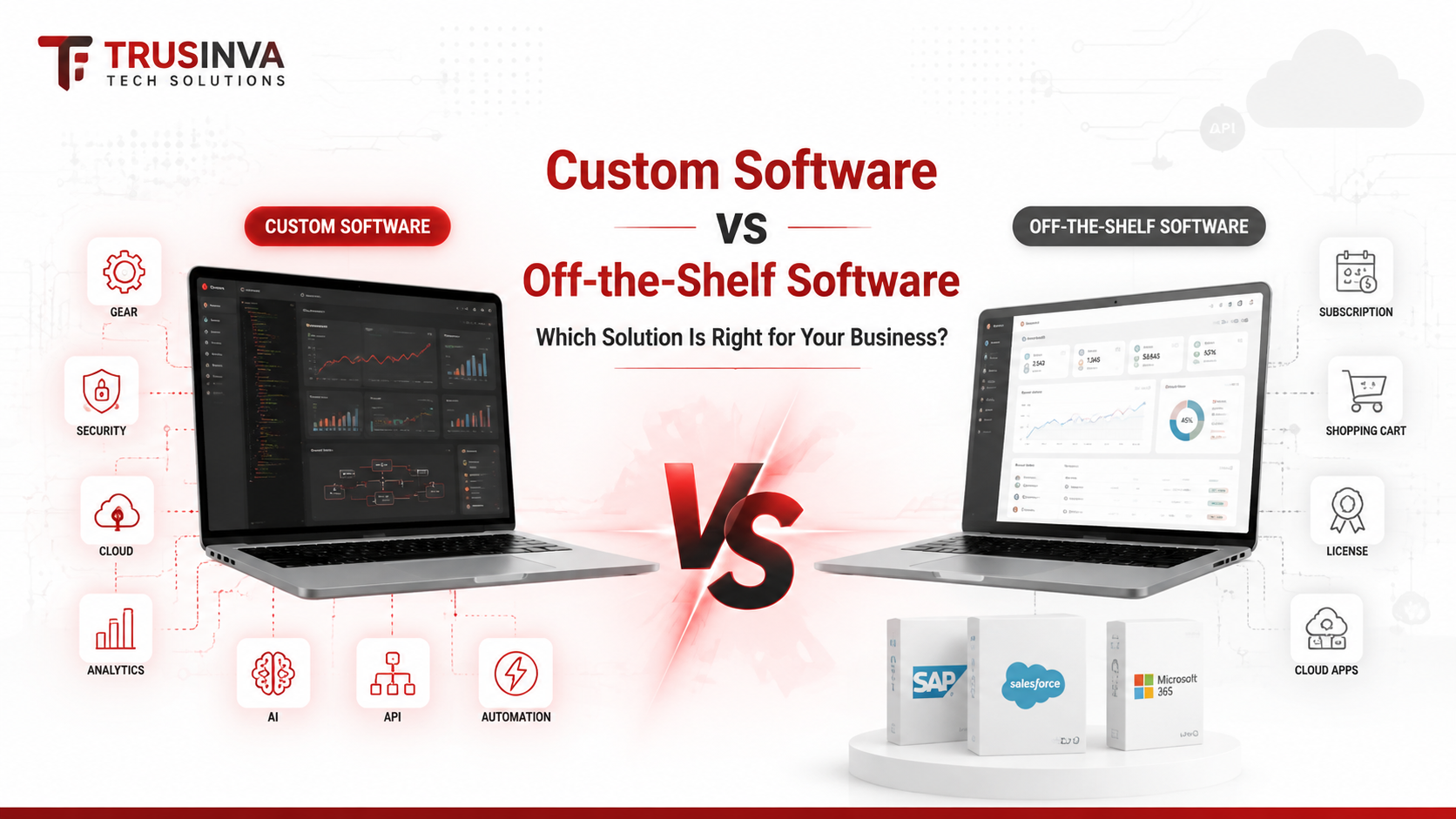
Custom Software vs. Off-the-Shelf Software: Which Should You Choose?
This is one of the most common decision points businesses face, so it's worth breaking down clearly.
Choose custom software when:
- Your workflows are genuinely different from what generic tools support
- You need deep integration with existing systems
- The software itself is meant to be a competitive advantage
- You're planning to scale significantly and need full control over the architecture
Choose off-the-shelf software when:
- Your needs are standard and well-served by existing tools
- You need to move fast and don't want to wait for a build
- Budget is tight and a subscription model works better than upfront investment
- The functionality isn't core to your competitive differentiation
Many businesses actually do both — running standard tools for back-office needs while investing in custom software product development for the parts of the business that are genuinely unique.
In-House Team vs. Outsourced Development Partner
| Factor | In-House Team | Outsourced Partner |
| Speed to start | Slower (hiring takes time) | Faster (team is ready) |
| Cost | Higher (salaries, benefits, tools) | Generally lower, flexible |
| Expertise breadth | Limited to who you hire | Access to specialists across stacks |
| Long-term control | Full control | Shared, contract-defined |
| Best for | Core, long-term proprietary IP | MVPs, defined projects, scaling fast |
There's no universally "right" answer here — it depends on whether the software is core to your long-term competitive advantage or a tool that needs to exist and work well. Many of our clients start with an outsourced, dedicated team for speed and lower risk, then transition parts of the work in-house as the product matures.
Why Choose Trusinva Tech Solutions for Software Product Development
Why choose Trusinva Tech Solutions comes down to a straightforward answer: we treat every engagement as product development, not just code delivery. Our team covers the full stack a modern product needs — custom web development, mobile app development, CRM and ERP-style system development, blockchain development, and UI/UX design — so you're not stitching together five different vendors to launch one product.
We also don't stop at launch. Our SEO services, Google Ads management, and social media marketing teams work alongside the engineering team so that once your product is live, it actually reaches its target users in the U.S. market. You can browse real examples of this combined approach on our projects page, and see how we've approached similar builds in our blog post on how to hire the best mobile app development company without wasting your budget.
Security and Quality: Building Software That Holds Up
Security can't be bolted on at the end — it has to be part of the process from day one. The U.S. National Institute of Standards and Technology (NIST) published the Secure Software Development Framework (SSDF) specifically to help teams integrate security practices throughout the SDLC, rather than treating it as a final review step. (NIST SSDF, SP 800-218)
Practical secure-by-design habits worth adopting:
- Run automated security scans as part of your CI/CD pipeline, not as a one-time audit
- Apply the principle of least privilege across every system and API
- Keep dependencies patched and monitor for known vulnerabilities
- Encrypt sensitive data both at rest and in transit
- Build access control checks into the architecture, not just the UI
Combined with a quality framework like ISO/IEC 25010 — which formally defines characteristics like reliability, usability, and maintainability — these practices are what separate software that merely "works" from software that's genuinely production-ready.
How AI Is Changing Software Product Development
Artificial intelligence has moved from being a feature inside products to being part of how products get built. AI coding assistants can now scaffold entire modules, generate test cases, and flag potential bugs before code is even reviewed by a human. This is sometimes called agentic software development — where AI agents handle multi-step engineering tasks with human oversight rather than one-line autocomplete suggestions.
On the product side, generative AI, large language models, and retrieval-augmented generation (RAG) are being built directly into products themselves — AI chatbots, recommendation engines, and intelligent automation are now standard requests in product roadmaps, not experimental add-ons. Tools and platforms like OpenAI's GPT models, Anthropic's Claude, Google's Gemini, and open frameworks like LangChain and Hugging Face have made it far more practical for a mid-sized business to add real AI capability to a product without building a research team from scratch.
That said, AI-generated code still needs human review. It can introduce subtle bugs, security gaps, or licensing issues if it's merged without proper testing and code review — which is exactly why the discipline of software product development (structured stages, QA, security review) matters more, not less, as AI tools speed up the writing part.
Real-World Example: From Idea to Launch
Consider a mid-sized logistics company that wanted to replace a spreadsheet-based dispatch process with real software. The path looked like this: discovery calls to map the actual dispatch workflow, a lightweight MVP covering just load assignment and driver tracking, a pilot with a handful of dispatchers, then a full rollout with reporting dashboards and integrations into their existing accounting system. That's the software product development lifecycle in practice — not a straight line from "idea" to "done," but a series of validated, iterative steps. This mirrors the kind of transformation we cover in our blog post on website vs. mobile app: which one is better for your business, where the right answer always comes back to the actual workflow, not a default assumption.
Future Opportunities in Software Product Development
Looking ahead, a few trends are shaping where software product development is headed:
- AI-native products — products designed around AI capability from day one, not AI bolted on afterward
- Composable architecture — modular systems built from interchangeable services rather than rigid monoliths
- Secure-by-design as standard practice — driven by frameworks like NIST SSDF and OWASP guidance becoming baseline expectations, not optional extras
- Industry-specific platforms — purpose-built software for healthcare, fintech, logistics, and real estate rather than generic horizontal tools
- Low-code and AI-assisted development — speeding up the build phase for simpler features while human engineers focus on architecture and complex logic
Businesses that treat software as a strategic product — with a roadmap, a quality bar, and a growth plan — will keep pulling ahead of those that treat it as a one-time project. If you're weighing your own next move, our post on how to choose the right web development company for your business in 2026 is a useful next read.
FAQs:
What is software product development? Software product development is the complete process of turning a business idea into a working software product — covering discovery, design, architecture, development, testing, deployment, and ongoing improvement after launch.
How much does software product development cost? Cost depends on features, platforms, design complexity, integrations, and security requirements. A simple MVP costs far less than a full enterprise platform; outsourcing is often more budget-friendly than hiring an in-house team from scratch.
How long does it take to build a software product? A simple MVP can take a few weeks to a couple of months, while a full SaaS or enterprise platform typically takes several months, often released in phases rather than one big launch.
Should I build custom software or use an off-the-shelf tool? Build custom software when your workflows are genuinely unique, you need deep system integration, or the product is meant to be a competitive advantage. Off-the-shelf tools make more sense for standard, well-served needs.
Is outsourced software development a good option for startups? Yes — outsourcing gives startups access to a full team of specialists immediately, without the cost and time of hiring in-house, which is especially valuable for building and validating an MVP quickly.
How is AI changing software product development? AI is speeding up coding through assistants and agentic tools, and it's increasingly built into the products themselves — through chatbots, recommendation engines, and automation — while human review, testing, and security practices remain essential.
Conclusion: Turn Your Idea Into a Real Product
Software product development isn't just about writing code — it's about following a disciplined process that turns an idea into something reliable, secure, and genuinely useful to the people who'll use it every day. Whether you're validating a first MVP or scaling an enterprise platform, the stages are the same: discover, design, build, test, launch, and keep improving.
If you have a product idea and want a team that handles the full lifecycle — from web development and mobile app development to design, security, and post-launch marketing — get in touch through our contact page or explore our full range of services. Book a Seat at Trusinva Tech Solutions and let's turn your idea into a product that's ready for real users.