Quick Answer:
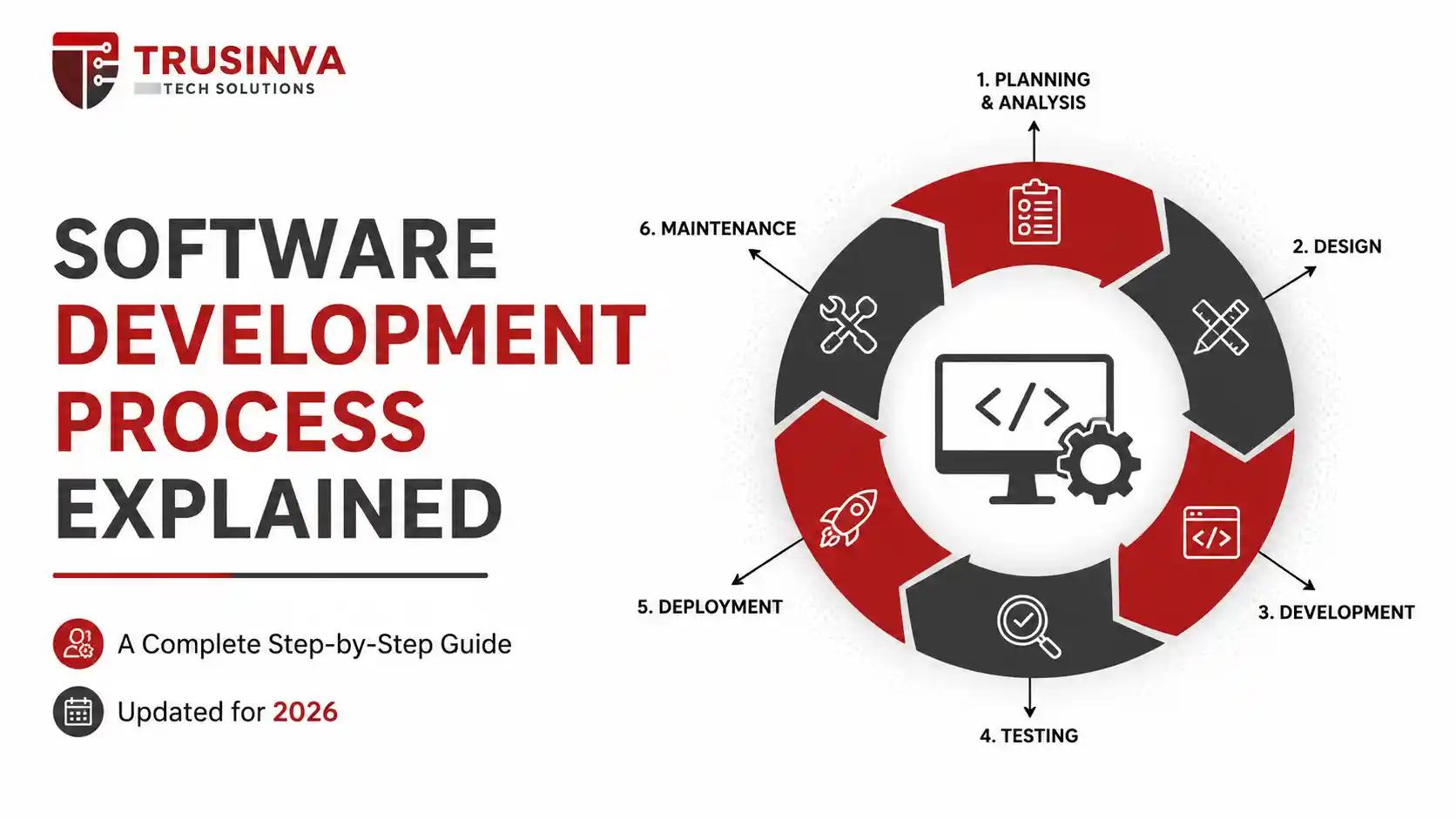
The software development process, commonly called the Software Development Life Cycle (SDLC), is the structured sequence of stages a team follows to plan, design, build, test, deploy, and maintain software. It typically includes requirement gathering, analysis, design, coding, testing, deployment, and maintenance — executed through a methodology like Agile, Scrum, or Waterfall to deliver reliable, scalable applications.
Introduction
Every application you use today — from a hospital's patient portal to a logistics company's dispatch dashboard — was built through a defined software development process. Understanding this process isn't just useful for developers; it's essential for business owners, founders, and IT managers who are investing money and time into a digital product. At Trusinva Tech Solutions, we've guided startups and enterprises alike through this exact lifecycle, from the first requirement-gathering call to post-launch support. Whether you're planning a custom web application, evaluating a mobile app development partner, or comparing web vs. mobile for your business, knowing how the software development process actually works will help you make smarter decisions and avoid costly delays. This guide breaks the entire process down step by step, using the frameworks and standards (IEEE, ISO/IEC 12207, Agile, DevOps) that professional engineering teams rely on in 2026.
Key Takeaways
- The SDLC has seven core stages: planning, analysis, design, development, testing, deployment, and maintenance.
- Agile and Scrum dominate modern software delivery because they support iterative releases and faster feedback loops.
- DevOps and CI/CD pipelines have merged development and operations into a continuous release cycle.
- Choosing the right SDLC model (Agile, Waterfall, Kanban) depends on project size, budget, and how well requirements are defined upfront.
- Skipping requirement gathering or QA is the most common — and costliest — mistake businesses make.
Table of Contents
- What Is the Software Development Process?
- Why the Software Development Process Matters
- The 7 Stages of the Software Development Life Cycle
- Popular SDLC Models Compared
- Tools Used in Each Stage
- Software Development Process: Cost & Timeline
- Common Mistakes to Avoid
- Best Practices for a Smooth Development Cycle
- Future Trends in Software Development
- FAQs
- Conclusion
1. What Is the Software Development Process?
The software development process — formally known as the Software Development Life Cycle (SDLC) — is a structured framework that defines the phases involved in building software, from the initial idea to long-term maintenance. It exists so that teams don't build software randomly; instead, they follow a repeatable, measurable sequence that reduces risk, controls cost, and ensures the final product actually solves the problem it was meant to solve.
The concept is formalized in standards like ISO/IEC 12207 (Software Life Cycle Processes) and has been shaped over decades by organizations like IEEE and thought leaders such as Kent Beck, Martin Fowler, and Jeff Sutherland, who helped popularize iterative and Agile approaches that now dominate the industry.
In short: the SDLC is the roadmap. The methodology (Agile, Scrum, Waterfall, Kanban) is how you drive it.
2. Why the Software Development Process Matters
A defined process matters because software failures are expensive and common. According to industry research from Gartner and the Stack Overflow Developer Survey, poorly scoped requirements and inadequate testing remain leading causes of failed or delayed software projects.
A structured process gives you:
- Predictability — clear milestones instead of guesswork
- Cost control — fewer expensive late-stage changes
- Quality assurance — issues caught before they reach users
- Stakeholder alignment — everyone knows what's being built and when
- Scalability — architecture decisions made early support future growth
For businesses evaluating vendors, this is also the best lens for choosing the right web development company — ask them to walk you through their process before you ask about price.
3. The 7 Stages of the Software Development Life Cycle
Stage 1: Requirement Gathering & Planning
Direct answer: This stage involves collecting business goals, user needs, and technical constraints to define exactly what the software must do. It usually takes the form of stakeholder interviews, market research, and documentation such as a Software Requirements Specification (SRS), following standards like IEEE 830.
Key activities:
- Stakeholder interviews and workshops
- Competitive and market analysis
- Feasibility study (technical, financial, operational)
- Defining scope, budget, and timeline
- Creating a product roadmap and backlog
Common deliverable: Software Requirements Specification (SRS) document, project charter.
Stage 2: Analysis & Feasibility
Direct answer: The analysis phase evaluates whether the proposed solution is technically achievable, financially viable, and aligned with business objectives before any code is written. Teams model use cases, define system requirements, and assess risk.
This is where teams decide on the technology stack (e.g., Python, Java, JavaScript, TypeScript, Go), evaluate whether cloud infrastructure like AWS, Azure, or Google Cloud fits the budget, and flag any regulatory or compliance requirements — especially critical for industries like healthcare or finance.
Stage 3: Design (System & UI/UX)
Direct answer: The design phase translates requirements into technical blueprints and user interfaces, covering system architecture, database schema, API structure, and the visual/interaction design users will experience.
This stage splits into two parallel tracks:
- System Design — architecture diagrams, database design, API contracts (REST or GraphQL), security planning based on frameworks like OWASP Top 10
- UI/UX Design — wireframes, prototypes, and usability testing, often done in tools like Figma
A well-run UI/UX design process at this stage prevents expensive rework later — redesigning after development starts can cost 3–5x more than getting it right upfront.
Stage 4: Development (Coding)
Direct answer: Development is where engineers write the actual code based on approved designs, typically working in short iterations (sprints) rather than building the entire system at once. Version control systems like Git, hosted on GitHub or GitLab, track every change.
Modern teams follow:
- Coding standards and peer code reviews
- Version control (Git workflow, feature branching)
- Modular architecture (microservices where appropriate)
- Continuous integration to catch issues early
Stage 5: Testing & Quality Assurance
Direct answer: Testing verifies that the software works as intended and meets requirements, using a combination of manual and automated methods including unit testing, integration testing, system testing, and user acceptance testing (UAT).
| Testing Type | Purpose | Performed By |
| Unit Testing | Verify individual code components | Developers |
| Integration Testing | Verify components work together | QA/Dev |
| System Testing | Verify entire system meets requirements | QA Team |
| UAT | Confirm software meets business needs | End Users/Client |
| Security Testing | Identify vulnerabilities (OWASP-based) | Security/QA |
Skipping structured QA is one of the fastest ways to inflate post-launch support costs.
Stage 6: Deployment
Direct answer: Deployment moves tested software from a staging environment into production, where real users can access it — often through automated CI/CD pipelines using tools like Jenkins, Docker, and Kubernetes for consistent, low-risk releases.
Common deployment strategies include phased rollouts, blue-green deployment, and canary releases — all designed to minimize downtime and let teams roll back quickly if something breaks.
Stage 7: Maintenance & Support
Direct answer: Maintenance is the ongoing process of monitoring, updating, and improving software after launch, including bug fixes, security patches, performance optimization, and feature enhancements based on user feedback.
This stage is often underestimated — industry data consistently shows that most of a software product's total lifetime cost is spent here, not during initial build.
4. Popular SDLC Models Compared
| Model | Best For | Pros | Cons |
| Agile/Scrum | Projects with evolving requirements | Flexible, fast feedback, iterative | Requires active client involvement |
| Waterfall | Fixed-scope, well-defined projects | Clear structure, easy to manage | Inflexible to change |
| Kanban | Continuous delivery teams | Visual workflow, flexible pacing | Less predictable timelines |
| DevOps | Teams needing rapid, frequent releases | Continuous delivery, automation | Requires cultural/tooling maturity |
Most modern software teams — including at Trusinva — use Agile/Scrum as the core methodology, layering in DevOps practices for deployment. This combination is why so many custom software development engagements now move from concept to MVP in weeks rather than months.
5. Tools Used in Each Stage
- Planning & Project Management: Jira, Trello, Azure DevOps
- Design: Figma
- Version Control: Git, GitHub, GitLab, Bitbucket
- Development: Visual Studio Code, IntelliJ IDEA
- API Testing: Postman
- CI/CD & Infrastructure: Jenkins, Docker, Kubernetes, Terraform
6. Software Development Process: Cost & Timeline
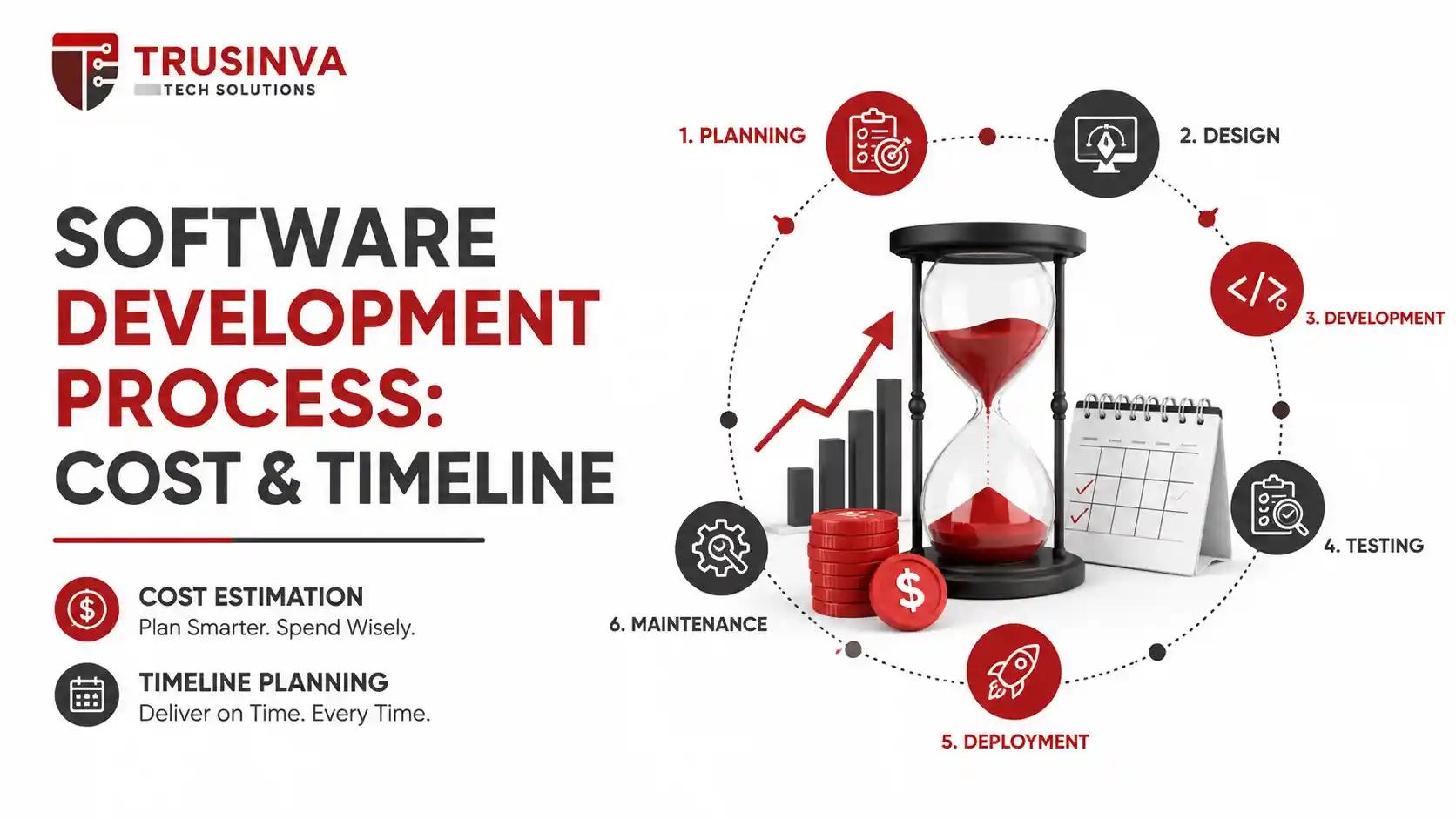
Cost and timeline vary widely based on complexity, but as a general guide:
- MVP / Small Application: 4–10 weeks
- Mid-size Business Application: 3–6 months
- Enterprise-Grade System: 6–12+ months
Factors that most affect cost include scope clarity, third-party integrations, compliance requirements, and whether the project is a new build or a legacy modernization. Businesses exploring this should also compare top web development services in the USA to benchmark realistic pricing.
7. Common Mistakes to Avoid
- Skipping proper requirement gathering to "save time"
- Choosing technology stack before understanding business needs
- Underinvesting in QA and testing
- Ignoring scalability during architecture design
- Treating deployment as the finish line instead of maintenance as ongoing
8. Best Practices for a Smooth Development Cycle
- Document requirements clearly (SRS) before development starts
- Use Agile sprints with regular stakeholder demos
- Automate testing and deployment pipelines early
- Prioritize security (OWASP Top 10) from the design phase, not after
- Plan a maintenance budget, not just a build budget
9. Future Trends in Software Development (2026)
- AI-assisted development — code generation and review copilots accelerating delivery
- Serverless and cloud-native architecture becoming the default for new builds
- Low-code/no-code tools handling simpler internal tools, freeing engineers for complex systems
- DevSecOps — security embedded across the entire pipeline, not bolted on at the end
FAQs
Q1: What are the main stages of the software development process? The seven core stages are requirement gathering, analysis, design, development, testing, deployment, and maintenance.
Q2: What's the difference between SDLC and Agile? SDLC is the overall framework of stages software goes through. Agile is a methodology for executing those stages iteratively, in short sprints, rather than sequentially.
Q3: How long does the software development process take? It ranges from 4–10 weeks for an MVP to 6–12+ months for enterprise systems, depending on scope and complexity.
Q4: Which SDLC model is best for startups? Agile or Scrum is typically best for startups because requirements often evolve as the product finds market fit.
Q5: What is the most important stage of the SDLC? Requirement gathering is arguably the most critical — errors here cascade through every later stage and are the most expensive to fix late.
Q6: What is DevOps and how does it fit into the SDLC? DevOps merges development and operations teams to automate testing, deployment, and monitoring, enabling faster and more reliable releases.
Q7: Do small businesses need a formal SDLC process? Yes — even a lightweight Agile process prevents scope creep and keeps budgets predictable, which matters even more for smaller budgets.
Conclusion
The software development process isn't just technical jargon — it's the difference between a product that launches on time and on budget, and one that spirals into delays and rework. Whether you're a startup building your first MVP or an enterprise modernizing legacy systems, following a structured SDLC — backed by the right methodology, tools, and QA discipline — is what separates successful software from expensive failures. If you're ready to move from planning to execution, the team at Trusinva Tech Solutions can walk you through every stage of this process for your specific project. Book a Seat for a free consultation and let's map out your software development roadmap together.