Quick Answer:
Retail ERP software is a centralized system that connects inventory, point of sale, ecommerce, procurement, and financial data across every store and sales channel a retailer operates. It gives US retailers a single source of truth for stock levels, orders, and customer data, which is essential for omnichannel fulfillment like BOPIS and ship-from-store. Most mid-size retailers implement it to reduce stockouts and unify multi-channel operations.
Introduction
Running a retail business across physical stores, an ecommerce site, and marketplaces like Amazon or Walmart without a connected system usually means constant stock mismatches, delayed orders, and manual reconciliation. Retail ERP software exists to fix exactly that — and this guide breaks down everything US retailers need to know before choosing a platform in 2026.
This guide comes from the team at Trusinva Tech Solutions, where we build ecommerce and web development solutions and custom software for retailers, DTC brands, and multi-location businesses across the US. We've also worked closely with CRM development projects for retail sales teams, which gives us a practical view of how ERP, POS, and customer data need to work together. If you're comparing platforms like NetSuite or Acumatica against a more tailored build, this article gives you the real picture.
Let's break down what retail ERP actually does.
Key Takeaways
- Retail ERP unifies POS, ecommerce, inventory, and financials into one system instead of disconnected tools.
- Leading 2026 platforms include Oracle NetSuite, Microsoft Dynamics 365, Acumatica, SAP, Infor, Odoo, and Brightpearl.
- The U.S. Census Bureau reported $326.7 billion in retail e-commerce sales for Q1 2026 alone, showing why real-time inventory visibility matters more than ever.
- NRF forecasts $5.6 trillion in total U.S. retail sales for 2026, a 4.4% increase over 2025.
- PCI DSS 4.0.1 compliance is now a core requirement for any retail ERP handling POS or payment data.
Table of Contents
- What Is Retail ERP Software?
- Why Retailers Need ERP Instead of Standalone Tools
- Core Modules in Retail ERP
- Retail ERP and Omnichannel Fulfillment
- Top Retail ERP Platforms in 2026
- Retail ERP by Business Type
- Benefits of Retail ERP Software
- Challenges and Disadvantages
- Retail ERP Cost in the USA
- Implementation Process: Step-by-Step
- Security and Compliance for Retail ERP
- Common Mistakes During Retail ERP Implementation
- Future Trends: AI and Unified Commerce
- Why Choose Trusinva Tech Solutions
- FAQs
- Conclusion
What Is Retail ERP Software?
Retail ERP software is a business management system that connects inventory, point of sale, ecommerce, procurement, and accounting into one platform built for the realities of multi-channel retail. Unlike generic ERP, it's designed around real-time inventory synchronization, order routing, and unified customer data across every sales channel.
In practice, retail ERP is what makes sure a product sold online, in-store, or through a marketplace updates stock levels everywhere instantly — instead of three different systems showing three different numbers.
Why Retailers Need ERP Instead of Standalone Tools
Retailers who rely on separate POS, ecommerce, and inventory tools almost always run into data mismatches that lead to overselling, stockouts, or manual reconciliation work. Retail ERP solves this by acting as a single source of truth that every channel pulls from and updates in real time.
This matters more now than ever. With the Census Bureau reporting $326.7 billion in Q1 2026 retail e-commerce sales — 16.9% of total retail sales for the quarter — retailers without unified systems are increasingly losing ground to competitors who can fulfill orders faster and more accurately across channels.
Core Modules in Retail ERP
- Inventory management – real-time stock visibility across all locations and channels
- Point of sale (POS) integration – connects in-store transactions to central inventory and financials
- Order management (OMS) – handles order routing, split fulfillment, and returns across channels
- Ecommerce integration – syncs with Shopify, Adobe Commerce, WooCommerce, BigCommerce, and marketplaces
- Procurement and supplier management – automates purchase orders and supplier tracking
- Merchandise and pricing management – manages product catalogs, pricing, and promotions
- Retail accounting – financial reconciliation across stores and channels
- Customer management – unified customer profiles, often tied to loyalty and CRM systems
- Warehouse management (WMS) – manages fulfillment centers and stock transfers
- Retail analytics – sales forecasting, demand planning, and store-level profitability reporting
Retail ERP and Omnichannel Fulfillment
Direct answer: Retail ERP powers omnichannel fulfillment by giving every channel — store, website, and marketplace — access to the same real-time inventory and order data, enabling services like buy-online-pickup-in-store (BOPIS), ship-from-store, and endless aisle.
Without a connected ERP, offering BOPIS or ship-from-store reliably is nearly impossible, because store staff and online systems would be working from different, outdated stock numbers. Retail ERP eliminates that gap by centralizing inventory allocation and order routing logic in one place.
Common omnichannel capabilities retail ERP enables:
- Buy online, pick up in store (BOPIS)
- Ship from store
- Endless aisle (selling out-of-stock items from other locations)
- Real-time inventory allocation across warehouses and stores
- Unified returns processing regardless of purchase channel
Top Retail ERP Platforms in 2026
| Platform | Best For | Deployment |
| Oracle NetSuite | Fast-growing multi-channel retailers | Cloud |
| Microsoft Dynamics 365 | Retailers on the Microsoft ecosystem | Cloud |
| Acumatica Cloud ERP | Mid-market, flexible licensing needs | Cloud |
| SAP S/4HANA / SAP Retail | Large enterprise retail chains | Cloud/On-Premise |
| Infor CloudSuite | Complex, multi-location retail operations | Cloud |
| Odoo ERP | Startups and small retailers, budget-conscious | Cloud/On-Premise |
| Brightpearl | DTC and ecommerce-first retailers | Cloud |
| Sage Intacct | Retailers prioritizing financial management | Cloud |
Current retail ERP comparisons for 2026 consistently place NetSuite, Microsoft Dynamics 365, Acumatica, SAP, Infor, Odoo, and Brightpearl among the most relevant platforms, depending on business size and channel complexity.
Retail ERP by Business Type
| Retail Type | Priority ERP Features |
| Department stores / large chains | Multi-location inventory, centralized procurement |
| Grocery retailers | Perishable tracking, high-frequency replenishment |
| Fashion retailers | Size/color variant management, seasonal forecasting |
| DTC / ecommerce-first brands | Ecommerce-native integration, fast order routing |
| Specialty and luxury retailers | Customer data unification, loyalty integration |
| Wholesalers | B2B pricing tiers, bulk order management |
Benefits of Retail ERP Software
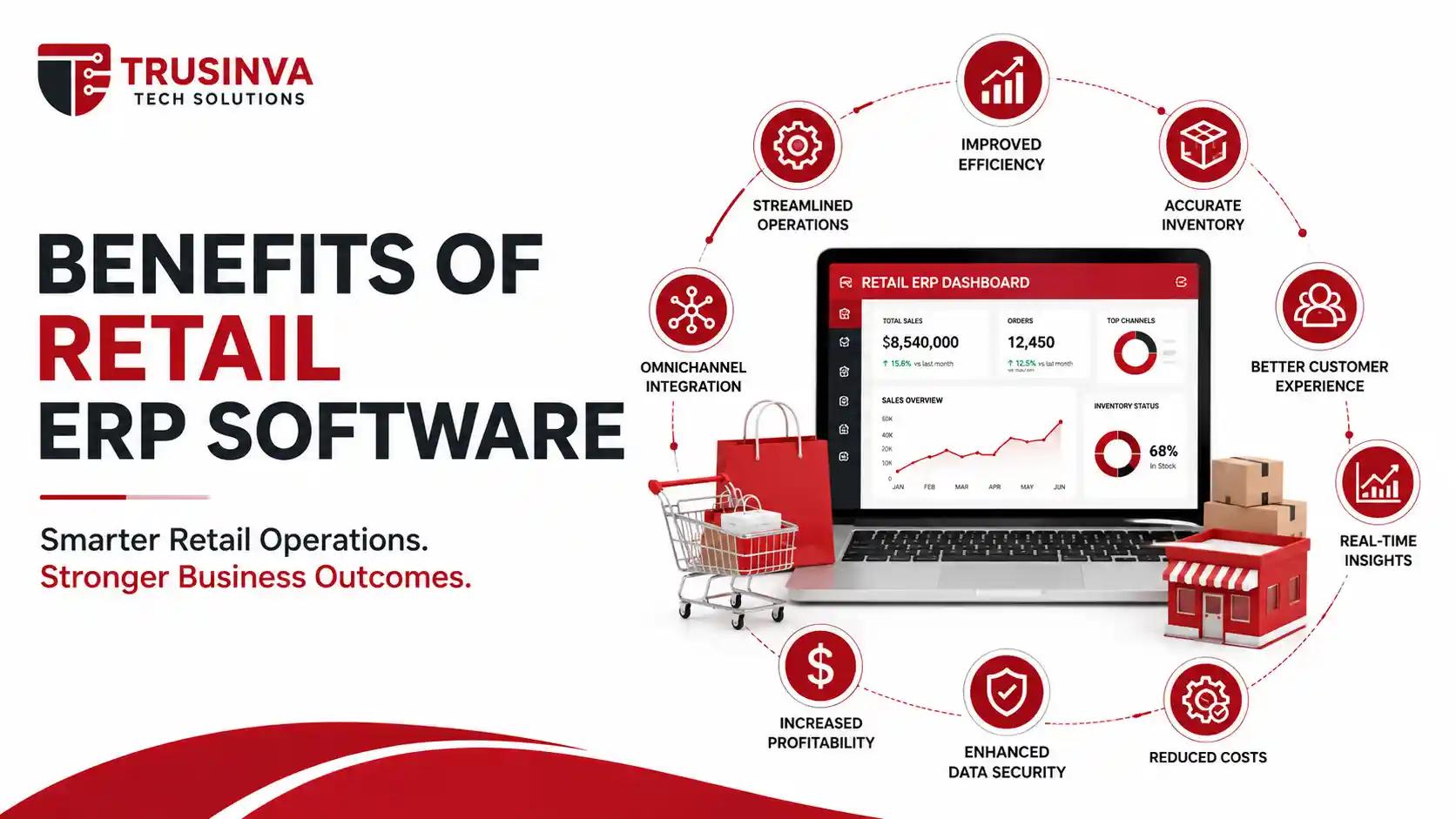
- Real-time inventory visibility across stores, warehouses, and online channels
- Fewer stockouts and overselling incidents
- Faster, more accurate order fulfillment across channels
- Unified customer data supporting better loyalty and personalization
- Centralized financial reporting across all locations
- Improved demand forecasting and automated replenishment
- Reduced manual reconciliation work between POS and ecommerce systems
Challenges and Disadvantages
- Implementation cost and time can be significant for smaller retailers
- POS and ecommerce integration complexity varies heavily by existing tech stack
- Staff training across store locations takes coordinated effort
- Data migration from legacy POS systems can be error-prone
- Over-customization can complicate future platform upgrades
Important note: Retailers that skip proper inventory data cleanup before migration are far more likely to see incorrect stock counts in the first few months after go-live — this is one of the most common and preventable ERP implementation mistakes.
Retail ERP Cost in the USA
| Retailer Size | Typical Cost Range |
| Small (1–5 locations) | $10,000–$60,000 |
| Mid-size (5–50 locations) | $75,000–$250,000 |
| Large/Enterprise chains | $250,000–$1,000,000+ |
Cost depends heavily on the number of sales channels, POS integration complexity, and whether the retailer chooses a cloud subscription model or a custom-built platform. For a broader cost comparison, see our guide on software development cost.
Implementation Process: Step-by-Step
- Assessment – map current POS, ecommerce, and inventory workflows
- Platform selection – match features to channel mix and business size
- Data migration planning – clean product, inventory, and customer data before transfer
- Integration setup – connect ERP with POS, ecommerce platforms, and marketplaces
- Configuration and customization – build workflows for pricing, promotions, and fulfillment rules
- Testing – validate order flows across every channel before go-live
- Staff training – onboard store and warehouse teams
- Go-live and support – phased rollout with ongoing monitoring
Security and Compliance for Retail ERP
- PCI DSS 4.0.1 – required for any system storing, processing, or transmitting cardholder data, which applies directly to POS-integrated ERP
- SOC 2 and ISO 27001 – relevant for retailers handling large volumes of customer data
- NIST Cybersecurity Framework – general security guidance for retail IT infrastructure
- CCPA / CPRA – California privacy requirements affecting customer data handling
- FTC privacy requirements – general consumer data protection obligations for US retailers
Retailers handling payment data through their ERP-POS integration should confirm PCI DSS 4.0.1 compliance with any vendor before implementation, since this standard was updated with stricter authentication and monitoring requirements.
Common Mistakes During Retail ERP Implementation
- Choosing a platform without confirming POS and ecommerce integration compatibility
- Underestimating data cleanup needs before migration
- Rolling out to all store locations at once instead of a phased approach
- Not training store-level staff adequately before go-live
- Ignoring compliance requirements like PCI DSS during integration planning
- Overlooking mobile and marketplace channels in the initial scope
Future Trends: AI and Unified Commerce
Retail ERP in 2026 is increasingly shaped by AI-driven demand forecasting, recommendation engines, and AI agents that help automate replenishment and pricing decisions in real time. Unified commerce — where POS, ecommerce, and fulfillment all run on one connected data layer — is becoming the standard expectation rather than a premium feature.
Retailers are also investing more in customer data platforms (CDPs) alongside ERP to power personalization, which connects closely with broader AI automation trends across business operations.
Why Choose Trusinva Tech Solutions
Retail ERP only works when it's actually built around how your stores, website, and fulfillment operations run day to day — not forced into a generic template. At Trusinva Tech Solutions, we help retailers and ecommerce businesses plan and build systems that fit their real operations.
What we bring to retail ERP projects:
- Direct experience in ecommerce web development and custom software development
- Integration expertise across CRM development and customer data systems
- Experience with platforms like Shopify and WordPress for ecommerce-connected ERP builds
- Full-stack capability from web development to UI/UX design for store and admin dashboards
- Transparent, phased project scoping so retailers avoid the common budget overruns seen in ERP rollouts
Browse our services or explore past projects to see how we've approached similar retail systems.
FAQs
1. What is retail ERP software used for? It's used to unify inventory, POS, ecommerce, procurement, and financial data across every store and sales channel a retailer operates.
2. How is retail ERP different from a POS system? POS handles in-store transactions only. Retail ERP connects POS with inventory, ecommerce, procurement, and accounting across the entire business.
3. Does retail ERP support omnichannel fulfillment like BOPIS? Yes. Retail ERP is what enables real-time inventory sharing needed for BOPIS, ship-from-store, and endless aisle fulfillment across channels.
4. How much does retail ERP cost for a small retailer? Small retailers with 1–5 locations typically spend $10,000–$60,000, depending on channel complexity and integration needs.
5. Which retail ERP is best for ecommerce-first brands? Brightpearl and Oracle NetSuite are commonly chosen by DTC and ecommerce-first retailers due to strong native ecommerce integrations.
6. How long does retail ERP implementation take? Typically 2–4 months for small retailers and 6–12 months for multi-location or enterprise chains.
7. Is PCI DSS compliance required for retail ERP? Yes, if the ERP stores, processes, or transmits cardholder data through POS integration, PCI DSS 4.0.1 compliance is required.
8. Can retail ERP integrate with Shopify or Amazon? Yes, most modern retail ERP platforms offer native or API-based integrations with Shopify, Amazon, Walmart Marketplace, and other major ecommerce platforms.
Conclusion
Retail ERP software has become essential infrastructure for US retailers navigating multi-channel selling, rising ecommerce volume, and growing customer expectations around fast, accurate fulfillment. With NRF projecting $5.6 trillion in US retail sales for 2026, retailers running on disconnected systems are increasingly at a competitive disadvantage against those with unified, real-time operations.
If you're evaluating a retail ERP project or want a clear-eyed assessment of what your business actually needs, the smartest next step is a direct conversation with a team that understands both retail operations and software architecture. Book a Seat with Trusinva Tech Solutions to walk through your current systems and get a realistic cost and timeline estimate. You can also explore our full services page, browse our blog for more retail and ecommerce insights, or learn more about our team before reaching out.