Quick Answer
A mobile app development company in the USA designs, builds, and maintains custom iOS and Android applications for businesses, handling everything from UI/UX design to backend development, API integration, testing, and app store deployment. The right company acts as a long-term technology partner, not just a one-time vendor, and typically combines native and cross-platform expertise (Swift, Kotlin, Flutter, React Native) with industry-specific experience.
Introduction
Picking the right mobile app development company in the USA is one of those decisions that quietly determines whether your app becomes a growth engine or a costly experiment that never gets updated. Trusinva Tech Solutions works with startups, SMBs, and enterprises across the country to build custom mobile applications that actually hold up post-launch — not just apps that look good in a pitch deck. In this guide, we'll break down what a proper mobile app development company should actually deliver, how mobile app development cost in the USA really works, and what separates a reliable long-term partner from an agency that disappears after handoff. If you're also comparing paths, our piece on how to hire the best mobile app development company without wasting money pairs well with this one.
Key Takeaways
- A mobile app development company should offer end-to-end services: strategy, design, development, QA, deployment, and maintenance.
- Cost in the USA ranges widely based on complexity, platform, and integrations.
- Native (Swift/Kotlin) vs cross-platform (Flutter/React Native) is the first major technical decision.
- Security standards like OWASP MASVS and OAuth-based authentication should be non-negotiable.
- The best agencies show proven portfolios, transparent pricing, and post-launch support commitments.
Table of Contents
- What Is a Mobile App Development Company?
- Services a Mobile App Development Company Should Offer
- Why US Businesses Hire a Dedicated App Development Partner
- In-House vs Outsourced vs Agency Development
- The App Development Process Explained
- Mobile App Development Cost in the USA
- Technology Stack: iOS, Android, and Cross-Platform
- Security, Compliance, and Data Privacy
- Common Mistakes When Hiring a Mobile App Development Company
- How to Evaluate and Choose the Right Company
- Industry-Specific Use Cases
- Future Trends Shaping Mobile App Development Companies
- Why Choose Trusinva Tech Solutions
- FAQs
- Conclusion
1. What Is a Mobile App Development Company?
A mobile app development company is a technology firm specializing in designing, building, testing, and maintaining mobile applications for businesses across iOS, Android, or both. Unlike freelancers or in-house solo developers, a full-service company typically brings together designers, developers, QA engineers, and project managers under one roof.
This matters because a mobile app isn't just code — it's a product that needs strategic thinking around user experience, backend architecture, app store deployment, and long-term maintainability. A dedicated mobile app development agency is built to handle that full lifecycle, rather than just one slice of it.
2. Services a Mobile App Development Company Should Offer
Direct answer: A complete mobile app development company should offer app strategy and discovery, UI/UX design, native and cross-platform development, backend and API development, QA testing, app store deployment, and ongoing maintenance — not development alone.
Core service areas typically include:
- Product discovery & strategy – defining goals, target users, and technical requirements
- UI/UX design – wireframing, prototyping, and visual design
- iOS & Android development – native or cross-platform builds
- Backend & API development – database architecture, cloud integration, third-party APIs
- QA & testing – functional, security, and performance testing
- App store deployment – Apple App Store and Google Play submission
- Post-launch maintenance – updates, bug fixes, OS compatibility
If your project also needs a strong design foundation, this breakdown of UI/UX design services that increase US conversions is a useful companion read.
3. Why US Businesses Hire a Dedicated App Development Partner
Direct answer: US businesses hire a dedicated mobile app development company because building an in-house team is expensive and slow to assemble, while an experienced agency brings tested processes, cross-industry insight, and faster time-to-market without the overhead of full-time hires.
Common reasons businesses go this route:
- Faster launch timelines with an established team
- Access to specialized skills (Flutter, React Native, native iOS/Android) without hiring full-time
- Lower long-term cost compared to building and managing an internal dev team
- Industry experience across FinTech, HealthTech, eCommerce, and SaaS
For growth-focused retailers specifically, mobile app development for US retail businesses covers sector-specific ROI in more detail.
4. In-House vs Outsourced vs Agency Development
| Model | Best For | Pros | Cons |
| In-House Team | Large enterprises with ongoing app needs | Full control, deep product knowledge | High cost, slow to build |
| Freelancers | Very small, simple projects | Lower cost | Inconsistent quality, no QA depth |
| Agency Partner | Most startups & SMBs | Full-service, proven process, faster delivery | Requires vetting the right partner |
For most startup app development and SMB mobile app development needs, an agency partner offers the best balance of speed, quality, and cost predictability — especially when the agency also supports custom software development beyond just the app itself.
5. The App Development Process Explained
Direct answer: A structured mobile app development process moves through discovery, UI/UX design, backend and frontend development, QA testing, app store deployment, and post-launch maintenance — typically taking 3 to 9 months depending on scope.
- Discovery & Requirements – business goals, user personas, feature list
- UI/UX Design – wireframes, prototypes, visual design system
- Backend Development – database, cloud infrastructure, API architecture
- Frontend Development – building the actual app using Flutter, React Native, Swift, or Kotlin
- QA & Testing – functional, security, and device compatibility testing
- Deployment – App Store Connect and Google Play Console submission
- Maintenance – ongoing updates, monitoring, and feature iterations
6. Mobile App Development Cost in the USA
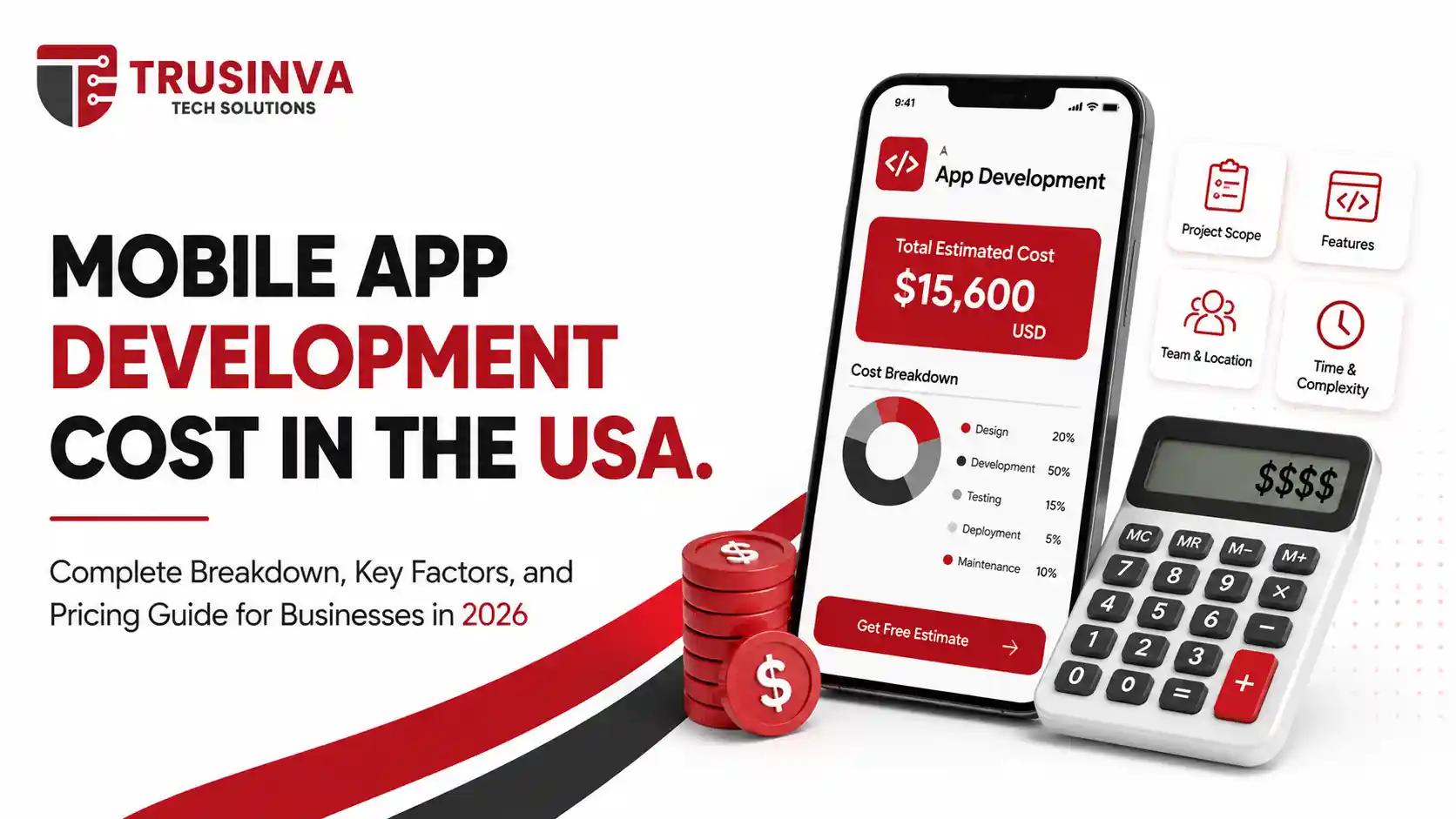
Direct answer: Mobile app development in the USA typically costs between $15,000 and $150,000+, depending on platform choice, feature complexity, backend requirements, and whether the build is native or cross-platform — with simple MVPs on the lower end and enterprise apps on the higher end.
Key cost drivers:
- Platform count (iOS only, Android only, or both)
- Design complexity and number of screens
- Backend and third-party integration needs
- Security and compliance requirements
- Ongoing maintenance and support plans
Startups working with tighter budgets should look at affordable mobile app development for US startups, and for a full cost breakdown by feature, see mobile app development cost USA.
7. Technology Stack: iOS, Android, and Cross-Platform
Direct answer: iOS apps are typically built with Swift and SwiftUI, Android apps with Kotlin and Jetpack Compose, while cross-platform apps use Flutter or React Native to share a single codebase across both platforms — the right choice depends on budget, timeline, and performance needs.
- Native iOS: Swift, SwiftUI, Xcode
- Native Android: Kotlin, Jetpack Compose, Android Studio — see our dedicated Android app development services guide
- Cross-Platform: Flutter (Dart) or React Native (JavaScript/TypeScript)
- Backend: Node.js, Firebase, AWS, Microsoft Azure, or Google Cloud
Most enterprise mobile application builds with heavy performance needs lean native, while startup mobile app development projects generally favor cross-platform for speed and cost efficiency.
8. Security, Compliance, and Data Privacy
Direct answer: Mobile app security should follow OWASP Mobile Application Security Verification Standard (MASVS) guidelines, use OAuth or OpenID Connect for authentication, enforce HTTPS/TLS encryption, and store sensitive data using strong encryption standards — especially critical for HealthTech, FinTech, and eCommerce apps.
Security best practices include:
- Secure authentication (biometric login, multi-factor authentication)
- Encrypted data storage and transmission
- Regular penetration testing and vulnerability scans
- Compliance alignment with relevant US data privacy expectations
Reference: OWASP Mobile Application Security provides the industry-standard framework most reputable development companies follow.
9. Common Mistakes When Hiring a Mobile App Development Company
- Choosing based on price alone, ignoring portfolio quality and communication style
- Skipping the discovery phase and jumping straight into design
- Not asking about post-launch support until after the app is already live
- Underestimating backend complexity, especially around integrations
- Failing to check references or past client outcomes
10. How to Evaluate and Choose the Right Company
Direct answer: Evaluate a mobile app development company based on portfolio relevance, transparent pricing, in-house design and QA capability, communication process, and whether they offer post-launch maintenance — not just how fast they promise to deliver.
Checklist:
- Portfolio with apps similar to your industry or use case
- Clear, itemized pricing with no hidden fees
- In-house UI/UX, development, and QA teams
- Documented post-launch maintenance plan
- Strong communication and project visibility throughout
11. Industry-Specific Use Cases
- Healthcare – appointment scheduling, telehealth, patient portals
- eCommerce & Retail – mobile shopping, loyalty programs, push-based promotions
- Logistics – dispatch tracking, route optimization, driver apps
- FinTech – secure payments, budgeting tools, account management
- SaaS – companion apps for existing web platforms, extending SaaS development services into mobile
12. Future Trends Shaping Mobile App Development Companies
- AI-powered features – chatbots, personalization, predictive recommendations
- Cross-platform performance gains – Flutter and React Native narrowing the gap with native
- Privacy-first architecture – stricter data handling built in from day one
- Mobile DevOps & CI/CD – faster, safer release cycles
- Super app consolidation – multiple services bundled into a single app experience
13. Why Choose Trusinva Tech Solutions
Trusinva Tech Solutions is a full-service technology partner for US businesses building custom mobile applications — combining strategy, UI/UX design, native and cross-platform development, backend architecture, and ongoing support under one team.
What makes the partnership different:
- Transparent, itemized pricing with no hidden costs
- In-house design, development, and QA — no outsourcing gaps
- Proven experience across healthcare, retail, logistics, and SaaS
- Post-launch maintenance plans to keep your app secure and compatible
- A real portfolio you can review on the projects page
Businesses that need a broader digital foundation can also pair mobile development with CRM development, web development, and digital marketing — all under one accountable partner instead of coordinating multiple vendors.
14. FAQs
Q1: What does a mobile app development company actually do? It handles the full lifecycle of building a mobile app — strategy, UI/UX design, development, testing, deployment, and post-launch maintenance.
Q2: How much does it cost to hire a mobile app development company in the USA? Costs typically range from $15,000 for a simple MVP to $150,000+ for a complex, enterprise-grade application.
Q3: Should I choose native or cross-platform development? Cross-platform (Flutter, React Native) works well for most startups and MVPs; native (Swift, Kotlin) suits performance-heavy or complex enterprise apps.
Q4: How long does it take to build a custom mobile app? Most projects take 3 to 9 months depending on feature complexity and platform requirements.
Q5: Do mobile app development companies also provide maintenance after launch? A reputable company will offer ongoing maintenance plans covering bug fixes, OS updates, and feature improvements.
Q6: What security standards should a mobile app development company follow? At minimum, OWASP MASVS guidelines, OAuth-based authentication, and HTTPS/TLS encryption for all data in transit.
Q7: Can a mobile app development company integrate my app with existing business systems? Yes — API integration with CRM, ERP, and payment systems is a standard part of most custom app development projects.
Q8: Is outsourcing app development to a US-based agency worth it over freelancers? For most businesses, yes — agencies offer consistent quality, in-house QA, and accountability that individual freelancers typically can't match.
15. Conclusion
Choosing a mobile app development company in the USA isn't just about who can build the app fastest — it's about finding a partner who understands your business, builds with security and scalability in mind, and sticks around after launch to keep the app running smoothly. Whether you're a startup validating an MVP or an enterprise modernizing your digital strategy, the fundamentals stay consistent: proven portfolio, transparent process, and real post-launch support. Ready to get started? Book a Seat for a free consultation with the Trusinva Tech Solutions team, explore the full range of services, browse past projects, read more on the blog, or contact us directly to discuss your app idea.