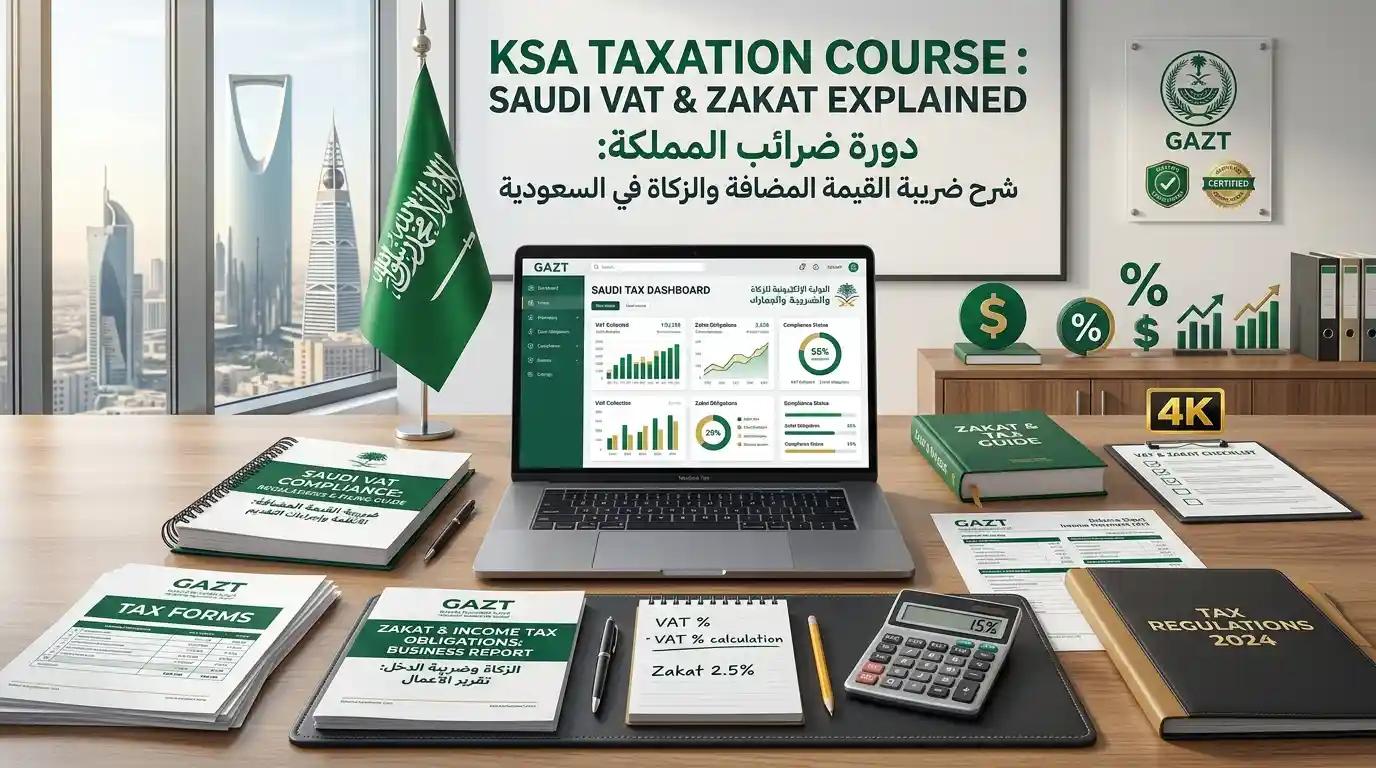
If you're an accountant, finance professional, or business owner operating in Saudi Arabia, understanding the KSA tax system is no longer optional — it's essential. Saudi Arabia has gone through significant tax reforms over the past few years, and staying compliant with ZATCA regulations can make or break your business operations in the Kingdom.
This guide covers everything you need to know about Saudi VAT and Zakat, why a KSA taxation course matters, and how you can master Saudi tax compliance step by step.
What Is VAT in Saudi Arabia?
Value Added Tax (VAT) in Saudi Arabia is a consumption tax applied to most goods and services at each stage of the supply chain. Saudi Arabia introduced VAT in January 2018 at 5%, then increased it to 15% in July 2020 as part of broader fiscal reforms.
VAT in KSA is governed by the Zakat, Tax and Customs Authority — commonly known as ZATCA. Every registered business must collect VAT from customers (output VAT), offset it against VAT paid on purchases (input VAT), and file regular VAT returns with ZATCA.
If your annual taxable supplies exceed SAR 375,000, VAT registration in Saudi Arabia is mandatory. Businesses with supplies between SAR 187,500 and SAR 375,000 can register voluntarily.
Understanding KSA VAT regulations is critical for any business operating in the Kingdom — whether you're a local company, a multinational, or a US-based firm with Saudi clients.
What Is Zakat in Saudi Arabia?
Zakat is an Islamic financial obligation applied to Saudi nationals and GCC citizen-owned businesses in the Kingdom. It's calculated at 2.5% on the Zakat base, which broadly reflects the net worth or working capital of a business.
Zakat is not the same as income tax. It is a religious levy administered by ZATCA, and it applies differently from VAT. Foreign-owned companies are typically subject to corporate income tax rather than Zakat, though mixed ownership businesses may face both.
The key difference between VAT and Zakat comes down to who pays and how it's calculated. VAT is a transaction-based consumption tax. Zakat is a wealth-based annual obligation tied to Islamic principles of redistribution.
For any finance professional working in or with Saudi Arabia, understanding both systems is foundational. That's exactly why a dedicated Saudi VAT and Zakat course has become one of the most in-demand professional qualifications in the region.
Why Saudi Tax Compliance Matters for Businesses
The Saudi tax framework is evolving rapidly. ZATCA has been rolling out e-invoicing regulations (called FATOORAH) in phases since 2021. By 2026, full integration with ZATCA's electronic invoicing platform is required for most businesses operating in the Kingdom.
Non-compliance carries serious consequences — including financial penalties, tax audits, and reputational damage. For US businesses or international companies working with Saudi clients, understanding Saudi Arabia VAT training requirements is critical before entering the market.
Here's why Saudi tax compliance should be a priority:
- ZATCA compliance is now strictly enforced with automated audit trails
- E-invoicing in Saudi Arabia is mandatory for B2B transactions in most sectors
- VAT invoice requirements are specific — missing fields can invalidate your invoices
- Tax audits in Saudi Arabia are increasing in frequency and scope
- VAT return filing deadlines are strict; late submissions attract penalties
- Corporate tax in Saudi Arabia applies to foreign companies and requires separate reporting
Whether you manage a business in Riyadh, consult for GCC clients, or handle international tax compliance from the USA, this knowledge directly impacts your professional value and your clients' bottom line.
Key Benefits of Taking a KSA Taxation Course
A structured Saudi taxation training program doesn't just teach you the rules — it builds the expertise that employers and clients pay a premium for.
Here's what you gain from enrolling in a quality Saudi VAT course:
- Full understanding of KSA VAT regulations including taxable supplies, VAT exemptions, and zero-rated categories
- Hands-on knowledge of the VAT return filing process in Saudi Arabia, including ZATCA portal navigation
- Mastery of ZATCA compliance requirements for e-invoicing and electronic reporting
- Ability to calculate output VAT and input VAT accurately across different transaction types
- Understanding of Zakat regulations in Saudi Arabia for Saudi-national-owned and mixed-ownership businesses
- Confidence handling tax audits and responding to ZATCA inquiries
- Career advancement — Saudi tax certification course credentials are valued by accounting firms, ERP consultancies, and multinationals
- Client service expansion for CPAs and tax consultants working with businesses that have Saudi operations
For US accountants and international finance professionals, this is one of the most accessible and high-ROI certifications you can add to your profile right now. The demand for Saudi VAT consulting and KSA tax advisory services continues to grow as more Western companies enter the Saudi market.
How Saudi VAT Works: A Step-by-Step Breakdown
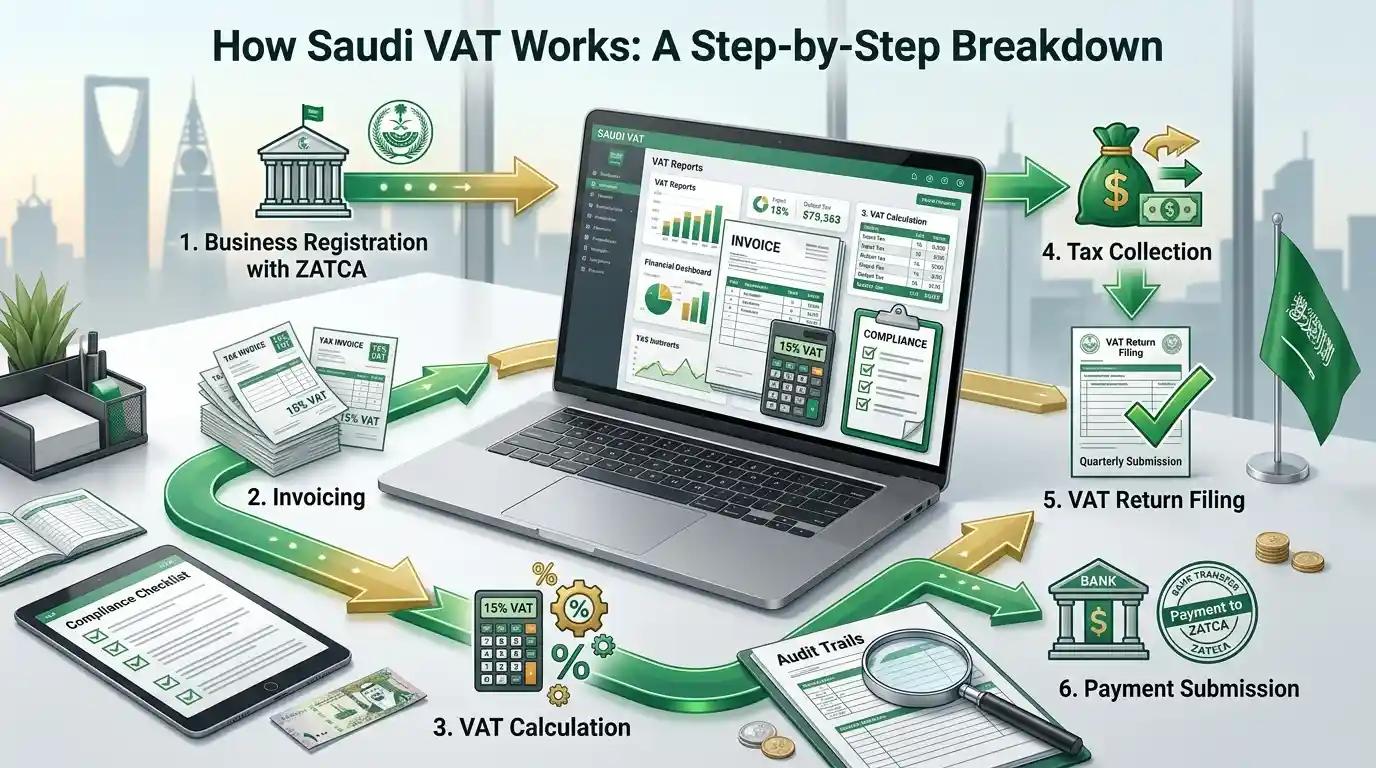
Understanding the VAT implementation process in KSA is simpler when you break it down into clear stages.
Step 1 — Determine your registration obligation. If your taxable turnover exceeds SAR 375,000 annually, you must register. Check your liability threshold and apply through the ZATCA portal.
Step 2 — Complete VAT registration in Saudi Arabia. Register online via the ZATCA platform. You'll receive a VAT registration certificate and a unique VAT number. This number must appear on all tax invoices.
Step 3 — Set up compliant VAT invoicing. Every VAT invoice in Saudi Arabia must include your VAT number, the buyer's details, invoice date, a description of goods or services, the VAT amount charged, and a QR code for e-invoices. Non-compliant invoices are rejected under ZATCA rules.
Step 4 — Track input and output VAT. Each month or quarter, record all VAT collected from customers (output VAT) and all VAT paid to suppliers (input VAT). The difference is your net VAT payable or refundable.
Step 5 — File your VAT return. Most businesses file VAT returns quarterly in Saudi Arabia, though larger businesses file monthly. Submit your return through the ZATCA online portal by the deadline.
Step 6 — Pay any VAT balance due. Pay the net VAT balance by the filing deadline to avoid penalties. ZATCA imposes late payment penalties calculated as a percentage of the unpaid amount.
Step 7 — Maintain records for audit readiness. Saudi tax accounting standards require you to retain all VAT records, invoices, and supporting documents for a minimum of six years. ZATCA can initiate a tax audit at any time.
This process is exactly what a structured Saudi tax course online will walk you through — step by step, with real examples and practical exercises.
Common Mistakes Businesses Make With Saudi VAT and Zakat
Even experienced finance teams make critical errors when dealing with Saudi tax obligations. Here are the most common ones:
Failing to register on time. Many businesses cross the VAT threshold without realizing it. Late registration triggers retrospective penalties from ZATCA.
Issuing non-compliant VAT invoices. Missing a required field — like the QR code or buyer's tax number — invalidates the invoice and creates audit risk.
Confusing Zakat with corporate income tax. Foreign companies assume Zakat applies to them. Saudi nationals assume corporate tax doesn't. The ownership structure of your entity determines which obligation applies.
Missing VAT return filing deadlines. The ZATCA portal has strict submission windows. Missing a deadline attracts an immediate fine, even if no VAT is owed.
Incorrect treatment of VAT exemptions. Not all goods and services attract 15% VAT. Some are zero-rated or exempt. Applying the wrong rate creates compliance risk and potential overpayments.
Ignoring e-invoicing requirements. Many businesses still issue manual invoices when ZATCA integration is already mandatory for their business tier. This is one of the most penalized compliance failures in 2026.
Not reconciling VAT accounts monthly. Poor VAT accounting in Saudi Arabia leads to mismatches between your books and your VAT return — a red flag in any tax audit.
A proper KSA taxation course teaches you how to avoid every single one of these mistakes before they cost your business money.
Why Choose Trusinva Tech Solutions for Your KSA Taxation Course
At Trusinva Tech Solutions, we don't just offer technology services — we offer knowledge that transforms careers and protects businesses.
Our KSA taxation course is designed specifically for accountants, finance professionals, ERP users, and business owners who need real-world, practical expertise in Saudi VAT and Zakat compliance.
What makes our course different:
- Delivered by experienced Saudi tax compliance professionals
- Covers ZATCA regulations, e-invoicing (FATOORAH), VAT return filing, and Zakat calculation in full
- Includes practical exercises using real Saudi tax scenarios
- Available online, so you can learn from anywhere in the world — including the USA
- Comes with a certificate upon completion, recognized by employers and clients
- Affordable pricing with flexible scheduling
- Taught in plain English with no unnecessary jargon
We also offer related courses including our UAE taxation course, UK taxation course, and USA taxation course — giving you comprehensive coverage of international tax systems from a single trusted platform.
Beyond courses, Trusinva Tech Solutions supports businesses with a full suite of digital and compliance-enabling services:
- ERP and CRM development with built-in VAT accounting and ZATCA-compatible invoicing modules
- Web development and mobile app development for businesses scaling in the GCC
- SEO services and digital marketing to grow your online presence internationally
- Shopify development with VAT-compliant checkout configurations
If your business needs both the knowledge and the technology to operate compliantly in Saudi Arabia, Trusinva Tech Solutions is the partner you've been looking for.
For additional expert-level Saudi tax advisory, you can also explore resources from BACO Consultants, who specialize in GCC financial compliance services.
Real-World Example: US Accounting Firm Entering the Saudi Market
A mid-sized US accounting firm took on a new client — a manufacturing company expanding into Saudi Arabia. The firm's senior accountants had strong US and UK tax backgrounds but zero experience with KSA VAT regulations or ZATCA compliance.
Within three months of the Saudi entity going live, the business received a ZATCA audit notice. The firm had issued non-compliant invoices, missed e-invoicing integration requirements, and incorrectly classified several supplies as exempt when they were actually taxable at 15%.
The result: a significant penalty, an urgent remediation project, and a damaged client relationship.
After enrolling in the Trusinva Tech Solutions KSA taxation course, the firm's team gained full command of Saudi VAT filing, e-invoicing rules, and input/output VAT reconciliation. They also worked with Trusinva to implement a ZATCA-compatible ERP module that automated compliance going forward.
Today, that same firm offers Saudi VAT consulting as a premium service line — a direct revenue stream that pays back the course investment many times over.
Frequently Asked Questions
What is VAT in Saudi Arabia? VAT (Value Added Tax) in Saudi Arabia is a 15% consumption tax applied to most goods and services. It was introduced in 2018 at 5% and increased to 15% in July 2020. It is administered by ZATCA.
Who must register for VAT in KSA? Any business with annual taxable supplies exceeding SAR 375,000 must register for VAT in Saudi Arabia. Voluntary registration is available for businesses with supplies above SAR 187,500.
What is Zakat for businesses in Saudi Arabia? Zakat is a 2.5% Islamic financial levy applied annually to Saudi nationals and GCC citizens' business interests. It is calculated on the Zakat base (broadly the net worth of the business) and is separate from VAT.
What is the difference between VAT and Zakat in Saudi Arabia? VAT is a transaction-based consumption tax at 15% collected on sales and purchases. Zakat is an annual wealth-based religious levy at 2.5% applied to qualifying business ownership. Foreign companies typically pay corporate income tax, not Zakat.
How do businesses file VAT returns in Saudi Arabia? VAT returns are filed through the ZATCA online portal, usually quarterly (monthly for large taxpayers). Businesses must submit their return and pay any net VAT balance by the deadline to avoid penalties.
Can I take a Saudi VAT course online from the USA? Yes. The Trusinva Tech Solutions KSA taxation course is fully online and accessible internationally, making it ideal for US accountants, tax consultants, and finance professionals working with Saudi clients.
Is a KSA taxation course worth it for accountants? Absolutely. Saudi tax certification adds a high-demand skill to your profile, enables you to serve GCC clients confidently, and can open new revenue streams in Saudi VAT consulting and compliance services.
Conclusion: Take Control of Saudi Tax Compliance Today
Saudi Arabia's tax landscape is one of the most dynamic in the world right now. With ZATCA tightening enforcement, e-invoicing becoming universal, and more international businesses entering the Kingdom, the demand for qualified Saudi tax professionals has never been higher.
Whether you're an accountant looking to expand your expertise, a finance professional supporting Saudi operations, or a business owner trying to stay compliant, a structured KSA taxation course is the smartest investment you can make right now.
Trusinva Tech Solutions brings together expert-led training, technology-enabled compliance tools, and a full range of digital services — all under one roof. From our KSA taxation course to our ERP development, SEO services, and web development, we're built to help you grow and operate with confidence globally.
Ready to master Saudi VAT and Zakat? Contact Trusinva Tech Solutions today and enroll in the KSA taxation course that finance professionals trust. Let's grow your skills — and your business — together.