Quick Answer:
ERP development cost typically ranges from $30,000 for a small-business off-the-shelf setup to $500,000+ for a fully custom enterprise ERP system. Pricing depends on the number of modules, integration complexity, team location, and whether you choose custom development, SaaS ERP, or a hybrid model. Most mid-sized businesses spend between $75,000 and $250,000 on implementation.
Introduction
If you're budgeting for a new business management system, you've probably searched "ERP development cost" more than once trying to find a straight answer. That's fair — ERP pricing isn't a single number, and most guides online only make it more confusing. Working with businesses on custom software projects, we've seen ERP budgets swing anywhere from $30,000 to well over half a million dollars, and the difference almost always comes down to scope, not luck.
This guide breaks down real ERP development cost ranges for 2026, what drives the price up or down, and how to plan a budget that won't blow up mid-project. At Trusinva Tech Solutions, we work with startups, growing enterprises, and industry-specific businesses on everything from custom software development to full ERP-adjacent CRM builds, so this breakdown reflects what businesses are actually paying, not just theoretical estimates. We'll also touch on how ERP costs compare to related projects like web development costs and general software development pricing, since many businesses evaluate these together.
By the end, you'll know exactly what to budget for, what questions to ask a development partner, and where businesses commonly overspend.
Key Takeaways
- Custom ERP development typically costs $50,000–$500,000+, depending on scope and complexity.
- Cloud/SaaS ERP subscriptions usually run $100–$500 per user per month.
- Hidden costs — data migration, training, and ongoing maintenance — often add 15–25% to the total budget.
- Choosing the right development partner and technology stack can cut long-term costs significantly.
- ERP ROI usually becomes visible within 12–24 months when implementation is planned correctly.
Table of Contents
- What Is ERP Development Cost?
- Why ERP Costs Vary So Widely
- Average ERP Development Cost in 2026
- Cost Breakdown by ERP Deployment Type
- Factors That Influence ERP Development Pricing
- Cost by Business Size
- Hidden Costs Businesses Often Miss
- Custom ERP vs Off-the-Shelf ERP: Cost Comparison
- How to Reduce ERP Development Cost
- ERP Development Timeline
- Common Mistakes That Inflate ERP Costs
- Why Choose Trusinva Tech Solutions
- FAQs
- Conclusion
What Is ERP Development Cost?
ERP development cost is the total amount a business spends to design, build, customize, and deploy an Enterprise Resource Planning system that centralizes operations like finance, inventory, HR, procurement, and reporting into one platform. It includes software development, licensing (if applicable), integrations, data migration, testing, training, and ongoing support.
ERP systems from vendors like SAP, Oracle, Microsoft Dynamics 365, NetSuite, Sage, Infor, Acumatica, Odoo, and Epicor all price differently depending on whether you're buying a pre-built license or commissioning custom development. Understanding this distinction early saves businesses from budgeting mistakes later.
Why ERP Costs Vary So Widely
There's no fixed price tag for ERP because every business runs differently. A 20-person logistics company and a 500-employee manufacturer need completely different systems, even if both call it "ERP."
Cost mainly depends on:
- Number of modules (finance, HR, inventory, CRM, procurement, etc.)
- Whether it's custom-built, off-the-shelf, or hybrid
- Cloud vs on-premise deployment
- Integration complexity with existing tools
- Data volume and migration complexity
- Development team location and rates
- Industry-specific compliance needs (HIPAA, SOX, PCI DSS)
Average ERP Development Cost in 2026
| ERP Type | Typical Cost Range | Best For |
| Basic Cloud ERP (SaaS) | $10,000–$50,000/year | Small businesses, startups |
| Mid-Market Custom ERP | $75,000–$250,000 | Growing businesses, 50–500 employees |
| Enterprise Custom ERP | $250,000–$500,000+ | Large enterprises, complex operations |
| Industry-Specific ERP | $100,000–$400,000 | Manufacturing, healthcare, construction |
According to Gartner's ERP market research, the global ERP market was valued at roughly $66 billion in 2024, with continued growth into 2025 driven largely by cloud adoption and AI-powered capabilities — a trend that's pushing more mid-sized businesses toward flexible, modular ERP builds instead of rigid legacy systems.
Cost Breakdown by ERP Deployment Type
Cloud/SaaS ERP Usually priced per user, per month ($100–$500/user/month). Lower upfront cost, faster deployment, but ongoing subscription costs add up over time. Popular options include Oracle NetSuite, Dynamics 365 Business Central, and Acumatica Cloud ERP.
On-Premise ERP Higher upfront investment ($100,000–$500,000+) but no recurring license fees. Requires in-house IT infrastructure and maintenance, which increases long-term operational cost.
Hybrid ERP Combines cloud flexibility with on-premise control for sensitive data. Costs typically fall between SaaS and full on-premise builds, depending on the split.
Custom-Built ERP Built from scratch around your exact workflows. This is the most expensive option ($150,000–$500,000+) but offers full ownership, no licensing fees, and long-term scalability — which is why many businesses working with a custom software development partner choose this route once they outgrow off-the-shelf platforms.
Factors That Influence ERP Development Pricing
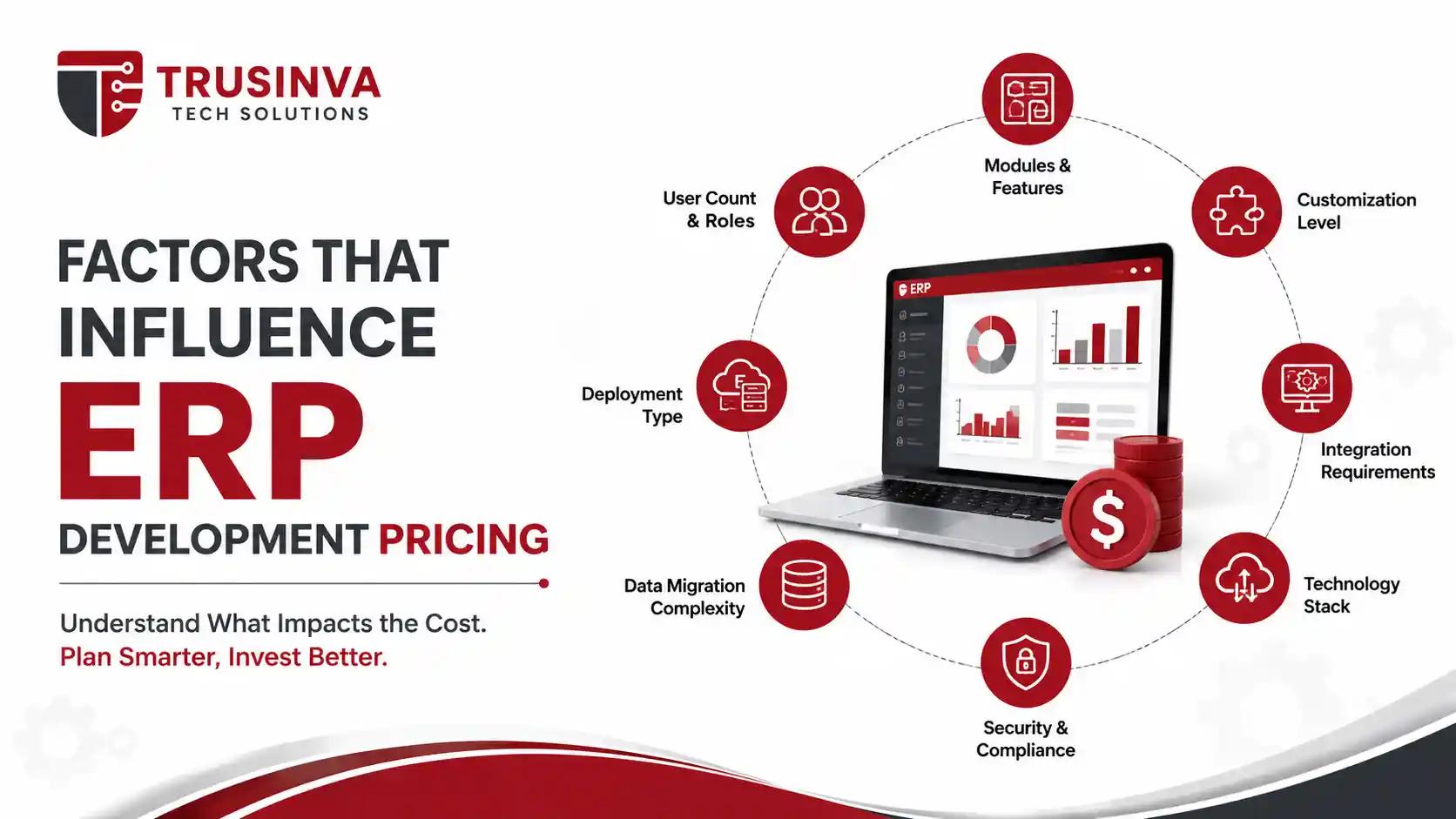
- Number of modules: Each additional module (payroll, warehouse management, procurement, business intelligence) adds development hours.
- Integration complexity: Connecting ERP with existing CRM, e-commerce, or accounting tools increases cost. Many businesses pair ERP with dedicated CRM development work for this reason.
- Team composition and rates: US-based development teams typically charge $80–$180/hour; offshore teams can be $25–$70/hour, though quality and communication vary.
- Data migration: Moving legacy data into a new system is often underestimated and can add 10–20% to the budget.
- Compliance requirements: Healthcare (HIPAA), finance (SOX), and payment-handling businesses (PCI DSS) require extra security work.
- Customization depth: Highly tailored workflows cost more than configuring standard modules.
- Scalability planning: Building for future growth (multi-currency, multi-company, multi-language support) adds cost now but saves money later.
Cost by Business Size
Startups & Small Businesses Usually best served by cloud ERP or lightweight custom builds ($10,000–$75,000). Focus on core modules — finance, inventory, basic reporting — and expand later. This mirrors advice we give startups evaluating affordable website design — start lean, scale with revenue.
Medium & Large Enterprises Custom ERP with deep integrations, typically $150,000–$500,000+. These businesses often need dedicated enterprise software development teams and ongoing IT consulting to manage complexity.
Industry-Specific Businesses Healthcare, manufacturing, logistics, and construction businesses need specialized modules and compliance features, pushing costs into the $100,000–$400,000 range depending on regulatory demands.
Hidden Costs Businesses Often Miss
- Employee training and onboarding (often 5–10% of total budget)
- Ongoing maintenance and support contracts
- Third-party API and integration fees
- Cloud hosting costs (AWS, Azure, Google Cloud)
- Change management and internal communication
- Post-launch bug fixes and upgrades
Panorama Consulting's implementation research consistently shows that businesses underestimate total cost of ownership by 15–25% when they don't account for these ongoing expenses upfront.
Custom ERP vs Off-the-Shelf ERP: Cost Comparison
| Factor | Custom ERP | Off-the-Shelf ERP |
| Upfront Cost | Higher | Lower |
| Long-Term Cost | Lower (no license fees) | Higher (ongoing subscriptions) |
| Customization | Full control | Limited to platform capabilities |
| Time to Deploy | 4–12 months | 1–3 months |
| Ownership | Full IP ownership | Vendor-dependent |
| Best For | Complex, unique workflows | Standard business processes |
How to Reduce ERP Development Cost
- Start with core modules and add features in phases (modular ERP approach)
- Choose cloud deployment to reduce upfront infrastructure spend
- Work with a development partner experienced in your industry to avoid costly rework
- Reuse existing integrations where possible instead of rebuilding from scratch
- Invest in proper planning and requirement-gathering before development starts — scope changes mid-project are one of the biggest cost drivers
- Consider AI-powered automation for reporting and workflows, which many businesses are now building alongside ERP through services like AI automation
ERP Development Timeline
| Business Size | Typical Timeline |
| Small Business | 6–12 weeks |
| Mid-Market | 3–6 months |
| Enterprise | 6–12 months |
Timelines directly affect cost — rushed implementations often lead to expensive post-launch fixes, while overly long timelines increase labor costs without added value.
Common Mistakes That Inflate ERP Costs
- Skipping proper requirement analysis before development starts
- Choosing the cheapest vendor without checking industry experience
- Underestimating data migration complexity
- Ignoring employee training, leading to poor adoption and wasted investment
- Adding features mid-project without adjusting budget or timeline
- Not planning for scalability, resulting in expensive rebuilds later
Why Choose Trusinva Tech Solutions
Choosing the right ERP development partner matters more than the platform itself. At Trusinva Tech Solutions, we help startups, growing enterprises, and industry-specific businesses plan and build ERP and enterprise software solutions that fit their actual workflows — not a generic template.
Here's what sets our approach apart:
- Transparent, phase-based pricing so there are no surprise costs mid-project
- Experience across web development, CRM development, and enterprise software solutions
- Support for industry-specific builds, including healthcare software solutions
- A full-service team covering everything from UI/UX design to backend architecture and post-launch support
- A track record of helping businesses modernize legacy systems without disrupting daily operations
You can explore our full range of services or browse past projects to see how we've approached similar builds.
FAQs
1. What is the average cost of ERP development in 2026? Most businesses spend between $75,000 and $250,000 for a mid-market custom ERP system, while small businesses using cloud ERP typically spend $10,000–$50,000 annually.
2. Is cloud ERP cheaper than custom ERP? Cloud ERP has a lower upfront cost but higher long-term expense due to recurring subscriptions. Custom ERP costs more initially but eliminates ongoing license fees.
3. How long does ERP development take? Timelines range from 6–12 weeks for small businesses to 6–12 months for enterprise-level implementations, depending on complexity.
4. What factors affect ERP implementation cost the most? Number of modules, integration complexity, data migration, compliance requirements, and development team rates are the biggest cost drivers.
5. Do ERP costs include training and support? Not always. Training, maintenance, and support are often billed separately and can add 15–25% to the total project cost if not planned for upfront.
6. Is it cheaper to build a custom ERP or buy an off-the-shelf license? It depends on your timeline and workflow complexity. Off-the-shelf is cheaper short-term; custom ERP is usually more cost-effective long-term for businesses with unique processes.
7. Can small businesses afford ERP systems? Yes. Cloud-based ERP solutions starting around $10,000–$50,000 make ERP accessible to small businesses without enterprise-level budgets.
Conclusion
ERP development cost isn't a fixed number — it's a range shaped by your business size, chosen modules, deployment type, and how well the project is planned from day one. Whether you're a startup looking for a lightweight cloud ERP or an enterprise needing a fully custom system, the key to controlling cost is working with a team that scopes the project properly before writing a single line of code.
If you're evaluating your options, the smartest next step is a proper consultation before committing to a platform or budget. At Trusinva Tech Solutions, we help businesses map out realistic ERP budgets and timelines based on their actual operations — not guesswork. Book a Seat with our team today to discuss your ERP project, or explore our services page to see how we can support your broader digital transformation goals. You can also check out our blog for more insights on software costs and technology planning, or learn more about our team.