Quick Answer
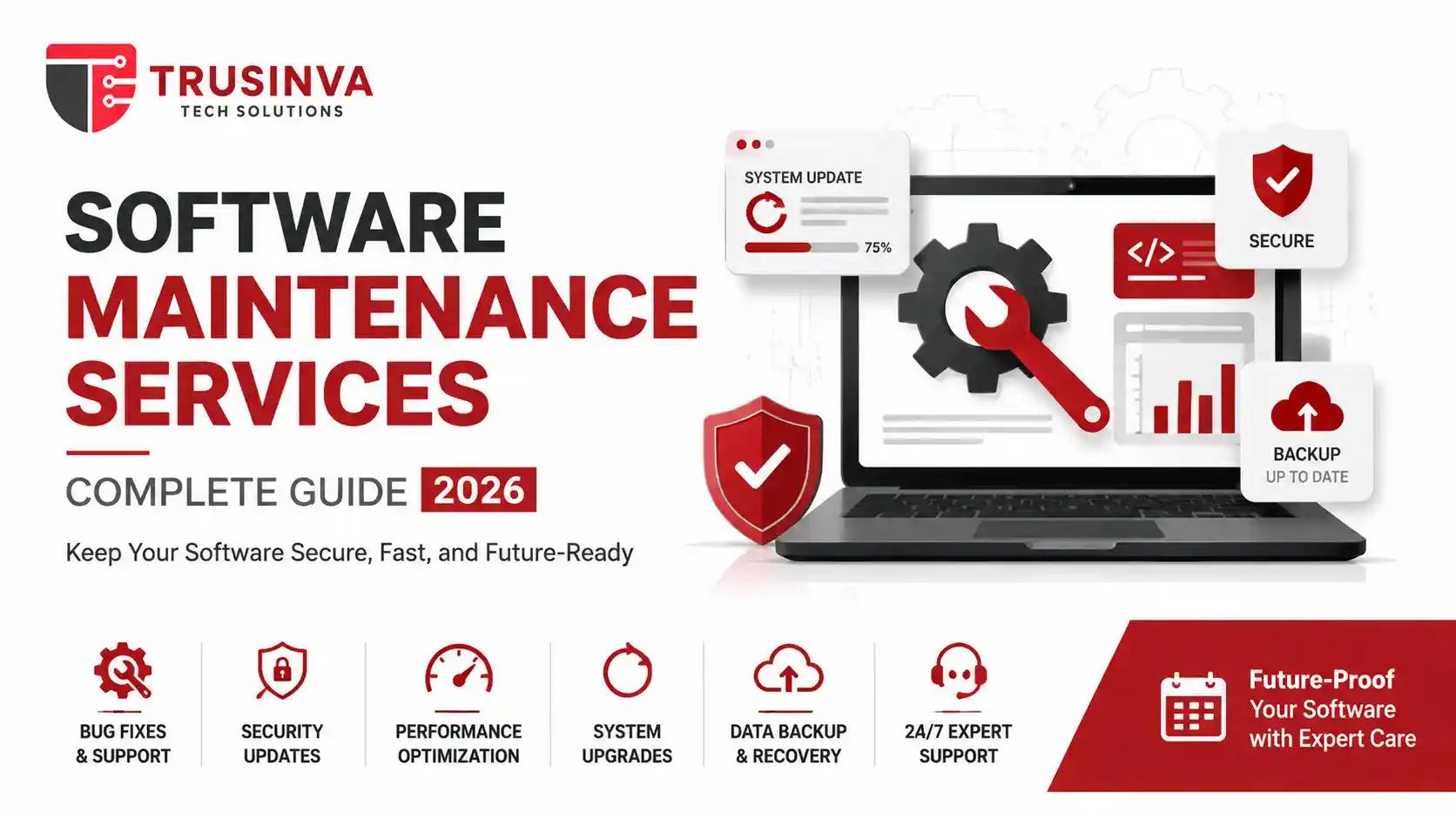
Software maintenance services cover the ongoing work needed to keep applications running securely and reliably after launch — including bug fixes, security patches, performance updates, and feature enhancements. There are four main types: corrective, adaptive, perfective, and preventive maintenance. Businesses use these services to reduce downtime, extend software lifespan, and avoid the rising cost of unmanaged technical debt.
Introduction
Launching software is only half the job — keeping it secure, fast, and bug-free for years afterward is where most of the real work happens. That's exactly what software maintenance services are built for, and it's a core part of what Trusinva Tech Solutions offers alongside its custom software development and CRM development work. Whether you're supporting a growing mobile app, an aging enterprise system, or a customer-facing WordPress site, the right maintenance plan prevents small issues from becoming expensive emergencies. This guide breaks down what software maintenance services actually include, what they cost, and how to choose the right provider in 2026.
Key Takeaways
- Software maintenance isn't optional — unmaintained applications accumulate technical debt and security risk fast.
- There are four core maintenance types: corrective, adaptive, perfective, and preventive.
- Outsourced maintenance is often more cost-effective than maintaining a full in-house team, especially for small and mid-sized businesses.
- SLAs (service-level agreements) define response times, uptime guarantees, and support scope — always review them carefully.
- ISO/IEC/IEEE 14764 is the international standard specifically governing software maintenance processes.
Table of Contents
- What Are Software Maintenance Services?
- Why Software Maintenance Matters
- The 4 Types of Software Maintenance
- What's Included in Software Maintenance Services
- In-House vs. Outsourced Maintenance
- How to Choose a Software Maintenance Provider
- Software Maintenance Cost
- Common Mistakes Businesses Make
- Best Practices for 2026
- Security & Compliance in Maintenance
- FAQs
- Conclusion
1. What Are Software Maintenance Services?
Software maintenance services are the ongoing activities that keep an application running correctly after it's been deployed — including fixing bugs, applying security patches, updating dependencies, and improving performance. They're a core part of the software development life cycle (SDLC), not a one-time afterthought.
The international standard ISO/IEC/IEEE 14764 formally defines software maintenance processes, while the broader ISO/IEC/IEEE 12207 standard covers the full software life cycle, including maintenance as an ongoing phase after deployment. Software maintenance is closely tied to concepts like technical debt, application modernization, and DevOps — all of which affect how much maintenance work is needed and how efficiently it gets done.
2. Why Software Maintenance Matters
Software maintenance matters because applications degrade without it — security vulnerabilities go unpatched, dependencies become outdated, and small bugs compound into major outages. Regular maintenance protects revenue, user trust, and long-term development speed.
Key reasons maintenance is critical:
- Security — unpatched software is a leading cause of data breaches
- Uptime — proactive maintenance reduces unplanned downtime
- Cost control — small fixes are cheaper than emergency repairs
- User retention — buggy or slow software drives users away
- Compliance — many industries require documented maintenance and patching processes
- Longevity — well-maintained software avoids premature legacy modernization projects
3. The 4 Types of Software Maintenance
Every software maintenance activity falls into one of four categories, a classification rooted in ISO/IEC/IEEE 14764.
Corrective Maintenance
Fixing bugs and defects discovered after deployment. This is reactive — something broke, and it needs to be fixed.
Adaptive Maintenance
Updating software to work with changes in its environment — a new OS version, an updated third-party API, or new browser requirements.
Perfective Maintenance
Enhancing existing features or performance based on user feedback, even when nothing is technically broken.
Preventive Maintenance
Proactively addressing potential future issues — refactoring fragile code, upgrading dependencies before they become unsupported, or improving test coverage.
Note: Most software maintenance contracts include a mix of all four types, with corrective and preventive maintenance typically prioritized first.
4. What's Included in Software Maintenance Services
| Service Area | Examples |
| Bug Fixing | Resolving defects, crash fixes, error handling |
| Security Updates | Patch management, vulnerability remediation |
| Performance Optimization | Database tuning, caching, load handling |
| Dependency Management | Updating libraries, frameworks, APIs |
| Monitoring & Alerting | Uptime monitoring, application performance monitoring |
| Feature Enhancements | Small improvements based on user feedback |
| Documentation | Keeping technical docs current with changes |
| Backup & Disaster Recovery | Ensuring data recoverability |
5. In-House vs. Outsourced Maintenance
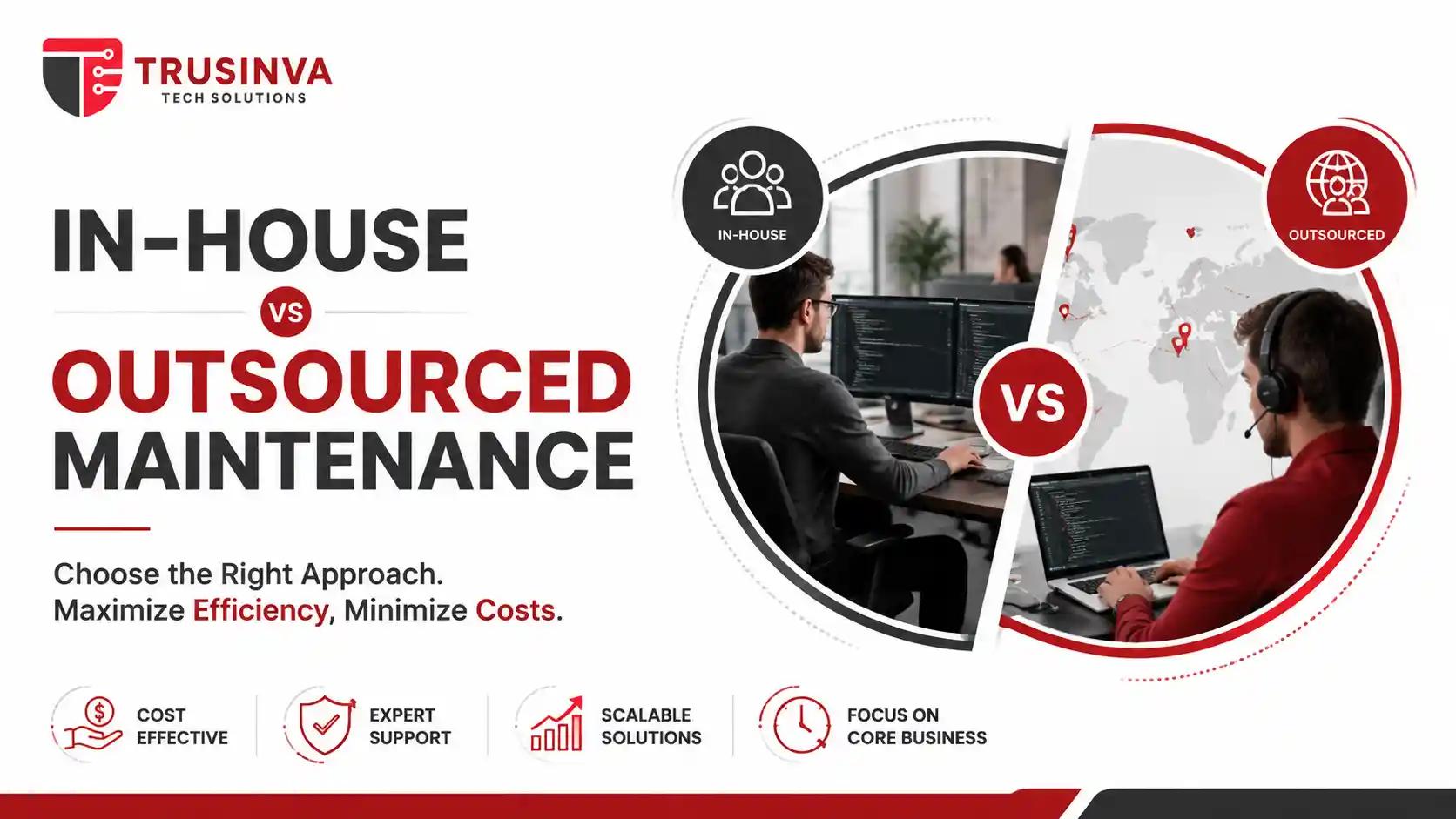
In-house maintenance:
- Pros: full control, deep institutional knowledge, immediate availability
- Cons: higher fixed cost, harder to scale up/down, requires ongoing hiring
Outsourced maintenance:
- Pros: cost-effective, access to broader expertise, easier to scale with need
- Cons: requires clear SLAs and communication processes to work well
Many growing businesses use a hybrid model — a small internal team handling day-to-day issues, with an outsourced partner like Trusinva Tech Solutions covering deeper technical work, security patching, or overflow capacity.
6. How to Choose a Software Maintenance Provider
- Check their SLA terms — response time, resolution time, and uptime guarantees should be clearly defined
- Ask about their tech stack expertise — make sure they know your specific frameworks (Java, .NET, React, etc.)
- Review their security practices — ask how they handle vulnerability management and patch management
- Look for 24/7 support options if your application is business-critical
- Ask for references from clients with similar application types
7. Software Maintenance Cost
Software maintenance costs vary based on application complexity, support hours needed (business hours vs. 24/7), and the scope of services included. Many providers offer tiered pricing — basic bug-fix retainers cost less than comprehensive plans covering security, performance, and feature enhancements.
A common industry rule of thumb, echoed in analysis from firms like Gartner and Deloitte Insights, is that annual maintenance can represent a significant ongoing percentage of the original development cost — which is why choosing an efficient maintenance partner matters as much as the initial build.
8. Common Mistakes Businesses Make
- Treating maintenance as optional until something breaks
- No documented SLA, leading to unclear expectations on response times
- Ignoring dependency updates until a library becomes unsupported
- Skipping monitoring tools, so issues aren't caught until users report them
- Choosing the cheapest provider without checking security practices
9. Best Practices for 2026
- Set up proactive application performance monitoring (tools like Datadog, New Relic, or Grafana)
- Automate dependency and vulnerability scanning
- Maintain a documented maintenance backlog, not just ad-hoc fixes
- Review SLAs annually as application usage grows
- Pair regular maintenance with periodic architecture reviews to catch technical debt early
10. Security & Compliance in Maintenance
Ongoing maintenance is where most security exposure gets managed — or missed. Following frameworks like the OWASP Application Security Verification Standard, the NIST Cybersecurity Framework, and CVE/CVSS vulnerability scoring helps maintenance teams prioritize what to patch first.
For regulated industries — healthcare, finance, logistics — maintenance documentation is often required for audits, making a structured maintenance process a compliance necessity, not just a technical nice-to-have.
FAQs
1. What is included in software maintenance services? Bug fixes, security patches, performance optimization, dependency updates, monitoring, and minor feature enhancements.
2. What are the 4 types of software maintenance? Corrective, adaptive, perfective, and preventive maintenance.
3. How much does software maintenance cost? It varies by application complexity and support scope, but many providers offer tiered plans based on required response times and included services.
4. Is software maintenance the same as software support? They overlap but aren't identical — support typically focuses on user issues and troubleshooting, while maintenance includes deeper code-level fixes and updates.
5. Should I outsource software maintenance? For most small and mid-sized businesses, outsourcing is more cost-effective than building a full in-house maintenance team.
6. What's a software maintenance SLA? A service-level agreement defining response times, resolution times, and support scope between a business and its maintenance provider.
7. How often should software be updated? Security patches should be applied as soon as they're available; other updates typically follow a regular monthly or quarterly cadence.
8. What happens if software isn't maintained? Unmaintained software accumulates technical debt, security vulnerabilities, and performance issues, often requiring costly legacy modernization later.
Conclusion
Software maintenance services aren't the glamorous part of a software project, but they're what keeps everything running smoothly long after launch day. Choosing the right maintenance approach — whether in-house, outsourced, or hybrid — directly affects your application's security, uptime, and long-term cost.
If you're evaluating software maintenance options for your business, Trusinva Tech Solutions offers ongoing support alongside its custom software development, CRM development, and mobile app development services. Explore our full services page, see examples of our work in past projects, or read related guides like how to choose the right web development company and top web development services in the USA. If your team also needs specialized training support, browse Trusinva's courses, including USA taxation and medical billing. Ready to keep your software secure and running smoothly? Contact Trusinva Tech Solutions and Book a Seat for a free maintenance consultation today.