
Quick Answer
To negotiate freight rates as a truck dispatcher, calculate the carrier's minimum acceptable rate first, benchmark the lane against current market data, open with a confident anchor above your target, justify it with capacity and service evidence, negotiate accessorials separately, and be willing to decline. Preparation decides the outcome — the conversation only confirms what your research already established.
Key Takeaways
- Negotiation is 80% preparation. The dispatcher who knows the lane average, the load-to-truck ratio, and the carrier's cost per mile wins before the phone rings.
- Never ask "what does it pay?" Whoever names a number first sets the anchor. Make it you.
- Accessorials are separate money. The industry baseline is two hours of free time, with detention pay starting on the third hour and rates ranging from $25 per hour on the soft end to $100 per hour on the firm end.
- 2026 is a leverage market. Spot linehaul rates rose at least 39% year over year across all three equipment types in June 2026 while volumes stayed flat to lower.
- Small wins compound massively. A dispatcher who consistently negotiates $0.10 per mile above average adds $100 to a 1,000-mile load — and that compounds across hundreds of loads per year.
- Relationships beat transactions. Private broker relationships consistently produce rates 5–15% above load board prices.
Introduction
Rate negotiation is the single skill that separates a dispatcher who books loads from a dispatcher who builds carrier income — and it is the skill Trusinva Tech Solutions puts at the centre of its dispatch training. Anyone can find a load. Turning a $2.55 posting into a $2.95 booking, collecting detention that most carriers write off, and getting first call on premium freight before it hits the board — that is professional work with measurable dollar value. If you are entering the field, our truck dispatching course teaches this on live boards with real rate data, while our guide on how to start a truck dispatching business in the USA covers setup and client acquisition, our truck dispatcher salary breakdown for 2026 shows what the skill pays, and our overview of owner-operator dispatch services explains the value carriers are actually buying.
This guide is written from the desk, not the classroom. Every script, threshold, and objection response below is something working dispatchers use in real broker calls under 2026 market conditions.
What Is Freight Rate Negotiation and Why Does It Decide Dispatcher Success?
Freight rate negotiation is the process of agreeing a price for moving a specific load between a freight broker or shipper and a motor carrier, usually represented by a truck dispatcher. It determines the carrier's revenue per mile, the dispatcher's commission, and whether the load is profitable after fuel, deadhead, and fixed costs.
Every load has three prices: what the broker hopes to pay, what the broker is authorised to pay, and what the market says the lane is worth. Amateur dispatchers accept the first. Professionals negotiate toward the third.
Why it matters more than load-finding
Finding loads is a search problem — solvable with filters and alerts. Negotiating is a judgement problem, and judgement is what carriers pay for. If a dispatcher books a carrier at $2.90 per mile on lanes where the carrier would self-dispatch at $2.65, the $0.25 improvement on a 1,000-mile load is $250, which far exceeds a 7% dispatch fee of roughly $203. That single comparison is the entire business case for the profession.
Who Actually Negotiates: Dispatcher, Carrier, or Broker?
The dispatcher negotiates on the carrier's behalf, within limits the carrier has authorised. The broker negotiates on behalf of the shipper while protecting their own margin. A dispatcher is an agent of the carrier — never of the broker — and that distinction matters legally, ethically, and commercially.
The three parties and their incentives
| Party | Primary goal | Hidden constraint |
| Shipper | Move freight reliably at budgeted cost | Service failures cost more than rate |
| Freight broker | Cover the load while protecting margin | Has a maximum authorised rate they will not reveal |
| Motor carrier / dispatcher | Maximise net revenue per working day | Fixed costs run whether the truck moves or not |
The broker's margin is the negotiating space. On a load where the shipper pays $3,400, a broker with a 15% target margin can pay up to roughly $2,890 — and will open somewhere near $2,500. Your job is to move toward their ceiling with evidence.
Important note: A dispatcher who negotiates rates, books loads, and handles paperwork on behalf of a carrier is providing a service to that carrier. Dispatchers do not need broker authority to perform this role, but they must not represent themselves as brokering freight to third parties. Understand the boundary clearly — our guide on how truck dispatching services save US carriers money covers the service model in detail.
The 2026 Freight Market: Why Dispatchers Have Real Leverage Now
2026 has been a supply-constrained freight market. Truck capacity contracted faster than demand fell, pushing spot rates to multi-year highs and giving carriers genuine negotiating power for the first time since 2021. Dispatchers who understand this shift are asking for — and getting — rates their peers assume are impossible.
What the data shows
- In June 2026, the national average van truckload spot rate exceeded the contract rate for the first time since February 2022, with spot van at $3.00 per mile, spot reefer at $3.39, and spot flatbed at $3.69 — an all-time high.
- ACT Research describes the current rate cycle as primarily supply-driven, with aggregate spot rates excluding fuel running 43% higher year over year in June 2026 as driver availability stays acutely tight.
- DAT iQ analysts noted that spring 2026 equipment availability was running 44% below the long-term average since 2017, excluding pandemic-era distortions.
- Tender rejection rates in some segments reached 18% in the Midwest and above 20% for reefer, meaning shippers with urgent freight will pay a premium — but only if someone is positioned to ask for it.
The practical translation
When spot exceeds contract, brokers are covering shortfalls at premium prices. When rejection rates climb, contracted carriers are refusing freight and it spills into the spot market. Both conditions mean the same thing for a dispatcher: the broker needs you more than you need that specific load.
Negotiate accordingly. In a tight market, a dispatcher who never loses a negotiation is a dispatcher who is asking for too little.
Before You Call: The Five-Minute Preparation Routine
Direct answer: Complete five checks before dialling — the carrier's minimum acceptable rate, the lane's current market average and high end, the load-to-truck ratio, the broker's credit and days-to-pay, and the reload options at destination. Skipping preparation is why most dispatchers accept the first offer.
The pre-call checklist
- Minimum acceptable rate calculated for this specific trip, including deadhead
- Lane benchmark pulled: 7-day, 15-day, 30-day averages plus the high end of the range
- Load-to-truck ratio checked for the origin market and equipment type
- Posting age noted — fresh posting or aged and re-posted?
- Broker credit score and days-to-pay verified
- Destination outbound volume checked for reload viability
- Carrier's HOS clock confirmed so you do not book an illegal transit
- Your target rate and walk-away rate written down before the call
That last item is non-negotiable. Write both numbers on paper. A dispatcher who has not pre-committed to a floor will drift toward the broker's number under conversational pressure. Every time.
How to Calculate a Minimum Acceptable Rate
Minimum acceptable rate equals the carrier's operating cost per total mile, multiplied by loaded plus deadhead miles, plus a required profit margin, plus any trip-specific costs like tolls or permits. Never quote a rate you have not calculated. Most single-truck operations in 2026 break even between $1.95 and $2.45 per total mile.

The formula
Minimum Acceptable Rate =
(Cost Per Mile × Total Miles)
+ Tolls, permits, scales
+ Required profit margin (25–35%)
+ Estimated deadhead cost to next likely reload
Worked example
| Input | Value |
| Carrier cost per mile | $2.05 |
| Loaded miles | 780 |
| Deadhead to pickup | 95 |
| Total miles | 875 |
| Base cost | $1,794 |
| Tolls and scales | $85 |
| Required margin (30%) | $564 |
| Minimum acceptable rate | $2,443 ($3.13 per loaded mile) |
Now you know that a $2,300 offer is a loss disguised as a decent-sounding number, and that $2,600 is a genuinely good load. That clarity is what makes a confident negotiator.
Summary box: Rate per loaded mile is what brokers discuss. Rate per total mile is what the carrier actually earns. Always convert before you commit.
The tax treatment of these costs — depreciation, per diem, deductible expenses — affects the carrier's real net. Our USA taxation guide for independent operators and the structured USA taxation course cover this properly.
Step-by-Step: How to Negotiate Freight Rates as a Truck Dispatcher
The professional sequence is: prepare, open with a data-backed anchor above target, present service evidence, handle the counteroffer with a small concession, negotiate accessorials, close with a clear commitment, confirm in writing, and log the result. Eight steps, roughly six minutes per call once practised.
Step 1 — Open by naming your rate, not asking theirs
Introduce yourself, name the load, state your availability, then state your number. Availability is value; lead with it.
Step 2 — Anchor above your target
If your target is $2,600, open at $2,850. Brokers expect movement. A dispatcher who opens at their true target has nowhere to go and ends up below it.
Step 3 — Justify immediately with market data
State the lane average and the range top in the same breath as your number. Unjustified numbers sound like greed; justified numbers sound like professionalism.
Step 4 — Sell service, not need
On-time percentage, tracking compliance, clean CSA score, experience on the lane, driver already 20 minutes from the shipper. Brokers pay premiums for certainty because service failures cost them customers.
Step 5 — Let silence do work
After you state your rate, stop talking. The pause is uncomfortable by design. Most brokers fill it by moving toward you.
Step 6 — Concede small and slow
Move in decreasing increments: $2,850 → $2,720 → $2,660. Decreasing steps signal you are approaching a real floor. Equal-sized steps signal there is more room.
Step 7 — Negotiate accessorials before agreeing linehaul
Once linehaul is agreed, accessorials feel like a re-negotiation. Fold them in while the deal is still open.
Step 8 — Confirm, document, and log
Get the rate confirmation in writing with detention terms, free time, layover, and TONU spelled out. Then record the booked rate against the market benchmark in your own system. After 100 loads, that log is more valuable than any subscription.
Price Anchoring and Counteroffer Strategy
Anchoring means naming the first number so the negotiation range forms around your figure rather than the broker's. Research on negotiation consistently shows first offers pull final outcomes toward them. In freight, the dispatcher who speaks first with a justified number typically closes 8–15% higher than one who responds to the broker's opening.
The anchoring rules
- Anchor high but defensible. 10–15% above target is credible. 40% above is a conversation-ender.
- Attach a reason to every number. "$2,850 because the seven-day average is $2,710 and the top of the range is $2,900" beats "$2,850" alone.
- Anchor on total value, not just linehaul. "$2,850 all-in with two hours free time and detention at $75/hour after."
- Never anchor from a position of visible desperation. If your carrier has been sitting three days, that is information the broker does not need.
Counteroffer decision matrix
| Broker's counter vs your target | Your move |
| Within 3% | Accept and build goodwill |
| 4–10% below | One firm counter at midpoint, then close |
| 11–20% below | Counter once with data, prepare to walk |
| Over 20% below | Decline politely, leave the door open |
| Below your minimum acceptable rate | Decline immediately, no counter |
That last row matters. Countering below your floor teaches the broker your floor is negotiable.
Word-for-Word Negotiation Scripts
Effective freight negotiation language is brief, specific, and non-apologetic. The four situations every dispatcher needs scripted are the opening anchor, the lowball response, the aged-posting urgency close, and the relationship ask.
Script 1 — Opening anchor
"Hi, this is [Name] with [Carrier], calling on your Atlanta to Charlotte van load picking up tomorrow morning. I've got a truck 18 miles from the shipper with a clean HOS clock and I can be there at 0700. The seven-day average on this lane is $2.94 with the range topping near $3.20. I can commit right now at $3.15 all-in."
Script 2 — Responding to a lowball
"I appreciate the offer, but $2.40 is well under where this lane has been trading. My carrier's operating cost puts the floor at $2.80. If you can get to $3.00 I'll send the packet in the next five minutes and you can close this out."
Script 3 — Aged posting urgency close
"I noticed this one has been posted since yesterday afternoon. I have a truck available today and I'm holding one other option. At $3.10 I'll take it off your board right now."
Script 4 — Building repeat freight
"This is our fifth load with you this quarter — all on time, no service issues, tracking every time. I'd like to be your first call on this lane. If you can send us consistent volume, I'll hold a rate for you rather than making you shop it every week."
Script 5 — The professional walk-away
"I understand you have a budget on this one. We're not going to get there today, but keep my number — if it doesn't cover by this afternoon, call me back and let's see where we are."
That last script is quietly the most powerful. It preserves the relationship while making clear your rate is not decorative. Brokers call back more often than new dispatchers expect.
Language to eliminate permanently
| Never say | Say instead |
| "What are you paying on this?" | "I can do this at $X." |
| "Whatever you can do is fine." | "My floor on this lane is $X." |
| "We really need this load." | "I have availability today." |
| "Is that your best?" | "I need $X to make this work." |
| "Sorry to ask, but..." | (nothing — just state the number) |
Negotiating Accessorials: Detention, Layover, TONU, and Extras
Accessorial charges compensate the carrier for time and work outside the basic haul. They must be negotiated before booking and documented in the rate confirmation. Detention, layover, TONU, driver assist, reconsignment, and stop-off pay are all standard, and dispatchers who ignore them leave thousands per truck per year uncollected.
2026 accessorial benchmarks
| Accessorial | Typical 2026 terms | Negotiation note |
| Detention | Two hours free time, detention starting hour three, $25–$100 per hour | Owner-operator ranges commonly run $50–$100/hour; specialised or hazmat $75–$150 |
| Layover | $150–$350 per 24 hours | Push for automatic trigger, not discretionary |
| TONU | $150–$500 | Must be in writing before dispatch |
| Driver assist / fork time | $50–$150 | Never included by default — ask |
| Stop-off | $50–$100 per extra stop | Multi-stop loads need this or they lose money |
| Reconsignment | $100–$300 plus mileage | Common on produce and retail freight |
Why most detention goes uncollected
Fewer than half of detention invoices get paid, and the reason is straightforward: carriers do not document the time. The fix is procedural, not conversational.
The documentation protocol:
- Driver records arrival time with GPS timestamp or gate photo.
- Dispatcher notifies the broker in writing — load board message or email, not just a phone call — as soon as free time expires, creating a real-time paper trail.
- Departure time recorded the same way.
- Signed BOL retained to establish the full arrival-to-departure timeline.
- Detention invoiced within the same week, not bundled into a month-end batch.
Warning for dispatchers charging commission: Many carrier-dispatcher agreements now explicitly exclude accessorials from the commission base. Detention pay is compensation for lost time rather than driving revenue, and carriers increasingly push to exclude it from percentage calculations — the same applies to fuel surcharges, which are reimbursement rather than earnings. Be transparent about this upfront; it builds trust faster than any pitch.
Reading Leverage: Load-to-Truck Ratio, Aged Postings, and Urgency
Leverage is measurable. Check the load-to-truck ratio for the market and equipment type, the age of the posting, the tightness of the pickup window, and whether the lane is currently trading above its 30-day average. Two or more favourable signals mean you should be asking well above the posted rate.
The leverage signals
| Signal | Reading | Your posture |
| High load-to-truck ratio | Reefer ratios around 14.9 in March 2026 indicated far more loads than posted trucks | Ask aggressively |
| Aged posting (4+ hours) | Broker is struggling to cover | Urgency premium available |
| Same-day or next-morning pickup | Coverage failure or hot freight | 20–40% above market is realistic |
| Spot above contract on the lane | Market is repricing upward | Anchor at range top |
| Weekend or holiday pickup | Thin competing capacity | Premium justified |
| Low ratio, freshly posted, flexible dates | Broker has options | Be reasonable or move on |
Ratios move constantly. In early April 2026, for example, the national dry van load-to-truck ratio sat at 9.0 while the national average flatbed rate jumped 11 cents in a single week to $2.55 a mile. A dispatcher who checks this daily negotiates with the market; one who does not negotiates with a guess.
Equipment type changes leverage too — flatbed and step deck typically carry thinner capacity and higher ceilings, as covered in our flatbed carrier dispatching guide.
Handling the Six Most Common Broker Objections
Broker objections are predictable, which makes them scriptable. The six you will hear weekly are budget limits, cheaper carriers, market softness, new-carrier scepticism, rate-confirmation delays, and take-it-or-leave-it pressure. Each has a professional response that keeps the deal alive without conceding your floor.
Objection 1 — "That's above my budget."
"I understand. What is your maximum on this one? If we're within $100 I'll find a way. If we're further apart than that, I'd rather not waste your time."
Why it works: invites disclosure without conceding, and sets a closing condition.
Objection 2 — "I can get this covered for $2.40."
"You might. But that carrier may not be 18 miles from the shipper with an available driver right now. I'm quoting for a truck that will actually be there at 0700."
Why it works: reframes from price to certainty of coverage.
Objection 3 — "The market is soft right now."
"On this lane the seven-day average is actually up 9 cents from the thirty-day. I'm quoting to current conditions, not last month's."
Why it works: data beats assertion, every time.
Objection 4 — "You're a new carrier, we don't pay premium for new authority."
"Fair. Give us this one at market and check our performance. If we're on time with clean tracking, I'll be back for a rate conversation on the next one."
Why it works: trades a short-term concession for a long-term position.
Objection 5 — "I'll send the rate con later."
"I need it before dispatch — that's carrier policy, not a preference. Send it now and the truck rolls."
Why it works: protects against rate reductions after commitment, which is a real and common problem.
Objection 6 — "This is my final offer, take it or leave it."
"Then I'll pass on this one, but thanks for the straight answer. Keep me in mind — I'll have capacity in this market again Thursday."
Why it works: the only response to an ultimatum that preserves both your floor and the relationship.
Building Broker Relationships That Pay Above Market
Rate negotiation is a transaction; broker relationships are an asset. Dispatchers who build a network of trusted brokers get called before loads are posted publicly, and pre-post freight is consistently the highest-margin freight available. This is the transition from booking loads to being offered them.
Private broker relationships consistently produce rates 5–15% above load board prices — a spread no amount of clever negotiation on public postings can match.
How to build the network
- Keep a broker CRM. Name, direct line, lanes, average rate paid, days-to-pay, quirks, and history. After 90 days you will know exactly who to call first. Spreadsheets work initially; growing desks outgrow them — see our overview of CRM features that matter, our CRM development services, and CRM solutions for US sales teams in 2026.
- Deliver flawlessly on the first three loads. Reputation is built on consistency, not on the first great negotiation.
- Communicate proactively. A delay reported early is a manageable problem. A delay discovered by the broker is a service failure.
- Never no-show. One abandoned load ends a relationship permanently and travels through the broker community faster than you would believe.
- Ask for the lane, not the load. "Send me your Atlanta–Charlotte freight" is a bigger ask and a better business.
- Follow up after quiet periods. A short check-in every three weeks keeps you in the mental rotation.
Expert observation: The dispatchers earning the most in 2026 spend roughly 30% of their time on relationship maintenance and 70% on execution. New dispatchers invert that ratio and wonder why every load is a fight.
Dispatcher Earnings: Salary, Commission, and What Negotiation Skill Is Worth
Truck dispatchers earn either a salary as employees or a percentage of gross load revenue as independents. The 2026 independent fee range runs roughly 3% to 10%, with most full-service dispatchers landing between 4% and 7%. Negotiation skill directly determines income in both models.
Compensation benchmarks
| Model | Typical 2026 range | Notes |
| Employee dispatcher (median) | Around $52,060 per year per BLS national median | Entry-level $34,000–$45,000; experienced $55,000–$75,000; senior managers $75,000–$97,000+ |
| Independent, percentage | 5%–10%, with 7% most common for owner-operators | Aligns dispatcher and carrier incentives |
| Independent, flat per load | $50–$150 per booked load | Predictable, but no scaling upside |
| Independent, flat weekly | Commonly $250–$500 per truck per week | Cost certainty for the carrier, risk shifts to dispatcher |
What negotiation skill is actually worth
Every $0.10 per mile improvement on a 1,000-mile load adds $100 to the gross, which at 7% commission is $7 more per load — compounding across hundreds of loads per year. Ten loads a week at that improvement is roughly $52,000 in additional annual carrier revenue from one dispatcher, one skill.
Pricing guidance for independents is to price to service depth rather than fear: if your service includes broker credit checks, negotiated floors based on the carrier's cost per mile, documented accessorial recovery, and clean same-week invoicing, 5% to 7% is your lane.
For a fuller career picture, see our truck dispatcher salary guide for the USA in 2026 and the 2026 guide to starting a dispatching business.
Tools and Technology That Support Better Negotiation
A negotiating dispatcher needs four tool categories: a load board with rate analytics, a TMS for documents and load history, a CRM for broker relationships, and a rate-history log of your own booked loads. Rate data is the negotiation input; everything else protects the money you win.
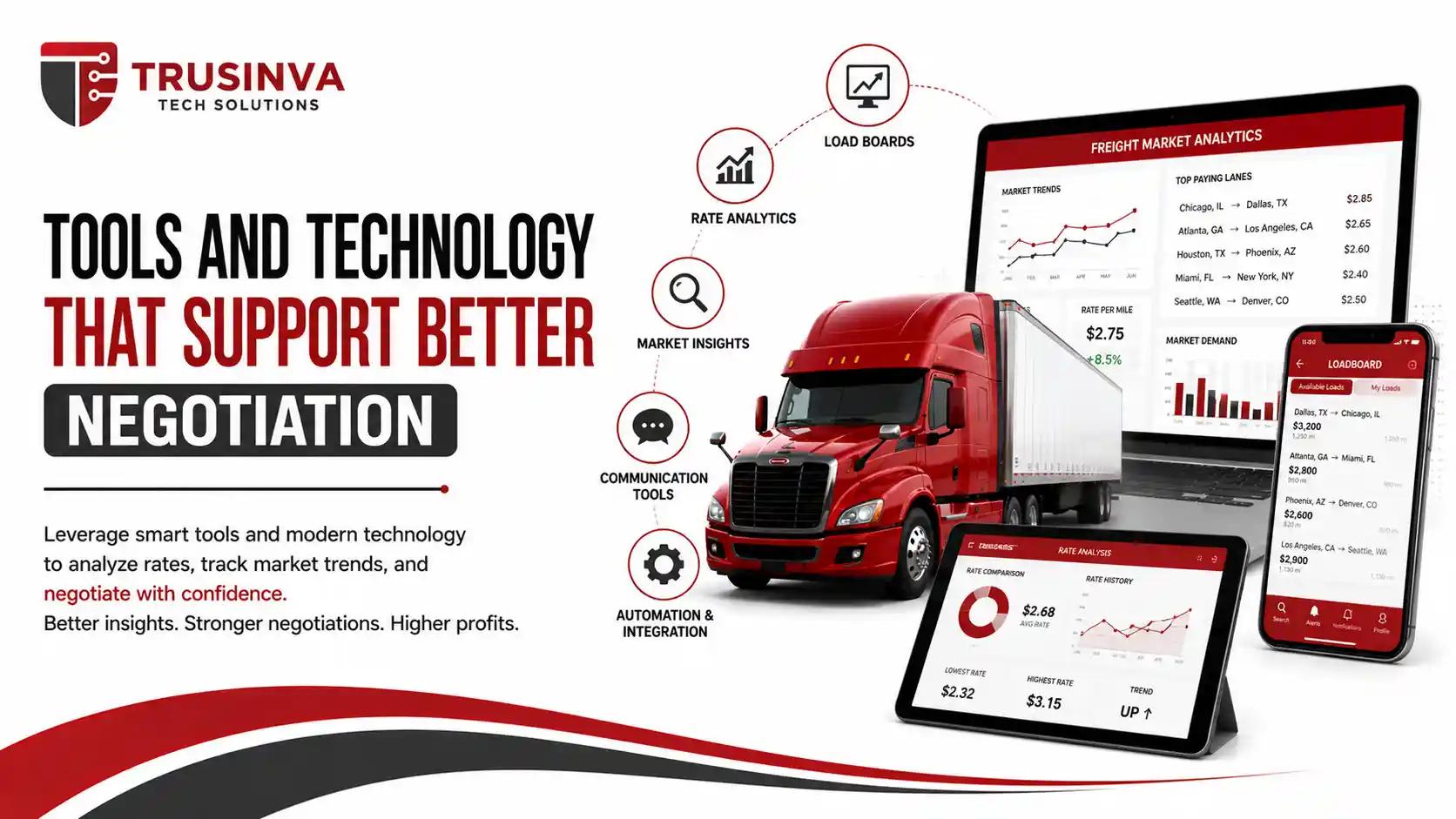
The negotiation tech stack
| Tool | Negotiation function |
| Load board rate analytics | Supplies the market benchmark you quote |
| TMS / dispatch software | Stores rate cons, BOLs, PODs, detention timestamps |
| Broker CRM | Tracks who pays what, and who to call first |
| ELD / telematics | Confirms HOS feasibility before you commit |
| Your own rate log | Your proprietary benchmark — the most underrated asset in dispatch |
That last row deserves emphasis. Public rate data tells you what the market pays. Your own log tells you what this broker pays your carrier on this lane. After 100 loads, your log outperforms any subscription for the lanes you actually run.
AI-assisted rate prediction and lane matching moved from novelty to practical tooling over the last two years. If you are evaluating automation for a growing desk, our guides on AI automation services in the USA, AI for small businesses, and custom software development cover realistic use cases and costs for logistics operators.
Common Mistakes That Kill Rates
The five most costly negotiation mistakes are asking the broker's rate first, negotiating without a calculated floor, ignoring accessorials, conceding in large steps, and never being willing to walk away. Each is a habit, and each is fixable within a week.
The full list
- Asking "what does it pay?" You surrendered the anchor before the conversation started.
- Negotiating without a minimum acceptable rate. You will drift toward the broker's number under pressure.
- Quoting loaded-mile rates while ignoring deadhead. The carrier finds out at settlement.
- Skipping accessorial terms. Uncollected detention is the quietest profit leak in the industry.
- Conceding in large, equal steps. It advertises that more room exists.
- Apologising while negotiating. "Sorry, but could we maybe..." invites a lower counter.
- Accepting verbal agreements. Get the rate confirmation before dispatch, always.
- Winning every negotiation. A 100% close rate means your asks are too low.
- Treating brokers as adversaries. They are repeat counterparties, not opponents.
- Never logging outcomes. You cannot improve a process you do not measure.
- Booking loads the HOS clock cannot legally support. A service failure costs more than the rate gained.
- Chasing rate while ignoring days-to-pay. A premium rate at 60 days can break a single-truck carrier's cash flow.
Expert Tips and Advanced Tactics
Advanced dispatchers negotiate trips rather than loads, lock short-term commitments when the market peaks, price service certainty explicitly, and use lane specialisation to build pricing power. These tactics separate a $52,000 dispatcher from a six-figure dispatch business.
Tactic 1 — Negotiate the round trip, not the leg
Quote the outbound with the reload economics already priced in. If the destination market is thin, that outbound needs to carry the empty return. Say so: "This lane runs into a soft outbound market, so I need $3.20 to make the round trip work."
Tactic 2 — Lock short-term commitments at market peaks
Skilled dispatchers in 2026 have been locking short-term mini-contracts at elevated rates before the market corrects, and timing the spot-to-contract transition deliberately. When spot sits above contract, that is a signal to convert some volume into committed freight.
Tactic 3 — Specialise in four to six lanes
Lane specialisation compounds. You learn the seasonal rhythm, the reliable brokers, the slow receivers, and the true rate ceiling. Generalists negotiate from data. Specialists negotiate from memory, and it shows.
Tactic 4 — Price certainty as a product
Brokers do not only buy trucks; they buy the absence of a 4pm coverage panic. Quantify it: on-time percentage, tracking compliance rate, zero-no-show record. Numbers are more persuasive than adjectives.
Tactic 5 — Use the second-option frame honestly
"I'm holding one other option" is powerful — and only usable if it is true. Dispatchers who bluff get caught, and reputation in a broker network travels fast.
Tactic 6 — Review your win rate monthly
Track: loads quoted, loads booked, average booked rate versus lane average. If your booked rate averages below market, your asks are too soft. If your close rate is under 25%, they are too high. The target zone is roughly 35–55% close rate at 5–12% above lane average.
Latest Updates, Trends, and Regulations (2026)
Three 2026 developments reshape dispatcher negotiations: capacity contraction from FMCSA enforcement, spot rates crossing above contract rates, and stricter broker financial responsibility rules. All three favour prepared, compliant, well-documented carriers.
Regulatory changes shrinking capacity
On February 13, 2026, FMCSA published a final rule titled "Restoring Integrity to the Issuance of Non-Domiciled Commercial Drivers Licenses," effective March 16, 2026, narrowing eligibility to H-2A, H-2B, and E-2 visa holders and requiring states to verify status and audit existing licences. In parallel, English Language Proficiency is now enforced at roadside inspections as an out-of-service condition, with federal officials reporting more than 14,000 drivers placed out of service for ELP violations.Analysis cited by J.B. Hunt estimates these enforcement measures could remove between 5% and 12% of CDL holders — roughly 214,000 to 437,000 drivers — from U.S. supply over the next two to three years.
What this means at the negotiating table
- Fewer trucks means firmer rates. Capacity exiting the market is leverage arriving at your desk.
- CSA scores are now commercial currency. Brokers screen on them before rate is discussed. A clean score is a negotiating asset — mention it.
- Compliance is a revenue strategy. An out-of-service truck earns nothing regardless of how well you negotiated.
- Stricter broker bonding rules reduce non-payment risk but do not eliminate it. Keep vetting credit and days-to-pay.
- Fuel is your problem on spot freight. Average fuel surcharges in July 2026 ran roughly 62 cents per mile for van, 67 cents for reefer, and 74 cents for flatbed — spot rates are all-in, so price fuel consciously into every quote.
Trend to watch
Rate volatility is increasing, which raises the value of dispatchers who monitor markets daily rather than weekly. In a stable market, last month's benchmark is fine. In 2026, it is a losing quote.
Pros and Cons of Aggressive Rate Negotiation
| Pros | Cons |
| Directly increases carrier revenue per mile | Longer time to book each load |
| Raises dispatcher commission income | Some brokers stop calling if you are always high |
| Builds a reputation as a professional desk | Risk of empty truck days if the floor is set too high |
| Improves carrier retention and referrals | Requires daily market monitoring |
| Creates negotiating data you own | Can strain relationships if handled without tact |
People Also Ask
How do you negotiate a freight rate with a broker? Prepare a minimum acceptable rate, open with an anchor 10–15% above your target backed by lane data, sell your availability and service record, concede in decreasing increments, negotiate accessorials before agreeing linehaul, and confirm everything in writing before dispatch.
What is a good rate per mile for a truck dispatcher to target in 2026? It depends on equipment and the carrier's cost structure. June 2026 national spot averages ran $3.00 per mile for van, $3.39 for reefer, and $3.69 for flatbed. Target the carrier's break-even plus at least 30%.
Can a truck dispatcher negotiate rates without broker authority? Yes. A dispatcher acting as an agent of a specific motor carrier can negotiate and book freight on that carrier's behalf. Brokering freight to third parties is a separate activity requiring broker authority.
How much do truck dispatchers charge? Typically 5% to 10% of gross revenue, with 7% most common for owner-operators, or $50–$150 per load on flat-fee models. Most full-service independents land between 4% and 7%.
What is detention pay and how much should I ask for? Detention compensates the carrier for excessive waiting at a shipper or receiver. Standard terms are two hours free time with detention starting hour three, at $25–$100 per hour depending on equipment and contract.
Should a dispatcher take commission on detention and fuel surcharge? Most carriers say no, and increasingly it is written into agreements. Fuel surcharge is reimbursement rather than earnings, and detention compensates lost time rather than driving revenue. Excluding both builds trust.
How long does a typical rate negotiation take? Two to six minutes on the phone once preparation is done. The preparation itself takes about five minutes. Negotiations that drag past ten minutes usually mean the gap is structural, not conversational.
How do I know when to walk away from a load? Walk when the offer falls below your calculated minimum acceptable rate, when the broker's credit or days-to-pay is unacceptable, when the destination has no viable reload and the rate does not cover the empty return, or when the HOS clock cannot legally support the transit.
Frequently Asked Questions
1. Do I need training to become a truck dispatcher? No licence is legally required, but structured training compresses the learning curve dramatically. Rate negotiation, load board mastery, HOS rules, and compliance are far faster to learn with a curriculum than by trial and error — see our truck dispatching course in the USA.
2. What is the single fastest way to improve my negotiated rates? Stop asking what the load pays. Name your number first, every time, with a market figure attached. Most dispatchers gain 10–20 cents per mile within 30 days from this one change.
3. Should I negotiate differently for reefer and flatbed? Yes. Higher-value equipment carries thinner capacity and higher ceilings, and accessorials matter more — reefer typically commands higher detention because the trailer runs fuel during dwell, and flatbed negotiates higher because of tarping labour.
4. What do I do if a broker reduces the rate after the load is booked? Refer to the signed rate confirmation. This is exactly why you never dispatch without one. If the broker refuses to honour it, document everything and reconsider working with them.
5. Is it unprofessional to decline a load? No. Declining is a legitimate negotiating position and, in a tight capacity market, an expected one. Decline politely and leave the relationship intact.
6. How many brokers should a dispatcher build relationships with? Twenty to thirty active relationships across your core lanes is a strong working network. Depth beats breadth — five brokers who call you first outperform fifty who do not.
7. What is the difference between spot and contract rate negotiation? Spot rates are negotiated per load and quoted all-in. Contract rates are negotiated for a period and typically quoted as linehaul plus a fuel surcharge. Contract negotiation rewards volume commitments and service history rather than immediate availability.
8. How do I negotiate as a brand-new dispatcher with no track record? Lead with preparation instead of history. Cite accurate lane data, be precise about availability and HOS, and be scrupulously reliable on early loads. Credibility built over five loads is worth more than any opening script.
9. Do dispatchers negotiate with shippers directly? Sometimes, particularly for carriers with direct shipper relationships. Direct freight usually pays better because there is no broker margin, but it requires more compliance documentation and insurance verification.
10. Where can I learn this properly with live practice? Our truck dispatching course runs live rate-negotiation drills with real market data and instructor feedback on your actual calls. Browse the full course catalogue for related programmes.
Conclusion: Preparation Is the Negotiation
Learning how to negotiate freight rates as a truck dispatcher is not about becoming a smoother talker. It is about walking into every call already knowing the carrier's floor, the lane's market range, the current leverage signals, and the broker's payment history. When you know all four, the conversation becomes a formality — you are confirming a number you already determined was fair.
The single highest-leverage change you can make this week: stop asking brokers what a load pays. Name your rate first, attach a market figure to it, then stop talking. Dispatchers who adopt only that one habit typically add 10–20 cents per mile within a month.
Your next step: turn this from reading into trained reflex. Trusinva Tech Solutions runs a hands-on truck dispatching programme built around live load boards, real rate data, recorded negotiation practice, and instructor feedback on your actual calls — not slideshows. Cohorts are kept small so every trainee gets individual review.
Book a Seat in the next dispatch training cohort and learn to negotiate freight rates with genuine confidence. Not sure which programme fits? Contact our team for a straight recommendation, explore more carrier and dispatch resources on our blog, or learn more about Trusinva Tech Solutions and the technology services we build for logistics businesses.