Quick Answer
Healthcare app development in the USA means building HIPAA-compliant mobile or web applications — such as telehealth platforms, patient portals, or remote monitoring tools — that securely handle protected health information (PHI) while integrating with EHR systems through standards like HL7 FHIR. Costs typically range from $40,000 for an MVP to $250,000+ for a full-featured enterprise platform, depending on complexity, compliance scope, and integrations.
Introduction
Healthcare in the USA is going digital faster than most other industries, and app development sits right at the center of that shift. From telehealth visits to remote patient monitoring, patients now expect the same convenience from their care providers that they get from banking or shopping apps. This is where a technology partner like Trusinva Tech Solutions comes in — helping healthcare organizations turn compliance-heavy requirements into usable, secure software.
Healthcare app development isn't just another category of web development. It sits closer to custom software development, where every feature has to be weighed against HIPAA, data security, and clinical workflow needs. Many providers also lean on mobile app development to reach patients directly, and pair that with AI automation services to streamline scheduling, triage, and documentation.
This guide walks through what healthcare app development actually involves in the USA in 2026 — the compliance rules, the technology, the costs, and the mistakes that trip up otherwise good projects.
Key Takeaways
- Every healthcare app that touches PHI must follow HIPAA's Privacy, Security, and Breach Notification Rules.
- Apps with a diagnostic or treatment function may qualify as Software as a Medical Device (SaMD) under FDA oversight.
- FHIR and HL7 are the backbone of EHR interoperability with systems like Epic, Oracle Health, and athenahealth.
- Average development timelines run 4–9 months depending on scope; costs scale with compliance, integrations, and platform count.
- Security by design — encryption, access controls, audit logging — is non-negotiable, not an add-on.
- Choosing an experienced, HIPAA-aware development partner reduces both legal risk and long-term maintenance cost.
Table of Contents
- Introduction
- What Is Healthcare App Development?
- Why Healthcare Organizations Are Investing in Apps in 2026
- Types of Healthcare Apps
- HIPAA and Regulatory Compliance Explained
- Is Your App a Medical Device? Understanding FDA and SaMD
- EHR Integration and Interoperability (FHIR, HL7)
- Core Features of a Modern Healthcare App
- Tech Stack for Healthcare App Development
- Step-by-Step Development Process
- Cost of Healthcare App Development in the USA
- Common Mistakes to Avoid
- Healthcare App Security Best Practices
- Future Trends in Healthcare App Development
- Why Choose Trusinva Tech Solutions
- FAQs
- Conclusion
What Is Healthcare App Development?
Healthcare app development is the process of designing, building, and maintaining software applications — mobile, web, or both — that support clinical, administrative, or patient-facing functions in the healthcare ecosystem. This includes everything from a simple appointment booking app to a full hospital management platform integrated with electronic health records.
Unlike standard business apps, healthcare applications almost always handle protected health information (PHI), which means compliance and security considerations shape the architecture from day one — not as an afterthought.
Key characteristics of healthcare apps:
- Handle sensitive patient data (PHI/PII)
- Often integrate with EHR/EMR systems
- Subject to HIPAA, and sometimes FDA, oversight
- Require strong authentication, encryption, and audit trails
- Serve two audiences: patients (consumer-facing) and providers (clinical-facing)
Why Healthcare Organizations Are Investing in Apps in 2026
Healthcare providers, payers, and startups are investing heavily in digital health because patients now expect on-demand access to care, and providers need better tools to manage growing patient loads efficiently.
Main drivers behind this investment:
- Patient expectations — people want virtual visits, digital records, and self-service scheduling.
- Value-based care models — better data tracking improves outcomes and reimbursement.
- Staffing pressure — automation and self-service tools reduce administrative burden.
- Interoperability mandates — ONC's information-blocking rules push providers toward open data access.
- Remote care growth — chronic disease management increasingly happens outside hospital walls.
Businesses exploring broader digital transformation often pair healthcare software with CRM development to manage patient relationships, or digital marketing to reach new patients online.
Types of Healthcare Apps
| App Type | Primary Users | Core Purpose |
| Telehealth/Telemedicine apps | Patients, providers | Virtual consultations, video visits |
| Patient portals | Patients | View records, book appointments, message providers |
| Remote patient monitoring (RPM) apps | Patients, care teams | Track vitals via wearables/IoT devices |
| Clinic/hospital management apps | Staff, admins | Scheduling, billing, resource management |
| Medication management apps | Patients | Reminders, refill tracking, adherence |
| Provider/clinical apps | Doctors, nurses | Clinical decision support, charting |
| Healthcare CRM | Sales/patient outreach teams | Manage patient relationships and follow-ups |
| Mental health/digital therapeutics apps | Patients | Guided therapy, mood tracking, teletherapy |
HIPAA and Regulatory Compliance Explained
HIPAA (the Health Insurance Portability and Accountability Act) sets the baseline legal requirement for how any app that creates, stores, or transmits PHI must protect that data. It applies through three core rules: the Privacy Rule, the Security Rule, and the Breach Notification Rule.
What this means in practice:
- Privacy Rule — governs how PHI can be used and disclosed.
- Security Rule — requires administrative, physical, and technical safeguards (encryption, access control, audit logs).
- Breach Notification Rule — mandates disclosure timelines if PHI is exposed.
Beyond HIPAA, HHS guidance on mobile health apps also flags other laws that may apply depending on the app's function: the FTC Health Breach Notification Rule, FDA/FD&C Act requirements, COPPA (if children's data is involved), the 21st Century Cures Act, and ONC's information-blocking provisions.
Important note: Not every health-related app is automatically a "HIPAA app." HIPAA applies to covered entities (providers, insurers, clearinghouses) and their business associates. A consumer wellness app built independently of a covered entity may fall outside HIPAA but still be regulated by the FTC.
Is Your App a Medical Device? Understanding FDA and SaMD
If your app is intended to diagnose, treat, cure, or prevent a disease on its own — without being part of a physical device — the FDA may classify it as Software as a Medical Device (SaMD). The FDA describes SaMD as software intended for one or more medical purposes that performs those purposes without being part of a hardware medical device.
Examples that often trigger SaMD classification:
- Apps that calculate dosages or provide diagnostic scores
- AI-based image analysis tools for detecting conditions
- Apps that make treatment recommendations
Examples that usually do NOT require FDA clearance:
- General wellness apps (step counters, sleep trackers)
- Administrative apps (scheduling, billing)
- Apps that simply display or organize existing health records
Because this line can be blurry, it's worth involving regulatory expertise early in the design phase rather than after development is complete.
EHR Integration and Interoperability (FHIR, HL7)
Most serious healthcare apps need to connect with existing electronic health record (EHR) systems, and HL7 FHIR is the modern standard that makes this possible. FHIR (Fast Healthcare Interoperability Resources) defines how patient data — like conditions, medications, and lab results — can be exchanged securely between systems such as Epic, Oracle Health, MEDITECH, athenahealth, and eClinicalWorks.
Common interoperability building blocks:
- HL7 / FHIR (R4, R5) — data exchange standards
- SMART on FHIR — framework for building apps that plug into EHRs
- US Core — baseline FHIR profiles required for US interoperability
- C-CDA — clinical document exchange format
- SNOMED CT, LOINC, ICD-10-CM — standardized clinical vocabularies
Getting this right early avoids expensive rework later — a poorly planned integration is one of the most common reasons healthcare app timelines double.
Core Features of a Modern Healthcare App
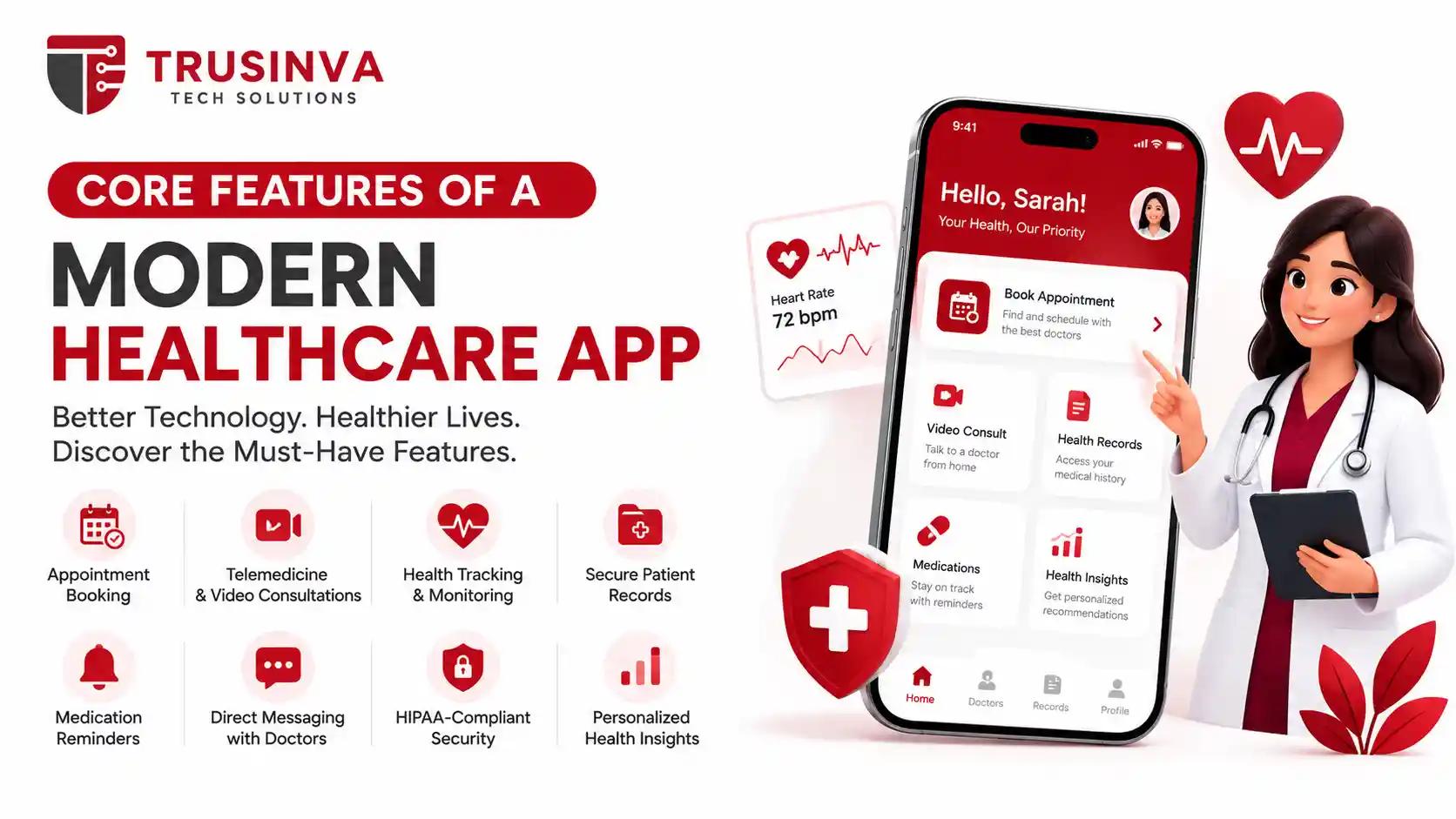
Patient-facing features:
- Secure login (biometric/MFA)
- Appointment booking and reminders
- Video consultations
- Access to lab results and records
- Secure messaging with providers
- Prescription refill requests
- Payment and insurance integration
Provider-facing features:
- Patient dashboard and charting
- Clinical decision support
- EHR/EMR integration
- E-prescribing
- Care team collaboration tools
- Analytics and reporting
Administrative features:
- Scheduling and resource management
- Billing and claims processing
- Compliance/audit logging
- Role-based access control
Tech Stack for Healthcare App Development
| Layer | Common Technologies |
| Mobile frontend | React Native, Flutter, Swift, Kotlin |
| Backend | Node.js, Python, .NET, Java |
| Database | PostgreSQL, MySQL, MongoDB |
| APIs | REST, GraphQL, FHIR APIs |
| Auth | OAuth 2.0, OpenID Connect, JWT |
| Infrastructure | AWS, Microsoft Azure, Google Cloud |
| DevOps | Docker, Kubernetes |
Cloud providers like AWS and Azure offer HIPAA-eligible services, but eligibility alone doesn't guarantee compliance — configuration, encryption, and access policies still have to be implemented correctly.
Step-by-Step Development Process
- Discovery and compliance mapping — define scope, identify which regulations apply (HIPAA, FDA, state laws).
- UI/UX design — design patient- and provider-facing flows with accessibility in mind (this often pairs with UI/UX design services).
- Architecture planning — decide on integrations, data flow, and security model.
- MVP development — build the core feature set first to validate with real users.
- EHR/API integration — connect to FHIR endpoints and third-party services.
- Security testing — penetration testing, vulnerability scanning, access control review.
- Compliance audit — HIPAA risk assessment before launch.
- Deployment and monitoring — launch with ongoing logging, uptime monitoring, and incident response readiness.
- Maintenance and updates — regulatory requirements and OS updates both demand continuous upkeep.
Cost of Healthcare App Development in the USA
| Project Type | Approximate Cost Range | Timeline |
| Basic MVP (booking, messaging) | $40,000 – $80,000 | 2–4 months |
| Mid-size app (telehealth + EHR integration) | $80,000 – $180,000 | 4–7 months |
| Enterprise platform (multi-role, full compliance, analytics) | $180,000 – $350,000+ | 7–12 months |
Costs vary based on platform count (iOS/Android/web), integration complexity, level of compliance auditing required, and whether AI features (like clinical decision support or automated triage) are included. Teams considering a phased approach often benefit from MVP development before committing to a full build.
Common Mistakes to Avoid
- Treating compliance as a final step instead of building it into architecture from day one.
- Skipping a risk assessment before launch, leaving security gaps undiscovered.
- Underestimating EHR integration complexity — this is often the single biggest cause of delays.
- Ignoring UX for clinical users — clinicians will abandon tools that slow down their workflow.
- Choosing a generic development team with no healthcare or HIPAA experience.
- Not planning for scale — patient data volume grows fast; architecture should anticipate it.
Healthcare App Security Best Practices
- Encrypt PHI both at rest and in transit (AES-256, TLS 1.2+)
- Use role-based access control and least-privilege principles
- Implement multi-factor authentication
- Maintain detailed, tamper-resistant audit logs
- Conduct regular penetration testing and vulnerability scans
- Have a documented breach response plan
- Follow OWASP secure coding guidelines throughout development
Future Trends in Healthcare App Development
- AI-powered clinical support — triage assistance, documentation automation, and predictive analytics are becoming standard rather than optional.
- Greater interoperability enforcement — ONC's information-blocking rules continue tightening, pushing more providers toward open, FHIR-based data access.
- Remote patient monitoring growth — wearables and IoT devices are feeding more real-time data into care decisions.
- Digital therapeutics — app-based treatment protocols are gaining clinical and reimbursement recognition.
- Consumer-grade UX expectations — patients increasingly compare healthcare apps to their favorite consumer apps, raising the design bar.
Why Choose Trusinva Tech Solutions
Building a healthcare app isn't just a technical challenge — it's a compliance, security, and workflow challenge all at once. Trusinva Tech Solutions brings together custom software development, mobile app development, and AI development expertise to help healthcare organizations move from idea to a secure, compliant, patient-ready application.
The team's broader services — including UI/UX design, CRM development, and digital marketing — also help healthcare businesses grow patient volume once the platform is live. You can review completed work in the projects portfolio or read more implementation guides on the blog.
FAQs
1. What is healthcare app development? It's the process of building mobile or web applications that support clinical, administrative, or patient-facing healthcare functions, typically while handling protected health information (PHI) under HIPAA.
2. Is every healthcare app required to be HIPAA compliant? No. HIPAA applies to covered entities and their business associates. A consumer wellness app not tied to a covered entity may fall outside HIPAA but could still be subject to FTC rules.
3. How much does healthcare app development cost in the USA? Costs typically range from $40,000 for a basic MVP to $350,000+ for a full enterprise platform, depending on features, integrations, and compliance scope.
4. How long does it take to build a healthcare app? Most projects take 2–4 months for an MVP and up to 7–12 months for a full-featured, EHR-integrated enterprise platform.
5. What is FHIR and why does it matter? FHIR (Fast Healthcare Interoperability Resources) is the standard used to exchange patient data between systems like Epic and athenahealth. It's essential for any app that needs EHR connectivity.
6. Can my app be classified as a medical device? If it independently diagnoses, treats, or makes clinical recommendations, it may qualify as Software as a Medical Device (SaMD) and require FDA oversight.
7. What technology stack is best for healthcare apps? Common choices include React Native or Flutter for mobile, Node.js/Python/.NET for backend, PostgreSQL/MongoDB for data, and AWS/Azure for HIPAA-eligible cloud infrastructure.
8. What's the biggest risk in healthcare app projects? Treating compliance and security as afterthoughts rather than building them into the architecture from the start — this is the most common source of delays and rework.
Conclusion
Healthcare app development in the USA sits at the intersection of technology, regulation, and patient trust. Getting it right means planning for HIPAA and FDA considerations early, building on solid interoperability standards like FHIR, and choosing a development partner who understands both the code and the compliance behind it.
If you're planning a healthcare app — whether it's a telehealth platform, patient portal, or clinical tool — the right partner can save months of rework and real compliance risk. Trusinva Tech Solutions works with healthcare businesses across the USA to design and build secure, scalable applications from the ground up. Explore the courses available for teams wanting to build in-house expertise, or reach out directly to discuss your project — and don't forget to Book a Seat in one of Trusinva's upcoming medical billing or technology training sessions to get your team up to speed before your app goes live.