Quick Answer
Flutter and React Native are both strong cross-platform frameworks, but they solve different problems. Flutter (Dart) renders its own UI engine for near-native performance and pixel-perfect consistency, while React Native (JavaScript/TypeScript) bridges to native components and benefits from a huge existing web-developer talent pool. The better choice depends on your team's skills, performance needs, and long-term maintenance plan.
Introduction
Picking between Flutter and React Native is one of the most consequential technical decisions a startup or enterprise makes before development begins, and it deserves more thought than "which one is trending on GitHub this year." At Trusinva Tech Solutions, this is a conversation we have with nearly every client evaluating mobile app development services, because the "right" framework depends on your team, budget, and product goals — not hype. This guide compares Flutter and React Native across cost, performance, and long-term maintenance, drawing on real numbers from our mobile app development cost breakdowns and lessons from our Android vs iOS development work. Whether you're a founder scoping an MVP or an IT manager planning an enterprise rebuild, this article gives you a data-driven way to decide.
Key Takeaways
- Flutter compiles to native ARM code and renders its own UI, giving it an edge in animation-heavy or highly custom-design apps.
- React Native uses native UI components under the hood, which can feel more "platform-native" out of the box.
- React Native has a larger existing developer pool since it's built on JavaScript/React, already familiar to most web teams.
- Flutter's single codebase tends to need less platform-specific tweaking than React Native's.
- Both frameworks now support mobile, web, and desktop targets, narrowing the gap with fully native development.
- Team skillset and long-term maintenance resources should weigh more heavily than raw benchmark numbers.
Table of Contents
- Introduction
- Flutter vs React Native: The Core Differences
- Programming Languages and Architecture
- Development Cost Comparison
- Development Speed and Complexity
- Performance Comparison
- UI Consistency and User Experience
- Community, Packages, and Ecosystem
- Testing, Debugging, and Maintenance
- Pros and Cons: Flutter vs React Native
- Common Mistakes Businesses Make
- Expert Tips and Best Practices
- Future Trends in Cross-Platform Development
- Why Choose Trusinva Tech Solutions
- FAQs
- Conclusion
Flutter vs React Native: The Core Differences
Flutter is Google's UI toolkit built on the Dart programming language. It renders every pixel itself using the Flutter Engine (built on Skia/Impeller), which means the same UI looks and behaves identically on Android, iOS, web, and desktop. React Native, built by Meta, uses JavaScript or TypeScript and renders through native UI components via a bridge (or the newer Fabric/TurboModules architecture), meaning your app taps into the platform's actual native widgets.
The core trade-off: Flutter gives you total design control and consistency because it owns the rendering pipeline; React Native gives you tighter integration with each platform's native look-and-feel because it uses real native components under the hood.
Programming Languages and Architecture
Flutter stack: Dart, Flutter SDK, Flutter Engine, Flutter Widgets, Flutter DevTools, Flutter packages/plugins.
React Native stack: JavaScript/TypeScript, React, React Native CLI or Expo, Metro bundler, Hermes JavaScript engine, Fabric renderer, TurboModules, native modules for platform-specific code.
| Factor | Flutter | React Native |
| Primary Language | Dart | JavaScript / TypeScript |
| Core Library | React | — (Flutter is the framework itself) |
| Rendering | Own engine (Skia/Impeller) | Native UI components via Fabric |
| Hot Reload | Yes | Yes (Fast Refresh) |
| JS Engine | N/A | Hermes |
| Backing Company | Meta |
Dart is a relatively niche language most teams need to learn from scratch, while JavaScript/TypeScript is already familiar to the vast majority of web development teams — a major factor in React Native's popularity among businesses that already run a web development team.
Development Cost Comparison
Flutter and React Native produce roughly comparable development costs for most business apps, with the real cost driver being team familiarity — a JavaScript-heavy team will build faster (and cheaper) in React Native, while a team open to learning Dart may see long-term savings in Flutter's reduced platform-specific debugging.
Cost factors to weigh:
- Existing team skillset — hiring or retraining for Dart vs. leveraging existing JavaScript/React talent.
- Design complexity — highly custom, animation-rich UIs often cost less to build in Flutter since there's no native-bridge overhead.
- Native module requirements — apps needing deep platform-specific integrations (e.g., complex Bluetooth, ARKit/Core ML features) may need more custom native code in either framework.
For detailed cost ranges by app complexity, see our mobile app development cost guide and our broader software development cost breakdown.
Development Speed and Complexity
Both frameworks offer hot reload, which dramatically speeds up UI iteration compared to native development. In practice:
- Flutter tends to be faster for teams building complex, custom UI from scratch, since widgets are consistent across platforms and don't require separate native styling.
- React Native tends to be faster for teams that already have React/JavaScript expertise and want to reuse logic from an existing web app.
A typical cross-platform MVP takes 10–16 weeks in either framework, with the timeline shifting based on team experience more than the framework itself. This mirrors what we see in our broader mobile application development for business growth engagements — the framework rarely determines the timeline as much as scope and team readiness do.
Performance Comparison
Direct answer: Flutter generally delivers slightly better raw performance for animation-heavy and graphics-intensive apps because it compiles to native ARM code and bypasses the JavaScript bridge, while React Native's newer architecture (Fabric, Hermes, TurboModules) has significantly closed this gap for typical business apps.
Performance considerations:
- Flutter apps tend to have smoother, more consistent 60fps+ animations out of the box.
- React Native's Hermes engine and Fabric renderer have reduced startup time and bridge-related lag considerably since earlier versions.
- For data-heavy business apps (forms, dashboards, CRUD operations), the performance difference is rarely noticeable to end users.
- Memory usage and app size are comparable, though Flutter apps have historically run slightly larger due to bundling the rendering engine.
UI Consistency and User Experience
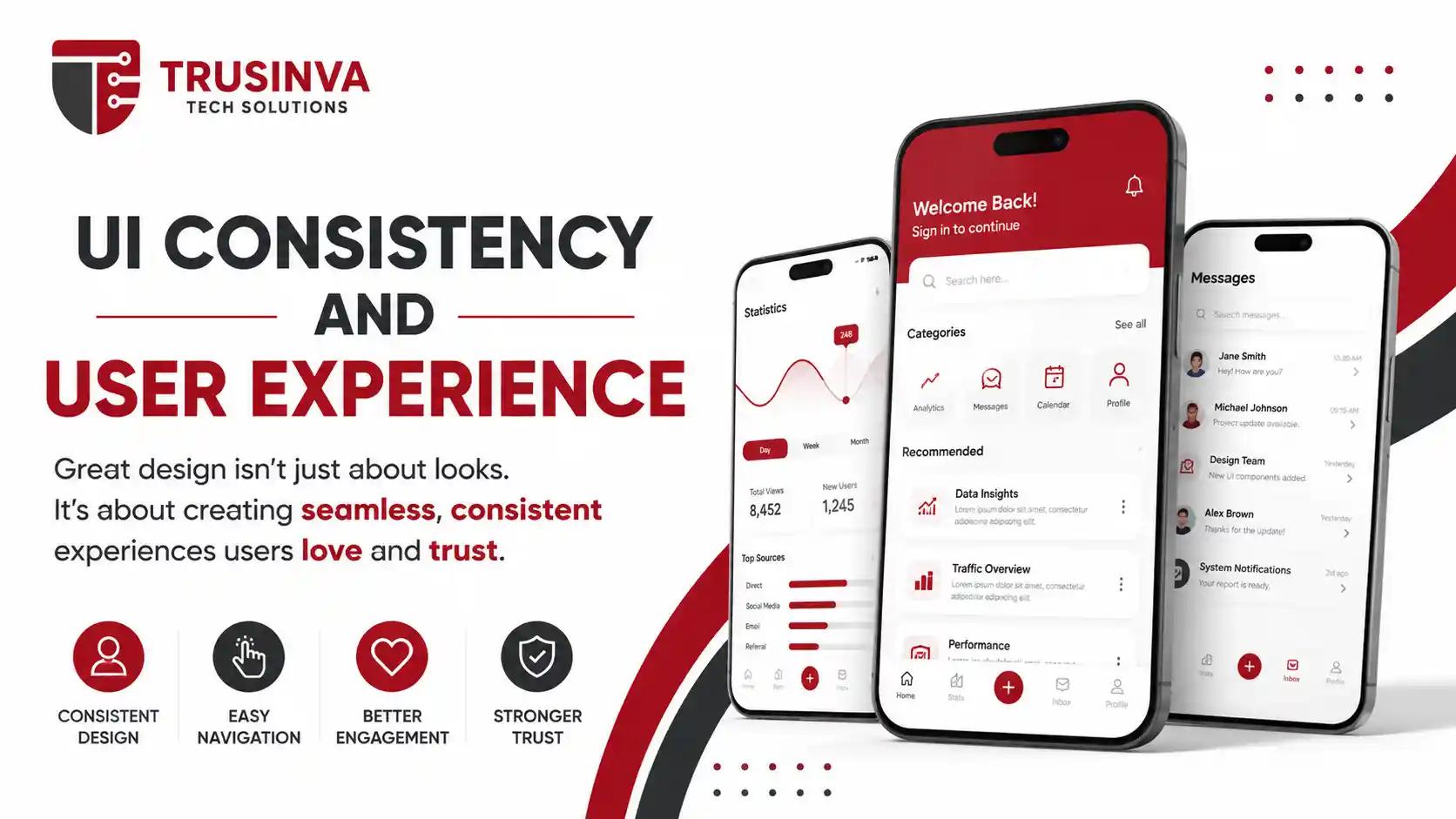
Flutter's widget-based rendering means your app looks pixel-identical on Android and iOS, which is a major advantage for brands wanting strict design consistency. React Native, using native components, automatically feels more "at home" on each platform — an iOS user sees native-feeling iOS controls, and an Android user sees native-feeling Android controls, without extra design work.
Neither approach is universally better — it depends on whether your brand wants full design control or platform-native familiarity. Our UI/UX design team typically runs a short UX audit to determine which rendering approach fits a specific product before development starts, similar to our process detailed in UI/UX design services that increase US conversions.
Community, Packages, and Ecosystem
React Native benefits from the enormous JavaScript/React ecosystem — most web libraries have a React Native equivalent, and the developer community is one of the largest in mobile development. Flutter's package ecosystem (pub.dev) has grown rapidly and is now extensive, backed strongly by Google, though it's still smaller than the combined JavaScript ecosystem.
| Factor | Flutter | React Native |
| Package Registry | pub.dev | npm |
| Community Size | Large, fast-growing | Very large, mature |
| Backing | Meta | |
| Web/Desktop Support | Native (Flutter Web/Desktop) | Via community tools (e.g., React Native Web) |
Testing, Debugging, and Maintenance
Both frameworks offer solid testing tooling: Flutter Test and Flutter DevTools for widget and integration testing, versus React Native DevTools and the broader JavaScript testing ecosystem (Jest, Detox) for React Native. Long-term maintenance costs are comparable, though Flutter's single rendering engine means fewer "it works on iOS but breaks on Android" bugs, which is a common pain point in React Native projects using older native-bridge architecture.
Pros and Cons: Flutter vs React Native
Flutter — Pros
- Near-native performance with a single, consistent codebase
- Pixel-perfect UI consistency across platforms
- Strong first-party tooling and Google backing
- Fewer platform-specific rendering bugs
Flutter — Cons
- Dart is a smaller talent pool than JavaScript
- Larger base app size in some cases
- Smaller (though rapidly growing) third-party package ecosystem
React Native — Pros
- Massive existing JavaScript/React developer pool
- Native UI components feel platform-authentic
- Huge library and package ecosystem
- Easier to integrate with existing web/React codebases
React Native — Cons
- Native-bridge architecture can add complexity for advanced features
- More platform-specific debugging historically
- Performance can lag native-heavy apps in animation-intensive use cases
Common Mistakes Businesses Make
- Choosing a framework based on trends rather than team skillset. A JavaScript-strong team forced into Dart (or vice versa) will slow the project down.
- Underestimating native module needs. Apps needing deep hardware integration may need custom native code regardless of framework.
- Skipping a technical audit before committing. A short architecture review upfront often prevents costly rework later.
- Assuming "cross-platform" means zero platform-specific testing. Both frameworks still require QA on real Android and iOS devices.
- Ignoring long-term maintenance costs when comparing initial build quotes.
Expert Tips and Best Practices
- Match the framework to your existing team's strongest language — Dart for teams open to a new stack, JavaScript/TypeScript for teams with existing React experience.
- Prototype the most complex UI screen first in both frameworks if performance is a major concern, rather than relying on benchmarks alone.
- Use Expo for React Native MVPs to speed up initial development, then eject to bare workflow if you need deeper native access.
- Budget for platform-specific QA regardless of framework — cross-platform doesn't mean zero device testing.
- Treat framework choice as a long-term maintenance decision, not just a launch-speed decision.
Future Trends in Cross-Platform Development
Both frameworks continue to mature rapidly. Flutter is expanding its web and desktop capabilities, while React Native's new architecture (Fabric, TurboModules, Hermes by default) continues narrowing the performance gap with native development. Competing approaches like Kotlin Multiplatform and .NET MAUI are also gaining traction for teams wanting shared business logic with fully native UI layers. Businesses planning 2026 mobile strategy should also factor in how AI-assisted development tools are speeding up cross-platform builds — see our related coverage on AI automation services for how AI is reshaping software delivery timelines.
Why Choose Trusinva Tech Solutions
Trusinva Tech Solutions builds cross-platform and native apps for U.S. startups, SMBs, and enterprises across healthcare, eCommerce, logistics, and SaaS. Our engineering team has hands-on experience in both Flutter (Dart) and React Native (JavaScript/TypeScript), and we start every project by matching the framework to your team, budget, and performance needs — not a one-size-fits-all recommendation. Explore our full mobile app development services, paired with UI/UX design and post-launch digital marketing support so your app doesn't just launch — it grows. See how we've guided other businesses through this exact decision in our guides on hiring the right mobile app development company and affordable app development for startups.
FAQs
1. Is Flutter or React Native better for startups? Both work well for MVPs. React Native is often faster for teams with existing JavaScript/React skills; Flutter suits teams prioritizing UI consistency and willing to learn Dart.
2. Which framework is faster: Flutter or React Native? Flutter generally has a slight performance edge for animation-heavy apps due to its native rendering engine, but React Native's newer architecture has closed most of the gap for typical business apps.
3. Is Flutter or React Native cheaper to develop? Costs are comparable overall. The bigger cost factor is whether your team already knows JavaScript (favoring React Native) or is open to learning Dart (favoring Flutter).
4. Can I share code between Flutter/React Native and my website? React Native shares more directly with React-based web apps. Flutter Web exists but is a separate rendering target, not a shared React codebase.
5. Which has a bigger developer community, Flutter or React Native? React Native has a larger overall community due to the size of the JavaScript ecosystem, though Flutter's community is large and growing quickly.
6. Do Flutter and React Native support desktop apps? Yes — Flutter has native desktop support, and React Native supports desktop through community tools like React Native Windows and macOS.
7. Which framework has fewer bugs across platforms? Flutter tends to have fewer platform-specific rendering bugs since it uses a single rendering engine instead of bridging to native components.
8. How much does it cost to build a cross-platform app in the USA? Costs vary by scope and complexity — see our full mobile app development cost breakdown for real ranges.
Conclusion
Flutter vs React Native isn't a debate with one universal winner — it's a decision that should be driven by your team's existing skills, your app's design and performance needs, and your long-term maintenance plan. Flutter offers stronger UI consistency and near-native performance out of the box; React Native offers a massive JavaScript talent pool and native platform feel. The smartest move is to evaluate both against your specific product requirements rather than following industry hype.
If you're ready to move from research to execution, Trusinva Tech Solutions can help you choose and build the right cross-platform solution — explore our mobile app development services, browse our case studies and projects, or get in touch to discuss your framework strategy. Want to build deeper technical or business skills alongside your app launch? Book a Seat in one of our professional courses and take the next confident step forward.