Quick Answer
An ERP software development company in the USA builds custom enterprise resource planning systems that connect finance, inventory, HR, and sales into one centralized platform. Costs typically range from $15,000 for small business ERP to $250,000+ for enterprise-grade systems, depending on modules, integrations, and deployment model (cloud, on-premise, or hybrid).
Introduction
Running a growing business on spreadsheets, disconnected apps, and manual reports eventually breaks down. That's the exact problem enterprise resource planning (ERP) software was built to solve, and it's why more American companies are now searching for a reliable ERP software development company in the USA rather than settling for rigid, one-size-fits-all platforms. Trusinva Tech Solutions works with startups and enterprises across the country to design ERP systems that actually match how their teams operate, instead of forcing teams to adapt to generic software.
This guide breaks down everything you need to know before hiring an ERP development partner — from core services and modules to real implementation costs. If you're also exploring related technology, our custom software development guide and our CRM development page cover two systems that often work alongside ERP. For businesses still weighing whether to build from scratch, our software development cost breakdown is a useful starting point too.
Whether you're a small business replacing spreadsheets or an enterprise modernizing a legacy system, this article will help you make an informed decision.
Key Takeaways
- Custom ERP software centralizes business data and automates repetitive workflows across departments
- USA-based ERP development companies offer better compliance support, time-zone alignment, and long-term maintenance
- Cloud ERP has become the dominant deployment model for small and mid-sized businesses in 2026
- Custom ERP typically costs less over 5 years than licensing multiple SaaS tools separately
- Choosing the right ERP development company for small business needs matters more than choosing the biggest vendor name
Table of Contents
- What Is ERP Software Development?
- Why USA Businesses Need Custom ERP Software
- Core ERP Modules Explained
- Custom ERP vs Off-the-Shelf ERP (SAP, Oracle, NetSuite)
- ERP Software Development Services
- How Much Does ERP Software Development Cost in the USA?
- Step-by-Step ERP Development Process
- Benefits of Custom ERP Software
- Common ERP Implementation Mistakes
- Future Trends in ERP Development
- Why Choose Trusinva Tech Solutions
- Conclusion
- FAQs
1. What Is ERP Software Development?
ERP software development is the process of designing, building, and deploying a centralized system that manages core business operations — finance, inventory, HR, procurement, and sales — inside one connected platform. Instead of switching between five different tools, your team works from a single source of truth.
At its core, enterprise resource planning software replaces fragmented spreadsheets and siloed apps with a unified enterprise application. Every department feeds data into the same database, so leadership gets real-time business intelligence instead of outdated monthly reports.
There are three common ERP architectures:
- Cloud ERP (SaaS ERP): Hosted online, accessible anywhere, lower upfront cost
- On-premise ERP: Installed on company servers, more control, higher setup cost
- Hybrid ERP: Mix of cloud and on-premise, common during legacy system migration
2. Why USA Businesses Need Custom ERP Software
American businesses need custom ERP software because generic platforms rarely match specific industry workflows, compliance requirements, or growth plans. A custom-built system automates the exact processes your business runs — not a generic template built for a different market.
A manufacturing company in Ohio and a healthcare billing firm in Texas don't operate the same way, yet many off-the-shelf ERP platforms force both into similar workflows. Custom ERP development solves this by building modules around your actual operations, not the vendor's assumptions.
Common drivers behind ERP adoption in the USA include:
- Manual data entry causing costly errors
- Disconnected finance and inventory systems
- Lack of real-time reporting across locations
- Legacy systems that no longer scale
- Compliance and audit-trail requirements
3. Core ERP Modules Explained
Most ERP systems are built from a combination of these modules, added based on business need:
| Module | Function |
| Finance & Accounting | Manages ledgers, invoicing, tax reporting, and cash flow |
| Inventory Management | Tracks stock levels, reorder points, and warehouse data |
| HR & Payroll | Handles employee records, payroll runs, and benefits |
| CRM | Manages sales pipeline and customer interactions |
| Procurement | Automates purchase orders and vendor management |
| Supply Chain / Logistics | Tracks shipments, suppliers, and delivery timelines |
| Manufacturing | Manages production schedules and bill of materials |
| Business Intelligence | Generates dashboards and predictive analytics |
Not every business needs every module. A retail business might prioritize inventory and CRM, while a manufacturer prioritizes production and supply chain management.
4. Custom ERP vs Off-the-Shelf ERP (SAP, Oracle, NetSuite)
Off-the-shelf platforms like SAP, Oracle, Microsoft Dynamics, NetSuite, and Odoo work well for companies willing to adapt their processes to the software. Custom ERP development works better for companies that need the software to adapt to them.
Off-the-shelf ERP pros:
- Faster initial deployment
- Established support ecosystem
- Pre-built industry templates
Off-the-shelf ERP cons:
- Ongoing licensing fees per user
- Limited flexibility for unique workflows
- Expensive customization requests
Custom ERP pros:
- Built around your exact processes
- No unnecessary features or bloated licensing
- Full ownership of source code and data
- Easier to scale as the business grows
Custom ERP cons:
- Longer initial build time
- Requires a capable development partner
5. ERP Software Development Services
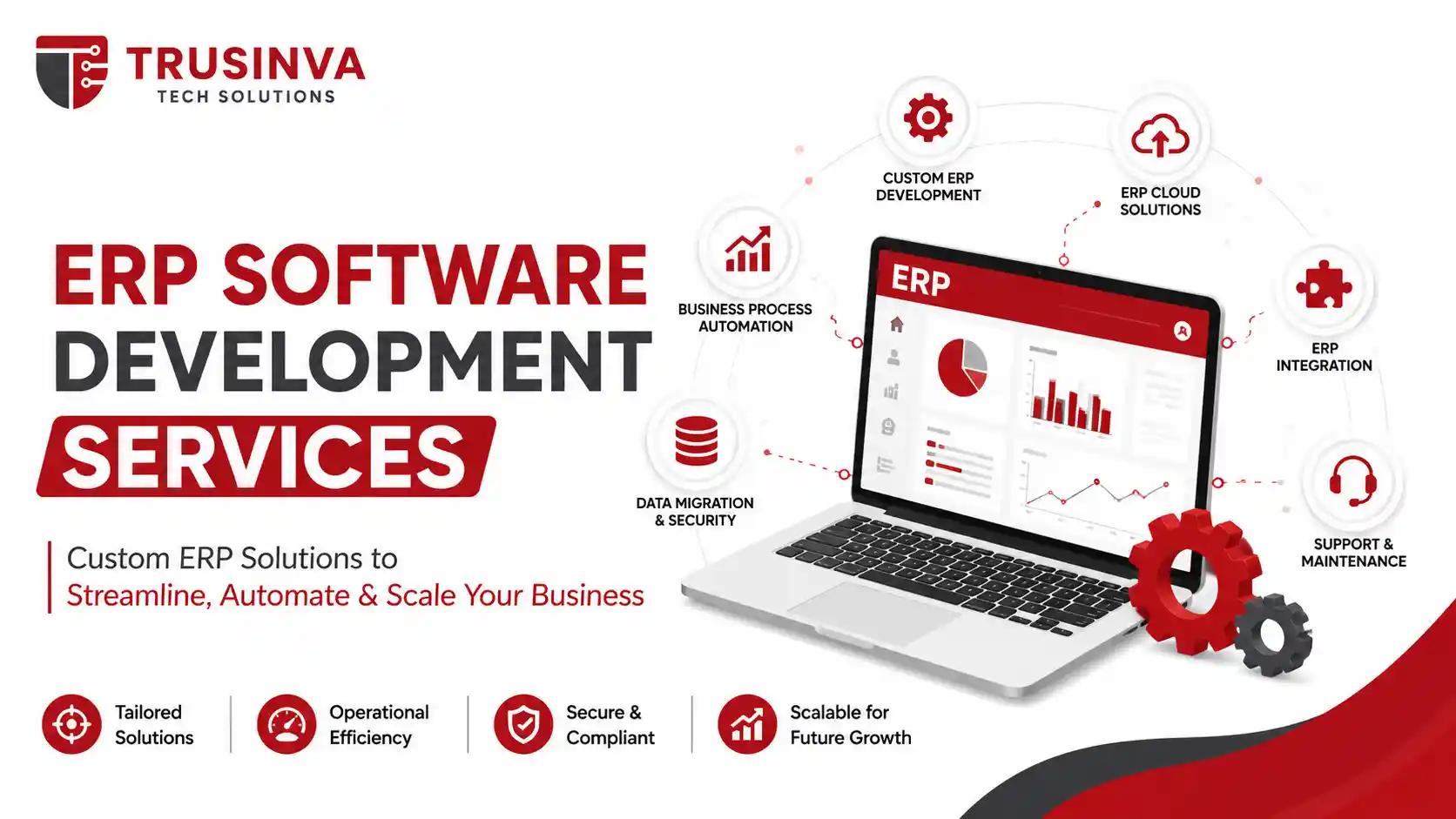
A full-service ERP development company typically offers:
- ERP consulting – Assessing current systems and mapping requirements
- Custom ERP development – Building modules from scratch around your workflows
- ERP implementation – Deploying and configuring the system
- ERP integration – Connecting ERP with existing tools via API integration
- ERP data migration – Moving records from legacy systems safely
- ERP customization – Adjusting modules as business needs change
- ERP modernization – Upgrading outdated legacy platforms
- ERP maintenance & support – Ongoing updates, bug fixes, and scaling
If your business already runs on outdated internal tools, our software development company USA article walks through when modernization makes more sense than a full rebuild.
6. How Much Does ERP Software Development Cost in the USA?
Custom ERP software development in the USA typically costs between $15,000 and $250,000+, depending on the number of modules, integrations, data volume, and deployment model. Small business ERP systems with 2-3 modules generally fall on the lower end, while multi-department enterprise ERP systems cost significantly more.
| Business Size | Typical Cost Range | Common Modules |
| Small Business | $15,000 – $45,000 | Finance, inventory, basic CRM |
| Mid-Size Business | $45,000 – $120,000 | Finance, HR, inventory, procurement, BI |
| Enterprise | $120,000 – $250,000+ | Full module suite, multi-location, custom integrations |
Factors that increase cost include third-party API integrations, legacy data migration complexity, industry-specific compliance needs, and the number of user roles requiring role-based access control.
For a broader comparison across software types, see our software development cost guide.
7. Step-by-Step ERP Development Process
- Discovery & Requirement Gathering – Mapping current workflows and pain points
- System Architecture Planning – Choosing cloud, on-premise, or hybrid deployment
- Module Design – Prioritizing which modules to build first
- Development & API Integration – Building the core system and connecting third-party tools
- Data Migration – Transferring records from legacy systems
- Testing & QA – Validating workflows, security, and performance
- Deployment – Rolling out the system, often department by department
- Training & Support – Onboarding staff and providing ongoing maintenance
8. Benefits of Custom ERP Software
- Centralized business data across every department
- Real-time reporting instead of delayed monthly summaries
- Workflow automation that reduces manual data entry
- Improved decision-making through accurate business intelligence
- Scalability as your business adds locations or product lines
- Cost reduction by eliminating multiple disconnected software subscriptions
- Better cross-department visibility between finance, sales, and operations
Businesses that also run separate customer-facing systems often pair ERP with CRM. Our CRM features article explains how the two systems typically work together without duplicating data.
9. Common ERP Implementation Mistakes
- Trying to migrate all departments at once instead of phasing rollout
- Skipping proper staff training, leading to poor adoption
- Choosing modules based on trends rather than actual need
- Underestimating data migration complexity from legacy systems
- Not planning for future scalability from day one
Expert tip: Start with the two departments causing the most operational friction — usually finance and inventory — before expanding the ERP system company-wide. This reduces risk and builds internal confidence in the new system.
10. Future Trends in ERP Development
ERP systems in 2026 are increasingly moving toward AI-assisted operations. Predictive analytics, AI agents that flag inventory anomalies, and automated financial reconciliation are becoming standard rather than premium add-ons. Cloud-first, API-driven architecture continues to replace rigid legacy ERP installs.
Businesses exploring this shift often start smaller, with automation added incrementally. Our AI automation services USA page and AI development company USA article cover how AI is being layered onto existing business systems, including ERP.
Why Choose Trusinva Tech Solutions
Trusinva Tech Solutions builds custom ERP systems designed around how your business actually operates — not a generic template. The team works closely with startups, mid-size businesses, and enterprises across healthcare, logistics, manufacturing, and eCommerce to design ERP modules that solve real operational bottlenecks.
What sets the approach apart:
- Custom ERP development instead of forcing your business into rigid, pre-built software
- Transparent, phased implementation to reduce operational disruption
- Ongoing ERP maintenance and support after launch, not just a one-time build
- Experience integrating ERP with CRM, web development, and SaaS platforms
- A team that also understands supporting technology — from blockchain development for supply chain transparency to UI/UX design that makes complex ERP dashboards easy for staff to actually use
You can review past work on the projects page or learn more about the team on the about page.
Conclusion
Choosing between custom ERP development and an off-the-shelf platform comes down to how closely your business processes match the vendor's assumptions. If your operations are unique, growing, or already frustrated by rigid software, a custom-built ERP system typically pays for itself through reduced licensing costs, better automation, and fewer workarounds.
The next logical step is a discovery call to map your current workflows and identify which modules would deliver the fastest return. Trusinva Tech Solutions offers exactly that — a straightforward conversation about your business before any development begins. If you're ready to move forward, Book a Seat for a free ERP consultation and see what a system built around your business, instead of against it, actually looks like.
FAQs
1. What does an ERP software development company do? It designs, builds, and implements custom enterprise resource planning systems that connect departments like finance, inventory, and HR into one centralized platform.
2. How much does custom ERP software cost in the USA? Costs typically range from $15,000 for small business ERP to $250,000+ for enterprise systems, depending on modules and integrations.
3. Is custom ERP better than SAP or Oracle for small businesses? For most small businesses, custom ERP is more cost-effective since it avoids per-user licensing fees and only includes needed features.
4. How long does ERP implementation take? Small business ERP systems typically take 8-16 weeks, while enterprise systems can take 6-12 months depending on module complexity.
5. Can ERP software integrate with existing tools? Yes, ERP integration through APIs allows the system to connect with existing CRM, accounting, or eCommerce platforms.
6. What is the difference between cloud ERP and on-premise ERP? Cloud ERP is hosted online with lower upfront costs, while on-premise ERP is installed on company servers with more control but higher setup costs.
7. Do small businesses really need ERP software? Small businesses benefit from ERP once manual processes start causing errors, delays, or lost visibility across departments.
8. Who should I hire: an ERP development company or a freelancer? An established ERP development company offers long-term support, testing rigor, and integration experience that most freelancers can't consistently match.