Enterprise software development is how large and mid-sized organizations build complex, scalable applications that run core business operations. This guide covers the full process — architecture, integration, security, cost, and best practices — for businesses planning a serious enterprise software investment.
Quick Answer
Enterprise software development is the process of designing, building, and maintaining large-scale applications that support complex organizational workflows across departments, systems, and users. Unlike standard business software, enterprise solutions are built for high availability, deep system integration, strict security compliance, and long-term scalability across an entire organization.
Introduction
Enterprise software development is a different discipline than building a small business app or a marketing website. It involves multiple departments, thousands of users in some cases, strict compliance requirements, and systems that simply cannot go down without real business consequences. Getting it right requires careful architecture planning, not just good code.
At Trusinva Tech Solutions, we help medium and large enterprises across the US design and build software that holds up under real organizational complexity — from custom software development and CRM development to blockchain development for specialized use cases and UI/UX design that keeps large-scale systems usable for everyday employees. This guide walks through what enterprise software development actually involves, how the process works, what it costs, and the mistakes that derail even well-funded projects.
Key Takeaways
- Enterprise software is built for organization-wide use, not a single team or department.
- Scalability, security, and integration are non-negotiable requirements, not optional features.
- The development process typically follows Agile methodology with DevOps and CI/CD pipelines.
- Security should be built into the software development lifecycle from day one, not added afterward.
- Legacy system modernization is often part of enterprise software projects, not a separate initiative.
- Cost depends heavily on integration complexity, compliance requirements, and the number of enterprise systems involved.
Table of Contents
- What Is Enterprise Software Development?
- Enterprise Software vs. Standard Business Software
- Core Components of Enterprise Software
- Benefits of Enterprise Software Development
- Enterprise Software Development Process
- Enterprise Architecture Approaches
- Security and Compliance in Enterprise Software
- Cost of Enterprise Software Development
- Common Mistakes in Enterprise Software Projects
- Expert Tips and Best Practices
- Future Trends in Enterprise Software (2026)
- FAQs
- Conclusion
1. What Is Enterprise Software Development?
Direct answer: Enterprise software development is the process of building large-scale applications designed to support the operations of an entire organization, rather than a single team or business function. These systems typically integrate with multiple databases, third-party platforms, and departments, and are built with high availability, security, and scalability as core requirements.
Enterprise applications commonly include ERP (enterprise resource planning), CRM (customer relationship management), HRM (human resource management), and SCM (supply chain management) systems, along with custom internal platforms built for a specific organization's operations.
Key characteristics of enterprise software include:
- Support for a large number of concurrent users across departments
- Deep integration with existing enterprise systems and APIs
- High availability and fault tolerance requirements
- Strict security architecture and access control
- Long-term maintainability across years, sometimes decades
2. Enterprise Software vs. Standard Business Software
Direct answer: Enterprise software is built for organization-wide use with strict scalability, security, and integration requirements, while standard business software typically serves a single team, function, or small business with simpler operational needs.
| Factor | Enterprise Software | Standard Business Software |
| Scale | Organization-wide, thousands of users | Single team or small business |
| Integration | Deep integration across multiple systems | Limited or standalone |
| Security | Enterprise-grade, compliance-driven | Basic security controls |
| Architecture | Distributed, microservices, high availability | Simpler, often monolithic |
| Development timeline | Months to years | Weeks to months |
| Maintenance | Dedicated ongoing support teams | Minimal ongoing maintenance |
| Cost | Significant investment | Lower investment |
3. Core Components of Enterprise Software
Enterprise software typically includes several interconnected layers:
- Enterprise architecture — the overall blueprint connecting business processes, data, and technology
- Application architecture — how individual applications are structured internally (microservices, monolithic, or service-oriented)
- Data architecture — how data is stored, governed, and moved across systems
- Security architecture — identity and access management, encryption, and compliance controls
- Integration layer — APIs, middleware, and API gateways connecting enterprise systems together
Understanding how these layers interact is critical before development begins — skipping architecture planning is one of the most common reasons enterprise projects run over budget.
4. Benefits of Enterprise Software Development
Direct answer: Enterprise software development gives organizations centralized data, automated workflows, stronger security, and systems that scale with business growth — advantages that fragmented, department-specific tools cannot deliver at an organizational level.
- Centralized data management across departments instead of siloed spreadsheets and disconnected tools
- Business process automation that reduces manual work across large teams
- Improved interoperability between enterprise systems like ERP, CRM, and HRM platforms
- Stronger security posture through unified access control and identity management
- Scalability that supports growth without a costly platform migration
- Better business intelligence through centralized analytics and reporting
5. Enterprise Software Development Process
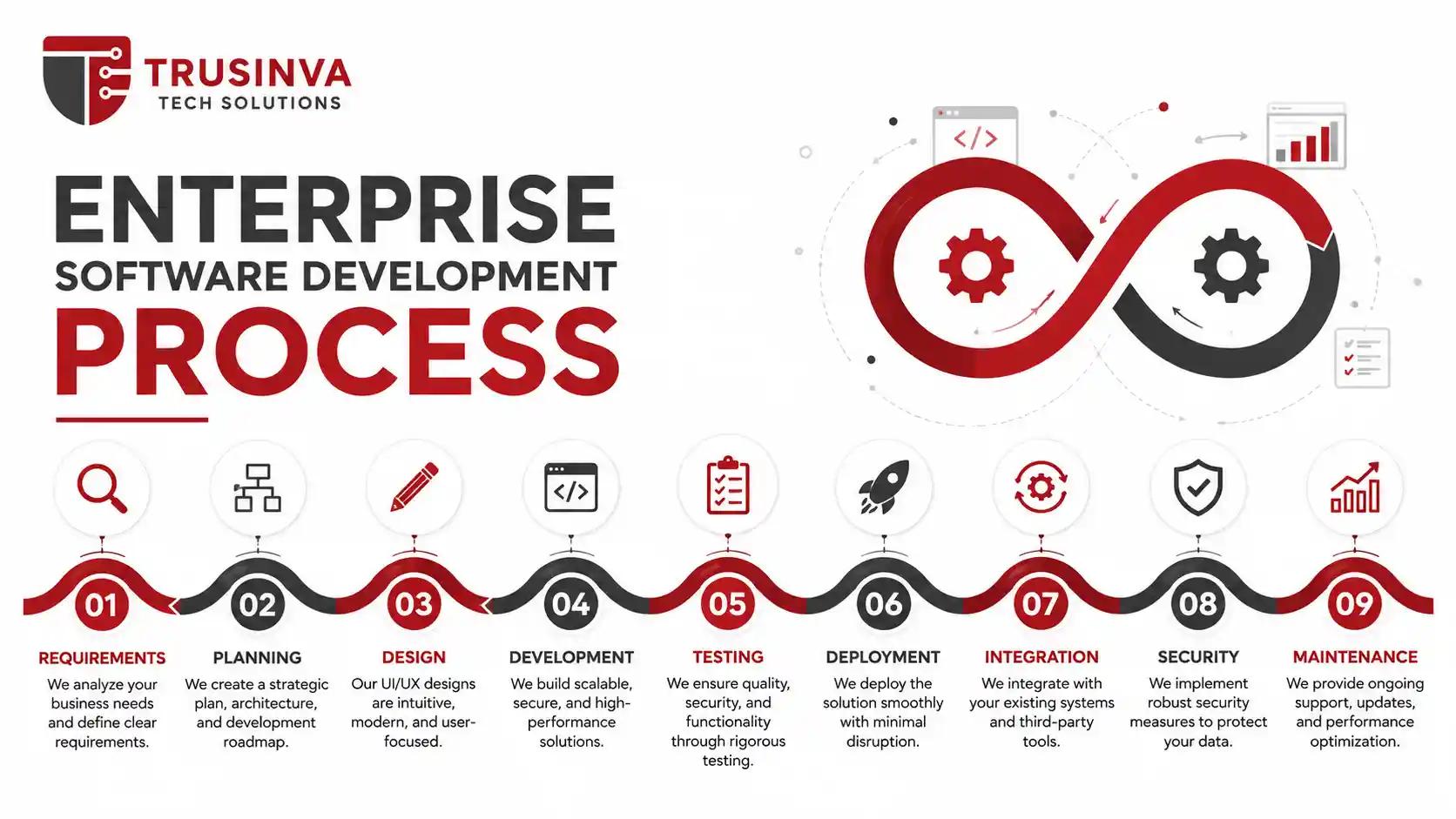
Direct answer: The enterprise software development process typically follows a structured software development lifecycle (SDLC) that includes requirements engineering, architecture design, Agile development sprints, security testing, and phased deployment across the organization.
- Requirements engineering — Gathering functional and non-functional requirements across departments and stakeholders
- Solution architecture design — Defining enterprise architecture, technology stack, and integration points
- Agile development cycles — Building in iterative sprints with regular stakeholder feedback
- Security integration (DevSecOps) — Embedding security testing throughout development, not just at the end
- Quality assurance and testing — Automated testing, performance testing, and load testing for high availability
- Phased deployment — Rolling out to departments in stages to reduce operational risk
- Ongoing maintenance and monitoring — Observability, performance optimization, and continuous updates
6. Enterprise Architecture Approaches
Direct answer: Enterprise software can be built using several architectural approaches — microservices, monolithic, service-oriented, or event-driven — and the right choice depends on the organization's scale, integration needs, and long-term flexibility requirements.
- Microservices architecture breaks the application into independently deployable services, improving scalability and fault tolerance for large systems
- Monolithic architecture keeps the application as a single unit, which can be simpler to manage for smaller enterprise projects
- Event-driven architecture allows systems to react to real-time events, useful for organizations needing instant data synchronization
- API-first architecture ensures every component is built to integrate cleanly with other systems from the start
Most modern enterprise projects lean toward cloud-native, API-first, and microservices-based designs because they offer better long-term flexibility, even though they require more upfront architectural planning.
7. Security and Compliance in Enterprise Software
Direct answer: Enterprise software must build security into every stage of development rather than treating it as a final checklist item — this is the core idea behind NIST's Secure Software Development Framework (SSDF), which provides practices for integrating security throughout the development lifecycle.
NIST published updated DevSecOps guidance in March 2026 demonstrating how SSDF practices can be implemented directly within modern CI/CD pipelines, reflecting a broader industry shift toward embedding security earlier in development rather than testing for it afterward.
Relevant security and compliance frameworks include:
- NIST SSDF — secure software development practices
- OWASP — application security best practices
- ISO/IEC 27001 — information security management standards
- SOC 2 — trust and security controls for service organizations
Compliance frameworks like HIPAA apply specifically to healthcare software, PCI DSS applies to systems handling payment data, and FedRAMP applies to software used by federal agencies. Not every enterprise system needs every framework — the right compliance approach depends entirely on the industry and the data being handled.
8. Cost of Enterprise Software Development
Direct answer: Enterprise software development costs vary significantly based on integration complexity, number of enterprise systems involved, security requirements, and team size — projects can range from the low six figures for a focused internal system to significantly more for organization-wide platforms with complex integrations.
Key cost drivers include:
- Number and complexity of system integrations (ERP, CRM, legacy systems)
- Security and compliance requirements specific to the industry
- Number of user roles and permission structures
- Whether legacy application modernization is part of the scope
- Ongoing maintenance, monitoring, and support needs
Businesses evaluating enterprise software development services should request a detailed scope-based estimate, since flat pricing rarely reflects the real complexity of enterprise-level integration work.
9. Common Mistakes in Enterprise Software Projects
- Underestimating the complexity of integrating legacy systems
- Treating security as a final step instead of part of the development lifecycle
- Skipping proper requirements engineering across departments
- Choosing an architecture that doesn't scale with future growth
- Failing to plan for change management and employee adoption
- Ignoring the total cost of ownership when comparing vendors
10. Expert Tips and Best Practices
- Involve stakeholders from every affected department during requirements gathering, not just IT
- Choose a scalable architecture upfront, even if the current user base is small
- Build security and compliance controls in from the beginning using DevSecOps practices
- Plan legacy system integration carefully — it's often the most underestimated part of enterprise projects
- Roll out deployment in phases to reduce operational disruption
- Invest in proper documentation, since enterprise systems are maintained for years, often by different teams over time
11. Future Trends in Enterprise Software (2026)
- Continued adoption of AI-powered automation within enterprise workflows
- Growing use of microservices and cloud-native architecture for flexibility
- Stronger emphasis on DevSecOps as security regulations tighten
- Wider adoption of Zero Trust security models across enterprise systems
- Increased demand for enterprise application modernization as legacy systems age out
- Rising integration between enterprise platforms and specialized tools, including AI automation and industry-specific software
Why Choose Trusinva Tech Solutions
Trusinva Tech Solutions helps US businesses build secure, scalable, and high-performance enterprise software tailored to complex business requirements. From automating processes and integrating business systems to improving data security and supporting future growth, our enterprise software solutions are designed to enhance operational efficiency, reduce technology costs, and give organizations the flexibility they need to stay competitive in a rapidly evolving market.
FAQs
Q1: What is enterprise software development? Enterprise software development is the process of building large-scale applications designed to support an entire organization's operations, with a focus on scalability, security, and deep system integration.
Q2: How is enterprise software different from regular business software? Enterprise software is built for organization-wide use with strict scalability and security requirements, while regular business software typically serves a single team or smaller operation.
Q3: How long does enterprise software development take? Enterprise software projects typically take several months to over a year, depending on integration complexity, compliance requirements, and the number of systems involved.
Q4: What architecture is best for enterprise software? Most modern enterprise projects use microservices or API-first architecture for flexibility and scalability, though the right choice depends on the organization's specific needs.
Q5: Why is security important in enterprise software development? Enterprise systems often handle sensitive organizational and customer data, making security a core requirement — frameworks like NIST SSDF and OWASP help ensure security is built into development from the start.
Q6: What compliance standards apply to enterprise software? It depends on the industry — HIPAA applies to healthcare, PCI DSS applies to payment data, and FedRAMP applies to software used by federal agencies. Not every system requires every framework.
Q7: How much does enterprise software development cost? Costs vary widely based on integration complexity and compliance requirements, ranging from low six figures for focused systems to significantly more for organization-wide platforms.
Q8: Can legacy systems be integrated into new enterprise software? Yes, legacy application modernization is a common part of enterprise software projects, though it requires careful planning to avoid disrupting existing operations.
Conclusion
Enterprise software development is a long-term investment that goes far beyond writing code — it requires careful architecture planning, security built in from day one, and integration strategies that account for the systems an organization already relies on. The businesses that get the best results are the ones that treat requirements engineering and architecture as seriously as the actual build.
If your organization is planning an enterprise software initiative, the smartest first step is a detailed requirements conversation with a development partner who understands both the technical and organizational side of the project. Trusinva Tech Solutions works with medium and large enterprises across the US to design secure, scalable software built around real organizational complexity. Reach out today to Book a Seat for a consultation and map out what enterprise software development could look like for your business.