Quick Answer
Custom software development services USA involve designing, building, and maintaining software applications tailored to a specific business's workflows, rather than using off-the-shelf products. These services typically include requirement analysis, UI/UX design, development, QA testing, deployment, and ongoing support — helping startups and enterprises automate operations, scale efficiently, and stay competitive in 2026.
Introduction
If your business is still running on spreadsheets, disconnected tools, or software that almost fits your workflow, you already know the frustration. That's exactly the gap custom software development services USA are built to close. Trusinva Tech Solutions works with startups, growing companies, and established enterprises across the country to design software that actually matches how they operate — not the other way around. Whether you need a full enterprise software development build, a lightweight CRM system, or a mobile application to serve customers on the go, the right development partner can turn a messy operational bottleneck into a real competitive advantage. This guide breaks down what custom software development actually involves, what it costs, how the process works, and how to choose a partner you won't regret hiring — with practical, real-world context throughout, including where a strong digital marketing strategy fits once your product is built.
Key Takeaways
- Custom software is built around your exact business processes, unlike generic SaaS tools.
- USA businesses across healthcare, finance, logistics, and eCommerce increasingly rely on tailored software for compliance and scalability.
- Costs vary widely based on scope, but the ROI usually outweighs the upfront investment.
- Choosing the right development partner matters more than choosing the cheapest one.
- AI integration, cloud-native architecture, and DevOps practices are now standard expectations, not add-ons.
Table of Contents
- What Are Custom Software Development Services
- Why USA Businesses Need Custom Software
- Key Features of a Strong Custom Software Partner
- Custom Software vs Off-the-Shelf Software
- The Development Process, Step by Step
- Cost of Custom Software Development in the USA
- Industries That Benefit Most
- Common Mistakes to Avoid
- Future Trends in 2026
- Frequently Asked Questions
- Conclusion
1. What Are Custom Software Development Services
Custom software development services refer to the design, coding, testing, and deployment of applications built specifically for one organization's needs — as opposed to licensing a generic, one-size-fits-all product. A software development company works directly with your team to map out workflows, then builds tools around them: internal dashboards, customer portals, mobile apps, automation systems, or full enterprise platforms.
Unlike buying a subscription to a mass-market tool, custom software gives you ownership over the code, the data structure, and the roadmap. That means no forced feature updates you didn't ask for, no paying for modules you'll never use, and no working around limitations baked into someone else's product.
What's Typically Included
- Requirement gathering and business analysis
- UI/UX design
- Backend and frontend development
- Database architecture
- API integration with existing tools
- Quality assurance and testing
- Deployment and cloud hosting
- Ongoing maintenance and support
2. Why USA Businesses Need Custom Software
Generic software works fine — until it doesn't. Most businesses hit a ceiling where their off-the-shelf CRM, inventory system, or scheduling tool can't keep up with how they actually operate. That's usually the point where teams start stitching together spreadsheets, browser extensions, and manual workarounds just to get through the day.
A software development company solves this by building around your actual process, not a generic template. This matters more in regulated or fast-moving industries — healthcare providers dealing with HIPAA requirements, logistics companies managing real-time freight data, or fintech startups that need airtight security from day one.
Practical example: A mid-sized logistics company using a generic dispatch tool often loses hours reconciling load data manually. A custom-built dispatch system, by contrast, can automate that reconciliation entirely — which is part of why services like truck dispatch software have become so valuable to US carriers specifically.
3. Key Features of a Strong Custom Software Partner
Not every software development company delivers the same quality. Here's what separates a dependable partner from a risky one:
| Feature | Why It Matters |
| Discovery-first approach | Prevents scope creep and wasted budget |
| Transparent pricing | Avoids hidden costs mid-project |
| Agile development process | Allows iteration instead of a rigid, late-stage reveal |
| Security-first architecture | Protects sensitive business and customer data |
| Post-launch support | Software needs maintenance, not just a launch date |
| Clear communication cadence | Keeps stakeholders aligned throughout the build |
Expert tip: Ask any prospective partner how they handle scope changes mid-project. Their answer tells you more about how the engagement will actually feel than their portfolio does.
4. Custom Software vs Off-the-Shelf Software
| Factor | Custom Software | Off-the-Shelf Software |
| Fit to business process | Built around your workflow | You adapt to its workflow |
| Upfront cost | Higher | Lower |
| Long-term cost | Often lower (no per-seat fees) | Recurring subscription costs scale with growth |
| Ownership | You own the code and data | Vendor controls updates and access |
| Scalability | Built to scale with your business | Limited by vendor's roadmap |
| Customization | Unlimited | Limited to available settings |
Bottom line: Off-the-shelf tools make sense for simple, standard needs. Custom software makes sense once your workflow, data, or growth plans stop fitting into someone else's box.
5. The Development Process, Step by Step
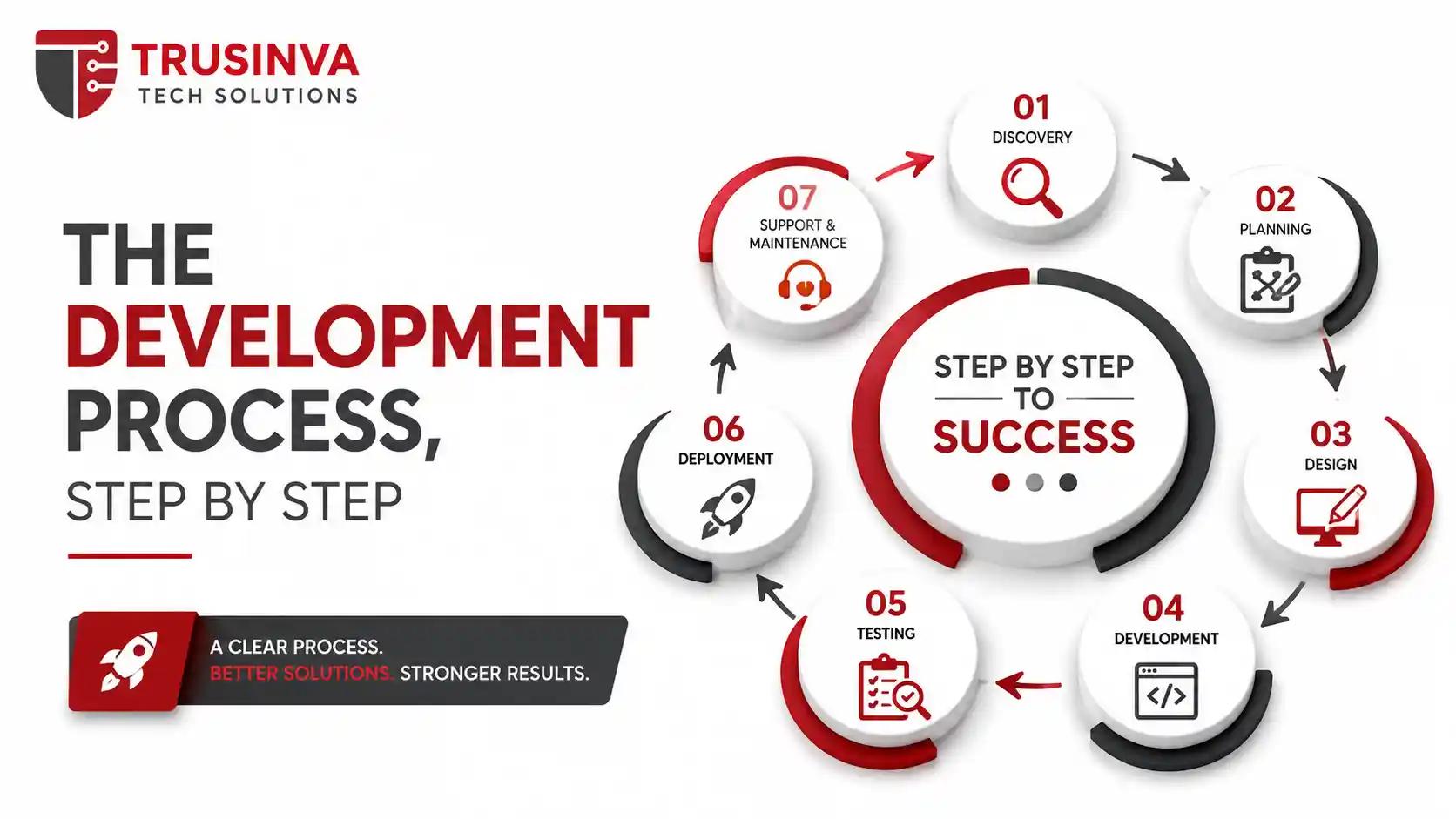
- Discovery & Requirement Analysis — Understanding business goals, current pain points, and technical constraints.
- UI/UX Design — Wireframes and prototypes built around real user behavior, not guesswork.
- Development — Frontend and backend built in sprints, often using frameworks like React, Node.js, or .NET depending on the project.
- Quality Assurance — Functional, security, and performance testing before anything ships.
- Deployment — Cloud hosting setup, often on AWS, Azure, or similar infrastructure.
- Maintenance & Support — Bug fixes, updates, and scaling support as your business grows.
Businesses exploring this process for the first time often start with a smaller build — like an MVP development engagement — before committing to a full enterprise rollout. It's a lower-risk way to validate the product before scaling investment.
6. Cost of Custom Software Development in the USA
Costs vary significantly based on project scope, integrations, and complexity. A simple internal tool or MVP typically costs far less than a full enterprise platform with multiple integrations, custom security layers, and ongoing DevOps support.
Factors that influence cost:
- Number of features and user roles
- Integration with existing systems (CRM, ERP, payment gateways)
- Compliance requirements (HIPAA, SOC 2, GDPR)
- Platform (web, mobile, or both)
- Ongoing maintenance and support needs
Important note: The cheapest quote is rarely the best value. Underpriced projects often cut corners on QA testing or security — costs that resurface later as expensive fixes.
7. Industries That Benefit Most
- Healthcare: Patient portals, scheduling systems, HIPAA-compliant record management.
- Logistics: Fleet tracking, dispatch automation, route optimization.
- Finance & FinTech: Secure transaction processing, compliance reporting.
- eCommerce: Custom checkout flows, inventory automation, and platforms built through Shopify development or fully custom storefronts.
- Professional services: CRM systems tailored to sales pipelines, like those built through CRM development engagements.
8. Common Mistakes to Avoid
- Skipping the discovery phase to "save time"
- Choosing a vendor based on price alone
- Underestimating the importance of QA testing
- Failing to plan for post-launch maintenance
- Not aligning stakeholders before development begins
- Treating the website or app launch as the finish line instead of the starting point — this is where many businesses also underinvest in SEO services to actually drive users to the product
9. Future Trends in 2026
- AI-powered features are now expected in most enterprise software, from intelligent automation to AI chatbots.
- Cloud-native architecture continues to replace traditional on-premise systems.
- DevOps and CI/CD pipelines are standard practice, not optional extras.
- Security-by-design is increasingly non-negotiable given rising compliance requirements across industries.
- Low-code/no-code hybrid approaches are being used alongside custom development to speed up delivery for simpler modules.
Why Choose Trusinva Tech Solutions for Custom Software Development Services in the USA?
At Trusinva Tech Solutions, we build custom software solutions that help US businesses streamline operations, improve productivity, and accelerate growth. Our experienced development team creates secure, scalable, and high-performance applications tailored to your unique business goals, whether you need a CRM, ERP, SaaS platform, enterprise application, or workflow automation system. Using the latest technologies and agile development practices, we deliver reliable software with transparent communication, on-time project completion, and ongoing support. From startups to established enterprises, businesses across the USA trust Trusinva Tech Solutions for innovative custom software development that drives long-term success.
10. Frequently Asked Questions
Q1. How long does custom software development take? Timelines vary by scope — a simple MVP can take a few weeks, while a full enterprise platform may take several months.
Q2. Is custom software more expensive than off-the-shelf tools? Upfront costs are usually higher, but custom software often costs less over time since it avoids recurring per-seat licensing fees.
Q3. Can custom software integrate with tools I already use? Yes. Most custom builds are designed to integrate with existing CRMs, ERPs, and third-party APIs.
Q4. Do I need a custom software solution, or would off-the-shelf work? If your workflow is standard and simple, off-the-shelf may work. If your business has specific processes or compliance needs, custom software usually fits better.
Q5. What happens after the software launches? A good development partner provides ongoing maintenance, bug fixes, and scaling support — launch is the beginning, not the end.
Q6. Which industries need custom software the most? Healthcare, finance, logistics, and eCommerce businesses typically see the fastest ROI due to compliance needs and operational complexity.
Q7. Can custom software include AI features? Yes — AI-powered automation, chatbots, and predictive features are increasingly built directly into custom platforms.
Conclusion
Custom software development services USA exist for one simple reason: generic tools eventually stop fitting how real businesses operate. Whether you're a startup building your first MVP or an enterprise modernizing legacy systems, the right development partner can turn your operational bottlenecks into a scalable advantage. Trusinva Tech Solutions works with businesses across the USA to design and build software that fits their actual workflow — not a template. If you're ready to explore what a custom-built solution could look like for your business, Book a Seat for a free consultation and let's talk through your project.