If you're running a small business in the United States and still tracking leads in spreadsheets or sticky notes, you already know the pain: missed follow-ups, scattered customer data, and deals that quietly slip through the cracks. This is exactly the gap that custom CRM development closes. At Trusinva Tech Solutions, we build CRM development services tailored to how small US businesses actually sell, not how a generic template thinks they should. This guide walks through what custom CRM software really is, why it matters for small businesses in the USA, what it costs, and how to choose the right approach — including a look at our own past CRM projects for sales teams.
What Is Custom CRM Development?
Custom CRM development is the process of designing and building a customer relationship management system from the ground up (or by heavily customizing an existing platform) so it matches your exact sales process, customer data, and reporting needs — instead of forcing your business to adapt to a one-size-fits-all tool like Salesforce or HubSpot.
In short:
- Custom CRM software is built around your workflow, not the other way around.
- It centralizes customer data, sales pipelines, and communication in one place.
- It can include AI-powered features like predictive lead scoring and automated follow-ups.
- It's usually more cost-effective long term for small businesses with specific needs, since you're not paying for a stack of features you'll never use.
Why Small Businesses in the USA Need Custom CRM Software
Small businesses across the USA — from Texas contractors to New York retail brands — are under constant pressure to do more with fewer people. A CRM system solves a very specific problem: it stops customer information from living in someone's inbox, someone's head, or a dozen disconnected spreadsheets.
A few reasons custom CRM development has become a priority for small business CRM software buyers in 2026:
- Lead management is broken without it. Without a lead management system, sales reps chase leads inconsistently, and follow-ups get forgotten.
- Customer data is scattered. Email, calls, invoices, and support tickets often live in separate tools with zero connection between them.
- Off-the-shelf CRM software often doesn't fit. Platforms like Salesforce and HubSpot are built for enterprise-scale complexity, and small teams end up paying for modules they never touch.
- AI-powered CRM is now expected, not optional. Buyers increasingly expect sales automation, predictive analytics, and AI-assisted follow-ups baked into the system.
Industry research backs this up: small businesses that adopt CRM software report meaningfully higher lead conversion rates, and CRM is widely cited as one of the highest-ROI technology investments a small business can make — some benchmarks put the average return well above $8 for every $1 spent, though actual results depend heavily on how well the system is adopted by the team. That's a strong argument for getting the CRM development process right the first time, rather than buying an off-the-shelf CRM system and hoping it fits.
Benefits of Custom CRM Development
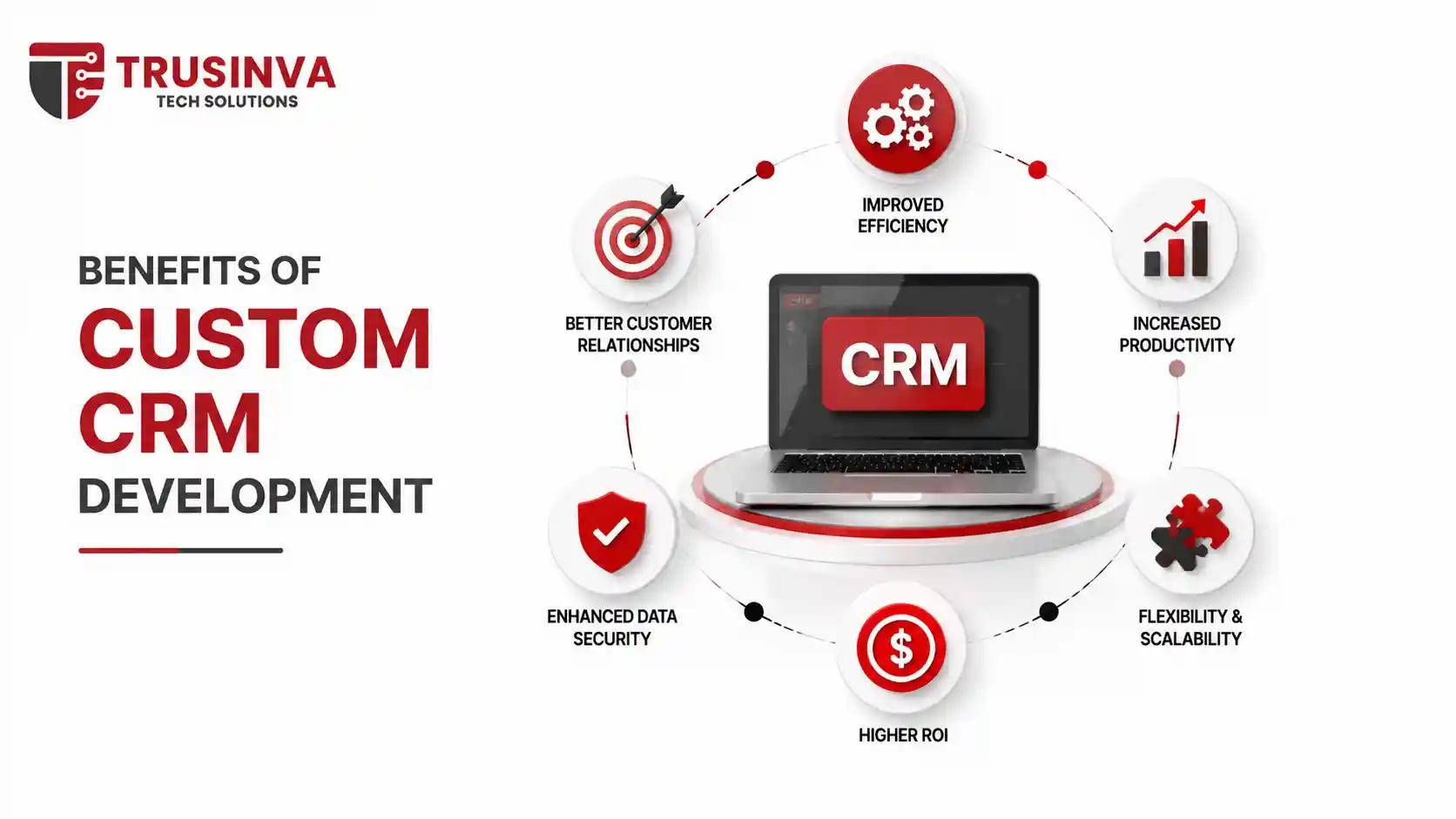
A well-built custom CRM system does more than store contact information. Here's what small businesses in the USA typically gain:
- A single source of truth. Sales, support, and marketing teams all work from the same customer data, eliminating duplicate records and conflicting information.
- Automated workflows. Repetitive tasks — sending follow-up emails, updating deal stages, assigning leads — happen automatically through CRM workflow automation.
- Better sales pipeline visibility. Managers can see exactly where every deal sits, which reps are hitting targets, and where deals are stalling.
- Custom reporting dashboards. Instead of exporting data into Excel, you get real-time dashboards built around the metrics that actually matter to your business.
- Scalability. A custom CRM system development project is built to grow with you — adding users, features, or integrations without needing to migrate platforms later.
- Ownership. Unlike SaaS CRM subscriptions, a custom-built system can be fully owned by your business, with no per-seat licensing fees eating into margins as you grow.
For small businesses evaluating custom software development more broadly, a CRM is often the highest-impact place to start, since it directly touches revenue.
Key Features of a Small Business CRM System
Not every business needs every feature, but most small business CRM software builds include:
- Lead management — capturing, scoring, and routing leads automatically
- Sales pipeline tracking — a visual view of every deal stage, from first contact to close
- Customer database — a centralized, searchable record of every customer interaction
- Marketing and sales automation — automated emails, reminders, and task assignments
- Reporting and analytics dashboard — real-time visibility into sales performance
- AI-powered analytics — predictive lead scoring, churn prediction, and next-best-action suggestions
- Third-party integrations — connections to email, accounting, e-commerce, or ERP systems
- Mobile access — CRM data available on the go, which now accounts for the majority of daily CRM usage across small businesses
H3: Step-by-Step Guide to the Custom CRM Development Process
Here's what a typical custom CRM software development project looks like from start to finish:
- Requirement analysis. We start by mapping your actual sales process — how leads come in, how deals move, what data your team needs to see. This step determines almost everything that follows.
- UI/UX design. A CRM your team won't use is a wasted investment. We design an interface built around real usage, not just feature lists — this is where our UI/UX design work matters most.
- Development. The CRM platform is built using a scalable architecture — typically cloud-based, so your team can access it from anywhere.
- Integration. The CRM is connected to your existing tools: email, accounting software, marketing platforms, or an ERP system if you run one.
- Testing. Every workflow, automation rule, and integration is tested against real-world scenarios before launch.
- Deployment and training. The system goes live, and your team gets hands-on training so adoption doesn't stall in week one — a common reason CRM projects fail to deliver ROI.
- Ongoing support. Post-launch, most businesses need occasional customization, bug fixes, or new feature requests as their sales process evolves.
H4: Tips for a Successful CRM Rollout
- Involve your sales team early. A CRM designed without input from the people using it daily is far more likely to be abandoned.
- Start with core workflows. Don't try to automate everything on day one — nail lead capture and pipeline tracking first, then expand.
- Clean your existing data before migration. Garbage data in a new system is still garbage data.
- Set a realistic timeline. Rushed CRM development often means skipped testing, which shows up as bugs later.
- Plan for training time. Poor adoption, not poor software, is the most common reason CRM projects underperform.
Custom CRM vs. Ready-Made CRM (Salesforce, HubSpot)
This is one of the most common questions small business owners ask before starting a CRM development project.
| Factor | Custom CRM Development | Ready-Made CRM (Salesforce, HubSpot) |
| Fit to your workflow | Built exactly around your process | You adapt your process to the platform |
| Ongoing cost | One-time build + maintenance | Recurring per-seat licensing fees |
| Feature bloat | Only what you need | Often includes unused enterprise features |
| Scalability | Fully controlled by you | Limited by the vendor's pricing tiers |
| Time to launch | Longer initial build | Faster initial setup |
| Ownership | You own the system | You're renting access |
For a small business with a fairly standard sales process and a tight timeline, a ready-made platform can be the faster starting point. But for businesses with unusual workflows, specific compliance needs, or a desire to avoid growing SaaS CRM subscription costs, custom CRM development for small businesses in the USA is usually the stronger long-term investment. Many businesses in industries like real estate, healthcare, or logistics choose custom builds specifically because generic CRM software doesn't map well to their sales cycle.
How Much Does Custom CRM Development Cost in the USA?
CRM development cost varies widely depending on complexity, but here's a general framework small business owners can use to budget:
- Basic custom CRM (lead tracking, pipeline, basic reporting): lower end of the budget range, suitable for very small teams
- Mid-tier custom CRM (automation, integrations, custom dashboards): mid-range investment, the most common choice for growing small businesses
- Advanced AI-powered CRM (predictive analytics, multi-channel automation, ERP/API integrations): higher investment, typically for businesses with more complex sales operations
Compare that against ready-made CRM software, where small businesses commonly pay a recurring monthly fee per user — a cost that compounds every year and scales with headcount, regardless of whether every feature gets used.
The real cost driver isn't the CRM itself — it's the complexity of your requirements, the number of integrations, and how much customization your workflows need. That's why we always start CRM development projects with a scoping call rather than a flat quote.
Real-World Example: What a Custom CRM Solves
Consider a typical small US service business — say, a regional logistics or field-services company. Before a custom CRM, sales reps track leads in personal notebooks or shared spreadsheets. Follow-ups get missed. Management has no real visibility into which reps are performing or where deals stall.
After a custom CRM system development project, the same business typically sees:
- A centralized lead management system that automatically assigns and tracks every inbound lead
- A visual sales pipeline that shows exactly where every deal sits
- Automated follow-up reminders that cut down on missed opportunities
- A reporting dashboard that gives ownership real-time visibility without asking for a manual report
This mirrors what we cover in more depth in our related blog post on CRM development solutions for US sales teams.
The Future: AI-Powered CRM Development
CRM in 2026 looks very different from CRM even three years ago. The biggest shift is AI. Modern CRM development increasingly includes:
- Predictive lead scoring — AI ranks which leads are most likely to convert
- AI-generated follow-ups — automatically drafted emails based on conversation history
- Churn prediction — flagging at-risk customers before they leave
- Conversational AI assistants — built into the CRM to answer sales rep questions instantly
- No-code automation builders — letting non-technical staff adjust workflows without a developer
Businesses that invest in AI CRM development services now are positioning themselves ahead of competitors still relying on static, manual systems. If you're exploring this alongside other growth channels, it's worth pairing CRM automation with your broader digital marketing and SEO strategy, since a stronger pipeline is only useful if it's full of the right leads.
Why Choose Trusinva Tech Solutions for Custom CRM Development
Trusinva Tech Solutions builds custom CRM software for small businesses across the USA, with a focus on systems teams actually use — not just systems that look good in a demo. Our approach includes:
- Requirement analysis built around your real sales process, not a generic template
- Clean, modern UI/UX design so adoption doesn't become a training headache
- Integration with the tools you already run, including ERP, accounting, and marketing platforms
- AI-powered features where they genuinely add value, not as a checkbox
- Ongoing support after launch, since a CRM should evolve as your business does
Beyond CRM, we also support small businesses with web development, mobile app development, and broader software development services, so your CRM can sit inside a connected digital ecosystem rather than as an isolated tool. You can see examples of our work on our projects page.
FAQs About Custom CRM Development
Q1. What is custom CRM development? Custom CRM development is building a customer relationship management system designed specifically around your business's sales process, customer data, and reporting needs, rather than using a generic off-the-shelf platform.
Q2. How much does it cost to build a custom CRM system? Cost depends on complexity — a basic system with lead tracking and reporting costs less than an advanced AI-powered CRM with multiple integrations. Most small businesses fall into a mid-range budget once automation and integrations are included.
Q3. Why should small businesses use a custom CRM instead of Salesforce or HubSpot? A custom CRM avoids paying for unused enterprise features, removes recurring per-seat licensing costs, and can be built to match workflows that ready-made platforms don't support well.
Q4. How long does CRM software development take? Timelines vary by scope, but most small business CRM projects move through requirement analysis, design, development, integration, and testing over a period of several weeks to a few months.
Q5. Can a custom CRM integrate with my existing software? Yes. Custom CRM development typically includes integration with email platforms, accounting software, marketing tools, and ERP systems your business already uses.
Q6. Is custom CRM better than ready-made CRM software? It depends on your business. Ready-made CRM software can be faster to launch for simple, standard sales processes. Custom CRM development tends to deliver better long-term value for businesses with specific workflows, compliance needs, or a desire to avoid growing SaaS subscription costs.
Conclusion: Ready to Build a CRM That Actually Fits Your Business?
Custom CRM development isn't about chasing the newest technology — it's about giving your sales team a system that matches how they actually work, so leads stop slipping through the cracks and your data finally lives in one place. Whether you're a small business in California, Texas, Florida, or anywhere else in the USA, the right CRM system can be the difference between guessing at your pipeline and actually managing it.
If you're ready to explore what a custom CRM system could look like for your business, book a free consultation with Trusinva Tech Solutions and let's map out a system built around how you sell — not around a generic template.