Every growing business eventually hits the same wall: spreadsheets stop working, sales leads slip through the cracks, and off-the-shelf software feels either too rigid or too expensive. That's usually the moment a US business starts asking, "How much does it actually cost to build a custom CRM?" At Trusinvatechsolutions, we get this question from founders, sales directors, and operations leads almost every week, and the honest answer is: it depends on what you need, not what a generic price list says. This guide breaks down real 2026 pricing, the factors that move the number up or down, and how our CRM development services approach a project from the first conversation to launch day.
By the end of this article, you'll understand what a custom CRM actually involves, what a realistic budget looks like for a small business versus an enterprise, and how to avoid overpaying for features you'll never use. We'll also compare building custom against buying a subscription like Salesforce, walk through the development process step by step, and answer the questions US business owners ask most often before they contact a development partner.
Custom CRM Development Cost in 2026
The average cost to build a custom CRM in the USA ranges from $20,000 to $250,000+, depending on features, integrations, complexity, and the size of the development team. A basic CRM with core contact and pipeline management typically costs $20,000–$50,000. A mid-tier CRM with automation, reporting, and third-party integrations runs $50,000–$150,000. Enterprise-grade CRM platforms with AI features, custom workflows, and multi-department access often exceed $150,000.
Most small-to-mid-sized US businesses land somewhere in the $35,000–$90,000 range for a functional, production-ready CRM.
What Is a Custom CRM, and Why Does It Matter?
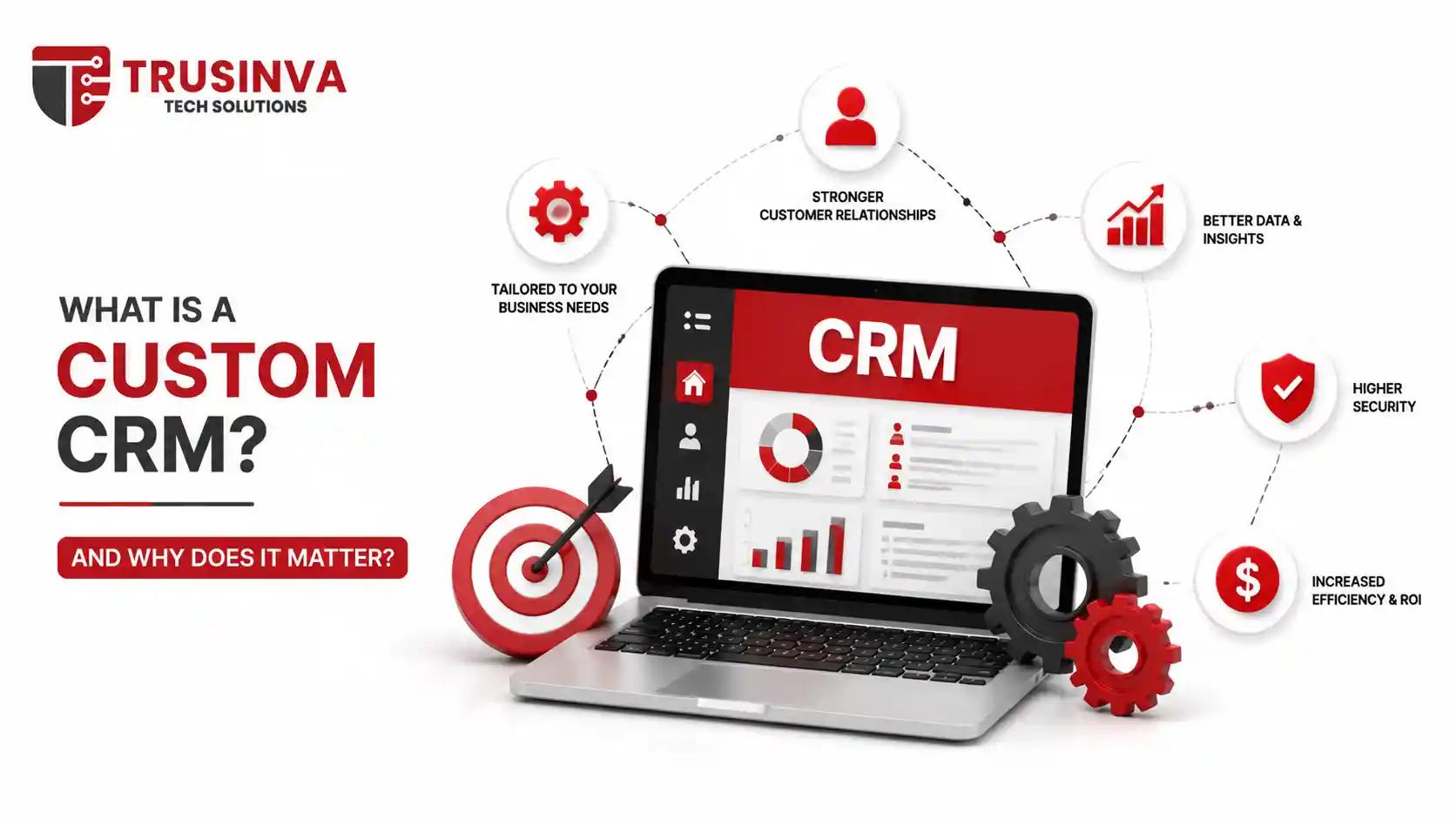
A custom CRM (customer relationship management system) is software built specifically around how your business actually sells, supports, and retains customers — instead of forcing your team to adapt to someone else's workflow.
Unlike off-the-shelf platforms, a custom CRM gives you:
- Full ownership of your customer data and infrastructure
- Workflows that match your exact sales or service process
- No recurring per-seat licensing fees that scale painfully with headcount
- The freedom to integrate any tool, API, or AI model you choose
- A system that grows and changes as your business changes
For US businesses in competitive industries — logistics, healthcare, finance, ecommerce, and professional services — a generic CRM often becomes a bottleneck within 12–18 months. That's usually when companies start exploring custom CRM software development as a long-term investment rather than a monthly expense.
Why It's Especially Important Right Now
2026 has brought a shift in how CRMs are built and used. Sales and support teams increasingly expect AI-assisted lead scoring, automated follow-ups, and predictive analytics built directly into their CRM — features that many legacy platforms only offer at their most expensive pricing tiers, if at all. Businesses building custom CRM systems today are baking AI in from day one, rather than bolting it on later.
Step-by-Step Guide: How Custom CRM Development Works
Understanding the process helps explain where the cost actually comes from. Here's how a typical custom CRM development project unfolds.
Step 1: Discovery and Requirements Mapping
The development team studies your sales pipeline, support process, and existing tools. This stage defines what "done" looks like and prevents scope creep later.
Step 2: System Architecture and Database Design
Engineers design the database structure, decide on cloud infrastructure, and plan how the CRM will scale as your data and user count grow.
Step 3: UI/UX Design
A CRM is only useful if your team actually enjoys using it. This phase focuses on dashboard layout, navigation, and reducing clicks for repetitive tasks — an area where our UI/UX design team spends significant time refining usability.
Step 4: Core Development
This is where contact management, deal pipelines, task automation, and permission structures get built. It's typically the largest portion of the budget.
Step 5: Integrations
Most custom CRMs connect to email platforms, calendars, payment systems, marketing tools, or third-party APIs. Each integration adds development hours and testing time.
Step 6: AI and Automation Features (Optional but Increasingly Standard)
Lead scoring, automated email sequences, chatbot support, and predictive analytics can be layered in here.
Step 7: Testing and Quality Assurance
Bug testing, load testing, and security testing happen before launch to avoid costly post-launch fixes.
Step 8: Deployment and Training
The CRM goes live, and your team gets onboarded so adoption doesn't stall in the first month.
Step 9: Ongoing Support and Maintenance
Most agencies, including ours, offer maintenance packages after launch to handle updates, bug fixes, and new feature requests.
Custom CRM Development Cost Breakdown (2026)
Here's a realistic pricing table based on current US market rates for custom software development.
| CRM Type | Estimated Cost | Typical Timeline | Best For |
| Basic CRM | $20,000 – $50,000 | 6–10 weeks | Startups, small sales teams |
| Mid-Tier CRM | $50,000 – $150,000 | 3–6 months | Growing businesses, multi-department teams |
| Enterprise CRM | $150,000 – $300,000+ | 6–12 months | Large organizations, complex workflows |
| AI-Powered CRM Add-Ons | $10,000 – $60,000 (additional) | Varies | Businesses wanting predictive analytics or automation |
These figures reflect US-based development costs. Businesses that outsource CRM development to experienced offshore or nearshore teams, like ours, often reduce total project cost by 30–50% without sacrificing quality, since hourly development rates are typically lower while engineering standards remain high.
Factors Affecting Custom CRM Development Cost
Several variables push the final number up or down. Here's what actually moves the budget.
- Number of features — A CRM with just contact and pipeline management costs far less than one with automation, reporting, and AI built in.
- Integrations — Connecting to email marketing tools, accounting software, or payment gateways adds development hours per integration.
- Complexity of workflows — Multi-stage approval processes, role-based permissions, and custom reporting logic increase build time.
- Platform choice — Web-only CRMs cost less than CRMs that also need dedicated mobile app development.
- Team location and structure — In-house US developers typically bill $100–$180/hour, while experienced outsourced teams often bill $30–$70/hour for comparable output.
- Data migration — Moving historical customer data from an old system adds cleanup and mapping time.
- AI features — Predictive analytics, lead scoring models, and AI chatbots require additional data science and engineering work.
- Ongoing maintenance — Post-launch support is usually billed separately, often 15–20% of the original build cost annually.
Tips to Control Your CRM Development Budget
- Start with a Minimum Viable Product (MVP) instead of every feature at once.
- Prioritize the 3–5 workflows your sales team uses daily before adding "nice-to-have" features.
- Choose a development partner that offers a fixed-scope discovery phase before quoting a full project price.
- Ask whether AI features can be added in Phase 2 rather than the initial build.
- Request a detailed cost breakdown by feature, not just a lump-sum number.
Custom CRM vs Salesforce vs Ready-Made CRM Software
This is one of the most common questions we hear before a project even starts: is it cheaper to just buy Salesforce, HubSpot, or another subscription CRM?
Ready-made CRM software (Salesforce, HubSpot, Zoho):
- Lower upfront cost, but ongoing per-seat licensing adds up fast
- Faster to launch
- Limited customization without expensive add-ons or third-party plugins
- You don't own the platform — pricing and features can change
Custom CRM software:
- Higher upfront investment
- No recurring per-seat fees
- Built exactly around your sales process
- Full data ownership and flexibility to add AI or automation on your terms
- Better long-term ROI for businesses with 20+ users or unique workflows
As a general rule: if your team is under 10 people with a simple sales process, a subscription CRM is often more cost-effective. If you're scaling past 15–20 users, or your workflow doesn't fit a template, a custom CRM system usually pays for itself within 18–24 months by eliminating licensing fees and inefficiencies.
Key Features Every Custom CRM Should Have
- Centralized contact and account management
- Visual sales pipeline with drag-and-drop deal stages
- Task and follow-up automation
- Email and calendar integration
- Custom reporting dashboards
- Role-based access and permissions
- Mobile access for field or remote sales teams
- API access for future integrations
- AI-powered lead scoring (increasingly standard in 2026 builds)
Benefits of Building a Custom CRM
- Better data accuracy — one centralized source of truth instead of scattered spreadsheets
- Faster sales cycles — automated follow-ups and reminders reduce dropped leads
- Stronger customer retention — support teams see full customer history in one place
- Scalability — the system grows with your business instead of forcing a costly re-platform later
- Competitive advantage — workflows built around your actual sales process instead of a generic template
AI-Powered CRM: The Biggest Trend in 2026
AI is no longer an optional add-on for CRM systems — it's becoming the standard businesses expect. AI-powered CRM development now commonly includes:
- Predictive lead scoring that ranks prospects by likelihood to close
- Automated email drafting and follow-up sequencing
- AI chatbots that qualify leads before a human ever gets involved
- Sentiment analysis on customer support conversations
- Forecasting tools that predict revenue trends based on pipeline data
Businesses that build AI-powered CRM software today are positioning themselves ahead of competitors still relying on manual data entry and static dashboards. Our team frequently pairs CRM builds with our broader AI automation capabilities so clients don't need a second vendor for AI features later.
Why Choose Trusinvatechsolutions for Custom CRM Development
We've built CRM systems for US businesses across sales, logistics, and healthcare-adjacent services, and a few things consistently set our approach apart:
- Transparent, itemized pricing — you see exactly what each feature costs before development starts
- US-market experience — we understand American sales cycles, compliance expectations, and integration needs
- Full-stack capability — CRM projects often connect to web development, mobile app development, and marketing tools, and our team builds all of it under one roof
- Post-launch support — we don't disappear after deployment; ongoing maintenance keeps your CRM running smoothly
- Competitive development rates — clients typically save 30–50% compared to hiring a US-only in-house team, without cutting corners on quality
You can see examples of our recent builds on our projects page, and read more about how custom CRM systems are helping US sales teams in our related article on CRM development solutions for US sales teams.
Real-World Example: A Mid-Sized Logistics Company
Consider a mid-sized freight brokerage with 25 sales reps managing hundreds of active shipments and client accounts. Before switching to a custom CRM, the team relied on spreadsheets and a basic subscription tool that didn't handle their multi-stage approval process well.
After a custom CRM build (mid-tier, roughly $85,000, delivered in about 4 months), the company consolidated dispatch tracking, client communication, and invoicing status into one dashboard. Sales reps reported faster follow-up times, and management gained real-time visibility into pipeline health — something the old spreadsheet system never allowed.
This kind of outcome is common across industries: the value of a custom CRM isn't just the software itself, but the operational clarity it creates.
The Future of Custom CRM Development
Looking ahead, a few trends are shaping where CRM development is headed for US businesses:
- AI agents handling first-contact interactions before a human sales rep steps in
- Deeper integration with communication platforms so CRMs become the single hub for calls, emails, and messages
- No-code customization layers that let non-technical teams adjust workflows without a developer
- Predictive analytics becoming standard, not a premium add-on
- Stronger data privacy controls as US businesses face growing compliance expectations around customer data
Businesses that invest in a custom CRM now are building a foundation that can absorb these changes without another expensive re-platform in a few years.
Frequently Asked Questions
How much does it cost to build a custom CRM in the USA? Costs typically range from $20,000 for a basic CRM to $250,000+ for an enterprise-grade system with AI features, depending on complexity and integrations.
Is custom CRM cheaper than Salesforce in the long run? For teams under 10–15 users, Salesforce or similar subscriptions are often cheaper short-term. For larger teams or unique workflows, a custom CRM usually becomes more cost-effective within 18–24 months due to eliminated licensing fees.
How long does it take to develop a custom CRM? A basic CRM typically takes 6–10 weeks. Mid-tier systems take 3–6 months, and enterprise CRMs with AI and complex integrations can take 6–12 months.
What factors affect CRM development cost the most? Number of features, integration complexity, AI functionality, and whether the CRM needs a dedicated mobile app are the biggest cost drivers.
Can a small business afford a custom CRM? Yes. Starting with an MVP (minimum viable product) focused on core pipeline and contact management typically costs $20,000–$35,000, with additional features added in later phases.
Does a custom CRM include AI features by default? Not automatically, but AI features like lead scoring and automated follow-ups are increasingly requested as standard additions rather than optional extras in 2026 builds.
Final Thoughts and Next Steps
Building a custom CRM in 2026 is less about chasing a trend and more about solving a real operational problem: disconnected data, missed follow-ups, and software that doesn't match how your team actually sells. Whether your budget is $25,000 for a lean MVP or $200,000 for a full enterprise platform with AI baked in, the right development partner should walk you through exact costs before writing a single line of code.
If you're ready to get a real number for your project, Trusinvatechsolutions offers a free discovery consultation to map out your requirements and provide an itemized cost breakdown — no generic pricing, no surprise add-ons. Explore our full range of software development services, check out our CRM development page, or contact our team today to discuss your project and get a tailored quote.