Quick Answer
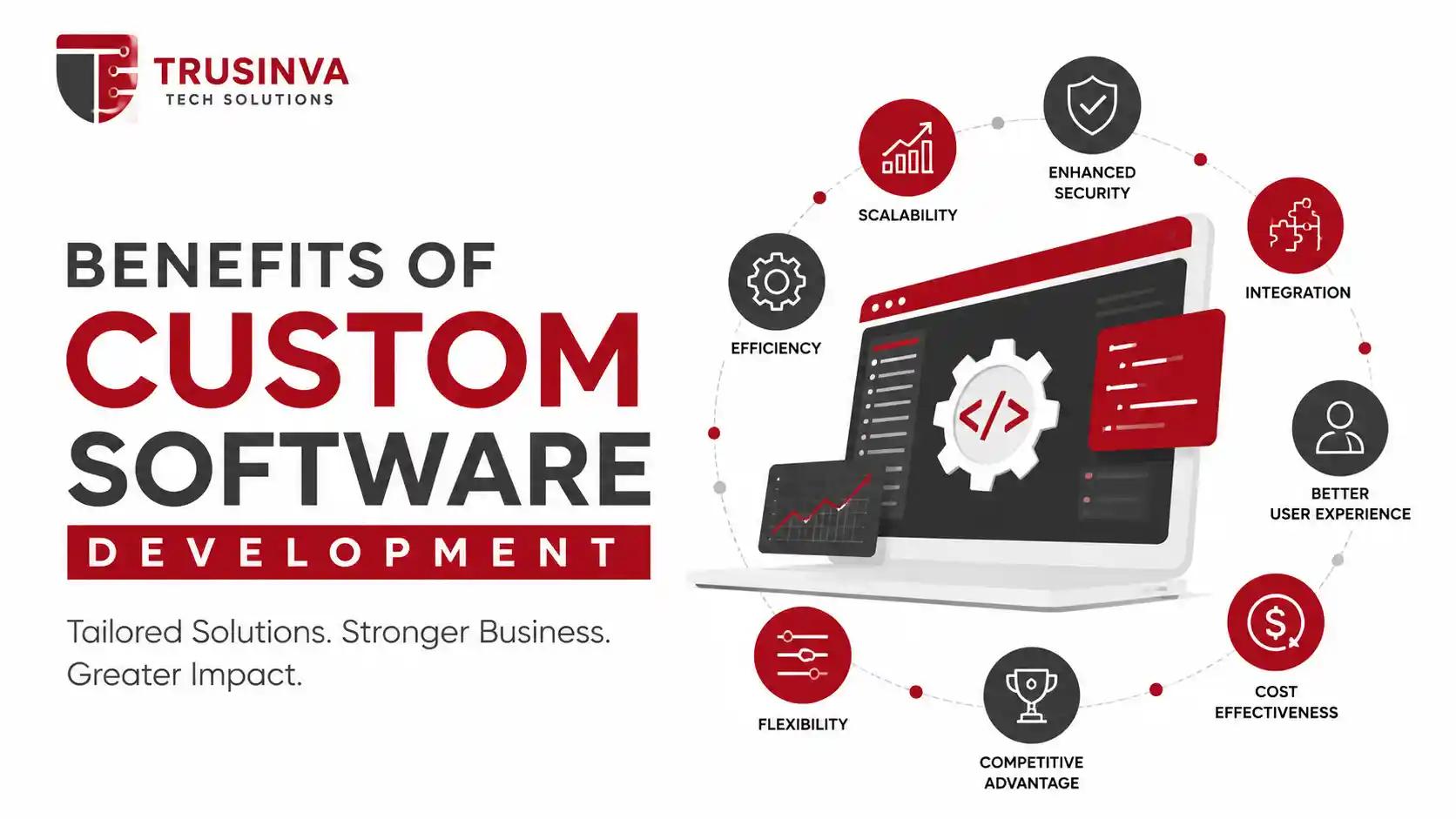
Custom software development gives businesses tailored functionality, better scalability, stronger security, and seamless integration with existing systems — advantages off-the-shelf software rarely delivers. Instead of paying for unused features or working around software limitations, businesses get applications built precisely around their workflows, which improves efficiency, reduces long-term costs, and supports sustainable growth.
Introduction
Every business eventually hits the same wall: the software that once made things easier starts holding growth back. Spreadsheets turn into workarounds, off-the-shelf tools charge more every year for features you don't use, and your team spends more time adapting to software than the software spends adapting to you. This is usually the point where businesses start looking seriously at custom software development.
At Trusinva Tech Solutions, we work with startups, small businesses, and growing enterprises across the US to design software that fits how they actually operate — not the other way around. Whether that means a purpose-built web development platform, a tailored CRM development system, or a dedicated mobile app development solution, custom software gets designed around your workflows, your users, and your growth plans. In this guide, we'll walk through the real, practical benefits of custom software development, where it outperforms off-the-shelf platforms, what it costs, and how to know if it's the right move for your business.
Key Takeaways
- Custom software is built around your specific business requirements, not generic industry assumptions.
- It eliminates recurring licensing fees tied to per-user SaaS pricing models.
- Custom applications scale with your business instead of forcing a costly platform migration later.
- Security and compliance controls can be built in from day one, which matters for healthcare, finance, and logistics businesses.
- Integration with existing tools (CRM, ERP, APIs, databases) is far easier with custom-built systems.
- The upfront investment is higher than off-the-shelf software, but the total cost of ownership is often lower over time.
Table of Contents
- What Is Custom Software Development?
- Custom Software vs. Off-the-Shelf Software
- Top Benefits of Custom Software Development
- Industry-Specific Benefits
- Disadvantages to Consider
- Custom Software Development Cost
- How the Custom Development Process Works
- Common Mistakes Businesses Make
- Expert Tips and Best Practices
- Future Trends in Custom Software
- FAQs
- Conclusion
1. What Is Custom Software Development?
Custom software development is the process of designing, building, and maintaining software specifically for one organization's requirements, rather than selling the same product to many businesses. It's also called bespoke software development, and it stands in direct contrast to commercial, off-the-shelf (COTS) or SaaS products like generic CRM or accounting tools.
Instead of adjusting your operations to fit a vendor's assumptions about how "most businesses" work, custom software starts with your actual business workflows — your data structure, your user roles, your compliance needs — and builds the application around them.
Custom software typically includes:
- Application architecture designed for your specific use case
- Custom functionality mapped to real business requirements
- Integration with your existing databases, APIs, and third-party tools
- Security and access control built around your compliance obligations
- Long-term ownership of the source code and system
2. Custom Software vs. Off-the-Shelf Software
Direct answer: Custom software is built specifically for one business's workflows and is owned by that business, while off-the-shelf software is a pre-built product sold to many businesses under a subscription or license model. The right choice depends on how unique your processes are and how long you plan to scale on the platform.
| Factor | Custom Software | Off-the-Shelf Software |
| Fit to business workflows | Built around your exact processes | Built for generic, broad use cases |
| Ongoing costs | Higher upfront, lower long-term | Lower upfront, recurring subscription costs |
| Scalability | Scales with business needs | Often limited by vendor's plan tiers |
| Integration | Designed for your existing systems | May require workarounds or middleware |
| Ownership | You own the software and source code | Vendor owns the platform |
| CustomizationCustomizationCustomizationCustomization | Fully flexible | Limited to vendor's settings |
| Time to deploy | Longer development timeline | Immediate or fast setup |
| Security | Controls tailored to your compliance needs | Shared, standardized security model |
Off-the-shelf software makes sense for standard, well-understood processes like basic accounting or email. Custom software makes more sense when your workflows, compliance requirements, or growth plans don't fit neatly into a generic product.
3. Top Benefits of Custom Software Development
3.1 Tailored to Your Exact Business Requirements
Direct answer: Custom software is designed around your specific business processes, so employees work the way they already do instead of adapting to a vendor's generic workflow. This reduces training time and eliminates the awkward workarounds common with commercial software.
Off-the-shelf platforms are built for the "average" business in an industry. Custom software is built for yours specifically — your approval chains, your data fields, your reporting needs, your user roles. That precision is often the single biggest reason businesses move to custom development after outgrowing SaaS tools.
3.2 Long-Term Cost Efficiency
Direct answer: While custom software has a higher upfront cost, it usually results in a lower total cost of ownership because there are no recurring per-user licensing fees, forced upgrades, or unused features you're still paying for.
SaaS pricing models often scale with your headcount, meaning your software bill grows every time you hire — regardless of whether new employees even need every feature. Custom software has fixed development costs and predictable maintenance costs, which makes long-term budgeting far more manageable, especially for growing teams.
3.3 Scalability That Matches Business Growth
Direct answer: Custom software architecture is built to scale alongside your business, avoiding the plan limits, seat caps, or performance ceilings that come with commercial platforms.
A scalable software architecture means you can add users, features, and data volume without hitting artificial vendor-imposed limits. This matters most for businesses expecting rapid growth, seasonal spikes, or expansion into new markets or service lines.
3.4 Seamless Integration With Existing Systems
Direct answer: Custom-built software is designed from the start to integrate with your existing tools — CRM, ERP, databases, and third-party APIs — reducing the data silos and manual re-entry common with disconnected off-the-shelf tools.
Whether you're connecting to Salesforce, SAP, Microsoft Dynamics 365, or an internal database, custom applications can be architected with API integration and system integration in mind, so information flows automatically between systems instead of living in separate, disconnected platforms.
3.5 Stronger Security and Compliance Controls
Direct answer: Custom software allows businesses to build security, encryption, authentication, and access control specifically around their compliance requirements — which is critical for industries like healthcare (HIPAA), finance (PCI DSS), and businesses handling sensitive customer data.
Generic software applies the same security model to every customer, regardless of industry. Custom development lets you align with frameworks like OWASP, NIST, or ISO/IEC 27001 based on your actual risk profile, rather than relying on a vendor's one-size-fits-all approach.
3.6 Full Ownership and Independence
Direct answer: With custom software, your business owns the source code, data, and system architecture outright — there's no dependency on a third-party vendor's pricing changes, feature removals, or platform shutdowns.
This ownership also means you're not locked into a vendor's roadmap. If your business needs a new feature next quarter, you're not waiting for a SaaS company to prioritize it — your development team builds it on your timeline.
3.7 Competitive Advantage Through Unique Functionality
Direct answer: Custom software lets businesses build features and workflows competitors using generic tools simply don't have access to, creating a genuine operational advantage.
If every competitor in your space uses the same off-the-shelf CRM or booking system, there's very little differentiation in how efficiently they operate. Custom functionality — built around your specific customer experience or internal process — becomes a real competitive edge.
3.8 Better User Experience for Employees and Customers
Direct answer: Because custom software is designed around actual user requirements and real workflows, it typically delivers a smoother, more intuitive user experience than generic platforms trying to serve every type of business at once.
This applies to both internal tools your employees use daily and customer-facing applications. A well-designed custom platform, informed by proper UI/UX design, reduces friction, increases adoption, and improves productivity across the board.
3.9 Business Process Automation
Direct answer: Custom software can automate repetitive, manual tasks specific to your operations — something generic automation tools often can't fully replicate because they're built for broad use cases, not your exact process.
Automation of scheduling, approvals, reporting, and data entry directly reduces manual workload and human error, freeing employees to focus on higher-value work.
3.10 Reliable Long-Term Support and Maintenance
Direct answer: Custom software comes with dedicated maintenance and technical support built around your system, rather than shared support queues used by thousands of other SaaS customers.
Because your development partner understands the full architecture, updates, bug fixes, and improvements happen faster and with fewer disruptions to daily operations.
4. Industry-Specific Benefits
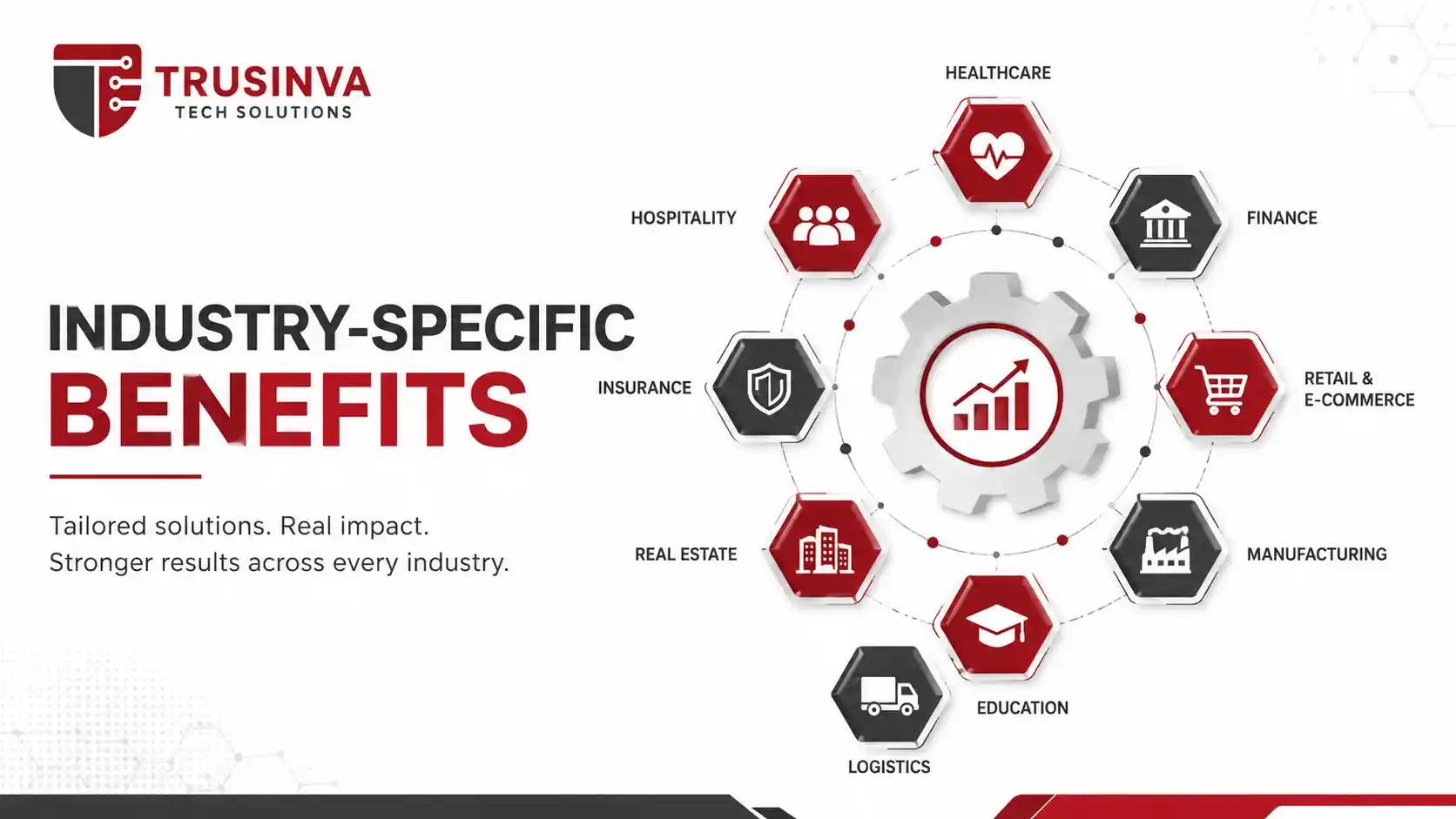
Healthcare businesses benefit from custom software built around HIPAA compliance, patient data security, and specialized billing workflows — something generic practice management tools rarely handle perfectly out of the box.
eCommerce businesses gain custom inventory management, personalized checkout flows, and integrations with platforms like Shopify that generic storefronts can't replicate at scale.
Logistics and transportation businesses use custom dispatch, tracking, and routing systems built around their specific fleet operations, rather than adapting to generic logistics software.
Financial services firms need custom applications with strict access control, audit trails, and PCI DSS-aligned security — areas where off-the-shelf tools often fall short of specific regulatory needs.
Manufacturing companies benefit from custom software connecting production data, inventory, and supply chain systems into one centralized, purpose-built platform.
5. Disadvantages to Consider
Custom software isn't automatically the right choice for every business. Being honest about the trade-offs matters:
- Higher upfront investment compared to subscribing to an existing SaaS tool
- Longer development timeline since the software is built from scratch or heavily customized
- Requires clear requirements gathering upfront — vague goals lead to scope creep
- Ongoing maintenance responsibility falls on your business or development partner, not a large vendor's support team
- Not ideal for simple, standardized needs where a proven off-the-shelf tool already works well
The right approach is usually a candid conversation about your business requirements, budget, and timeline before committing either way.
6. Custom Software Development Cost
Direct answer: Custom software development cost varies widely based on complexity, features, integrations, and timeline — small business applications may start in the low five figures, while enterprise-grade platforms with complex integrations can run significantly higher. Most development partners provide a cost estimate after a requirements consultation.
Key factors that affect pricing include:
- Number of user roles and permission levels
- Complexity of integrations (APIs, databases, third-party platforms)
- Whether the software includes mobile components
- Security and compliance requirements
- Ongoing maintenance and support needs
Businesses evaluating custom software development services should request a clear, itemized estimate rather than a flat quote, since custom projects vary significantly based on scope.
7. How the Custom Development Process Works
- Requirements gathering — Understanding your business workflows, user roles, and technical requirements
- Planning and architecture — Designing the software architecture and choosing the right technology stack
- MVP development — Building a functional first version to validate core features
- Agile development cycles — Iterating through sprints with regular feedback
- Quality assurance and automated testing — Catching bugs before deployment
- Cloud deployment — Launching the application on scalable cloud infrastructure
- Ongoing maintenance — Continuous updates, monitoring, and improvements after launch
This structured approach — often using Agile and DevOps practices with CI/CD pipelines — keeps development transparent and allows businesses to adjust priorities as real-world usage reveals new needs.
8. Common Mistakes Businesses Make
- Skipping proper requirements gathering and starting development with vague goals
- Choosing the cheapest development partner without evaluating technical expertise
- Underestimating the importance of scalable software architecture from day one
- Failing to plan for long-term maintenance and software updates
- Ignoring security and compliance requirements until late in development
- Not involving actual end users in the design process
9. Expert Tips and Best Practices
- Start with a clearly documented list of business and technical requirements before contacting developers
- Prioritize a scalable architecture even if you're starting small — retrofitting scalability later is expensive
- Choose a development partner experienced with your industry's compliance requirements
- Build in monitoring and observability from the start, not as an afterthought
- Plan your budget around total cost of ownership, not just the initial build cost
- Treat MVP development as a learning tool, not a finished product
10. Future Trends in Custom Software (2026 and Beyond)
- Increased use of AI-powered automation within custom business applications
- Growth in microservices architecture for easier scaling and maintenance
- Stronger emphasis on cybersecurity and data privacy as regulations tighten
- Wider adoption of cloud-native development across AWS, Azure, and Google Cloud
- Rising demand for custom CRM and ERP systems tailored to specific industries, supported by services like CRM development and workflow automation platforms
11. Why Choose Trusinva Tech Solutions
Trusinva Tech Solutions delivers custom software solutions designed around your unique business needs—not generic, one-size-fits-all systems. Our solutions help US businesses streamline operations, automate workflows, improve security, scale efficiently, and reduce long-term technology costs. With the right custom software strategy, businesses can gain greater flexibility, productivity, and a competitive advantage in a rapidly evolving digital market.
FAQs
Q1: What is custom software development? Custom software development is the process of building applications specifically designed for one business's requirements, rather than a generic product sold to many companies.
Q2: Is custom software more expensive than off-the-shelf software? Custom software usually has a higher upfront cost but a lower total cost of ownership over time, since there are no recurring per-user licensing fees.
Q3: How long does custom software development take? Timelines vary based on complexity, but most projects range from a few months for an MVP to a year or more for enterprise-grade platforms.
Q4: Who owns custom software after development? The business that commissions the software typically owns the source code, data, and system architecture outright.
Q5: Is custom software more secure than off-the-shelf software? Custom software can be more secure because access control, encryption, and compliance measures are built specifically around your business's risk profile, rather than a generic shared model.
Q6: Can custom software integrate with tools I already use? Yes. Custom software is typically designed with API integration in mind, allowing it to connect with existing CRM, ERP, and third-party systems.
Q7: What businesses benefit most from custom software? Businesses with unique workflows, strict compliance needs, or growth plans that outpace generic SaaS tools benefit the most — including healthcare, logistics, finance, and eCommerce companies.
Q8: Should a small business invest in custom software? It depends on the complexity of their processes. Small businesses with standard needs may be fine with off-the-shelf tools, while those with unique workflows or growth ambitions often benefit from custom development.
Conclusion
Custom software development isn't the right fit for every business, but for companies whose workflows, security requirements, or growth plans have outgrown generic tools, the benefits are hard to ignore — tailored functionality, better scalability, stronger security, and full ownership of the system that runs your operations. The businesses that get the most value are the ones that go in with clear requirements and a development partner who understands both the technical and business side of the build.
If your business is weighing custom software against off-the-shelf tools, the smartest next step is a direct conversation about your specific requirements and budget. Trusinva Tech Solutions works with startups, small businesses, and growing enterprises across the US to design software that fits how they actually operate. Reach out today to Book a Seat for a free consultation and find out what a custom-built solution could look like for your business.