Quick Answer:
Agile software development is an iterative approach to building software where teams work in short cycles called sprints, gather constant feedback, and adapt requirements as they go instead of following a rigid, fixed plan. Rooted in the 2001 Agile Manifesto, it prioritizes working software, customer collaboration, and responding to change over exhaustive documentation and upfront planning.
Introduction
If you've ever wondered why some software projects launch on time and adapt smoothly to changing requirements while others drag on for months and still miss the mark, the answer often comes down to methodology. Agile software development has become the standard approach for building software that actually meets user needs, and it's the process that experienced teams — including the developers at Trusinva Tech Solutions — rely on to deliver reliable custom software development and mobile app development projects for clients across the USA. Whether you're a startup building your first MVP or an enterprise modernizing a legacy system, understanding agile is essential before you start any web development or CRM development project. This guide breaks down exactly what agile is, how it works, and how to apply it successfully.
Key Takeaways
- Agile software development breaks projects into small, manageable iterations instead of one long development cycle.
- Scrum and Kanban are the two most widely used agile frameworks in the industry today.
- Agile improves product quality, speeds up time-to-market, and keeps stakeholders involved throughout the project.
- Successful agile adoption depends on cross-functional teams, continuous feedback, and a willingness to adapt.
- Businesses of every size — from startups to large enterprises — use agile to reduce project risk and deliver value faster.
Table of Contents
- What Is Agile Software Development?
- The Agile Manifesto and Core Principles
- How the Agile Software Development Process Works
- Popular Agile Frameworks
- Benefits of Agile Software Development
- Challenges and Common Mistakes
- Agile vs. Waterfall
- Agile Roles and Team Structure
- Tools Used in Agile Development
- Best Practices for Agile Success
- Future Trends in Agile Development
- Frequently Asked Questions
1. What Is Agile Software Development?
Agile software development is a project management and engineering approach built around short, iterative work cycles rather than one long, fixed plan. Teams build small pieces of working software, test them with real users or stakeholders, and adjust direction based on that feedback — repeating the cycle until the product is complete.
Unlike traditional models where requirements are locked in before coding begins, agile assumes that change is normal. Markets shift, customer needs evolve, and technology moves fast — so the development process is designed to absorb that change instead of resisting it.
This is why agile has become the default approach for SaaS application development, enterprise systems, and consumer apps alike.
2. The Agile Manifesto and Core Principles
The Agile Manifesto was published in 2001 by seventeen software practitioners and is maintained today by the Agile Alliance. It rests on four core values:
- Individuals and interactions over processes and tools
- Working software over comprehensive documentation
- Customer collaboration over contract negotiation
- Responding to change over following a fixed plan
These values are supported by 12 underlying principles that emphasize early and continuous delivery, welcoming changing requirements even late in development, close daily collaboration between business people and developers, and sustainable development pace. The Agile Manifesto doesn't reject planning or documentation — it simply prioritizes adaptability and functioning software above rigid process.
3. How the Agile Software Development Process Works
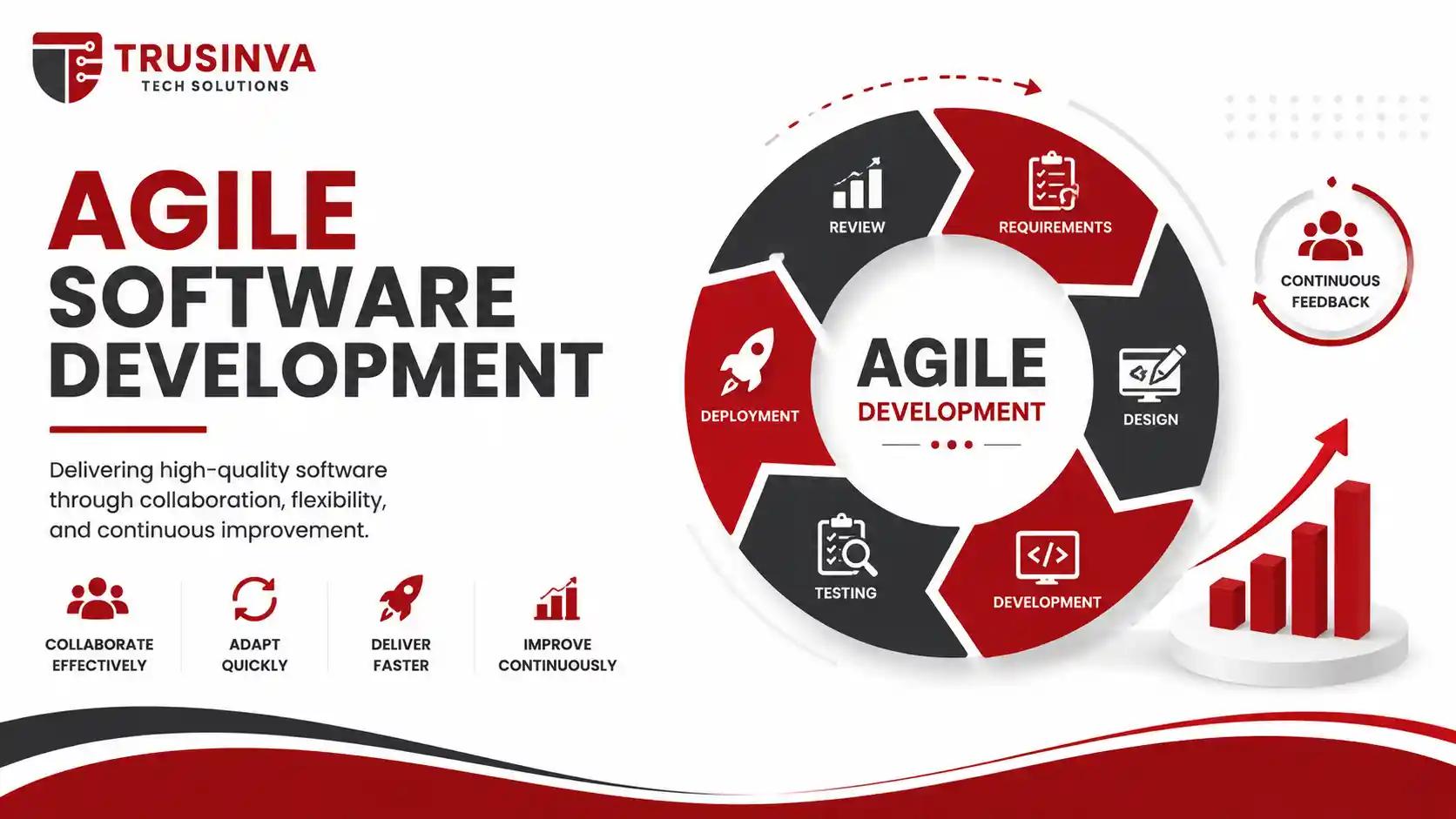
The agile process typically follows this cycle:
- Product vision and backlog creation – Stakeholders and the Product Owner define the product vision and populate the Product Backlog with user stories, epics, and features.
- Backlog refinement – The team clarifies and estimates upcoming work, breaking large items into smaller, actionable tasks.
- Sprint planning – The team selects items from the Product Backlog to complete during the next sprint (usually 1–4 weeks) and moves them into the Sprint Backlog.
- Daily standups – Short daily check-ins (Daily Scrum) keep the team aligned on progress and blockers.
- Development and testing – Developers build, test, and integrate features continuously, often using CI/CD pipelines.
- Sprint review – The team demonstrates the completed increment to stakeholders and gathers feedback.
- Sprint retrospective – The team reflects on what went well and what to improve before the next sprint begins.
This loop repeats until the product reaches the desired state, with each sprint producing a potentially shippable increment of working software.
4. Popular Agile Frameworks
Agile is a mindset, not a single method — several frameworks implement its principles differently.
| Framework | Best For | Key Characteristic |
| Scrum | Teams needing structured, time-boxed delivery | Fixed-length sprints, defined roles (Product Owner, Scrum Master, Developers) |
| Kanban | Teams with continuous, flow-based work | Visual board, WIP limits, no fixed sprints |
| Extreme Programming (XP) | Engineering-heavy teams | Emphasizes pair programming, TDD, and frequent releases |
| Lean Software Development | Teams focused on eliminating waste | Derived from lean manufacturing principles |
| SAFe (Scaled Agile Framework) | Large enterprises with multiple teams | Coordinates agile across departments and portfolios |
| LeSS (Large-Scale Scrum) | Multiple Scrum teams on one product | Extends Scrum principles to scale |
Scrum remains the most widely adopted framework, with the official Scrum Guide maintained by Ken Schwaber and Jeff Sutherland as the authoritative reference (current edition: November 2020). Kanban is a close second, especially for support and maintenance teams that need continuous flow rather than fixed sprints.
5. Benefits of Agile Software Development
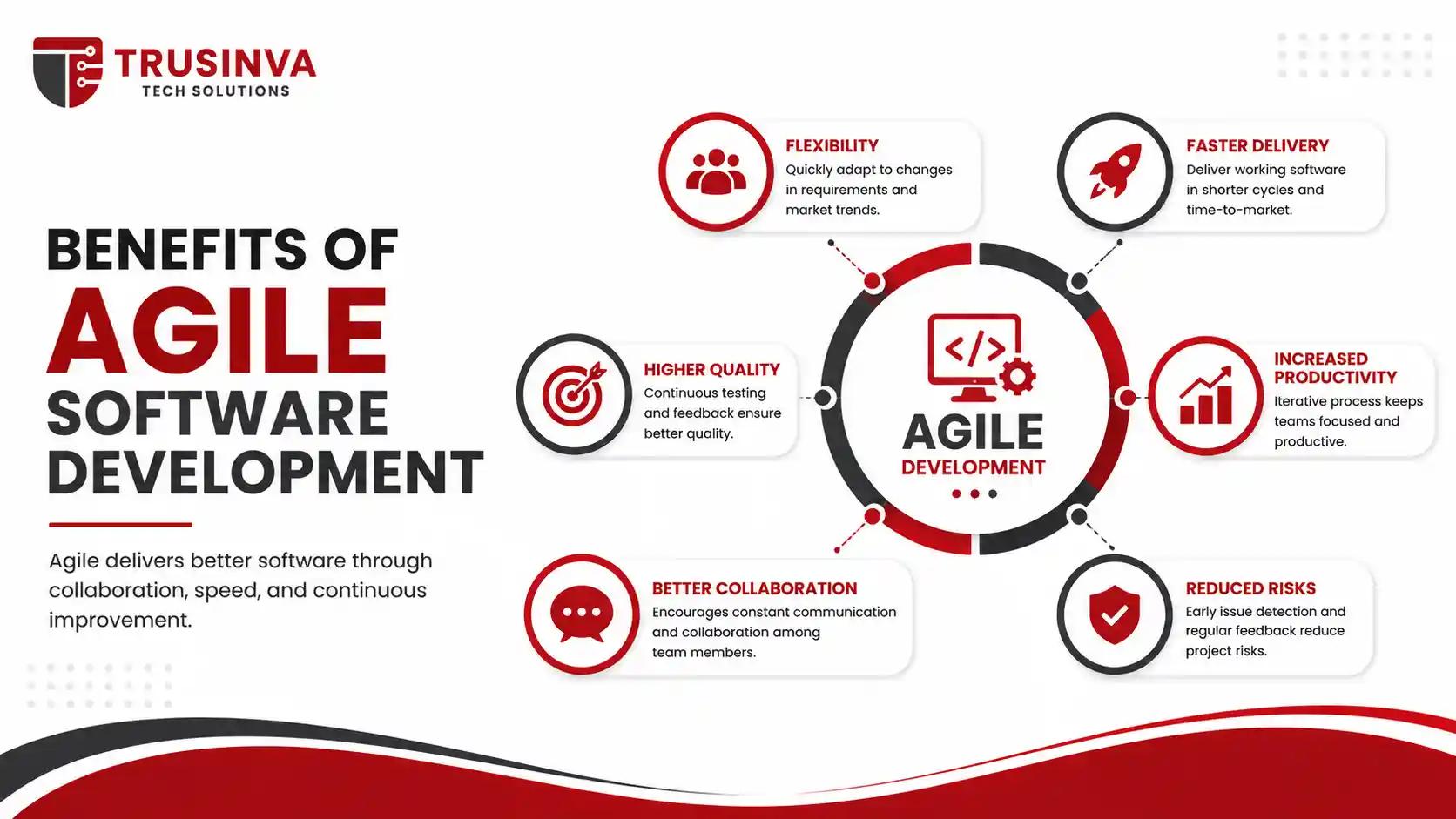
Faster time-to-market: Because agile delivers working increments every sprint, businesses can launch usable products sooner instead of waiting for a single "big bang" release.
Better product quality: Continuous testing, code review, and integration catch defects early rather than at the end of a long development cycle.
Higher customer satisfaction: Regular sprint reviews keep stakeholders involved, so the final product actually reflects what users need.
Reduced project risk: Short iterations mean problems surface early, when they're cheaper and easier to fix.
Greater flexibility: Teams can reprioritize the backlog as business needs shift, without derailing the entire project.
Improved team morale: Self-organizing, cross-functional teams tend to have more ownership and accountability over their work.
Companies pursuing digital transformation or building an MVP particularly benefit from agile's ability to validate ideas quickly with real users before committing to a full build.
6. Challenges and Common Mistakes
Agile isn't automatically successful just because a team calls its process "agile." Common pitfalls include:
- Treating daily standups as status reports instead of collaborative problem-solving sessions
- Overloading sprints with more work than the team can realistically complete
- Skipping retrospectives, which removes the continuous-improvement loop that makes agile effective
- Weak Product Backlog management, leading to unclear priorities
- Misunderstanding agile as "no planning," when in fact agile requires disciplined, ongoing planning
- Poor stakeholder engagement, which defeats the purpose of iterative feedback
Avoiding these mistakes usually comes down to having an experienced Scrum Master or delivery lead who protects the process and keeps the team focused on outcomes, not just ceremonies.
7. Agile vs. Waterfall
| Aspect | Agile | Waterfall |
| Approach | Iterative, incremental | Linear, sequential |
| Requirements | Can evolve throughout the project | Fixed upfront |
| Delivery | Working software every sprint | One final delivery at project end |
| Customer involvement | Continuous | Mostly at the start and end |
| Risk | Identified and mitigated early | Often discovered late |
| Best for | Evolving products, startups, SaaS | Projects with fixed, well-understood requirements |
Waterfall still has a place — regulated industries or fixed-scope contracts sometimes favor its predictability. But for most modern software, including ERP development and customer-facing platforms, agile's adaptability wins out.
8. Agile Roles and Team Structure
In a typical Scrum team:
- Product Owner – Owns the Product Backlog, defines priorities, and represents stakeholder interests.
- Scrum Master – Facilitates the process, removes blockers, and coaches the team on agile practices.
- Developers – The cross-functional group responsible for building, testing, and delivering the increment.
Agile teams are intentionally small (typically 5–9 people) and self-organizing, meaning they decide how to accomplish the work rather than being directed task-by-task by a manager.
9. Tools Used in Agile Development
Agile teams rely on a mix of project management and engineering tools, including:
- Project tracking: Jira, Azure DevOps, Trello, ClickUp, Linear, Monday.com
- Collaboration: Confluence, Miro, Slack, Microsoft Teams
- Version control & CI/CD: GitHub, GitLab, Bitbucket, Jenkins, GitHub Actions
- Cloud infrastructure: AWS, Microsoft Azure, Google Cloud, Docker, Kubernetes
Choosing the right toolset depends on team size, existing tech stack, and whether the team follows Scrum, Kanban, or a hybrid approach.
10. Best Practices for Agile Success
- Keep sprints short and consistent (1–2 weeks works well for most teams)
- Maintain a well-groomed, prioritized Product Backlog
- Set a clear Definition of Done for every user story
- Automate testing and deployment wherever possible
- Hold retrospectives seriously and act on what's learned
- Involve real stakeholders in sprint reviews, not just internal team members
- Track velocity and cycle time to improve estimation over time
11. Future Trends in Agile Development
Agile continues to evolve alongside broader shifts in software engineering. In 2026, expect to see deeper integration of AI-assisted coding and testing tools within sprints, wider adoption of DevSecOps practices that bake security into every iteration, and growing use of scaled frameworks like SAFe as more enterprises run agile across multiple coordinated teams. Remote and distributed agile teams are also driving demand for asynchronous-friendly ceremonies and better tooling for cross-timezone collaboration.
Frequently Asked Questions
What is agile software development in simple terms? It's a way of building software in small, repeated cycles instead of one long process — allowing teams to test, learn, and adjust as they go.
What is the difference between Scrum and Agile? Agile is the overall mindset and set of principles; Scrum is one specific framework used to implement agile through defined roles, events, and artifacts.
How long is a typical sprint? Most teams use sprints between one and four weeks, with two weeks being the most common length.
Is agile suitable for small businesses and startups? Yes — agile is especially useful for startups because it allows rapid iteration on an MVP based on real user feedback, reducing wasted development time.
What is the biggest benefit of agile over waterfall? Agile allows requirements to change throughout the project, which reduces the risk of building something that no longer matches business needs by the time it launches.
Do I need a certified Scrum Master to run agile? It helps, but it's not mandatory. What matters most is having someone dedicated to protecting the process and removing blockers for the team.
Can agile be used for non-software projects? Yes, agile principles are increasingly applied to marketing, product design, and operations teams, though it originated in software development.
What is a Sprint Retrospective? It's a recurring meeting at the end of each sprint where the team reflects on what worked, what didn't, and how to improve the next cycle.
Conclusion
Agile software development has become the standard for building modern, user-focused software because it embraces change instead of fighting it. By working in short, iterative cycles, involving stakeholders continuously, and improving with every sprint, teams deliver better products faster and with far less risk than traditional linear approaches.
If you're planning a new software project — whether it's a custom software build, a mobile app, or a CRM system — working with a team that genuinely practices agile delivery makes all the difference between a project that stalls and one that ships. Trusinva Tech Solutions builds every engagement around agile principles to keep clients involved at every sprint and every milestone. If you're ready to start your own agile-driven software project, reach out through the contact page or explore the services page to see how the team can help — and if you're looking to build these skills yourself, don't wait to Book a Seat in one of Trusinva's professional courses today.