Quick Answer:
Startup software development is the process of designing, building, and scaling a technology product for an early-stage business — usually starting with an MVP to validate demand before investing in a full platform. It covers technical strategy, architecture, team structure, budgeting, and choosing between an in-house team, a technical co-founder, or a software development agency.
Introduction
Every founder eventually hits the same wall: a great idea, a tight runway, and no clear picture of how to actually turn that idea into working software. That's the gap startup software development is meant to close. At Trusinva Tech Solutions, we help early-stage and growth-stage founders across the USA move from idea to shipped product — whether that means custom web application development, a mobile app build, an MVP built to validate demand fast, or a CRM layer to manage the customers your product is about to bring in. This guide walks through the full startup software development lifecycle — architecture decisions, cost ranges, team structure, security basics, and the mistakes that quietly drain a startup's runway — so you can make informed decisions before you write a single requirement.
Key Takeaways:
- Most early-stage startups should validate with an MVP before building a full product
- Startup software development cost typically ranges from $15,000 to $150,000+ depending on scope and stage
- Choosing the right architecture early prevents expensive rebuilds later
- Security and compliance (OWASP, NIST SSDF) matter even at the earliest stages
- A development partner should reduce your technical burden, not just write code
Table of Contents
- Introduction
- What Is Startup Software Development?
- Why Startup Software Development Is Different From Enterprise Development
- The Startup Software Development Lifecycle
- Choosing Your Technology Stack
- In-House Team vs Technical Co-Founder vs Development Agency
- Startup Software Development Cost in the USA
- Security, Compliance, and Data Privacy for Startups
- Common Mistakes in Startup Software Development
- Startup Software Development vs MVP Development vs Full Product Build
- Best Practices for Startup Founders
- Future Trends in Startup Software Development
- FAQs
- Conclusion
What Is Startup Software Development?
Direct answer: Startup software development is the process of planning, designing, building, testing, and scaling a software product for an early-stage or growth-stage company, typically under constraints of limited runway, an unproven business model, and a small team. It differs from enterprise development in speed, risk tolerance, and how tightly technical decisions are tied to business validation.
Unlike enterprise software, which is usually built against known requirements for an established user base, startup software development happens under uncertainty. You're not just writing code — you're testing a hypothesis about what customers will actually pay for. That changes almost every decision: architecture choices favor speed and flexibility over long-term optimization, and the product roadmap stays fluid until real usage data comes in.
Core components of startup software development include:
- Technical strategy — deciding what to build first and what to defer
- Product architecture — choosing a stack that supports iteration without a full rebuild
- Team structure — in-house hires, a technical co-founder, or an outsourced development agency
- Budget and timeline management — building within a fixed runway, not an open-ended enterprise budget
Why Startup Software Development Is Different From Enterprise Development
Startup software development prioritizes speed, validated learning, and lean budgets over the exhaustive requirements gathering and long approval cycles typical of enterprise projects, because a startup's biggest risk isn't technical failure — it's building something the market doesn't want.
| Factor | Startup Development | Enterprise Development |
| Primary risk | Building the wrong product | Building the product incorrectly |
| Budget | Fixed, limited runway | Larger, ongoing budget |
| Speed priority | Very high | Moderate |
| Requirements | Fluid, evolve with feedback | Fixed, documented upfront |
| Team size | Small, often outsourced | Large, in-house |
| Architecture goal | Fast iteration | Long-term scale and compliance |
This is one reason founders who partner with a software development company that has actually shipped startup products — not just enterprise systems — tend to avoid over-engineered first versions that eat months of runway before a single customer has paid.
The Startup Software Development Lifecycle
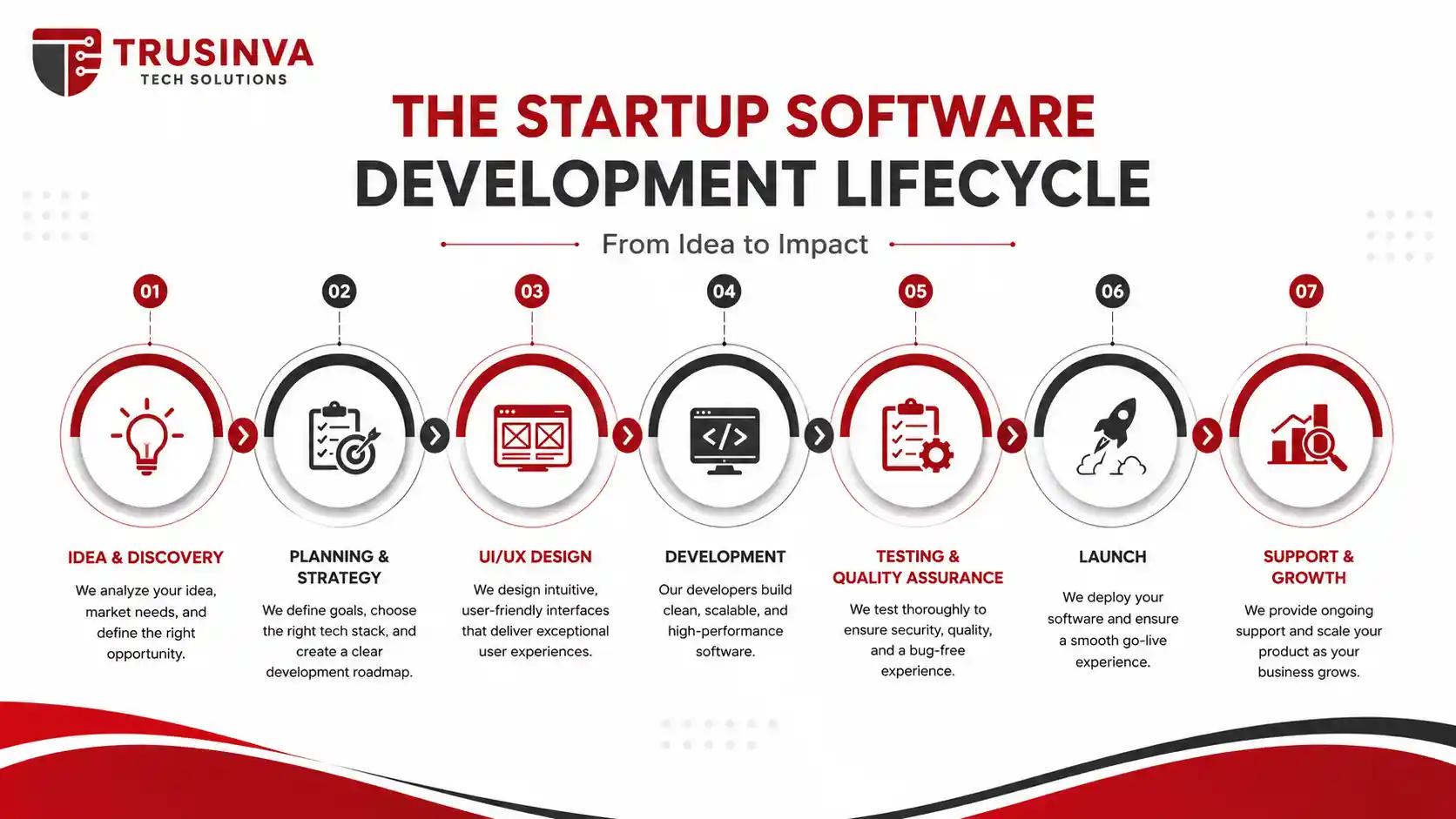
The startup software development lifecycle typically moves through six stages: idea validation, technical planning, MVP or first-version build, launch, iteration based on user feedback, and scaling into a full product once product-market fit is confirmed.
Stage 1: Idea and Market Validation
Talk to potential customers before writing requirements. Confirm the problem is real and painful enough that people will pay for a solution.
Stage 2: Technical Planning and Architecture
Define your product roadmap, pick a technology stack, and scope what "version one" actually needs to include. This is where a rushed decision creates technical debt that shows up eighteen months later as a costly rebuild.
Stage 3: Design and Prototyping
Wireframe and test user flows before development starts. A UI/UX design pass here — even a lightweight one — consistently pays for itself by catching usability problems before they're baked into production code, as covered in more detail in our guide on UI/UX design services that increase conversions.
Stage 4: Build and QA
Development happens in short cycles — usually Agile sprints — with continuous testing rather than a single QA phase at the end. Founders deciding between a full custom build and a faster path, like WordPress or Shopify for content- or commerce-heavy products, should weigh speed to launch against long-term flexibility — our breakdown of website vs. mobile app for your business covers a similar version of this trade-off.
Stage 5: Launch and Early Feedback
Release to a limited group of early adopters first. Instrument analytics from day one — you can't iterate on data you never collected.
Stage 6: Iteration and Scaling
Once usage data confirms product-market fit, shift from "validate" mode into "scale" mode — hardening infrastructure, adding integrations like a proper CRM system, and investing in growth channels such as SEO and digital marketing.
Choosing Your Technology Stack
Direct answer: Startups should choose a technology stack that balances development speed, hiring availability, and future scalability — commonly React or Next.js on the frontend, Node.js, Python, or Django on the backend, and PostgreSQL or Firebase for data — rather than optimizing for theoretical performance the product doesn't need yet.
Common startup stack patterns:
| Layer | Common Choices |
| Frontend | React, Next.js, Vue.js |
| Backend | Node.js, Python/Django, PHP/Laravel |
| Database | PostgreSQL, MongoDB, Firebase, Supabase |
| Hosting/Infrastructure | AWS, Google Cloud, Microsoft Azure, Vercel |
| Version control & CI/CD | GitHub, GitLab, automated pipelines |
| Containerization | Docker, Kubernetes (usually only once scaling) |
Expert tip: Most early-stage startups don't need Kubernetes on day one. Reaching for enterprise-grade infrastructure before you have enterprise-scale traffic is a common way to burn budget on complexity the product doesn't need yet.
In-House Team vs Technical Co-Founder vs Development Agency
Startups typically choose between hiring an in-house team, bringing on a technical co-founder, or outsourcing to a software development agency — the right choice depends on funding stage, how core software is to the business model, and how quickly the product needs to ship.
| Option | Best For | Trade-off |
| Technical co-founder | Deeply technical products, long-term equity alignment | Hard to find, dilutes equity |
| In-house team | Well-funded startups scaling fast | High fixed cost, slow to build |
| Development agency | Pre-seed to Series A, need to ship fast on a budget | Requires clear scope and communication |
For founders without a technical background, working with a development company that also understands UX, infrastructure, and go-to-market channels like Google Ads often removes the need to coordinate five separate vendors during the most time-pressured phase of the business. Our guide on how to choose the right web development company walks through the vetting questions in more depth.
Startup Software Development Cost in the USA
Direct answer: Startup software development cost in the USA typically ranges from $15,000 for a simple MVP to $150,000+ for a full-featured SaaS or mobile product, depending on platform complexity, integrations, and whether the build is outsourced or handled in-house.
| Build Type | Typical Cost Range | Typical Timeline |
| MVP (web or simple mobile) | $15,000 – $50,000 | 6–14 weeks |
| Full SaaS product (v1) | $50,000 – $120,000 | 3–6 months |
| Enterprise-grade platform | $120,000 – $250,000+ | 6–12 months |
| eCommerce build (Shopify) | $20,000 – $60,000 | 6–10 weeks |
Costs shift significantly with third-party integrations — payment processors like Stripe, analytics tools, and CRM systems all add scope. Founders comparing affordable mobile app development options should treat "affordable" as scoped-down, not corner-cut — cutting the wrong corners is what turns a cheap build into an expensive rebuild a year later.
Security, Compliance, and Data Privacy for Startups
Direct answer: Startups should apply baseline security practices from day one — including OWASP's guidance on common vulnerabilities and NIST's Secure Software Development Framework (SSDF) — because retrofitting security into a live product is far more expensive than building it in from the start, especially for startups handling payment or health data.
Practical security baseline for early-stage products:
- Follow the OWASP Top 10 to avoid the most common web application vulnerabilities
- Align development practices with NIST SSDF where the product will eventually need enterprise or government customers
- Use encrypted connections and hashed credentials by default, not as a later add-on
- Handle payment data through PCI DSS–compliant processors (Stripe, PayPal, Braintree) rather than storing card data yourself
- Plan for GDPR or HIPAA compliance early if you're building for European users or the healthcare space — this is directly relevant for startups exploring medical billing-adjacent or healthcare products
Common Mistakes in Startup Software Development
Direct answer: The most common startup software development mistakes are overbuilding the first version, skipping customer validation, choosing infrastructure built for scale you don't have yet, and treating security or SEO as something to "deal with later."
- Overbuilding v1: Trying to ship the long-term vision instead of the smallest testable version
- Skipping validation: Building based on founder assumptions instead of customer interviews
- Premature scaling infrastructure: Adopting Kubernetes, microservices, or multi-region deployment before there's traffic to justify it
- No analytics from day one: Launching without tracking, so early usage data is lost
- Ignoring SEO until "later": Waiting to think about search visibility until after launch, instead of building it in from the start
- Underestimating support and marketing: A finished product with no plan for turning visitors into customers doesn't generate revenue on its own
Startup Software Development vs MVP Development vs Full Product Build
| Aspect | Startup Software Development (Overall) | MVP Development | Full Product Build |
| Scope | End-to-end technical strategy | Smallest testable version | Complete feature set |
| Goal | Build a sustainable technology foundation | Validate demand cheaply | Scale a validated business |
| Timeline | Ongoing | 6–16 weeks | 3–12+ months |
| Risk level | Managed across stages | Low, contained | Higher, capital-intensive |
Best Practices for Startup Founders
- Validate the problem before validating the product
- Choose a stack your team (or agency) can hire for and maintain, not just what's trendy
- Build security and analytics in from day one, not as a retrofit
- Keep architecture modular enough to avoid a full rebuild at scale
- Treat your MVP as a data-collection tool, not a finished product
- Pair product development with early growth planning — SEO and digital marketing strategy work best when they start alongside development, not after launch
Future Trends in Startup Software Development
AI coding assistants — including GitHub Copilot, Cursor, and Claude Code — are measurably shortening the time it takes startups to go from idea to working prototype. Startups are also increasingly building AI agents and Retrieval-Augmented Generation features directly into their products rather than treating AI as a bolt-on, particularly in FinTech, HealthTech, and MarTech. On the infrastructure side, more early-stage teams are adopting containerized, cloud-native architectures earlier than before — not because they need the scale yet, but because tools like Docker have made it nearly as fast as a traditional deploy. Meanwhile, blockchain-based architectures are seeing renewed interest from startups building decentralized finance or Web3-native products, and security frameworks like NIST's AI-specific SSDF profile are becoming a relevant reference point even for early-stage AI-native startups.
Why Choose Trusinva Tech Solutions for Startup Software Development?
Trusinva Tech Solutions helps startups turn innovative ideas into scalable, secure, and market-ready software products. From idea validation and technology planning to UI/UX design, development, testing, and deployment, our team provides end-to-end startup software development solutions tailored to your business goals. We focus on building cost-effective, user-friendly, and scalable software that helps startups launch faster, validate their ideas, attract customers, and create a strong foundation for long-term growth.
FAQs
Q: How much does startup software development cost? A: Most US-based startup software builds range from $15,000 for a lean MVP to $150,000+ for a full SaaS product, depending on scope, platform, and integrations.
Q: Do I need a technical co-founder to build startup software? A: No. Many founders successfully build and launch through a software development agency instead of hiring a technical co-founder, especially before raising a priced round.
Q: Should I build an MVP first or go straight to a full product? A: Almost always start with an MVP. It validates demand with real users before you commit the budget a full product build requires.
Q: What technology stack is best for a startup? A: There's no single "best" stack — the right choice balances your team's hiring pool, the product's technical needs, and how fast you need to ship. React/Next.js with Node.js or Python backends is a common, well-supported default.
Q: Is security really necessary at the MVP stage? A: Yes, at least baseline security. Following OWASP's core guidelines from day one is far cheaper than retrofitting security after a breach or before an enterprise sales deal.
Q: How long does it take to build a startup's first product? A: An MVP typically takes 6–16 weeks; a full-featured v1 product usually takes 3–6 months, depending on complexity and team size.
Q: What's the biggest risk in startup software development? A: Building the wrong product, not building the product incorrectly. Most startup failures trace back to insufficient validation, not technical execution.
Conclusion
Startup software development succeeds or fails less on code quality and more on sequencing — validating early, building only what's needed to test the next assumption, and scaling infrastructure only once real usage demands it. Get the sequence right, and you turn a limited runway into a real, evidence-backed product. If you're a founder ready to move from idea to shipped software without guessing your way through architecture, security, and team decisions, Trusinva Tech Solutions can help you scope, build, and scale it properly. Book a Seat for a free consultation and let's map out your technical roadmap together.