If you run a business in Saudi Arabia — or you're a US or international company with operations there — VAT return filing is probably one of those tasks that sits on your to-do list and quietly stresses you out. You know it's mandatory. You know ZATCA doesn't play around with deadlines. But the actual process? That part often stays fuzzy until something goes wrong.
This guide breaks down KSA VAT return filing in plain language: what it is, why it matters, how it works step by step, and the mistakes that get businesses fined every single quarter. Whether you're handling this in-house or thinking about outsourcing it, you'll walk away knowing exactly what's involved.
What is KSA VAT Return Filing?
KSA VAT return filing is the process of reporting your business's Value Added Tax activity to the Zakat, Tax and Customs Authority (ZATCA) for a given tax period — either monthly or quarterly, depending on your revenue.
In simple terms: every time you sell something, you likely collect VAT (that's your output VAT). Every time you buy something for the business, you likely pay VAT (that's your input VAT). A VAT return is where you report both, calculate the difference, and either pay ZATCA the balance or claim a refund.
Saudi Arabia introduced VAT in 2018, and the standard rate now sits at 15%. Since then, compliance requirements have only gotten more detailed — especially with the rollout of ZATCA's e-invoicing (Fatoora) phases.
Why It Is Important
VAT compliance isn't optional, and treating it as an afterthought is one of the most common ways businesses end up with penalties, frozen accounts, or damaged relationships with the tax authority.
For businesses operating inside Saudi Arabia, timely and accurate VAT filing keeps you in good standing with ZATCA, protects your ability to bid on contracts, and avoids cash-flow surprises from unexpected fines.
For US and international companies entering the Saudi market — whether through a local entity, a branch, or cross-border digital services — VAT compliance is often the first real test of whether your business is set up to operate legally in the Kingdom. Getting this wrong early can slow down everything from bank account setup to government tenders.
Saudi Arabia's Vision 2030 push toward digital transformation also means tax administration itself is becoming more automated and data-driven. Businesses that treat VAT filing as a strategic process — not just paperwork — tend to scale more smoothly as regulations tighten.
Key Benefits of Getting VAT Filing Right
- Avoid penalties — Late or incorrect filings trigger fines that scale with the size of the error.
- Better cash flow management — Knowing your input and output VAT positions helps you forecast more accurately.
- Stronger credibility — Clean tax records matter for loans, investor due diligence, and government contracts.
- Faster VAT refunds — Accurate filing history speeds up refund processing when you're owed money.
- Audit readiness — Organized VAT ledgers mean audits are a formality, not a fire drill.
- Smoother ZATCA e-invoicing compliance — Good VAT habits make Phase 2 e-invoicing integration far less painful.
Step-by-Step Process: How to File a VAT Return in Saudi Arabia
Here's the general workflow businesses follow when filing through the ZATCA portal:
- Register for VAT — If your taxable supplies exceed the mandatory registration threshold, you must register with ZATCA and receive a VAT certificate and registration number.
- Determine your filing frequency — Businesses with higher annual revenue typically file monthly; smaller businesses often file quarterly.
- Maintain accurate VAT records — Track every tax invoice, both issued (output VAT) and received (input VAT), throughout the period.
- Reconcile your accounts — Match your accounting records against your VAT ledger before filing to catch discrepancies early.
- Log in to the ZATCA portal — Access your account and select the relevant tax period.
- Enter your sales and purchases data — Report standard-rated, zero-rated, and exempt supplies separately, along with input VAT on purchases and imports.
- Calculate the net VAT position — The system (or your team) determines whether you owe ZATCA or are due a refund.
- Submit the return before the deadline — Returns are generally due by the last day of the month following the tax period.
- Pay any VAT owed — Payment must be completed through approved channels before the due date to avoid penalties.
- Keep supporting documentation — Retain invoices, contracts, and reconciliation records in case of a ZATCA audit.
Common VAT Filing Mistakes Businesses Make
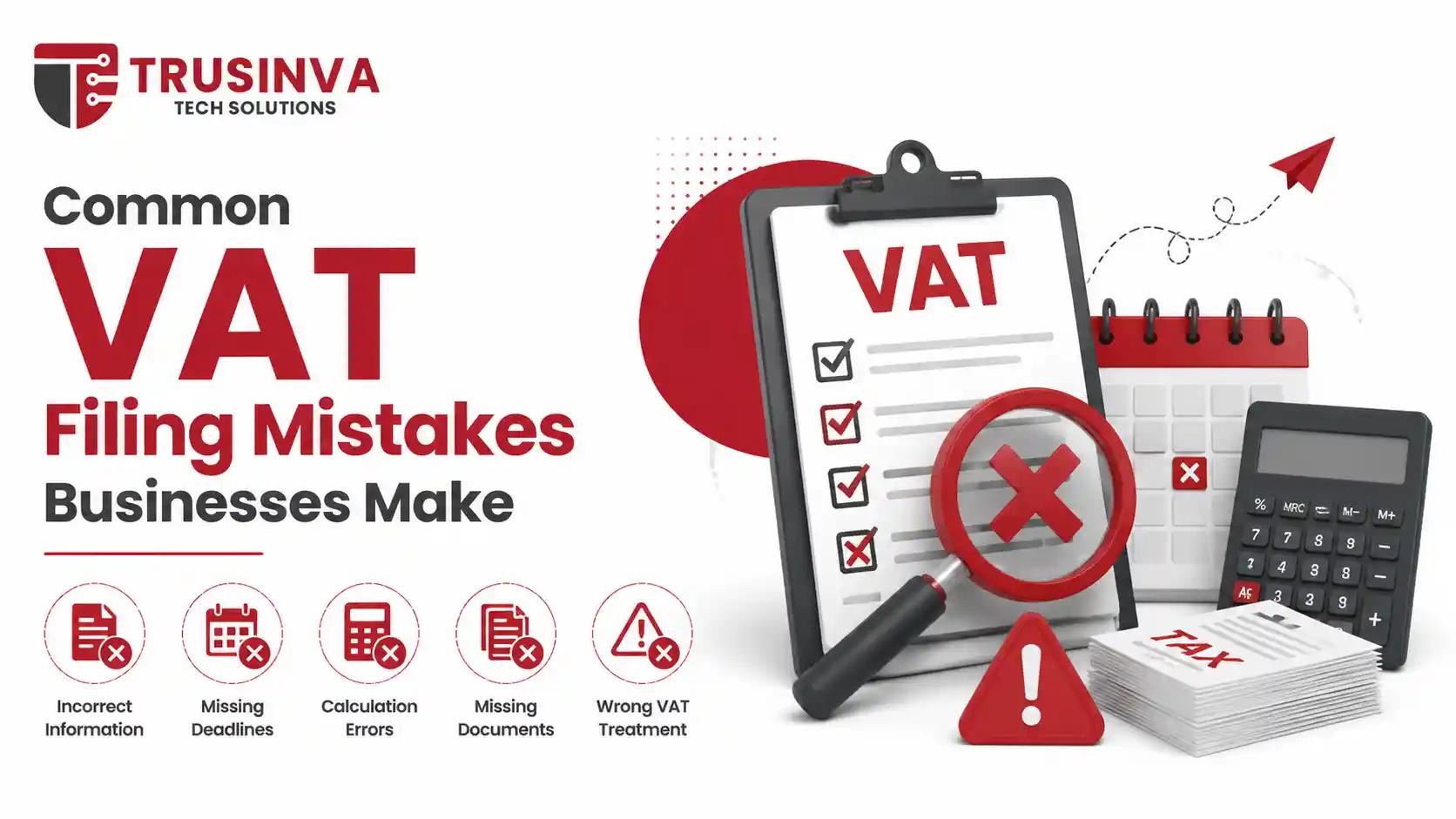
Even experienced finance teams slip up here. The most frequent issues include:
- Missing the filing deadline — Even a one-day delay can trigger penalties.
- Misclassifying supplies — Confusing zero-rated with exempt supplies leads to incorrect VAT calculations.
- Incomplete input VAT documentation — Claiming input VAT without a valid tax invoice is a common audit red flag.
- Manual reconciliation errors — Spreadsheet-based tracking often misses transactions, especially for businesses with high invoice volume.
- Ignoring the reverse charge mechanism — Companies importing services from abroad sometimes forget to self-account for VAT.
- Poor ERP-VAT integration — Disconnected systems make it easy for errors to slip through unnoticed until the return is already filed.
- Treating e-invoicing as separate from VAT filing — With ZATCA Phase 2 e-invoicing, invoice data and VAT reporting are increasingly linked, and businesses that don't align the two create compliance gaps.
Why Choose Trusinva Tech Solutions
VAT compliance rarely exists in isolation — it's tied to your accounting systems, your invoicing workflow, and often your entire tech stack. That's where having the right partner makes a real difference.
At Trusinva Tech Solutions, we help businesses in Saudi Arabia and beyond build the systems and processes that make VAT compliance simple instead of stressful. Our work spans:
- Web Development and WordPress Development for businesses that need a professional online presence to match their compliance credibility.
- Truck Dispatching support and training for logistics businesses managing cross-border operations.
- Medical Billing solutions for healthcare providers navigating complex compliance requirements.
- Mobile App Development to help businesses manage operations, invoicing, and reporting on the go.
- SEO Services and Digital Marketing to help VAT-compliant, trustworthy businesses actually get found by the clients searching for them.
- Software, ERP & CRM Solutions, including CRM Development, built to integrate cleanly with VAT and e-invoicing requirements so your finance team isn't reconciling data by hand.
We also run practical, job-focused training through our courses, including a dedicated KSA Taxation course, alongside programs in Medical Billing, Truck Dispatching, UAE Taxation, UK Taxation, and USA Taxation — so your team can build in-house VAT expertise, not just outsource it.
You can browse our full range of work in our services section, see real client work in our projects portfolio, read more insights on our blog, or learn more about us.
FAQs About KSA VAT Return Filing
What is KSA VAT return filing? It's the process of reporting your business's output and input VAT to ZATCA for a specific tax period, either monthly or quarterly.
Who must file VAT returns in Saudi Arabia? Any business registered for VAT with ZATCA, based on meeting the mandatory or voluntary registration threshold, must file returns.
How often do businesses file VAT returns in KSA? Larger businesses generally file monthly, while smaller businesses typically file on a quarterly basis, depending on annual taxable revenue.
What happens if a VAT return is filed late? Late filings and late payments both trigger penalties from ZATCA, with fines increasing based on the delay and the amount owed.
Can foreign companies file VAT returns in Saudi Arabia? Yes. Foreign companies with taxable activity in Saudi Arabia — including certain cross-border services — may need to register and file, sometimes through a tax representative.
What is the difference between input VAT and output VAT? Output VAT is the tax you charge customers on sales. Input VAT is the tax you pay on business purchases, which can often be reclaimed against your output VAT liability.
Final Thoughts
KSA VAT return filing doesn't have to be a source of stress. With the right process, accurate records, and systems that actually talk to each other, it becomes a routine part of running a compliant, credible business in Saudi Arabia.
Whether you need help setting up ERP systems that handle VAT correctly, want your business found online by the right clients, or you're ready to train your team through our KSA Taxation course, we're here for it.
Contact Trusinva Tech Solutions for professional digital services and business growth. Get in touch today and let's build the systems your business needs to stay compliant and grow with confidence.