Quick Answer
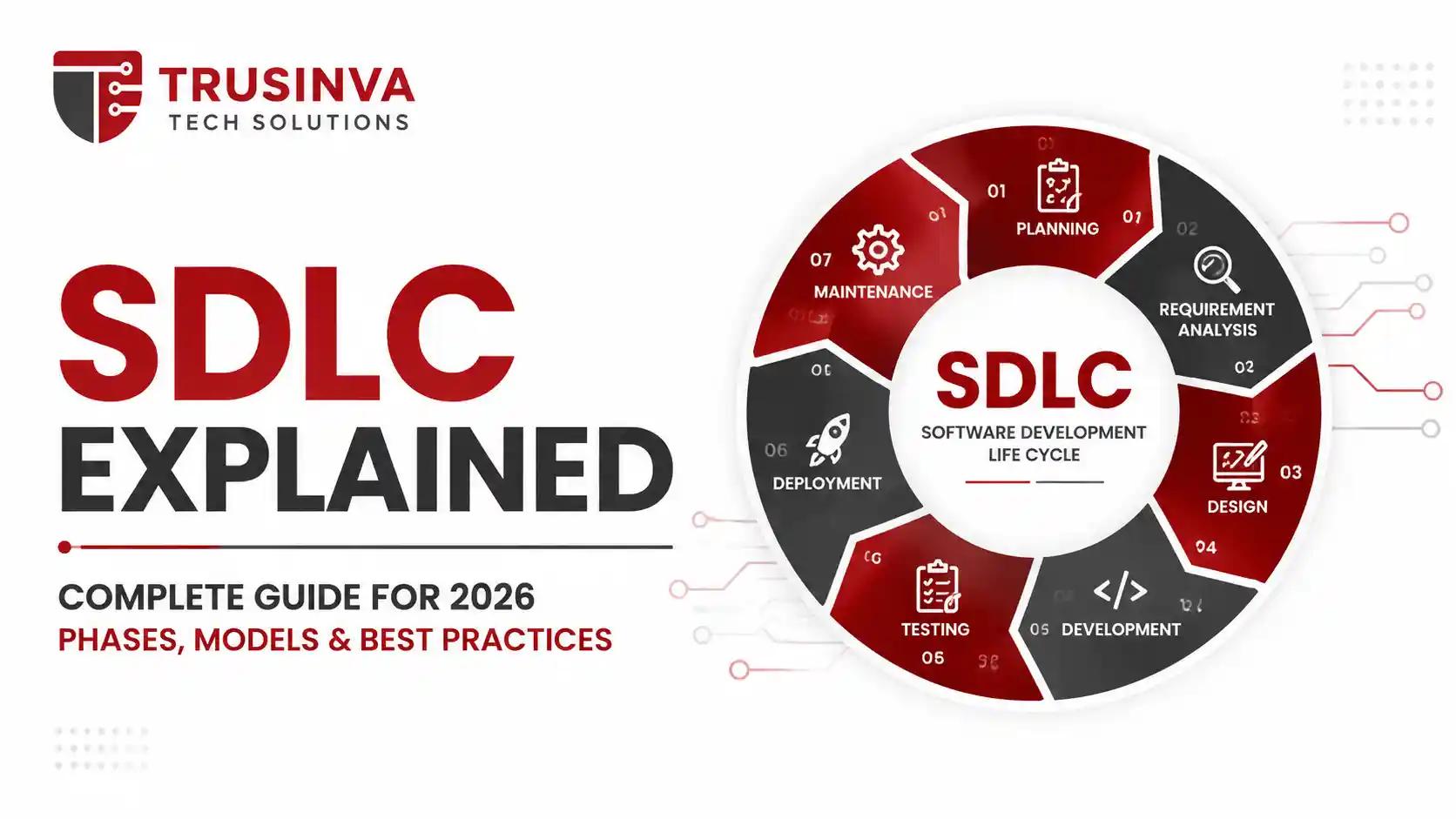
The Software Development Life Cycle (SDLC) is a structured process software teams follow to plan, build, test, deploy, and maintain applications. It typically includes seven phases: planning, requirements analysis, design, development, testing, deployment, and maintenance. A well-managed SDLC reduces risk, controls cost, and improves software quality — which is why it remains central to modern software engineering in 2026.
Introduction
If you've ever wondered how an idea turns into working software without turning into chaos, the answer is the Software Development Life Cycle, or SDLC. Whether you're a startup founder validating an MVP or an enterprise IT manager overseeing a digital transformation, understanding the SDLC helps you make smarter decisions about timelines, budgets, and vendors. This is exactly the kind of structured, outcome-driven approach that Trusinva Tech Solutions applies across its custom software development and mobile app development projects. Whether you need CRM development, a blockchain-based solution, or full-scale digital marketing support around your product launch, a disciplined SDLC is what separates a project that ships on time from one that drags on for months. In this guide, we'll break down every phase, compare the major models, and share practical advice for choosing the right approach in 2026.
Key Takeaways
- SDLC is a repeatable framework, not a single methodology — Agile, Waterfall, Spiral, and DevOps are all models of implementing it.
- The seven core phases apply across industries, from healthcare software to eCommerce platforms.
- DevSecOps and shift-left security are now standard expectations, not optional add-ons.
- AI coding assistants are changing how fast teams move through design, development, and testing.
- Choosing the right SDLC model depends on project size, budget, compliance needs, and how much requirements are likely to change.
Table of Contents
- What Is the SDLC?
- Why the SDLC Matters
- The 7 Phases of the SDLC
- Popular SDLC Models Compared
- SDLC vs Agile vs DevOps
- Security in the SDLC (DevSecOps)
- Common SDLC Mistakes
- Best Practices for 2026
- Cost and Team Considerations
- Future Trends: AI in the SDLC
- FAQs
- Conclusion
1. What Is the SDLC?
The Software Development Life Cycle (SDLC) is a systematic process for planning, creating, testing, and deploying software. It exists to ensure quality, control cost, and meet user requirements on schedule.
The concept dates back to structured methodologies like the Waterfall model, first formally described by Winston W. Royce, and has since evolved through Barry Boehm's Spiral Model, Agile approaches popularized by Kent Beck and Martin Fowler, and Scrum, developed by Jeff Sutherland and Ken Schwaber. Today, standards such as ISO/IEC/IEEE 12207 and ISO/IEC/IEEE 15288 formalize SDLC processes at an international level, while frameworks like CMMI help organizations measure process maturity.
At its core, the SDLC answers one question: how do we go from "we need software" to "we have working, reliable software" in a repeatable way?
2. Why the SDLC Matters
A defined SDLC matters because it reduces project risk, controls cost overruns, and ensures the final product actually meets user needs. Without it, teams face scope creep, missed deadlines, and software that doesn't solve the right problem.
Key benefits include:
- Predictability – clear phases make timelines and budgets easier to estimate
- Quality control – built-in testing and QA reduce post-launch bugs
- Risk management – issues are caught early, when they're cheaper to fix
- Better communication – stakeholders, developers, and QA teams share a common process
- Compliance readiness – easier to align with standards like NIST SP 800-218 or OWASP ASVS
For industry-specific businesses — healthcare, finance, logistics, or SaaS — a structured SDLC is often the difference between passing a compliance audit and failing one.
3. The 7 Phases of the SDLC
Every SDLC model, regardless of flavor, is built around these seven core phases.
Phase 1: Planning & Feasibility Study
Teams define project scope, budget, timeline, and resource needs. A feasibility study checks whether the project is technically and financially viable before real investment begins.
Phase 2: Requirements Analysis
This phase captures functional requirements (what the system must do) and non-functional requirements (performance, security, scalability). Tools like requirements specification documents, aligned with ISO/IEC/IEEE 29148, formalize this step.
Phase 3: Design
Architects translate requirements into system architecture, database design, and API design. This is where decisions about microservices vs. monolith, cloud-native infrastructure, and third-party integrations get made.
Phase 4: Development (Implementation)
Developers write the actual code, following version control practices using tools like Git, GitHub, or GitLab. Code review and adherence to coding standards happen here to maintain code quality and reduce technical debt.
Phase 5: Testing
Quality assurance teams run unit testing, integration testing, system testing, and acceptance testing. Automated testing tools such as Selenium, Playwright, Cypress, and JUnit or pytest are commonly used to catch defects before release.
Phase 6: Deployment
The application moves into the production environment, often through CI/CD pipelines using Jenkins, GitHub Actions, or GitLab CI/CD. Deployment automation and containerization tools like Docker and Kubernetes reduce release risk.
Phase 7: Maintenance
Post-launch, teams handle bug fixing, performance monitoring, and continuous improvement. This phase also covers incident management and long-term technical debt reduction.
Note: These phases aren't always linear. In Agile and DevOps models, several phases run in parallel, continuously, rather than in strict sequence.
4. Popular SDLC Models Compared
| Model | Best For | Key Trait |
| Waterfall | Fixed-scope projects with stable requirements | Sequential, one phase at a time |
| Agile | Projects with evolving requirements | Iterative sprints, frequent feedback |
| Spiral | Large, high-risk projects | Combines iterative development with risk analysis |
| V-Model | Safety-critical or regulated software | Each dev phase paired with a testing phase |
| Incremental | Projects needing early partial releases | Builds functionality in usable chunks |
| DevOps | Teams needing continuous delivery | Merges development and operations continuously |
Pros of Agile: flexibility, faster feedback loops, better stakeholder involvement. Cons of Agile: harder to predict final cost/timeline upfront.
Pros of Waterfall: predictable, easy to document and audit. Cons of Waterfall: inflexible to changing requirements.
5. SDLC vs Agile vs DevOps
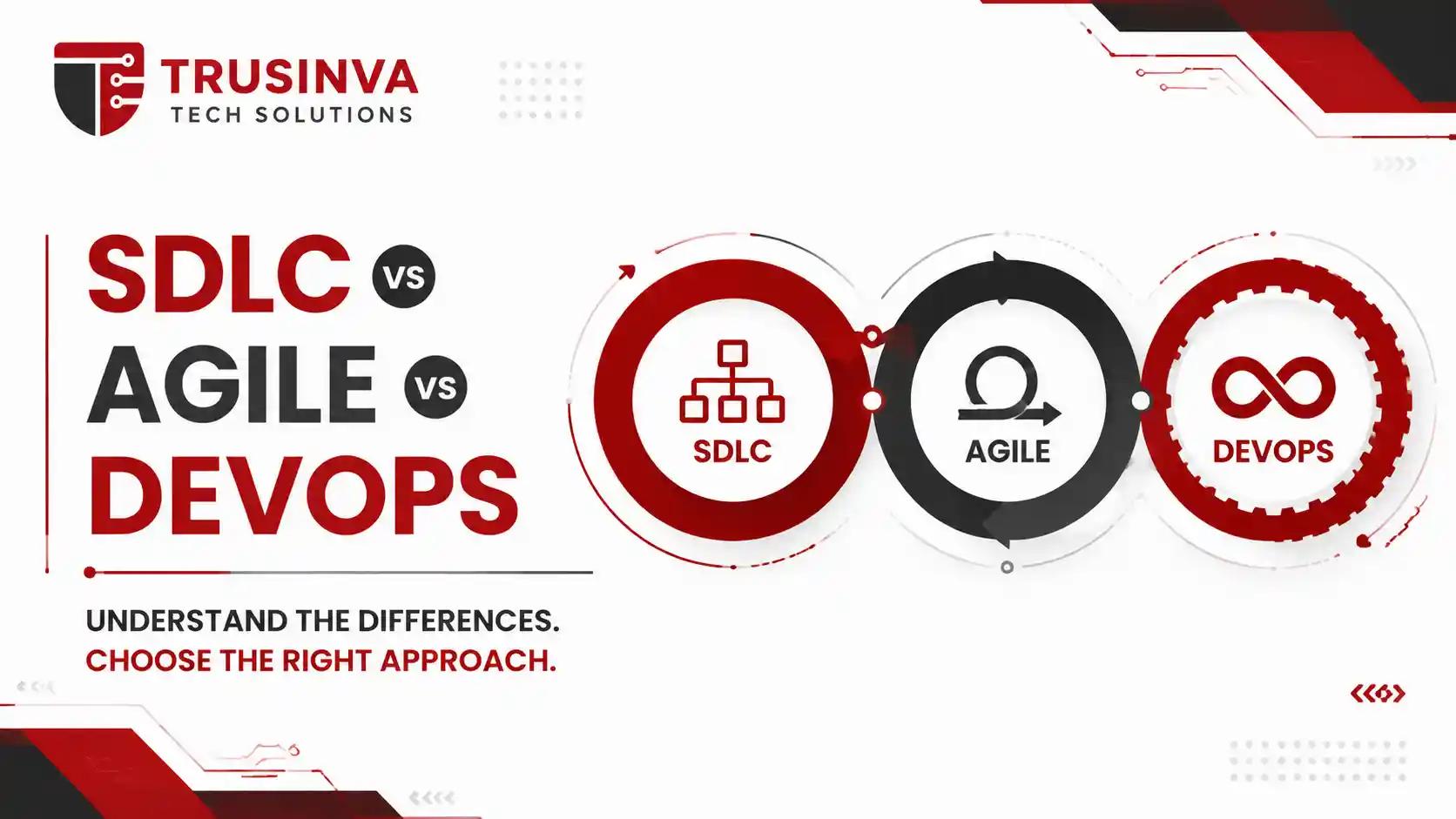
A common point of confusion: SDLC is the overall framework; Agile is a methodology within it; DevOps is a culture and toolchain that extends the SDLC into continuous delivery.
- SDLC = the complete lifecycle from planning to maintenance
- Agile = an iterative approach to executing the SDLC in short sprints
- DevOps = merges development and operations to enable continuous integration and continuous deployment (CI/CD)
Many modern teams — including enterprise clients working with Trusinva Tech Solutions' web development services — combine Agile execution with DevOps tooling to get both flexibility and release speed.
6. Security in the SDLC (DevSecOps)
Security can no longer be bolted on at the end. DevSecOps integrates security checks into every SDLC phase, a practice known as shift-left security.
Common shift-left practices:
- Threat modeling during the design phase
- Automated vulnerability scanning in CI/CD pipelines
- Secure coding standards aligned with OWASP Top 10
- Software Bill of Materials (SBOM) tracking for supply chain security
- Alignment with NIST's Secure Software Development Framework (SP 800-218)
Frameworks like OWASP SAMM and the Microsoft Security Development Lifecycle give teams structured checklists for embedding security without slowing releases down.
7. Common SDLC Mistakes
- Skipping requirements analysis to "save time" — this almost always costs more later
- Treating testing as a final gate instead of a continuous activity
- Ignoring non-functional requirements like scalability and security until it's too late
- Poor documentation, making handoffs and audits painful
- No change management process, leading to scope creep
8. Best Practices for 2026
- Adopt CI/CD pipelines early, even for small projects
- Use infrastructure as code (Terraform) for repeatable deployments
- Build observability (monitoring, logging) into the architecture from day one
- Pair automated testing with manual exploratory testing for critical flows
- Choose the SDLC model based on project volatility, not team preference alone
For startups exploring their first build, comparing a website vs. mobile app approach early in the planning phase can prevent costly pivots later.
9. Cost and Team Considerations
SDLC costs vary widely based on project complexity, team location, and compliance requirements. Custom enterprise software with strict security requirements will cost significantly more than a straightforward MVP build.
Businesses looking to control costs often explore custom software development partnerships or outsourced teams rather than building in-house from scratch, particularly for ERP and enterprise-grade systems.
10. Future Trends: AI in the SDLC
AI coding assistants — including GitHub Copilot, Claude Code, and Google Jules — are increasingly embedded across the design, development, and testing phases. AI agents can now draft code, generate test cases, and flag security issues, compressing timelines that once took weeks into days.
According to industry analysts like Gartner and McKinsey & Company, agentic AI tools are expected to play a growing role in software engineering workflows through 2026 and beyond, particularly in automated testing and code review.
FAQs
1. What are the 7 phases of the SDLC? Planning, requirements analysis, design, development, testing, deployment, and maintenance.
2. Which SDLC model is best for startups? Agile is generally best for startups because requirements often evolve as the product finds market fit.
3. Is DevOps a replacement for SDLC? No. DevOps is a culture and toolchain that speeds up the SDLC's development and deployment phases — it doesn't replace the overall lifecycle.
4. How long does a typical SDLC take? It varies from a few weeks for a small MVP to over a year for complex enterprise systems.
5. What is shift-left security? It means integrating security testing early in the SDLC — during design and development — rather than only at the end.
6. Do small businesses need a formal SDLC? Yes, even a lightweight version helps avoid scope creep and ensures the final product meets business goals.
7. What's the difference between Waterfall and Agile? Waterfall is sequential and rigid; Agile is iterative and adapts to changing requirements through sprints.
8. How does AI change the SDLC in 2026? AI coding assistants speed up development and testing phases, though human oversight remains essential for architecture and security decisions.
Conclusion
The SDLC isn't just a technical checklist — it's the backbone of every successful software project, whether you're building a simple business website or a complex enterprise platform. Understanding its phases and models helps you ask the right questions when evaluating a development partner, estimate realistic timelines, and avoid the common pitfalls that derail projects.
If you're planning a software build in 2026 and want a team that follows a disciplined, security-conscious SDLC from planning through maintenance, Trusinva Tech Solutions can help — from custom software and web development to mobile app development, CRM development, SaaS solutions, and digital marketing to support your launch. Explore our services, browse past projects, or check out related reads like how to choose the right web development company, top web development services in the USA, and affordable mobile app development for US startups. If your team also needs specialized training, Trusinva's courses cover everything from USA taxation to medical billing and truck dispatching. Ready to get started on your next software project the right way? Contact Trusinva Tech Solutions today and Book a Seat for a free consultation to map out your SDLC from day one.