Quick Answer:
MVP development for startups is the process of building a minimum viable product — a stripped-down version of your software with only core features — to test a business idea with real users before investing in full-scale development. It reduces financial risk, speeds up time to market, and helps founders validate product-market fit using real customer feedback instead of assumptions.
Introduction
Most startups don't fail because the technology was bad — they fail because they built something nobody wanted. That's exactly the problem MVP development for startups is designed to solve. At Trusinva Tech Solutions, we work with early-stage founders across the USA who need a working product fast, without burning through their entire runway before they know if the idea has legs. Whether you're planning a web MVP for a B2B SaaS tool, a mobile app MVP, or an eCommerce storefront built on Shopify, the same core principle applies: validate before you scale. This guide walks through the entire MVP development process — what it costs, how long it takes, and how to avoid the mistakes that sink first-time founders — based on real project patterns we see across custom software development engagements.
Key Takeaways:
- An MVP is not a "cheap" or "unfinished" product — it's a strategic validation tool
- The MVP development process typically takes 6–16 weeks depending on complexity
- Average MVP development cost for US startups ranges from $15,000 to $80,000+
- Customer discovery and feature prioritization matter more than technology choice
- Choosing the right MVP development company can save months of wasted engineering time
Table of Contents
- Introduction
- What Is MVP Development?
- Why Startups Need an MVP Before Full-Scale Development
- The MVP Development Process, Step by Step
- MVP Feature Prioritization: What to Build First
- MVP Development Cost in the USA
- MVP Development Timeline
- Choosing the Right MVP Development Company
- Common MVP Development Mistakes
- MVP vs Prototype vs Full Product
- Best Practices for MVP Success
- Future Trends in MVP Development
- FAQs
- Conclusion
What Is MVP Development?
Direct answer: MVP development is the process of designing, building, and launching the simplest working version of a product that solves a core customer problem, using only the features necessary to test the idea with real users. The goal isn't a smaller product — it's faster, cheaper learning.
The term comes from Eric Ries's Lean Startup methodology, which built on Steve Blank's customer development framework. The idea is simple: instead of spending a year and your entire seed round building a fully-featured platform based on guesses, you build a "build-measure-learn" loop. You ship the smallest thing that delivers real value, measure how users actually behave, and use that data to decide what to build next.
An MVP is not:
- A buggy, half-finished app
- A prototype with no real functionality
- A permanent version of your product
An MVP is a strategic decision about scope, not quality. The code should still be solid, secure, and usable — it's just intentionally narrow.
Why Startups Need an MVP Before Full-Scale Development
Direct answer: Startups need an MVP because it reduces financial risk, shortens time to market, and replaces assumptions with real customer feedback — all before committing to expensive, full-scale software development.
Here's what an MVP actually buys a founder:
1. Reduced development risk. Building a full platform based on unvalidated assumptions is the single biggest reason startups run out of runway. An MVP limits your exposure to a fraction of the total build cost.
2. Faster investor conversations. Investors — including accelerators like Y Combinator — consistently favor founders who can show real user traction over a polished deck with no data behind it.
3. Real product-market fit signals. You learn whether people will actually pay, return, and refer others — not whether they like the idea when you describe it to them. For SaaS founders specifically, this is often where a lightweight CRM development layer earns its place early, since tracking how leads move through your funnel is itself a validation signal.
4. Smarter resource allocation. Instead of guessing which features matter, your MVP tells you, through usage data and direct feedback, what to prioritize in your product roadmap.
5. Shorter time to market. In competitive spaces like SaaS or eCommerce, being six months faster to launch — paired with early SEO groundwork — can be the difference between owning a category and playing catch-up.
The MVP Development Process, Step by Step
The MVP development process has six core stages: customer discovery, MVP strategy and scope definition, UX/UI design, development and QA, launch, and iteration based on user feedback.
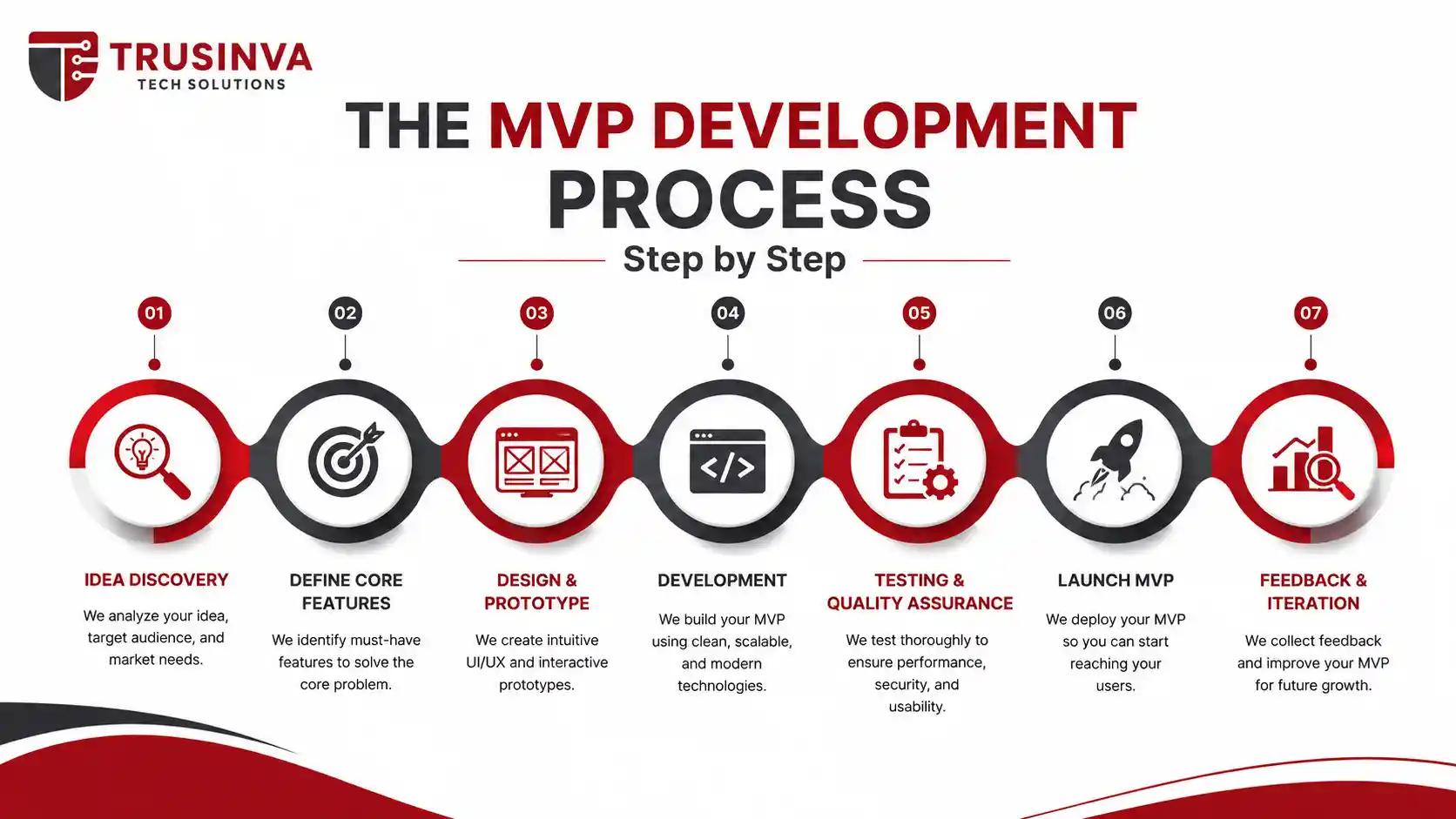
Step 1: Customer Discovery and Market Validation
Before a single line of code is written, talk to your target users. Run customer interviews, map pain points, and test your business hypothesis. This stage answers one question: does this problem matter enough to people that they'll adopt a solution?
Step 2: MVP Strategy and Scope Definition
Define your MVP roadmap and MVP requirements. This is where founders build a lightweight product requirements document outlining core functionality — the 20% of features that deliver 80% of the value.
Step 3: MVP UX/UI Design
Wireframe and prototype the user flow using tools like Figma or FigJam before writing production code. Rapid prototyping here saves weeks of rework later. This is a stage our UI/UX design team treats as non-negotiable, even on tight timelines.
Step 4: MVP Architecture and Development
Choose a technical architecture that supports your validation goals without over-engineering. Common stacks include React or Next.js on the frontend, Node.js, Python/Django, or Laravel on the backend, and PostgreSQL, Firebase, or Supabase for the database layer — deployed on AWS, Google Cloud, or Vercel. Content-driven MVPs sometimes lean on WordPress development instead, especially when speed to launch matters more than a fully custom backend.
Step 5: MVP Testing and Launch
QA testing, usability testing, and security checks (aligned with frameworks like OWASP and NIST SSDF where relevant) happen before launch. Then you release to early adopters — not the general public.
Step 6: MVP Iteration Based on Feedback
Collect analytics, run A/B tests, and treat every release as a hypothesis test. This loop continues until you've validated product-market fit — then, and only then, do you scale into full custom software development.
MVP Feature Prioritization: What to Build First
Prioritize features that directly test your core value proposition — the single problem your product solves — and defer anything "nice to have," including advanced settings, integrations, and secondary user flows, until after initial validation.
A simple framework startups use:
| Priority Tier | What Goes Here | Example |
| Must-Have | Core feature solving the primary problem | Booking flow for a scheduling app |
| Should-Have | Features that improve retention | Email reminders |
| Could-Have | Nice-to-have enhancements | Custom themes |
| Won't-Have (yet) | Anything not tied to core validation | Multi-language support |
Common mistake: Founders often try to include every feature from their long-term vision in version one. This delays launch, inflates MVP development cost, and dilutes the feedback signal you're trying to collect.
MVP Development Cost in the USA
MVP development cost for US startups typically ranges from $15,000 to $80,000+, depending on platform complexity, number of core features, integrations, and whether it's a web MVP, mobile app MVP, or AI-powered MVP.
| MVP Type | Typical Cost Range | Typical Timeline |
| Simple web MVP | $15,000 – $30,000 | 6–8 weeks |
| Mobile app MVP (iOS/Android) | $25,000 – $50,000 | 8–12 weeks |
| SaaS MVP with user accounts, billing | $35,000 – $65,000 | 10–14 weeks |
| eCommerce MVP (Shopify-based) | $20,000 – $45,000 | 6–10 weeks |
| Automation-heavy MVP (workflow/AI features) | $40,000 – $80,000+ | 12–16 weeks |
These are directional ranges based on standard industry patterns for MVP software development engagements — actual pricing depends heavily on scope, integrations (payments, CRM, third-party APIs), and whether you need ongoing DevOps support after launch.
MVP Development Timeline
Direct answer: Most startup MVPs take 6 to 16 weeks from customer discovery to launch, with simple web MVPs on the faster end and automation-heavy or multi-platform MVPs taking longer due to added technical complexity.
A realistic phase breakdown:
- Discovery & scoping: 1–2 weeks
- Design (UX/UI): 1–3 weeks
- Development: 4–8 weeks
- QA & testing: 1–2 weeks
- Launch prep: 1 week
Rushing this timeline to "save money" is one of the most common reasons MVPs launch with a broken core experience — which defeats the entire purpose of validation.
Choosing the Right MVP Development Company
Direct answer: Choose an MVP development company based on their process transparency, technical range across web and mobile, willingness to push back on unnecessary scope, and evidence of past MVPs that reached product-market fit — not just portfolio polish.
Questions to ask any MVP development agency before signing:
- Will you help us prioritize features, or just build whatever we ask for?
- What's your typical MVP development timeline for a project like ours?
- Do you handle both frontend and backend, or do we need multiple vendors?
- How do you handle post-launch iteration and support?
- Can you show a past MVP and what happened after launch? Take a look at our past projects to see how that plays out in practice.
At Trusinva Tech Solutions, our approach spans web development, mobile app development, CRM development, and UI/UX design, which means startups don't have to coordinate across multiple vendors during the most time-sensitive phase of their business. Once your MVP validates, the same team can carry you into digital marketing to actually get it in front of users.
Common MVP Development Mistakes
Direct answer: The most common MVP mistakes are overbuilding features, skipping customer discovery, ignoring analytics after launch, and treating the MVP as a finished product instead of a learning tool.
- Overbuilding: Adding features "just in case" instead of testing one core hypothesis
- Skipping discovery: Building based on founder assumptions instead of user interviews
- No analytics setup: Launching without tracking, so there's no data to learn from
- Perfectionism: Delaying launch to polish features that don't affect validation
- Ignoring technical debt: Cutting corners so badly the MVP can't be built on later
- Wrong platform choice: Building a mobile app MVP when a web MVP — or even a Shopify storefront for eCommerce ideas — would validate faster and cheaper
MVP vs Prototype vs Full Product
| Aspect | Prototype | MVP | Full Product |
| Purpose | Visualize the idea | Validate the idea with real users | Scale a validated business |
| Functionality | Often non-functional or clickable mockup | Core features, fully functional | All features, polished |
| Users | Internal team, investors | Early adopters | General market |
| Cost | Low | Moderate | High |
| Goal | Communicate a concept | Learn and iterate | Grow revenue |
Best Practices for MVP Success
- Start with one core user problem, not a list of features
- Talk to at least 15–20 potential users before writing a single requirement
- Set clear success metrics before launch (activation rate, retention, conversion)
- Build for iteration — choose an architecture that won't need a full rebuild
- Treat every early user as a source of data, not just feedback
- Plan your MVP roadmap in phases, not as a single fixed release
- Don't confuse "minimum" with "low quality" — security and usability still matter
Future Trends in MVP Development
Generative AI and large language models are reshaping how fast MVPs can be built and validated — from accelerating prototyping to automating customer support within the MVP itself and personalizing onboarding flows from day one. Frameworks like Retrieval-Augmented Generation and AI agents are moving from "nice to have" to core MVP features in categories like FinTech, HealthTech, and MarTech, alongside growing interest in blockchain-based MVPs for startups building decentralized or Web3 products. At the same time, regulatory expectations — around data privacy (GDPR, HIPAA where applicable) and security baselines like OWASP and NIST SSDF — are becoming relevant even at MVP stage, especially for startups in healthcare or finance building toward compliance from day one.
Why Choose Trusinva Tech Solutions for MVP Development?
Trusinva Tech Solutions helps startups turn innovative ideas into market-ready MVPs with scalable, user-focused, and cost-effective development solutions. From validating your concept and defining core features to UI/UX design, development, testing, and launch, our team focuses on building an MVP that delivers real value while minimizing development time and costs. With a focus on modern technologies, flexible development, and future scalability, Trusinva Tech Solutions enables startups to test their ideas, gather user feedback, attract investors, and confidently move toward a full-scale product.
FAQs
Q: How much does MVP development cost for a startup? A: Most US-based startup MVPs cost between $15,000 and $80,000, depending on platform (web vs mobile), feature complexity, and whether AI or advanced integrations are involved.
Q: How long does it take to build an MVP? A: A typical MVP takes 6 to 16 weeks from customer discovery through launch, depending on scope and platform.
Q: What's the difference between an MVP and a prototype? A: A prototype visualizes an idea and is often non-functional; an MVP is a real, working product with core features that real users can use and give feedback on.
Q: Do I need a technical co-founder to build an MVP? A: No. Many founders partner with an MVP development company or agency instead of hiring an in-house technical team, especially pre-funding.
Q: Should my MVP include AI features? A: Only if AI is core to your value proposition. Adding AI just to sound innovative often distracts from testing the actual core hypothesis.
Q: What happens after my MVP launches? A: You collect user feedback and analytics, iterate on the highest-impact features, and — if you've reached product-market fit — begin scaling into a full product.
Q: Can I build an MVP without funding? A: Yes. Many startups self-fund a lean MVP specifically to generate the traction needed to raise a seed round.
Conclusion
MVP development isn't about building less — it's about learning faster with less risk. The startups that succeed are the ones that treat their MVP as a structured experiment: define the hypothesis, build only what's needed to test it, and let real user behavior — not assumptions — decide what comes next. If you're a founder ready to turn your idea into a working product without burning your entire runway, Trusinva Tech Solutions can help you scope, design, and build an MVP that's built to validate and built to scale. Book a Seat for a free consultation and let's map out your MVP roadmap together.