Quick Answer
MVP development in the USA typically costs between $15,000 and $150,000+ in 2026, depending on complexity, features, and the development team's location and experience. Simple MVPs with core features start around $15,000–$40,000, mid-complexity products range from $40,000–$80,000, and advanced MVPs with AI, integrations, or custom infrastructure can exceed $150,000.
Introduction
Building a Minimum Viable Product (MVP) is often the single biggest financial decision a startup founder makes before proving product-market fit. Get the budget wrong, and you either run out of runway before launch or overbuild a product nobody asked for. That's why understanding real MVP development costs in the USA for 2026 — not vague "it depends" answers — is essential before you write a single line of code.
At Trusinva Tech Solutions, we work with startups and enterprises across the US on everything from early-stage MVPs to full-scale web development and mobile app development projects, and cost is almost always the first question founders ask. This guide breaks down what actually drives MVP pricing in 2026, how much you should realistically budget, and how services like UI/UX design and CRM development factor into the total cost of building a market-ready MVP.
Key Takeaways
- Most startup MVPs cost $15,000–$150,000, based on scope and platform.
- US-based developers charge $80–$200/hour; offshore teams charge $25–$60/hour.
- The biggest cost drivers are feature count, platform choice, integrations, and design complexity.
- Hidden costs — QA, DevOps, cloud hosting, and post-launch support — often add 15–25% to the initial budget.
- A clear discovery workshop and feature-prioritization process can cut MVP costs by 20–30%.
Table of Contents
- What Is an MVP and Why Cost Matters
- Average MVP Development Cost in the USA (2026)
- Cost Breakdown by MVP Complexity
- Key Factors That Affect MVP Development Cost
- Hourly Developer Rates in the USA vs. Offshore Teams
- Cost by Platform: Web, iOS, Android, Cross-Platform
- Hidden Costs Startups Often Overlook
- How to Reduce MVP Development Costs
- MVP vs. Prototype vs. Full Product: Cost Comparison
- Case Study: A Realistic MVP Budget Example
- Common Mistakes That Inflate MVP Costs
- Expert Tips for Budgeting Your MVP
- Future Trends in MVP Development Costs
- FAQs
- Conclusion
1. What Is an MVP and Why Cost Matters
An MVP (Minimum Viable Product) is the leanest version of a product that still delivers real value to early users while allowing a team to test assumptions and gather feedback. The concept, popularized by Eric Ries in The Lean Startup, exists specifically to reduce wasted spend — you build only what's needed to validate an idea, not a fully-loaded product.
Cost matters because MVP budgets directly shape runway. Overspending on unnecessary features before validating demand is one of the most common reasons early-stage startups fail. A disciplined cost structure keeps a startup focused on learning fast rather than building everything at once.
2. Average MVP Development Cost in the USA (2026)
In 2026, most MVPs built for the US market cost between $15,000 and $150,000, though highly specialized products (AI-driven platforms, fintech apps with compliance requirements, or complex marketplaces) can run higher. Pricing depends heavily on team location, feature scope, and platform choice.
| MVP Type | Estimated Cost (2026) | Typical Timeline |
| Simple MVP (single platform, core features) | $15,000 – $40,000 | 6–10 weeks |
| Mid-complexity MVP (multi-feature, integrations) | $40,000 – $80,000 | 10–16 weeks |
| Advanced MVP (AI, custom backend, compliance) | $80,000 – $150,000+ | 16–24 weeks |
3. Cost Breakdown by MVP Complexity
Simple MVP: A single core feature, basic UI, no third-party integrations. Think a scheduling app or a simple content platform. Best suited to a small team using frameworks like Next.js or Laravel for speed.
Mid-complexity MVP: Multiple user roles, payment integration (e.g., Stripe), basic analytics, and a moderate design system. Common for SaaS products and marketplace startups.
Advanced MVP: Custom architecture, AI/ML features, third-party API integrations (e.g., OpenAI, AWS, or Google Cloud services), and higher compliance needs such as SOC 2 or HIPAA. These projects require senior engineers and longer QA cycles.
4. Key Factors That Affect MVP Development Cost
- Feature count and complexity — Each additional user flow adds design, development, and testing time.
- Platform choice — Native iOS/Android costs more than a single cross-platform build using React Native or Flutter.
- Design complexity — Custom UI/UX design (often built in Figma) costs more than using pre-built component libraries.
- Backend architecture — Cloud infrastructure choices (AWS, Microsoft Azure, Google Cloud) affect both setup and ongoing costs.
- Team location — US-based agencies charge significantly more per hour than nearshore or offshore teams.
- Integrations — Payment gateways, CRMs, analytics tools, and APIs each add development and QA time.
- Compliance requirements — Healthcare, fintech, and enterprise products often need ISO 27001, SOC 2, or WCAG accessibility compliance, which increases cost.
5. Hourly Developer Rates in the USA vs. Offshore Teams
US-based development teams typically charge $80–$200 per hour, while nearshore teams (Latin America) charge $40–$90 per hour, and offshore teams (South Asia, Eastern Europe) charge $25–$60 per hour. Many US startups use a hybrid model: US-based product strategy and design, paired with a cost-efficient development team, to balance quality and budget.
| Team Type | Hourly Rate (USD) | Best For |
| US-based agency | $80 – $200 | High-compliance, enterprise-grade MVPs |
| Nearshore (LatAm) | $40 – $90 | Real-time collaboration with moderate savings |
| Offshore (Asia/E. Europe) | $25 – $60 | Budget-conscious startups with flexible timelines |
6. Cost by Platform: Web, iOS, Android, Cross-Platform
Web-based MVPs (built with React, Vue.js, or Angular) are generally the cheapest starting point since they avoid app store approval processes and work across devices. Native iOS (Swift) or Android (Kotlin) apps cost more individually but offer the best performance. Cross-platform frameworks like React Native or Flutter let startups launch on both iOS and Android from a single codebase, cutting costs by roughly 30–40% compared to building two native apps.
7. Hidden Costs Startups Often Overlook
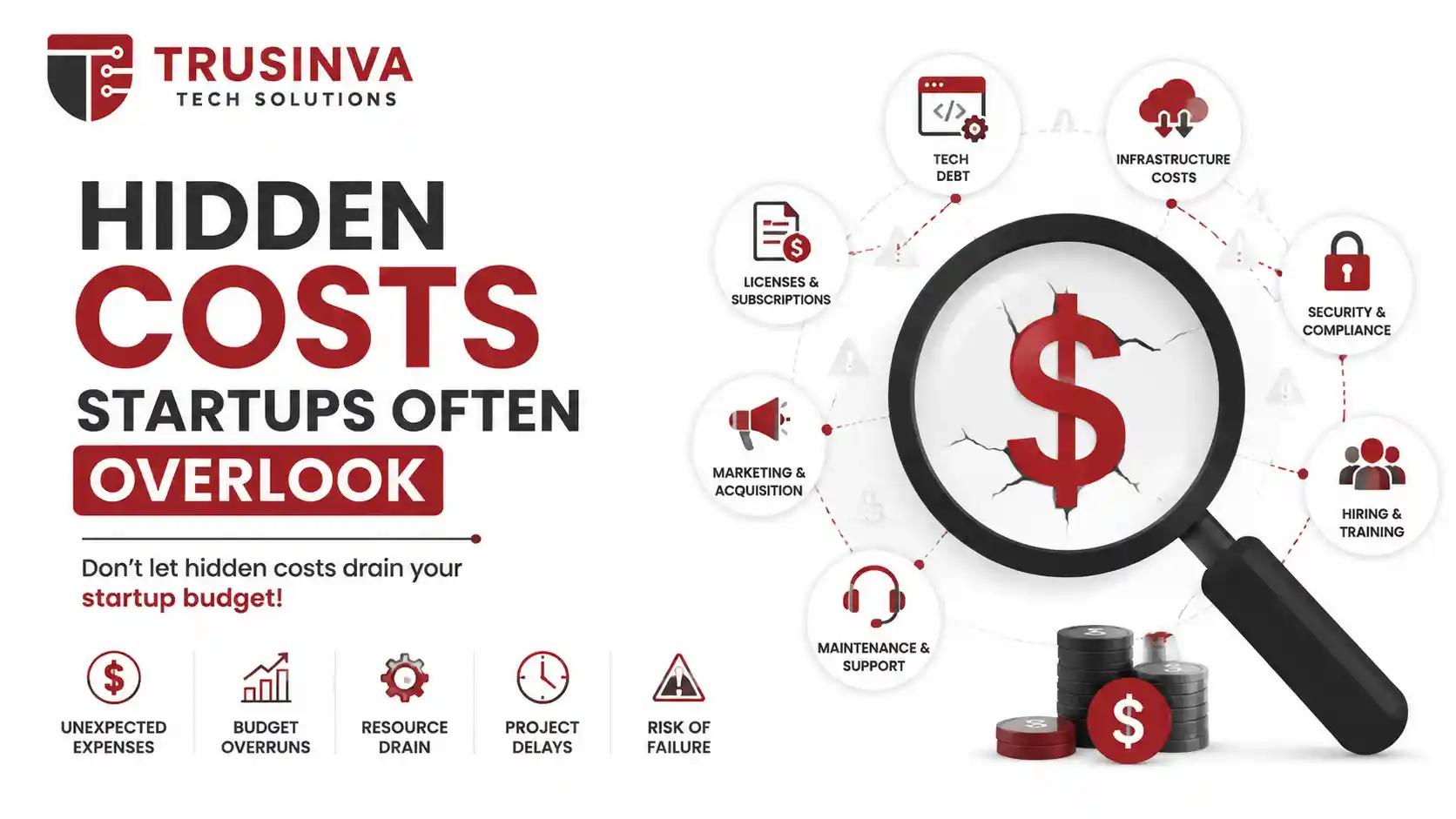
Many founders budget for development but forget the surrounding costs that keep an MVP running and improving:
- Cloud hosting and DevOps — Ongoing AWS, Azure, or Google Cloud costs plus CI/CD pipeline setup.
- QA testing — Manual and automated testing across devices and browsers.
- Post-launch support and maintenance — Bug fixes, server monitoring, and updates, typically 15–20% of initial build cost annually.
- Third-party tool subscriptions — Tools like Jira, Slack, and Figma for team collaboration.
- App store fees — Apple and Google developer account fees for mobile launches.
- Security and compliance audits — Especially relevant for healthcare, fintech, or enterprise clients.
Important Note: Budgeting only for development and skipping post-launch support is one of the most common ways startups underestimate their real MVP cost.
8. How to Reduce MVP Development Costs
- Run a discovery workshop before development to lock scope and avoid mid-project changes.
- Prioritize features using frameworks like MoSCoW (Must-have, Should-have, Could-have, Won't-have).
- Choose cross-platform frameworks over native development when performance needs allow it.
- Use existing cloud infrastructure and open-source tools instead of building custom systems from scratch.
- Partner with an experienced product engineering team that can guide feature prioritization instead of building everything a founder initially requests.
Agencies like Trusinva Tech Solutions offer structured discovery and development processes that help startups avoid the scope creep that inflates MVP budgets.
9. MVP vs. Prototype vs. Full Product: Cost Comparison
| Stage | Purpose | Typical Cost (USA, 2026) |
| Prototype | Test concept/UX, no real backend | $3,000 – $15,000 |
| MVP | Validate with real users, core features live | $15,000 – $150,000 |
| Full Product | Complete feature set, scalable architecture | $150,000 – $500,000+ |
10. Case Study: A Realistic MVP Budget Example
A US-based logistics startup approached a development team wanting a mid-complexity MVP: a web dashboard, mobile driver app, and basic route-optimization feature. After a discovery workshop cut the initial feature list by 35%, the final MVP — built with React for the dashboard and React Native for the driver app — launched in 14 weeks at approximately $62,000, including QA and three months of post-launch support. This mirrors the kind of scoping discipline teams need when planning custom software or CRM systems for growing businesses.
11. Common Mistakes That Inflate MVP Costs
- Building for "future scale" instead of current validation needs.
- Skipping a discovery phase and jumping straight into development.
- Choosing native iOS and Android builds when a cross-platform MVP would validate the idea just as well.
- Ignoring UX research, leading to costly redesigns after launch.
- Underestimating QA and DevOps time.
12. Expert Tips for Budgeting Your MVP
- Set a fixed budget ceiling before scoping features, not after.
- Ask any development partner for a line-item cost breakdown, not a single lump sum.
- Build in a 15–20% contingency buffer for scope adjustments.
- Treat your MVP as a learning tool, not a finished product — resist adding "nice-to-have" features early.
13. Future Trends in MVP Development Costs
Heading into the rest of 2026, AI-assisted development tools are reducing coding time for standard features, which is gradually lowering baseline MVP costs. At the same time, rising demand for AI-integrated products (using tools like OpenAI's APIs) is adding new cost categories for startups building intelligent features. Expect MVP budgets to stay flat or shrink slightly for standard products, while AI-native MVPs trend toward the higher end of the pricing spectrum.
FAQs
Q1: How much does a basic MVP cost in the USA? A basic MVP with core features on a single platform typically costs $15,000–$40,000 in 2026, depending on design complexity and integrations.
Q2: How long does it take to build an MVP? Most MVPs take 6–16 weeks, depending on complexity, with advanced products taking up to 24 weeks.
Q3: Is it cheaper to hire offshore developers for an MVP? Yes. Offshore developers typically charge $25–$60/hour versus $80–$200/hour for US-based teams, though communication and time zone differences should be factored in.
Q4: What's the difference between a prototype and an MVP? A prototype tests design and user experience without full functionality, while an MVP is a working product with real backend logic that early users can actually use.
Q5: Does MVP cost include post-launch maintenance? Not usually. Maintenance and support are typically billed separately and cost roughly 15–20% of the initial development cost per year.
Q6: Can I build an MVP on a $10,000 budget? It's possible for extremely simple, single-feature products, but most functional MVPs with real user validation require at least $15,000.
Q7: What increases MVP development cost the most? Custom integrations, native mobile development for multiple platforms, and compliance requirements (like HIPAA or SOC 2) are the biggest cost drivers.
Q8: Should I build web or mobile first for my MVP? Most startups validate faster and cheaper with a web-based MVP before investing in native mobile apps, unless mobile is core to the product experience.
Conclusion
MVP development cost in the USA for 2026 varies widely — from around $15,000 for a simple validation tool to $150,000+ for a feature-rich, AI-integrated product — but the number that matters most is the one tied to your actual validation goals, not your long-term vision. The startups that budget well are the ones that scope tightly, prioritize ruthlessly, and choose a development partner who pushes back on unnecessary features rather than building everything requested.
If you're planning an MVP and want a realistic, line-item cost estimate based on your specific product idea, Trusinva Tech Solutions can walk you through a discovery session and detailed pricing breakdown tailored to your startup's goals — Book a Seat for a free consultation and get a clear MVP roadmap before you spend a dollar on development.