Quick Answer
FinTech app development in the USA is the process of building secure, compliant financial applications — such as digital banking, payment, lending, or investment apps — that handle sensitive financial data under regulations like the CFPB, FinCEN, and PCI DSS. Costs typically range from $50,000 for an MVP to $300,000+ for a full-featured platform, depending on integrations, compliance scope, and security requirements.
Introduction
The financial services industry in the USA has moved almost entirely toward digital-first experiences, and fintech app development is the engine behind that shift. Businesses building banking, payment, or lending apps today face a mix of opportunity and complexity — customers expect instant, seamless experiences, while regulators expect airtight compliance. This is where a technology partner like Trusinva Tech Solutions becomes valuable, turning regulatory-heavy requirements into secure, usable software.
FinTech app development goes beyond typical web development — it demands the same discipline as custom software development, where every feature is weighed against compliance, fraud risk, and data security. Many fintech founders also rely on mobile app development to reach customers directly on their phones, and increasingly pair that with AI automation for fraud detection and customer support.
This guide covers what fintech app development actually involves in the USA in 2026 — the regulations, the technology, the costs, and the mistakes that derail otherwise promising projects.
Key Takeaways
- Fintech apps must account for regulatory oversight from bodies like the CFPB, FinCEN, SEC, and FDIC, depending on function.
- KYC and AML checks are mandatory for most apps that move money or onboard financial customers.
- Open banking and APIs from providers like Plaid and Stripe accelerate integration but add third-party risk to manage.
- PCI DSS compliance is required for any app handling card payment data.
- Security — encryption, tokenization, fraud detection — has to be built into the architecture, not bolted on later.
- A development partner familiar with financial compliance reduces both legal exposure and long-term technical debt.
Table of Contents
- Introduction
- What Is FinTech App Development?
- Why Businesses Are Investing in FinTech Apps in 2026
- Types of FinTech Apps
- Regulatory and Compliance Landscape in the USA
- Security Standards Every FinTech App Needs
- Open Banking, APIs, and Third-Party Integrations
- Core Features of a Modern FinTech App
- Tech Stack for FinTech App Development
- Step-by-Step Development Process
- Cost of FinTech App Development in the USA
- Common Mistakes to Avoid
- Future Trends in FinTech App Development
- Why Choose Trusinva Tech Solutions
- FAQs
- Conclusion
What Is FinTech App Development?
FinTech app development is the process of designing, building, and maintaining software applications that deliver financial services digitally — including banking, payments, lending, investing, and insurance functions. These apps almost always process sensitive financial data, which means security and regulatory compliance shape the architecture from the very first design decision.
Key characteristics of fintech apps:
- Handle sensitive financial and personal data (PII)
- Often integrate with banking APIs and payment networks
- Subject to oversight from CFPB, FinCEN, SEC, or FDIC depending on function
- Require strong identity verification, encryption, and fraud monitoring
- Serve both consumer-facing and business/enterprise use cases
Why Businesses Are Investing in FinTech Apps in 2026
Businesses are investing heavily in fintech because customers now expect instant payments, real-time account visibility, and seamless digital onboarding — experiences that legacy financial institutions often can't deliver fast enough on their own.
Main drivers behind this investment:
- Consumer demand — people expect mobile-first banking, instant transfers, and digital wallets.
- Open banking growth — APIs make it easier to build on top of existing financial infrastructure.
- Real-time payments — services like FedNow are pushing instant settlement into the mainstream.
- Embedded finance — non-financial companies are adding payment and lending features directly into their products.
- Competitive pressure — neobanks and fintech startups are winning market share from traditional banks.
Businesses building broader digital platforms often pair fintech features with CRM development to manage customer relationships, or digital marketing to acquire new users.
Types of FinTech Apps
| App Type | Primary Users | Core Purpose |
| Digital banking / neobank apps | Consumers | Account management, transfers, budgeting |
| Payment apps | Consumers, merchants | Peer-to-peer and merchant payments |
| Lending apps | Borrowers | Loan applications, underwriting, servicing |
| Investment / wealth management apps | Investors | Trading, portfolio tracking, robo-advisory |
| Digital wallets | Consumers | Store payment methods, contactless payments |
| Insurtech apps | Policyholders | Insurance quotes, claims, policy management |
| Accounting / expense apps | Businesses, freelancers | Bookkeeping, invoicing, expense tracking |
| Cryptocurrency apps | Consumers, traders | Buying, selling, and storing digital assets |
Regulatory and Compliance Landscape in the USA
FinTech apps in the USA operate under a patchwork of federal and state regulations that depend heavily on what the app actually does — moving money, lending, investing, or simply displaying financial data all trigger different oversight.
Key regulatory bodies and what they typically cover:
- CFPB (Consumer Financial Protection Bureau) — consumer protection, including rules like Section 1033 on financial data access.
- FinCEN — anti-money laundering oversight; apps that qualify as money services businesses fall under BSA requirements.
- SEC / FINRA — apply to apps offering investment or trading services.
- FDIC / OCC — relevant when apps partner with banks for deposit or lending products.
- FTC — enforces the Safeguards Rule, requiring covered financial institutions to protect customer information.
- State regulators — bodies like NYDFS impose additional cybersecurity requirements (23 NYCRR Part 500) for companies operating in certain states.
Important note: Many fintech companies don't hold a banking license themselves — they partner with a chartered bank (a "bank-as-a-service" model), which shifts some regulatory responsibility but doesn't eliminate the fintech company's own compliance obligations.
Security Standards Every FinTech App Needs
Security isn't optional in fintech — it's the foundation the entire product is built on, since a single breach can mean regulatory penalties, lawsuits, and permanent loss of customer trust.
Core security and compliance standards:
- PCI DSS — required for any app storing, processing, or transmitting card payment data.
- KYC (Know Your Customer) — identity verification during onboarding.
- AML (Anti-Money Laundering) — transaction monitoring and suspicious activity reporting.
- GLBA — governs how financial institutions handle consumer data.
- SOC 2 — demonstrates data security controls to enterprise partners.
- OWASP MASVS — provides a mobile app security baseline covering storage, cryptography, authentication, and network communication.
Best practices:
- Encrypt financial data at rest and in transit
- Use tokenization instead of storing raw card numbers
- Apply multi-factor and biometric authentication
- Run continuous fraud detection and transaction monitoring
- Maintain detailed audit logs for every financial transaction
Open Banking, APIs, and Third-Party Integrations
Open banking allows fintech apps to securely connect to users' bank accounts through APIs, and providers like Plaid, Stripe, and Adyen have become the standard building blocks for account linking, payment processing, and identity verification in US fintech products.
Common integration components:
- Account aggregation APIs (e.g., Plaid) — link and read bank account data
- Payment processing APIs (e.g., Stripe, Adyen) — handle transactions and settlements
- Card issuing platforms (e.g., Marqeta) — issue virtual or physical cards
- Real-time payment rails — FedNow, RTP Network, and ACH for money movement
- Identity verification services — KYC/AML checks during onboarding
Each third-party integration adds convenience but also adds a new point of security and compliance responsibility — vetting these providers carefully is one of the most overlooked steps in fintech app planning.
Core Features of a Modern FinTech App
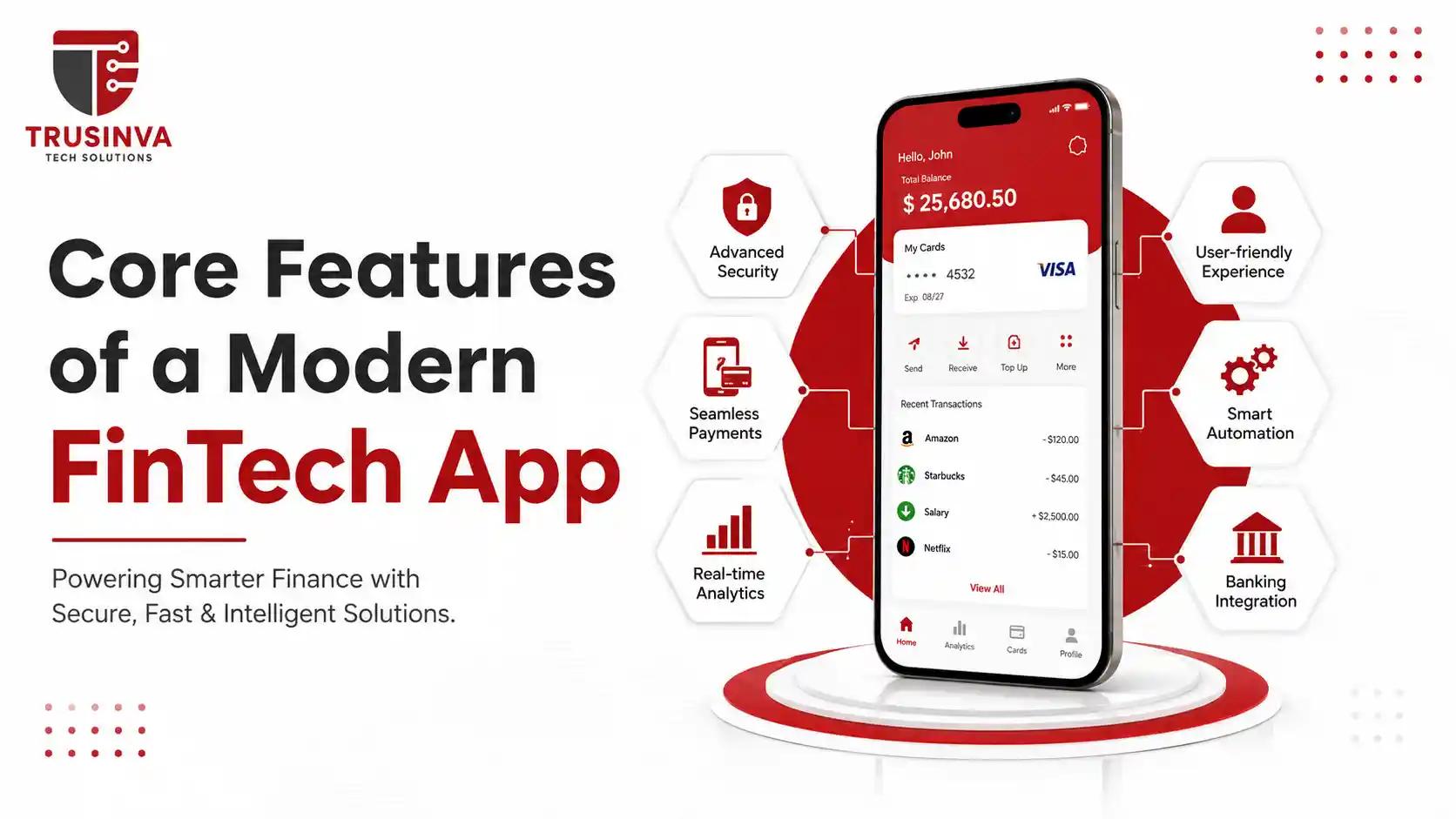
Consumer-facing features:
- Secure onboarding with KYC verification
- Account dashboard and transaction history
- Instant money transfers
- Bill payments and recurring transactions
- Budgeting and spending analytics
- Biometric login and MFA
Business/enterprise features:
- Multi-user account access with role-based permissions
- Invoicing and payment reconciliation
- Reporting and compliance dashboards
- API access for third-party integrations
Security and compliance features:
- Real-time fraud detection
- Transaction monitoring and AML screening
- Audit logging
- Encrypted data storage and tokenized payment details
Tech Stack for FinTech App Development
| Layer | Common Technologies |
| Mobile frontend | React Native, Flutter, Swift, Kotlin |
| Backend | Node.js, Python, .NET, Java |
| Database | PostgreSQL, MySQL, MongoDB |
| APIs | REST, GraphQL, banking/payment APIs |
| Auth | OAuth 2.0, tokenization, biometric auth |
| Infrastructure | AWS, Microsoft Azure, Google Cloud |
| DevOps | Docker, Kubernetes, DevSecOps pipelines |
Cloud providers offer compliance-ready infrastructure, but as with healthcare apps, compliance depends on correct configuration — encryption settings, access policies, and monitoring all have to be implemented deliberately.
Step-by-Step Development Process
- Discovery and compliance mapping — identify which regulators apply (CFPB, FinCEN, SEC, state-level rules).
- UI/UX design — design intuitive, trust-building flows (often paired with UI/UX design services).
- Architecture planning — decide on data flow, third-party integrations, and security model.
- MVP development — build core functionality first to validate with real users.
- API and banking integrations — connect to payment processors, card networks, and data aggregators.
- Security testing — penetration testing, fraud simulation, vulnerability scanning.
- Compliance audit — KYC/AML process review before launch.
- Deployment and monitoring — launch with real-time fraud monitoring and incident response readiness.
- Maintenance and updates — regulatory changes and new fraud patterns require continuous updates.
Cost of FinTech App Development in the USA
| Project Type | Approximate Cost Range | Timeline |
| Basic MVP (wallet, transfers) | $50,000 – $100,000 | 3–5 months |
| Mid-size app (banking + integrations) | $100,000 – $200,000 | 5–8 months |
| Enterprise platform (multi-product, full compliance) | $200,000 – $400,000+ | 8–14 months |
Costs vary based on the number of platforms (iOS/Android/web), the complexity of third-party integrations, the level of regulatory audit required, and whether AI-driven fraud detection is included. Startups often benefit from an MVP-first approach before scaling to a full platform.
Common Mistakes to Avoid
- Treating compliance as a launch-day checklist instead of a design principle from day one.
- Underestimating KYC/AML complexity — this is often the biggest source of onboarding delays.
- Choosing third-party providers without a security review — every integration inherits its risk.
- Weak fraud detection at launch — fraud patterns emerge fast once real users join.
- Ignoring state-level regulations — rules like NYDFS 23 NYCRR Part 500 can apply even to companies headquartered elsewhere.
- Hiring a generic development team with no financial compliance experience.
Future Trends in FinTech App Development
- Real-time payments become standard — FedNow and RTP adoption continue to grow, making instant settlement the expectation rather than the exception.
- Embedded finance expansion — more non-financial companies add payment, lending, or insurance features directly into their apps.
- AI-driven fraud detection — machine learning models are increasingly replacing rule-based fraud systems.
- Open banking maturity — CFPB's Section 1033 rulemaking continues to shape how consumer financial data can be shared.
- Rising security expectations — biometric authentication and passwordless login are becoming baseline requirements, not differentiators.
Why Choose Trusinva Tech Solutions
Building a fintech app means balancing user experience, security, and a constantly shifting regulatory landscape — all at the same time. Trusinva Tech Solutions combines custom software development, mobile app development, and AI development expertise to help fintech businesses move from concept to a secure, compliant, market-ready application.
The broader services lineup — including UI/UX design, CRM development, and digital marketing — also helps fintech companies grow their user base once the platform is live. You can review past work in the projects portfolio or explore more guides on the blog.
FAQs
1. What is fintech app development? It's the process of building applications that deliver financial services digitally — such as banking, payments, lending, or investing — while meeting the security and regulatory requirements that apply to financial data.
2. Do all fintech apps need a banking license? No. Most fintech companies partner with a chartered bank under a bank-as-a-service model rather than obtaining their own banking license, though they still carry their own compliance responsibilities.
3. How much does fintech app development cost in the USA? Costs typically range from $50,000 for a basic MVP to $400,000+ for a full enterprise platform, depending on features, integrations, and compliance scope.
4. How long does it take to build a fintech app? Most projects take 3–5 months for an MVP and 8–14 months for a full-featured, integration-heavy enterprise platform.
5. What is open banking and why does it matter? Open banking lets fintech apps securely access users' bank data through APIs, using providers like Plaid. It's essential for account linking, budgeting features, and payment initiation.
6. What compliance standards apply to fintech apps? Common requirements include PCI DSS for card data, KYC/AML for onboarding and transaction monitoring, GLBA for data handling, and SOC 2 for enterprise trust.
7. What technology stack is best for fintech apps? Common choices include React Native or Flutter for mobile, Node.js/Python/.NET for backend, PostgreSQL/MongoDB for data, and AWS/Azure for compliant cloud infrastructure.
8. What's the biggest risk in fintech app projects? Treating compliance and fraud prevention as afterthoughts instead of core design requirements — this is the most common cause of costly rework and regulatory issues.
Conclusion
FinTech app development in the USA sits at the intersection of technology, regulation, and customer trust. Getting it right means planning for CFPB, FinCEN, and PCI DSS requirements early, integrating carefully with banking and payment APIs, and choosing a development partner who understands both the code and the compliance behind it.
If you're planning a fintech app — whether it's a digital wallet, lending platform, or investment tool — the right partner can save months of rework and serious regulatory risk. Trusinva Tech Solutions works with fintech businesses across the USA to design and build secure, scalable applications from the ground up. Explore the courses available for teams wanting to build in-house financial and technical expertise, or reach out directly to discuss your project — and don't forget to Book a Seat in one of Trusinva's upcoming USA taxation or technology training sessions to get your team ready before your app goes live.